





About this worksheet
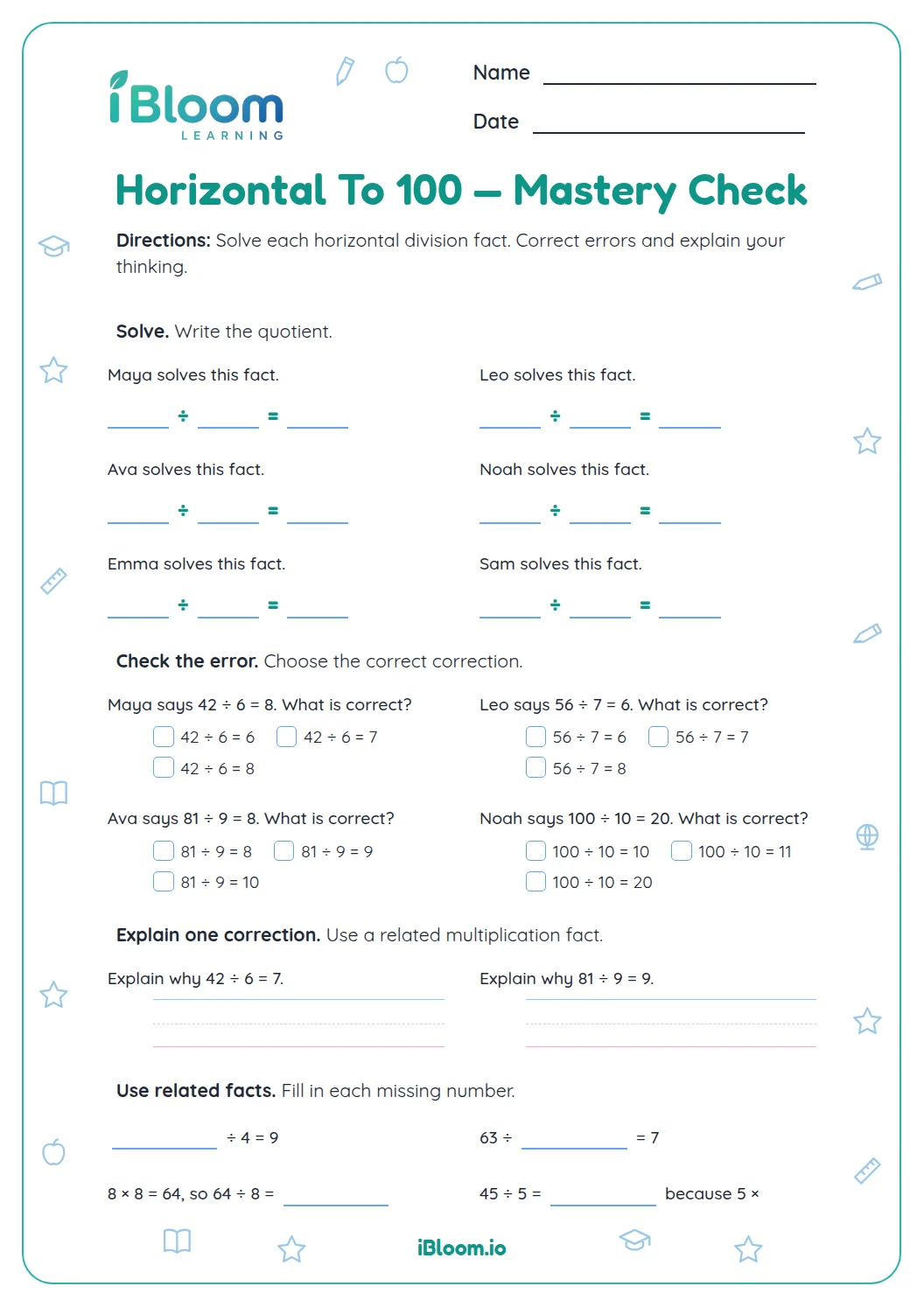
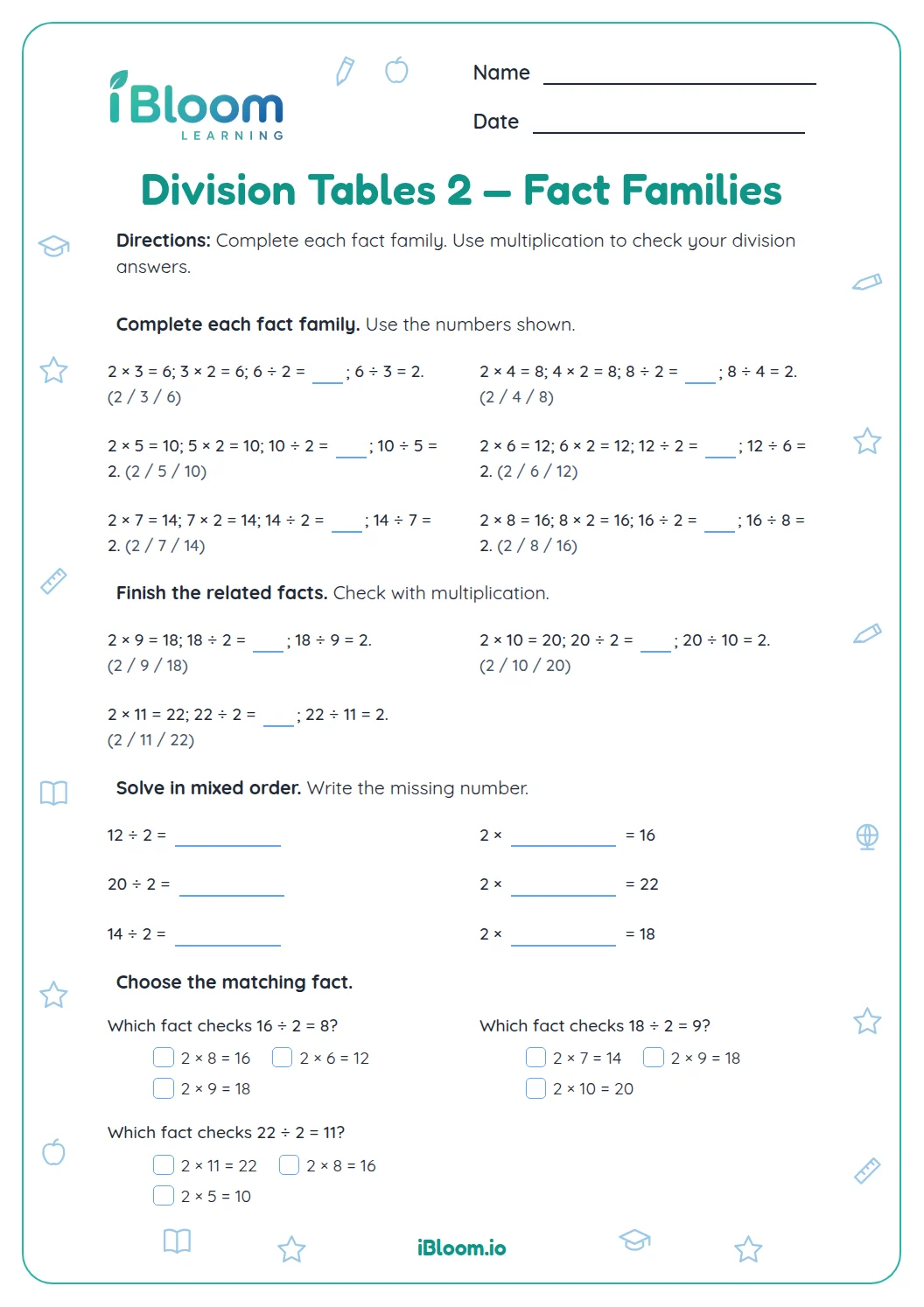
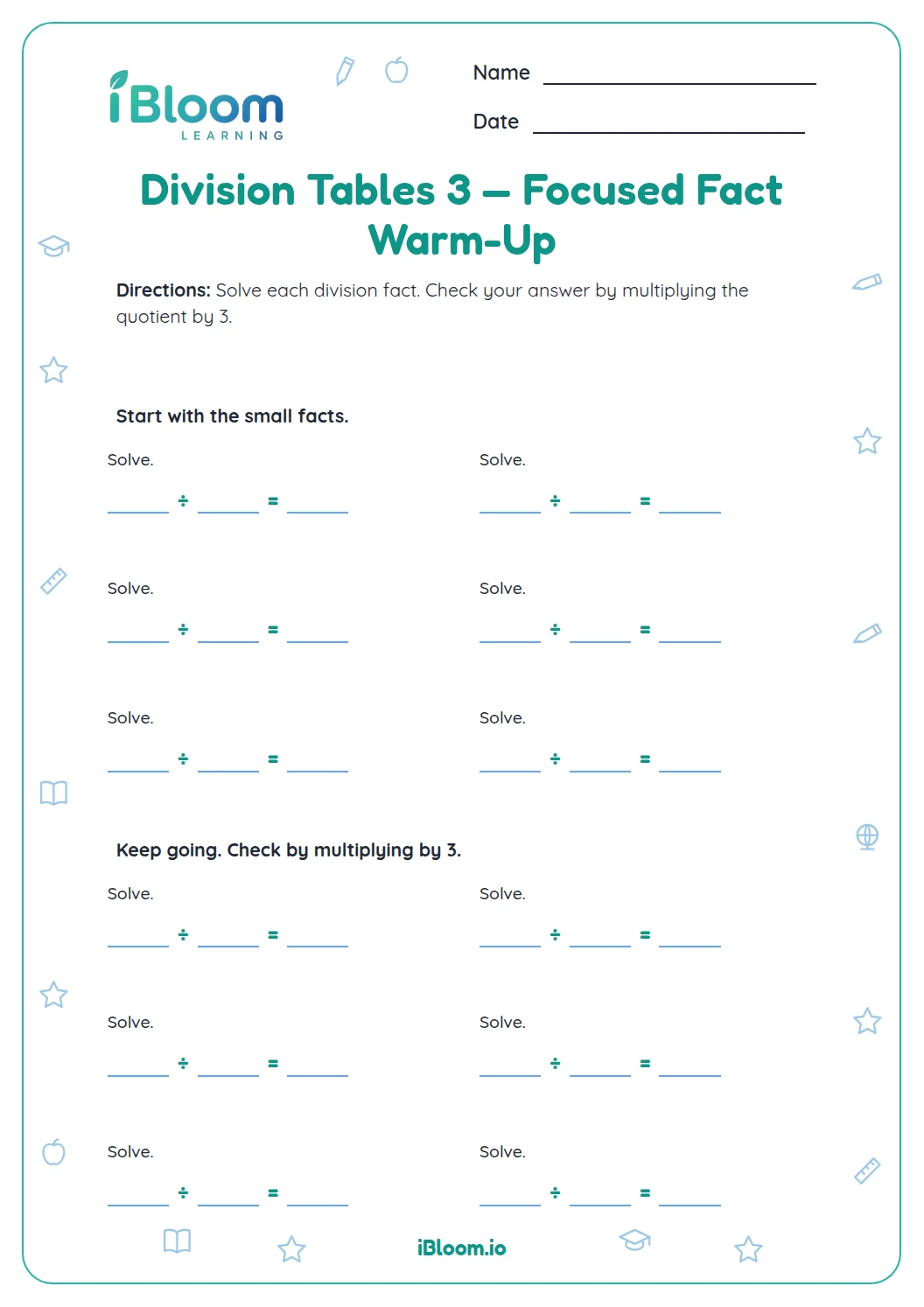
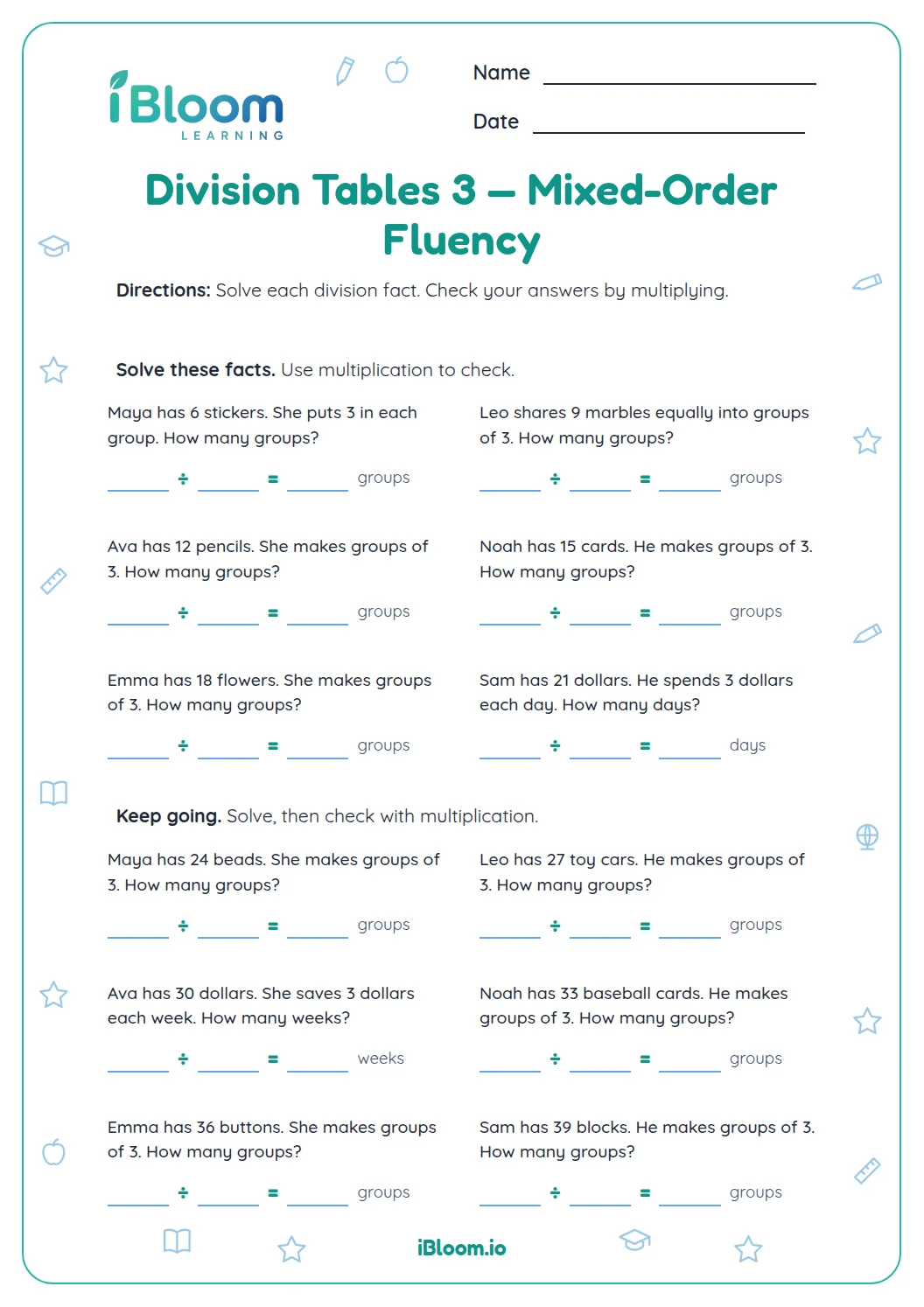
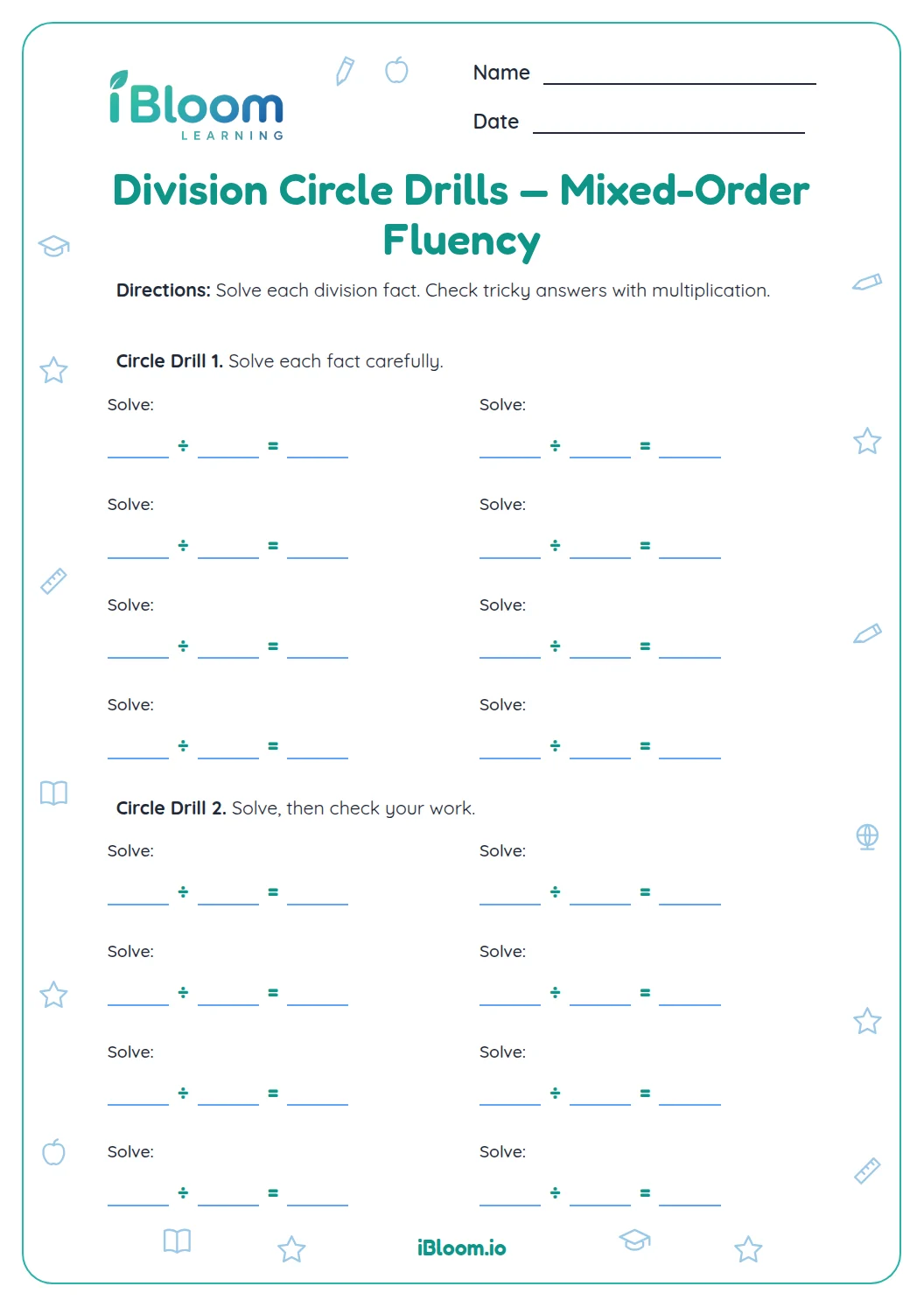
This printable gives students 18 horizontal division facts with dividends up to 100. The questions mix familiar divisor facts, including facts with 10, and appear in three short parts. Students can complete the page at a comfortable pace; any timing goal is optional. A separate answer key lists each quotient.
Aligned to 3.OA.C.7
What skill does this page practice?
The worksheet has 18 horizontal division facts with dividends up to 100, arranged in four parts. It retains the old drill’s accuracy-first approach and offers optional timing; students can solve at a steady pace and check the quotient with multiplication. A separate key lists the answers.
How can students solve a question?
Use the divisor and dividend to recall a related multiplication fact. Then check by multiplying the quotient by the divisor.
- 156 ÷ 7 asks how many groups of 7 make 56.
- 2Recall 7 × 8 = 56.
- 3So 56 ÷ 7 = 8.
- 4Check: 8 × 7 = 56.
What is included on the printable?
The 18 facts move from direct recall to equations with room for working. The timing cue is optional, so students can focus on correct answers and use a timer only when it suits the practice session.
How to use this worksheet
- 1Read the divisor and dividend before solving.
- 2Recall or build the related multiplication fact.
- 3Write the quotient in the blank.
- 4Multiply quotient by divisor to check.
- 5Try the optional timing only if it feels helpful.
Common mistakes and quick fixes
The mistake
Dividing the dividend by the wrong number.
The fix
Point to the divisor and say the matching multiplication fact.
The mistake
Confusing quotient and divisor.
The fix
Check by multiplying the quotient by the divisor to recover the dividend.
The mistake
Rushing and skipping an item.
The fix
Complete one row at a time and review every sign.
Common Core alignment
This worksheet gives students focused practice with this Common Core mathematics standard.
Recall division facts within 100 and use multiplication to check each quotient.
On this sheet: Every item is a division fact with a whole-number quotient within 100.
Show the official wordingHide the official wording
Fluently multiply and divide within 100, using strategies such as the relationship between multiplication and division (e.g., knowing that 8 × 5 = 40, one knows 40 ÷ 5 = 8) or properties of operations. By the end of Grade 3, know from memory all products of two one-digit numbers.
What to practice next
Make more practice
Further reading
Questions parents and teachers ask
What does this worksheet help students practice?
This printable gives students 18 horizontal division facts with dividends up to 100. Four parts organize direct recall and equations with room to work. Timing is optional, and a separate answer key lists each quotient for checking and follow-up practice.
How should students use the answer key?
Have students try each item before checking the key. If an answer differs, return to the equation or prompt and explain the step that determines it. The key is a check for reasoning as well as a way to confirm the final answer.
How long does this worksheet take?
The page invites students to use a timer only if it suits the practice session. Students can complete all 18 facts without timing and focus on accuracy. If timing is used, compare a later attempt with the student’s own earlier pace.
Can I use this for a small group?
Yes. Model one fact, then let students solve a short group of items and compare how they found each quotient. They can check answers with the key and use multiplication to confirm a division fact. The optional timing cue works for individual or group practice.
What should students do when they get stuck?
Use the related multiplication fact to find the quotient. For 56 ÷ 7, ask which number multiplied by 7 equals 56; 7 × 8 = 56, so the quotient is 8. Multiplying the quotient by the divisor checks the result.