



About this worksheet
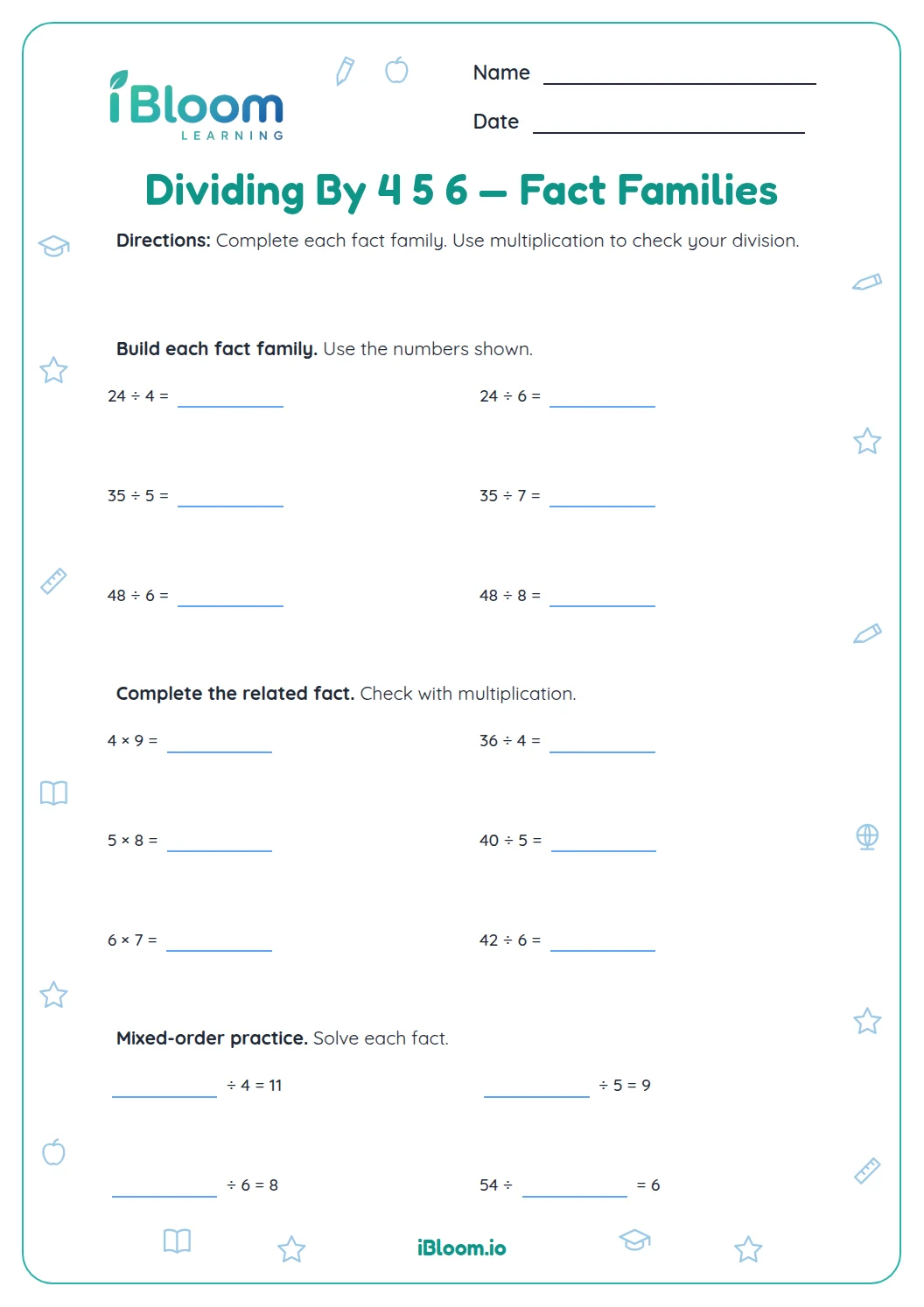
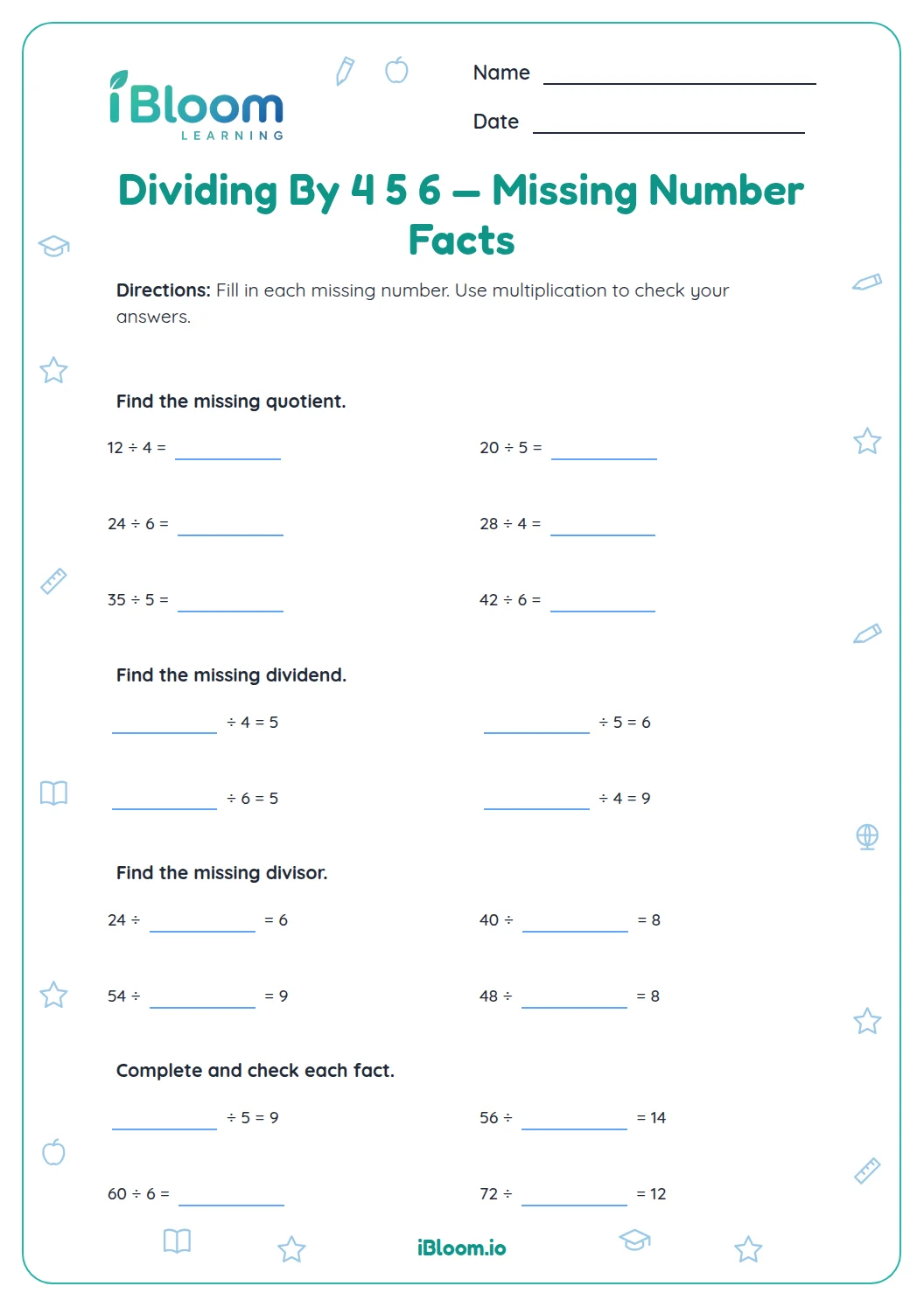
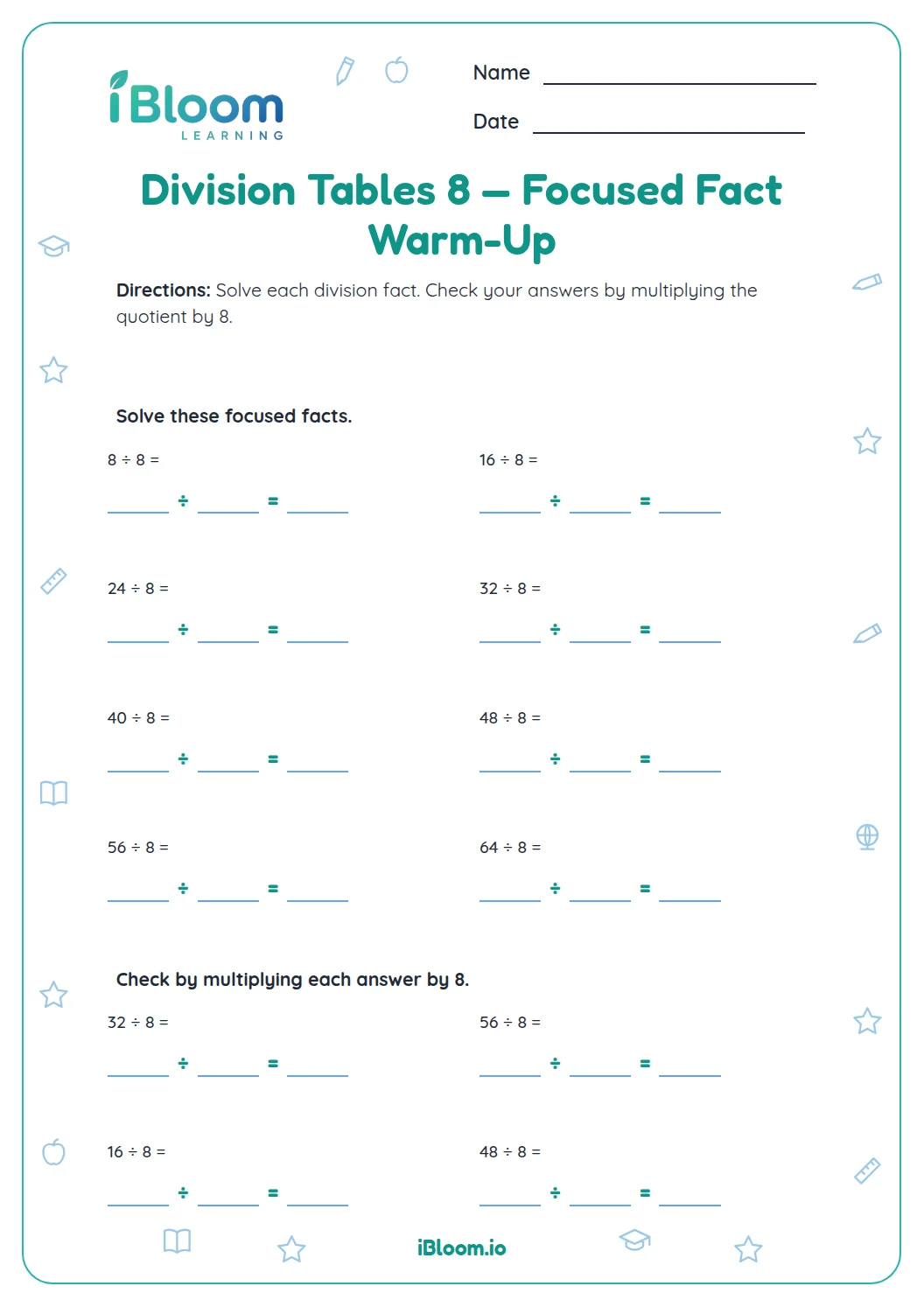
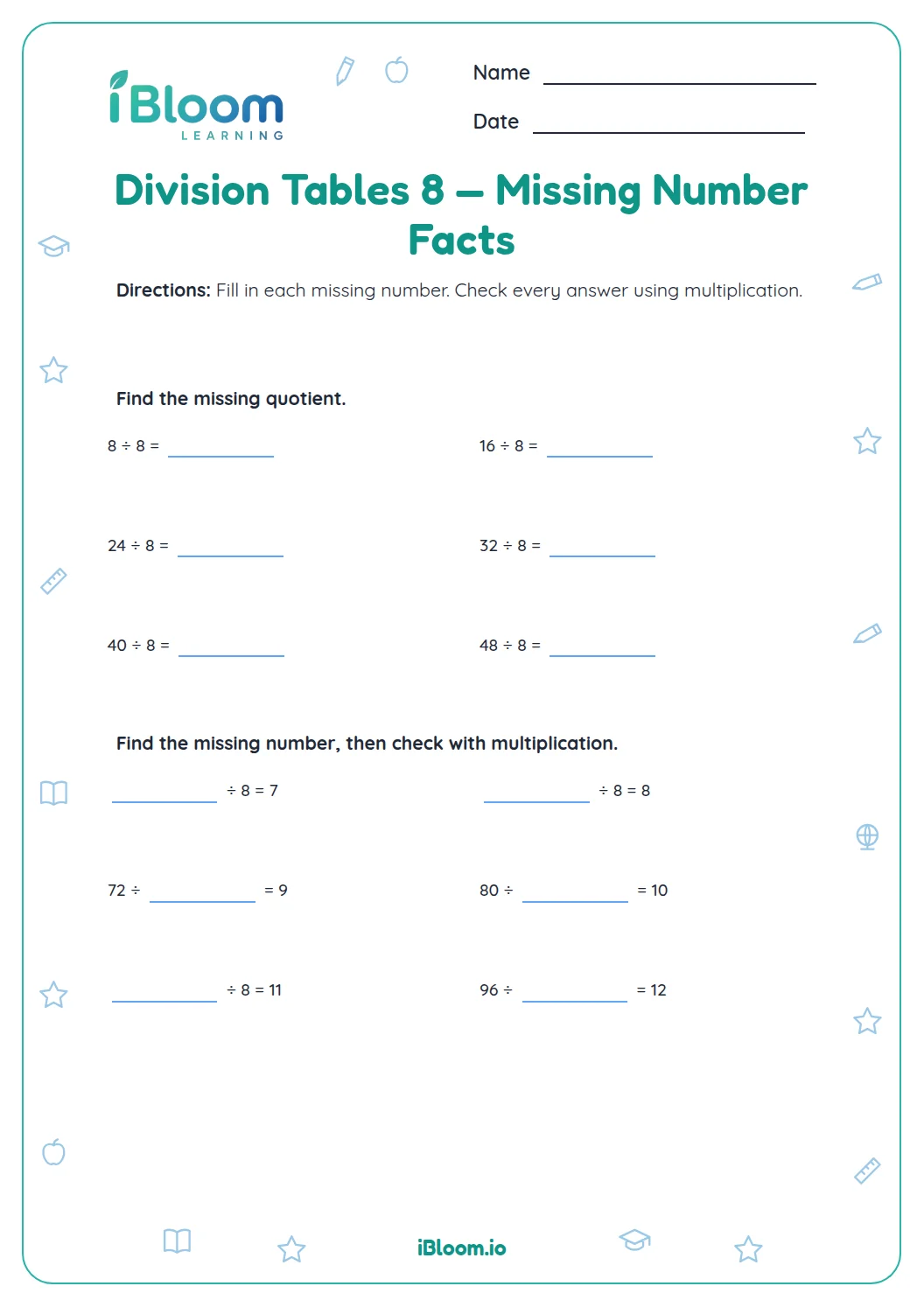
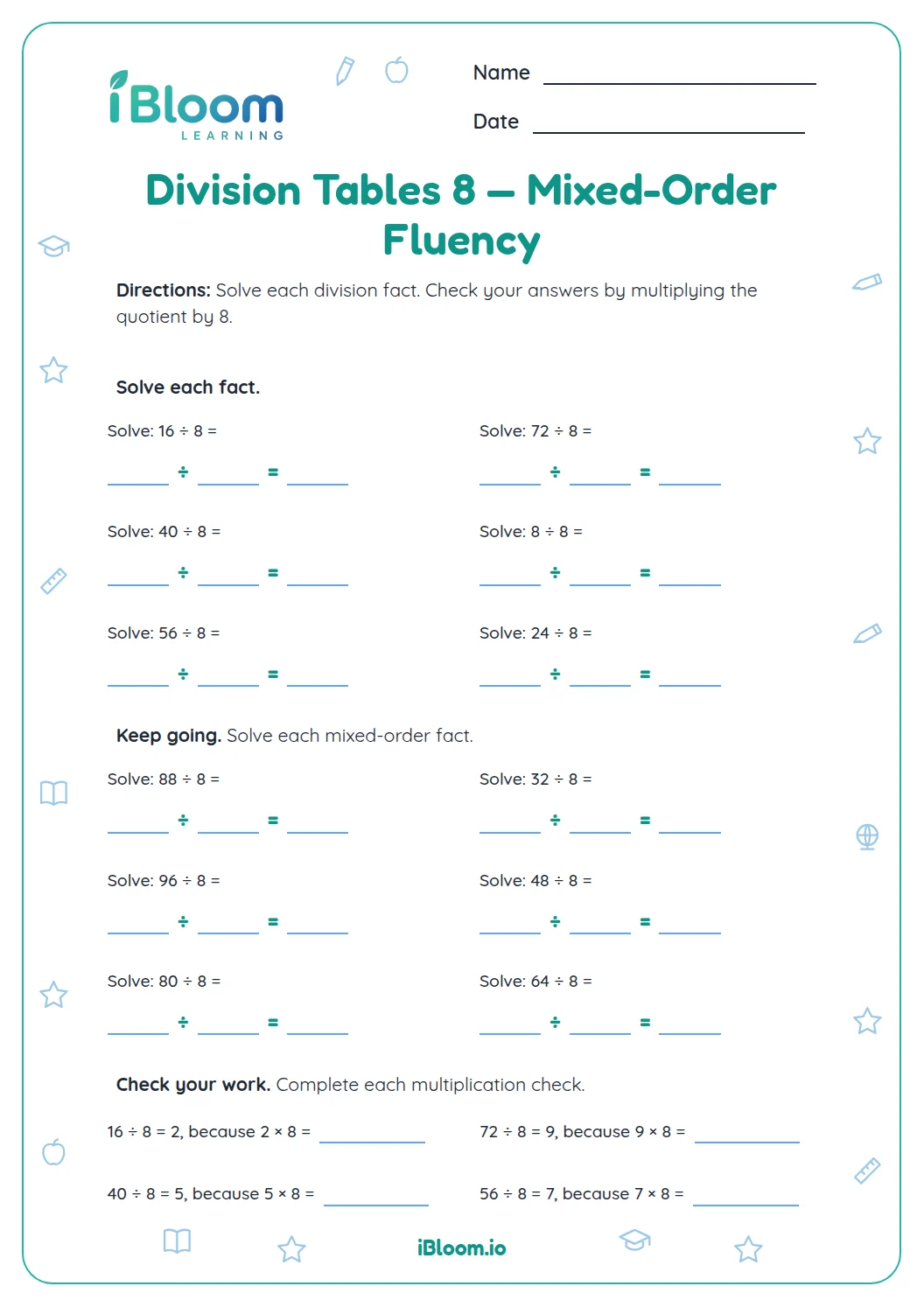
This printable division worksheet helps students use multiplication facts to solve related division facts. The first section builds families with the same three numbers; a multiplication circle drill then asks students to multiply a fixed factor by several outside numbers. The final questions return to missing quotients, divisors, and dividends. It includes 16 questions and a separate answer key. The work aligns with CCSS 3.OA.A.4.
Aligned to 3.OA.A.4
How are multiplication and division facts connected?
A fact family uses the same three numbers in multiplication and division. If 7 × 3 = 21, then 21 ÷ 7 = 3 and 21 ÷ 3 = 7.
- 17 × 3 = 21
- 221 ÷ 7 = ___
- 3The missing factor is 3.
How do you work through the circle drill?
Multiply the center number by each outside number. With 4 in the center, 4 × 2 = 8 and 4 × 3 = 12; these products can be used to state related division facts.
How can you check a quotient?
Question 9 is a multiplication circle drill that reinforces the related division facts: multiply 4 by 2, 3, 5, and 6 to get 8, 12, 20, and 24. The other items connect each quotient to its multiplication fact.
How to use this worksheet
- 1Read the multiplication fact and identify its three numbers.
- 2Use the dividend and divisor to find the missing quotient.
- 3For a missing divisor, use the multiplication fact to identify the remaining factor.
- 4In the circle drill, multiply the center by each outside number.
- 5Multiply quotient by divisor to check each answer.
Common mistakes and quick fixes
The mistake
Reversing dividend and divisor.
The fix
In 24 ÷ 6, 24 is the total being split and 6 is the divisor.
The mistake
Writing the divisor as the quotient.
The fix
Check by multiplying: 6 × 4 = 24, so 24 ÷ 6 = 4.
The mistake
Forgetting that division facts share factors with multiplication.
The fix
Write the related multiplication fact beside the division sentence.
Common Core alignment
These exercises use multiplication and division equations with related whole numbers.
Find an unknown whole number in a multiplication or division equation.
On this sheet: Students find missing factors, divisors, dividends, and quotients in connected facts.
Show the official wordingHide the official wording
Determine the unknown whole number in a multiplication or division equation relating three whole numbers. For example, determine the unknown number that makes the equation true in each of the equations 8 × ? = 48, 5 = _ ÷ 3, 6 × 6 = ?
What to practice next
Make more practice
Further reading
Questions parents and teachers ask
What is a division fact family?
A fact family uses the same three numbers in multiplication and division. For example, 6 × 4 = 24 helps solve 24 ÷ 6 = 4. This worksheet asks children to complete related division facts and use a division circle drill to practice quotients.
How can students check a quotient?
Multiply the quotient by the divisor. The product should equal the dividend. For example, 40 ÷ 8 = 5 because 5 × 8 = 40. This quick check helps catch a reversed or forgotten number. This check also helps distinguish a quotient from a divisor. Students can test a result right away without starting a second division procedure.
What does the circle drill ask students to do?
Question 9 is the circle drill. The center shows 4, and the outside numbers are 2, 3, 5, and 6. Children multiply each by 4 and write the products in order: 8, 12, 20, and 24. These products support the division fact families on the page.
Is an answer key provided?
Yes. The answer key lists the missing numbers in the fact families and the quotients from the circle drill. Students can use it to check a completed page or review one missed fact. Use the key after completing the whole set so students can see patterns across the related facts. Rework a missed item by writing its multiplication fact first.
What does the circle drill ask children to do?
The center shows 4, and the outside numbers are 2, 3, 5, and 6. Children multiply each outside number by 4 and record 8, 12, 20, and 24 in order. These products give a quick way to check related division facts.