




About this worksheet
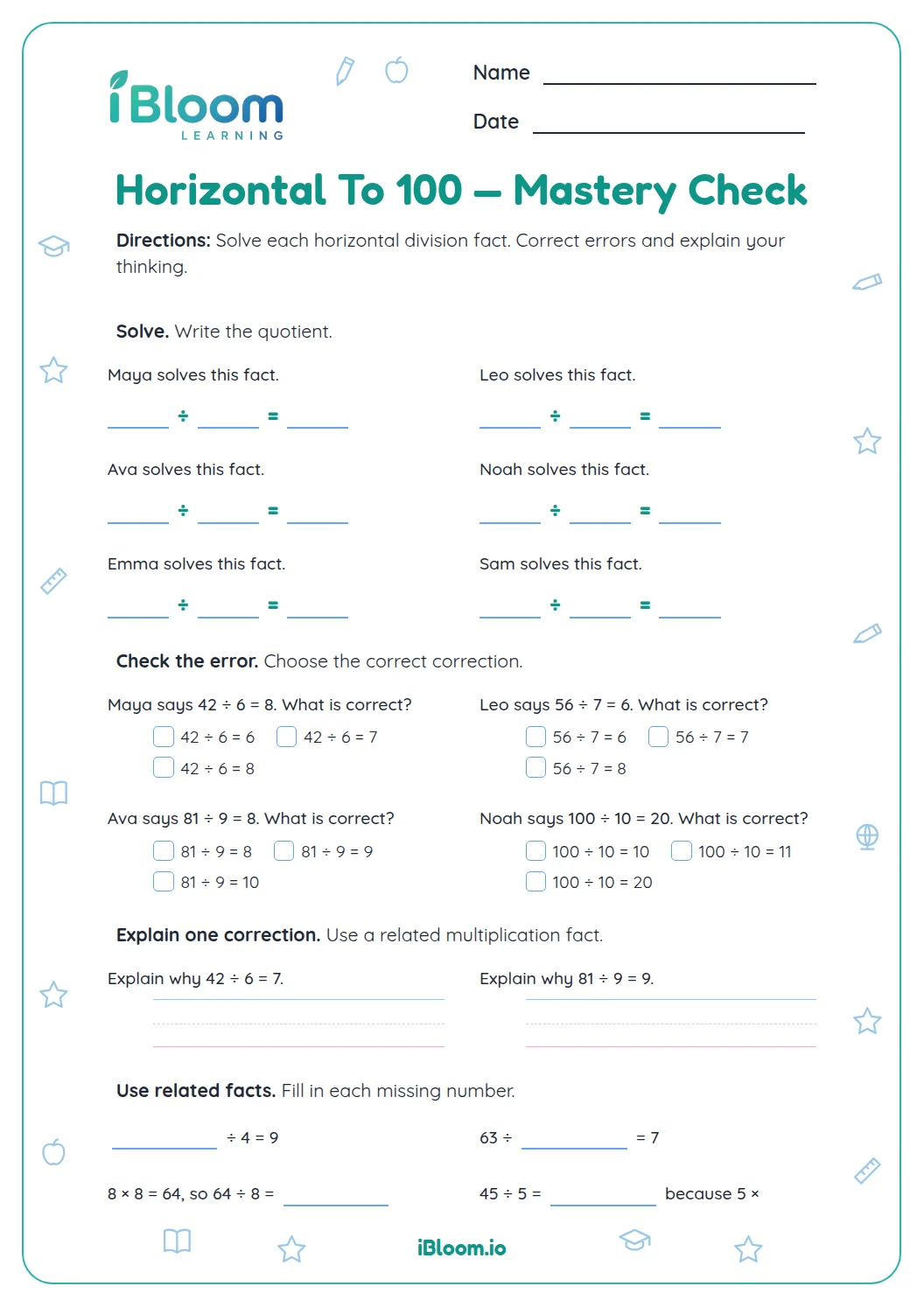
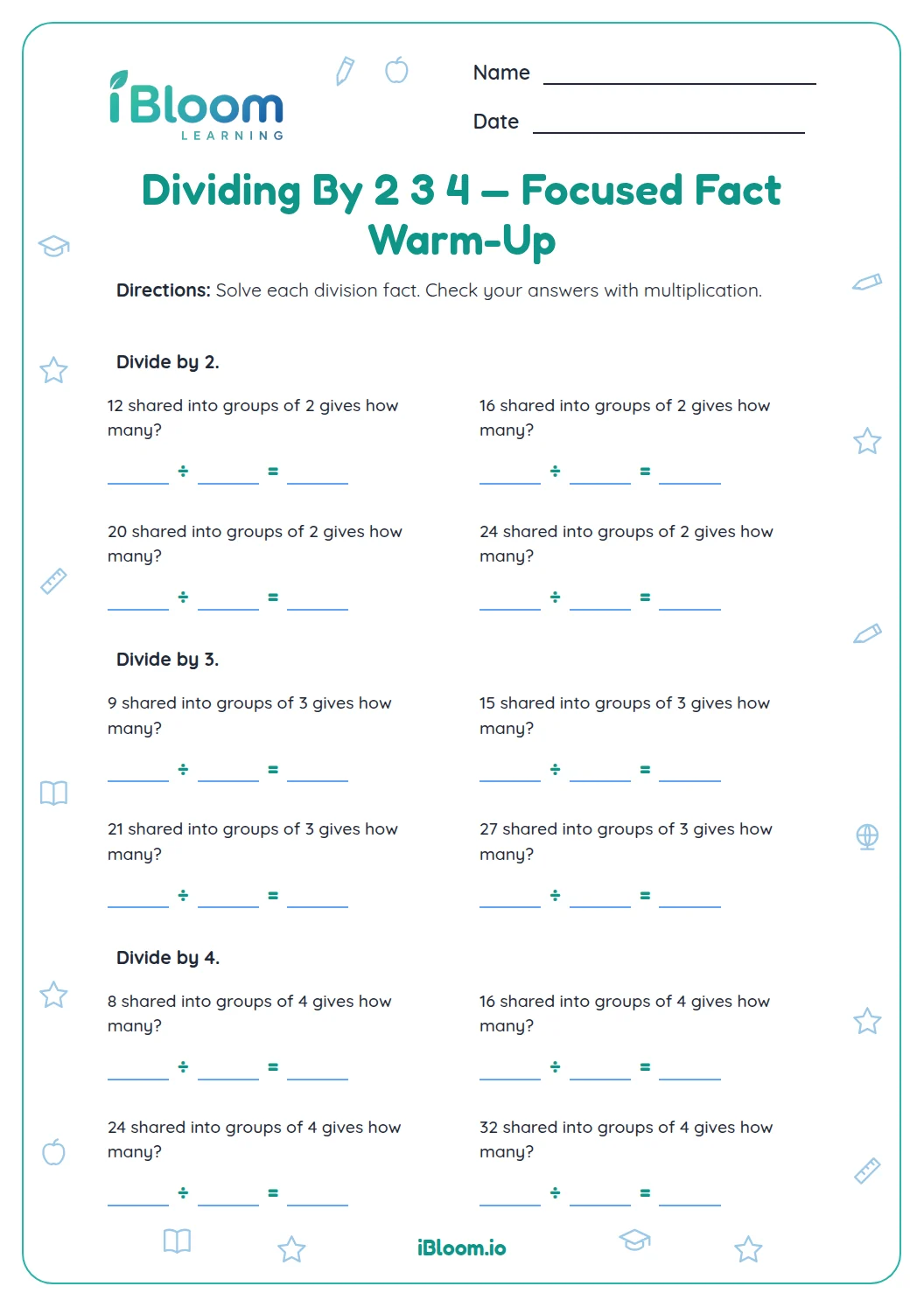
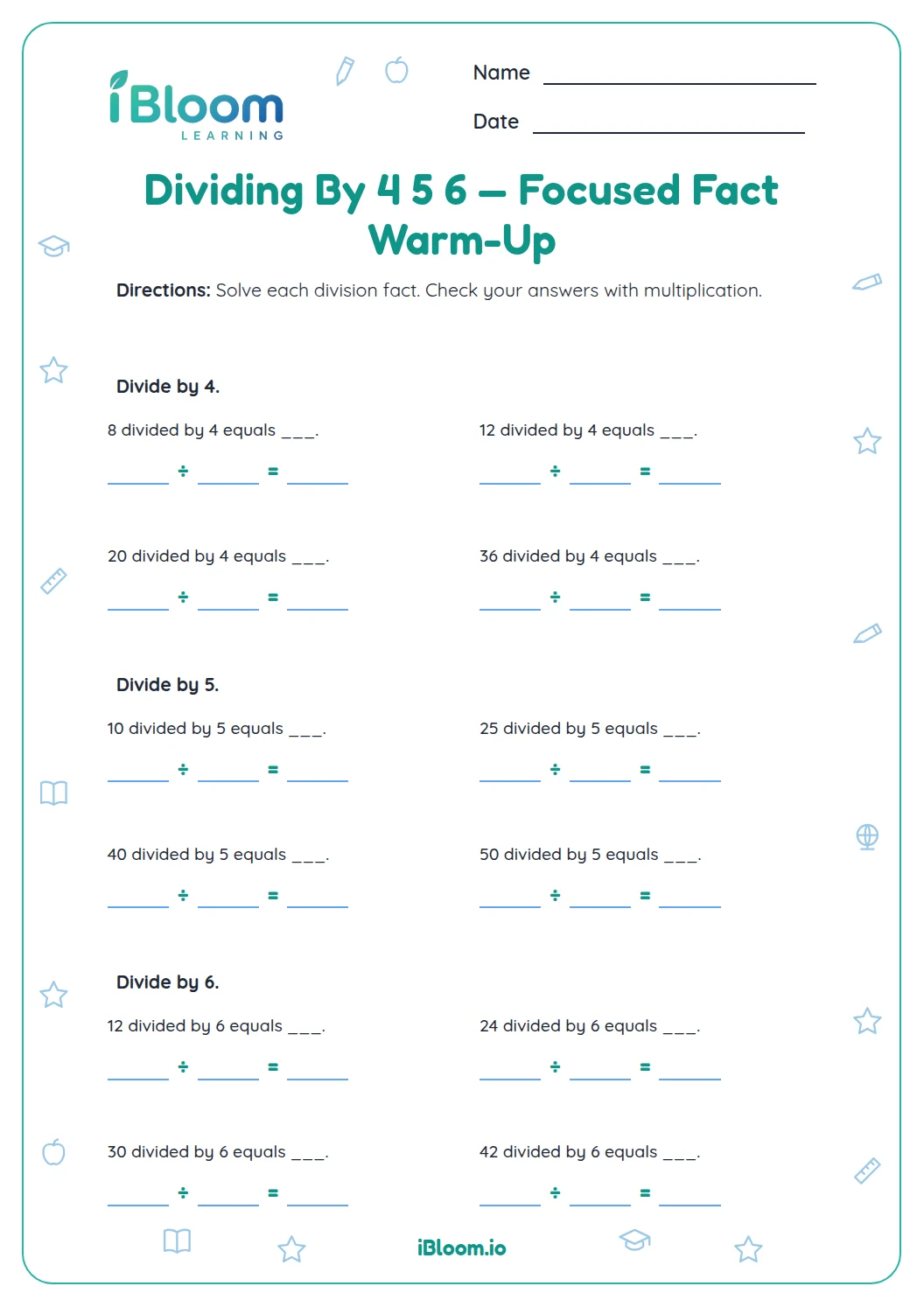
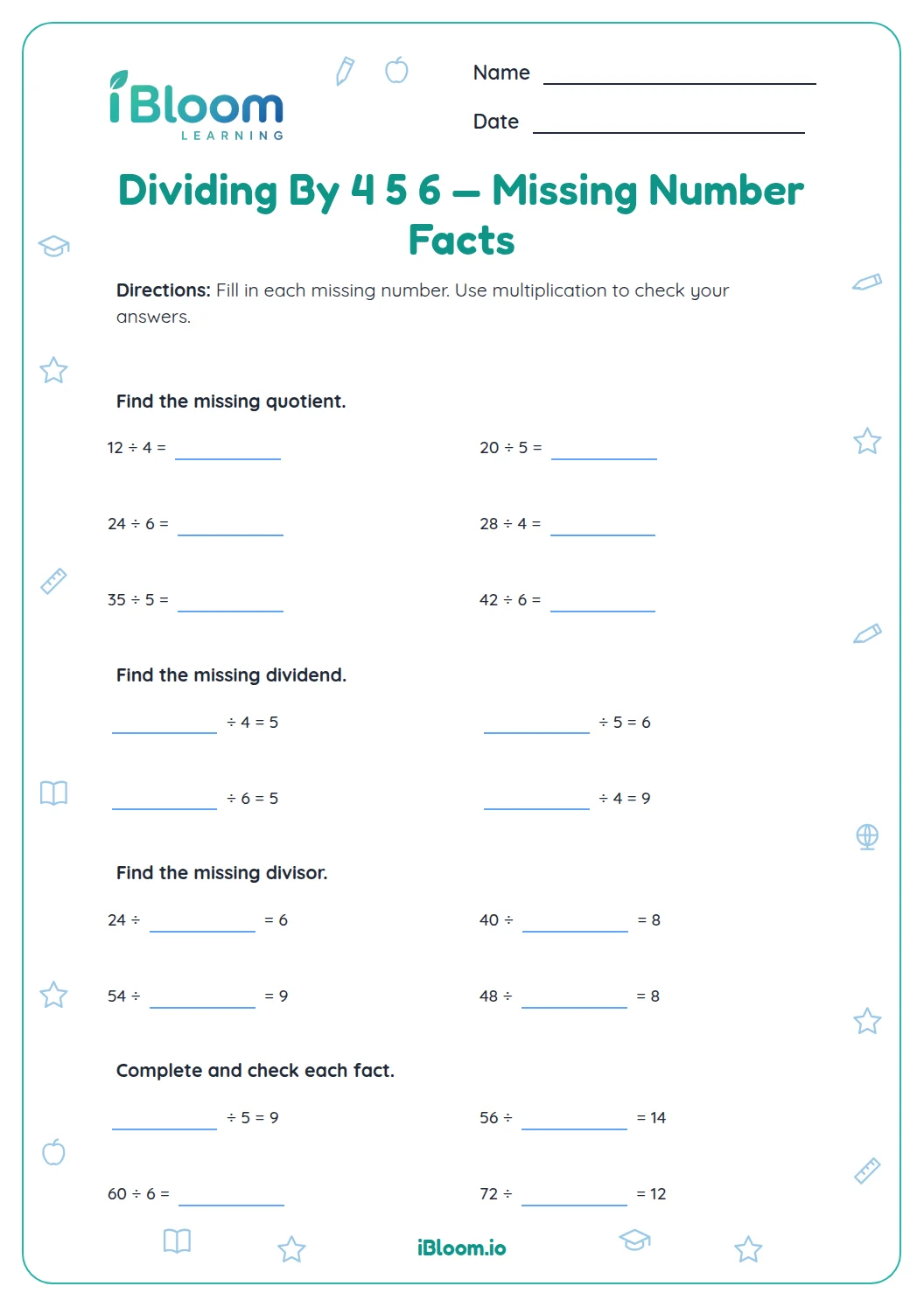
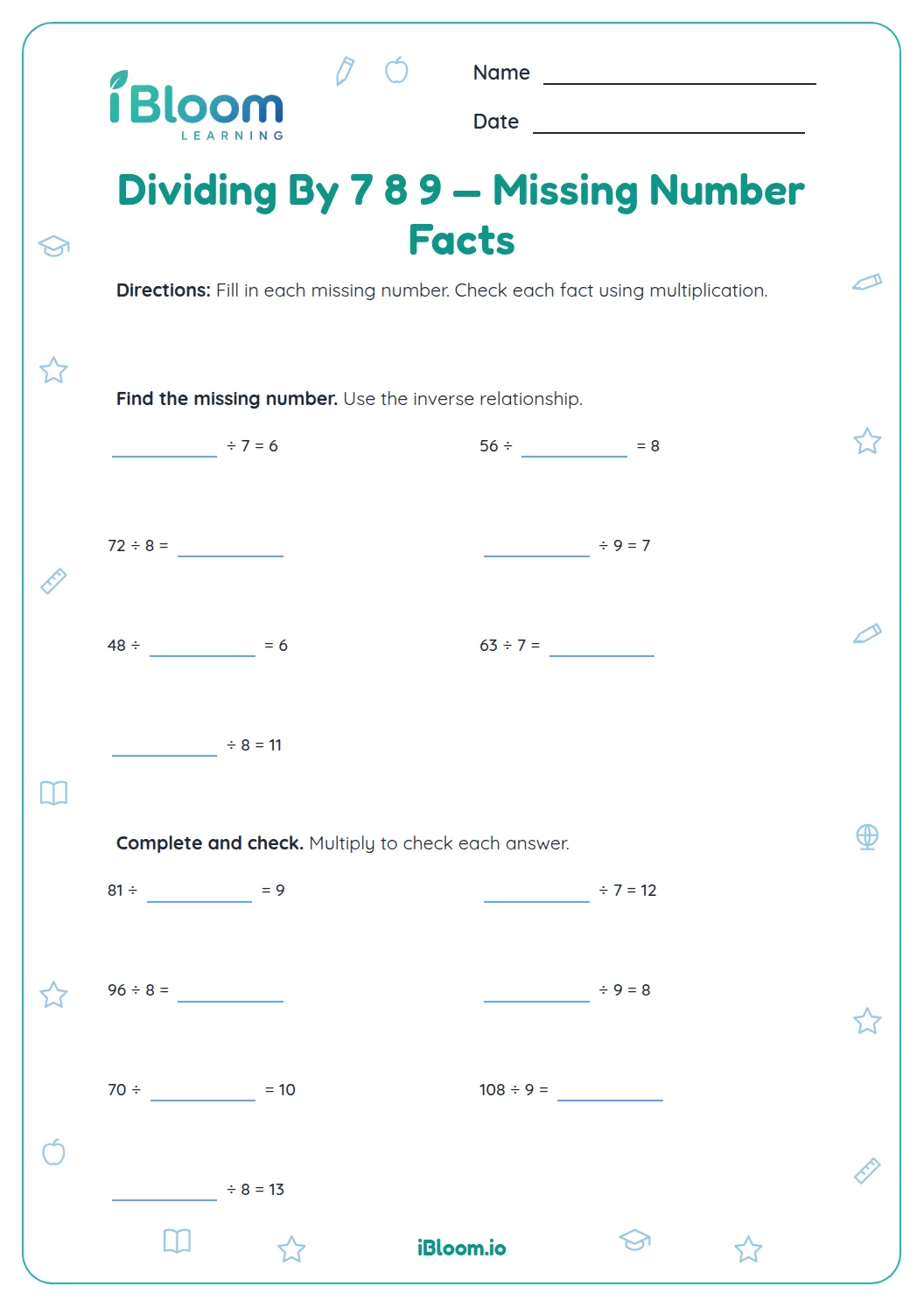
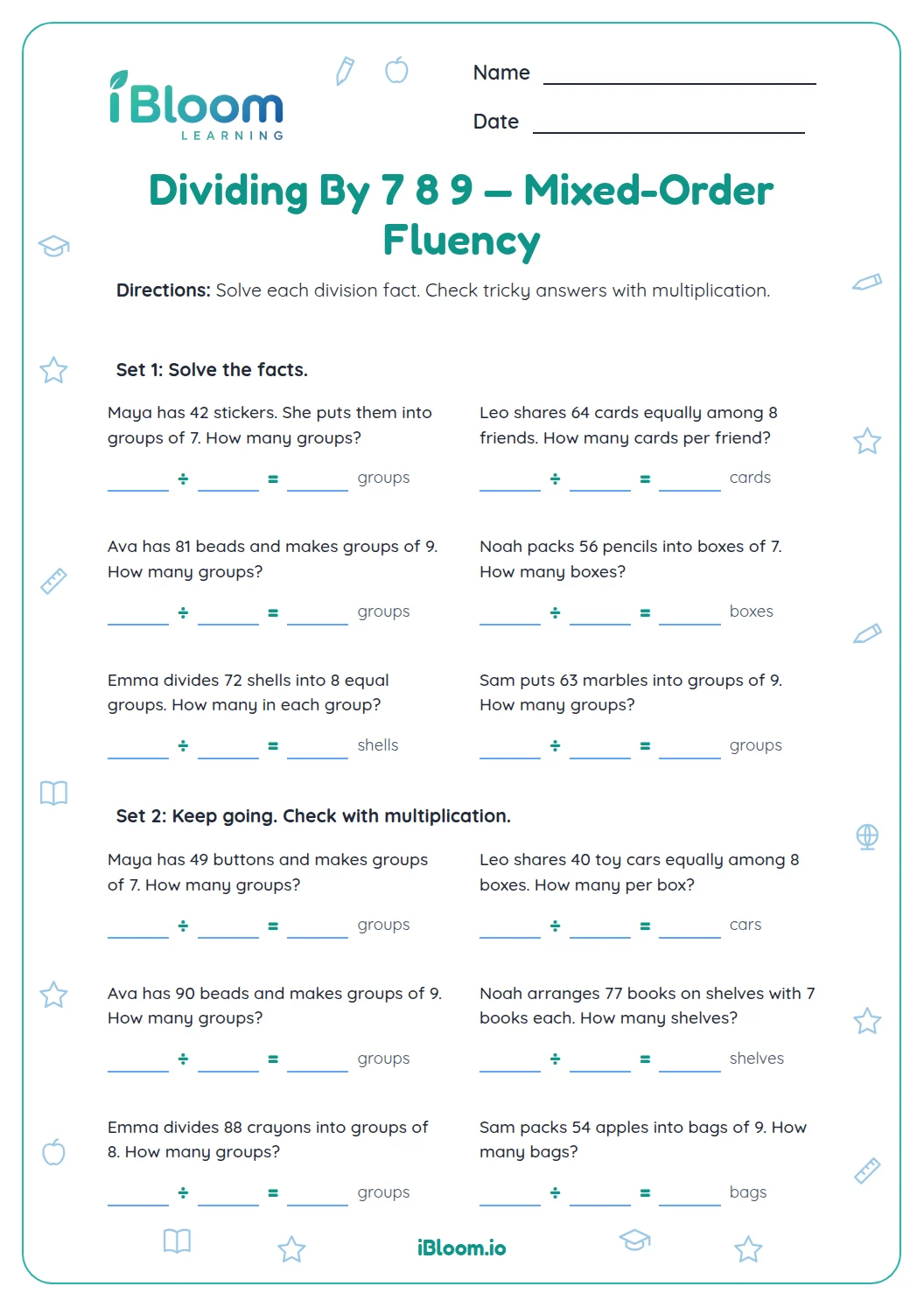
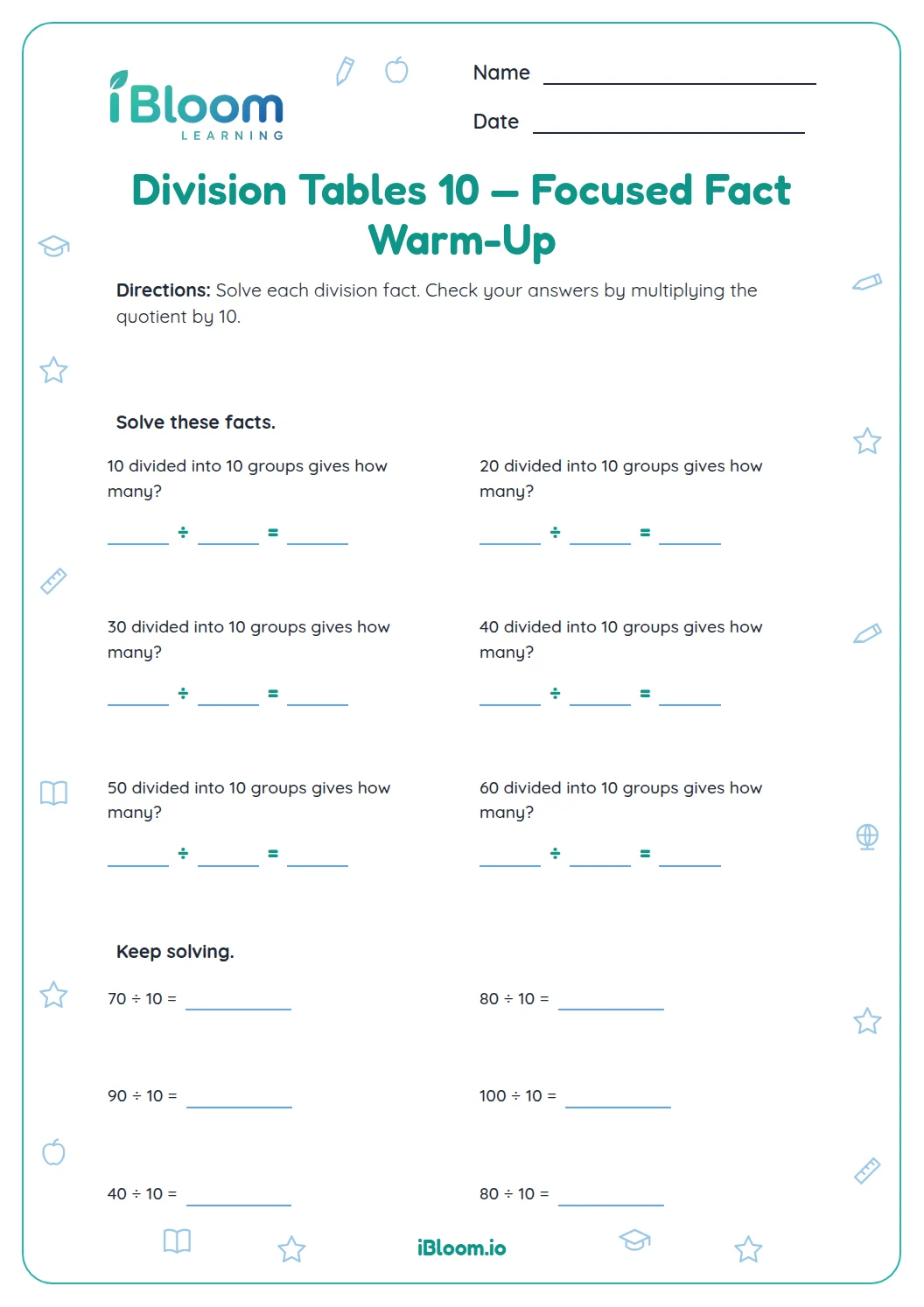
This printable Grade 3 division warm-up replaces a single sample equation with 16 horizontal facts across two pages. Part A starts with familiar fact-family relationships; Part B mixes dividends and divisors for additional retrieval practice. Every dividend is within 100, and a separate two-page answer key supports quick checking. The practice aligns with Common Core 3.OA.C.7, which connects multiplication and division facts.
Aligned to 3.OA.C.7
How are division and multiplication connected?
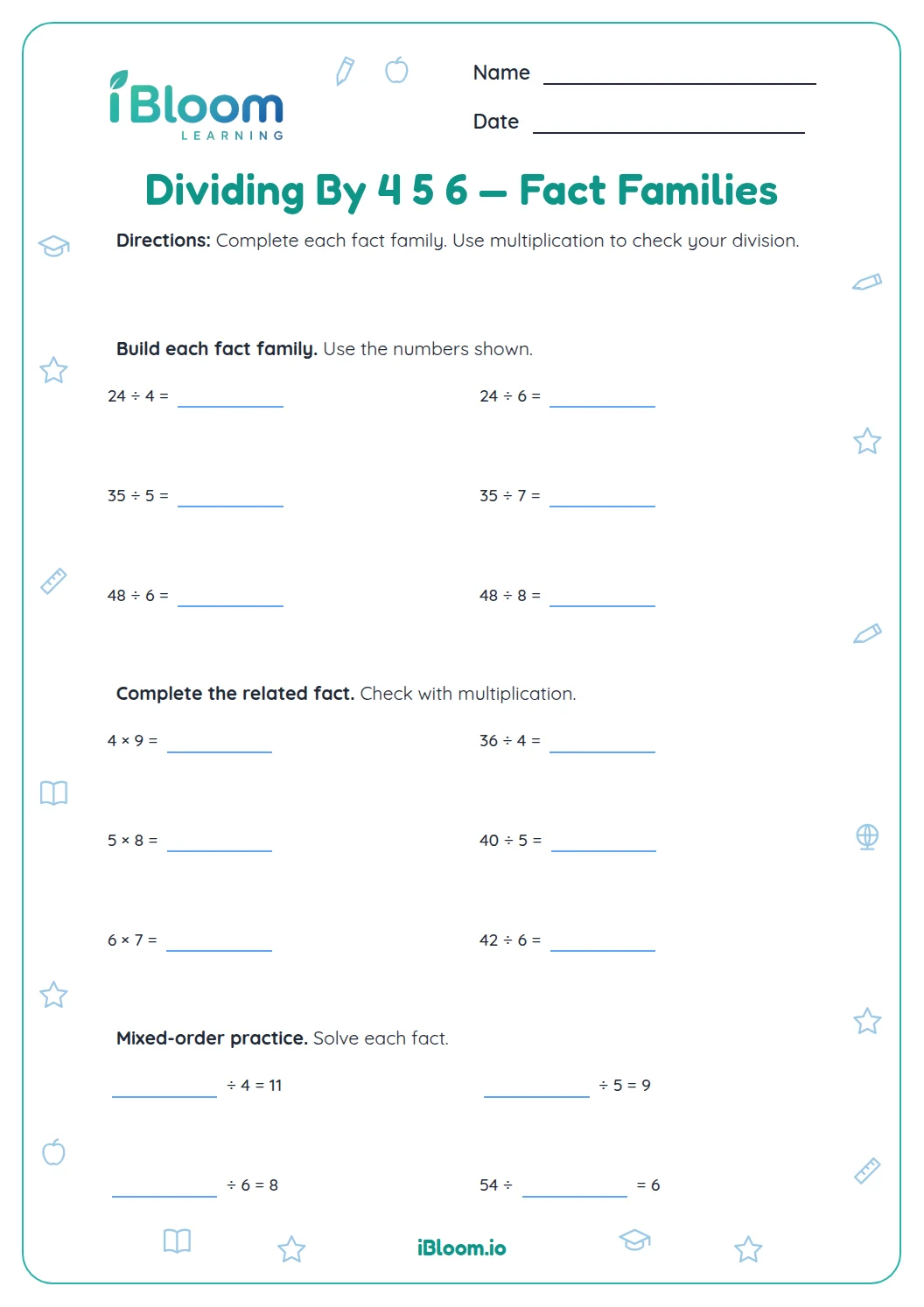
Division asks how many equal groups fit or how many are in each group. A related multiplication fact can reveal the missing quotient: if 6 × 7 = 42, then 42 ÷ 7 = 6.
All dividends on this warm-up are at most 100, and every quotient is an integer. Students can solve mentally, then use multiplication to check.
How can a multiplication fact check an answer?
Read the division sign carefully, then identify the related multiplication sentence. A fact family uses the same three numbers in both operations.
- 124 ÷ 6 = ___
- 2Ask: 6 times what equals 24?
- 36 × 4 = 24
- 4So 24 ÷ 6 = 4
How is the warm-up organized?
Part A contains eight division facts. Part B adds eight more mixed facts, all in horizontal number-sentence form. The separate answer key lists the quotients in question order.
How to use this division facts warm-up
- 1Read the dividend and divisor from left to right.
- 2Ask which number multiplied by the divisor gives the dividend.
- 3Write the quotient in the blank.
- 4Multiply the quotient by the divisor to check.
- 5Circle any fact to revisit after finishing the page.
Common mistakes and quick fixes
The mistake
Dividing the divisor by the dividend.
The fix
Check that divisor × quotient equals the dividend.
The mistake
Choosing a quotient that is close but not exact.
The fix
Use multiplication to find the factor that makes the product exactly equal.
The mistake
Mixing up a multiplication fact in the second part.
The fix
Say the related multiplication sentence aloud before writing the quotient.
Common Core alignment
This worksheet practices a specific Common Core skill through short, grade-level tasks.
Use multiplication and division relationships to solve facts within 100.
On this sheet: All division facts have dividends at or below 100 and connect to multiplication facts.
Show the official wordingHide the official wording
Fluently multiply and divide within 100, using strategies such as the relationship between multiplication and division (e.g., knowing that 8 × 5 = 40, one knows 40 ÷ 5 = 8) or properties of operations. By the end of Grade 3, know from memory all products of two one-digit numbers.
What to practice next
Make more practice
Further reading
Questions parents and teachers ask
What division facts are on this warm-up?
The sheet has 16 exact division facts with dividends from 24 to 96. Divisors range from 4 to 12, and each answer is a whole number. Students can connect each fact to a multiplication fact they already know. The set includes division facts with different divisors and quotients.
How can multiplication help with division?
Think of the missing factor. For 42 ÷ 7, ask what number times 7 equals 42. Since 6 × 7 = 42, the quotient is 6. Multiplication provides a quick way to check every answer on the page. For 24 divided by 6, the related fact is 6 times 4 equals 24.
Is the warm-up timed?
No time limit is printed on the worksheet. A teacher or family member may time a later attempt to notice growing fluency, but accuracy and a sensible multiplication check come first. Students can work at a steady pace and check each result.
How many questions are included?
There are 16 horizontal division equations on two worksheet pages, followed by a two-page answer key. The second part mixes the facts so students practice retrieving each quotient. There are sixteen equations split across two practice parts. The page divides the facts into two sets.
What does within 100 mean?
Every dividend on this sheet is 100 or less. The facts use whole-number quotients and are selected from familiar multiplication relationships, making the practice appropriate for Grade 3 division fluency. Every dividend is 100 or less, including the fact 96 divided by 8.
What should a student do after a missed fact?
Use multiplication to rebuild the fact family. For 64 ÷ 8, write or say 8 × 8 = 64, then return to the division equation. Revisit that fact after a few other problems instead of repeating it immediately. Revisit the related multiplication fact, then solve the division again.