
About this worksheet
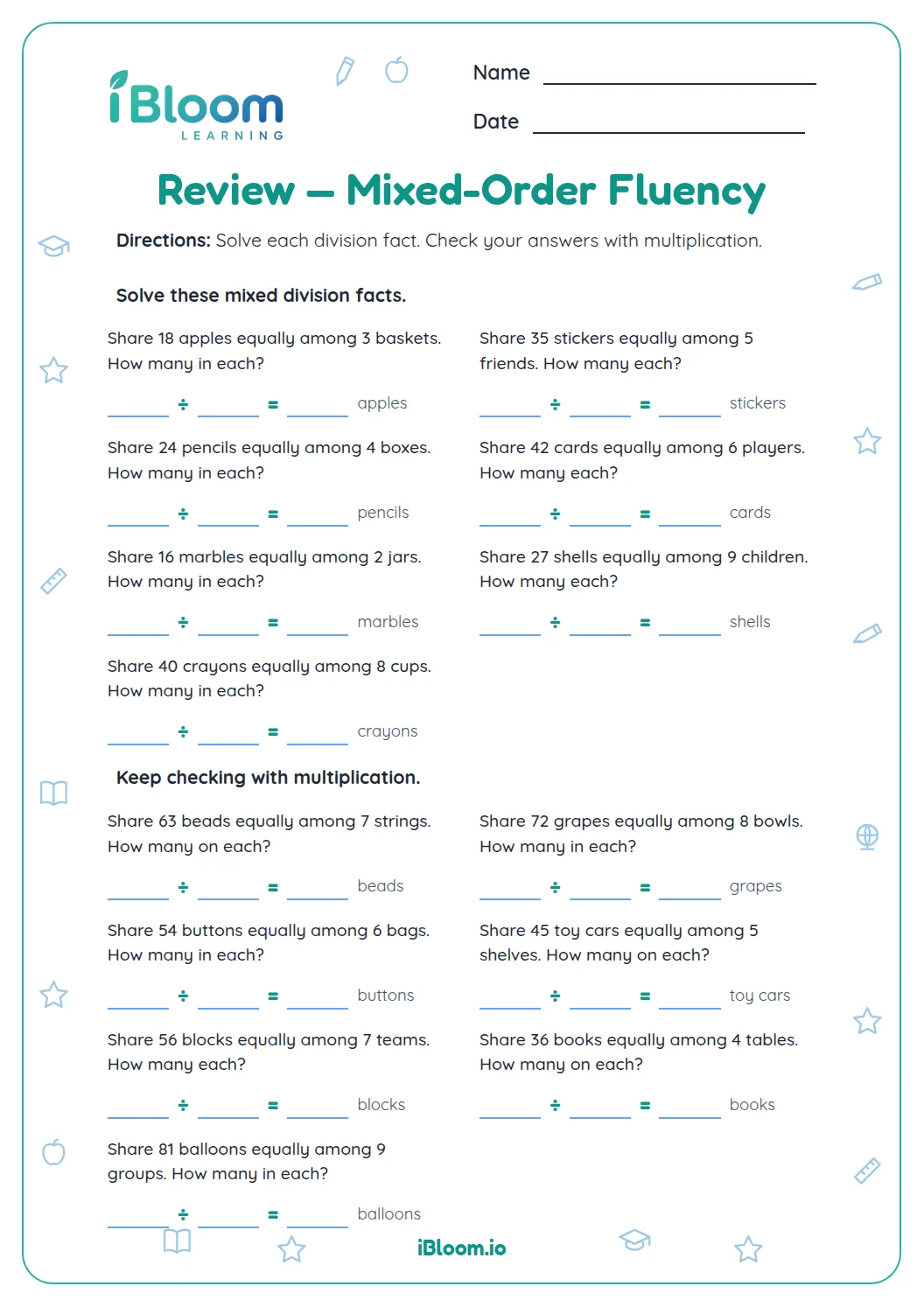
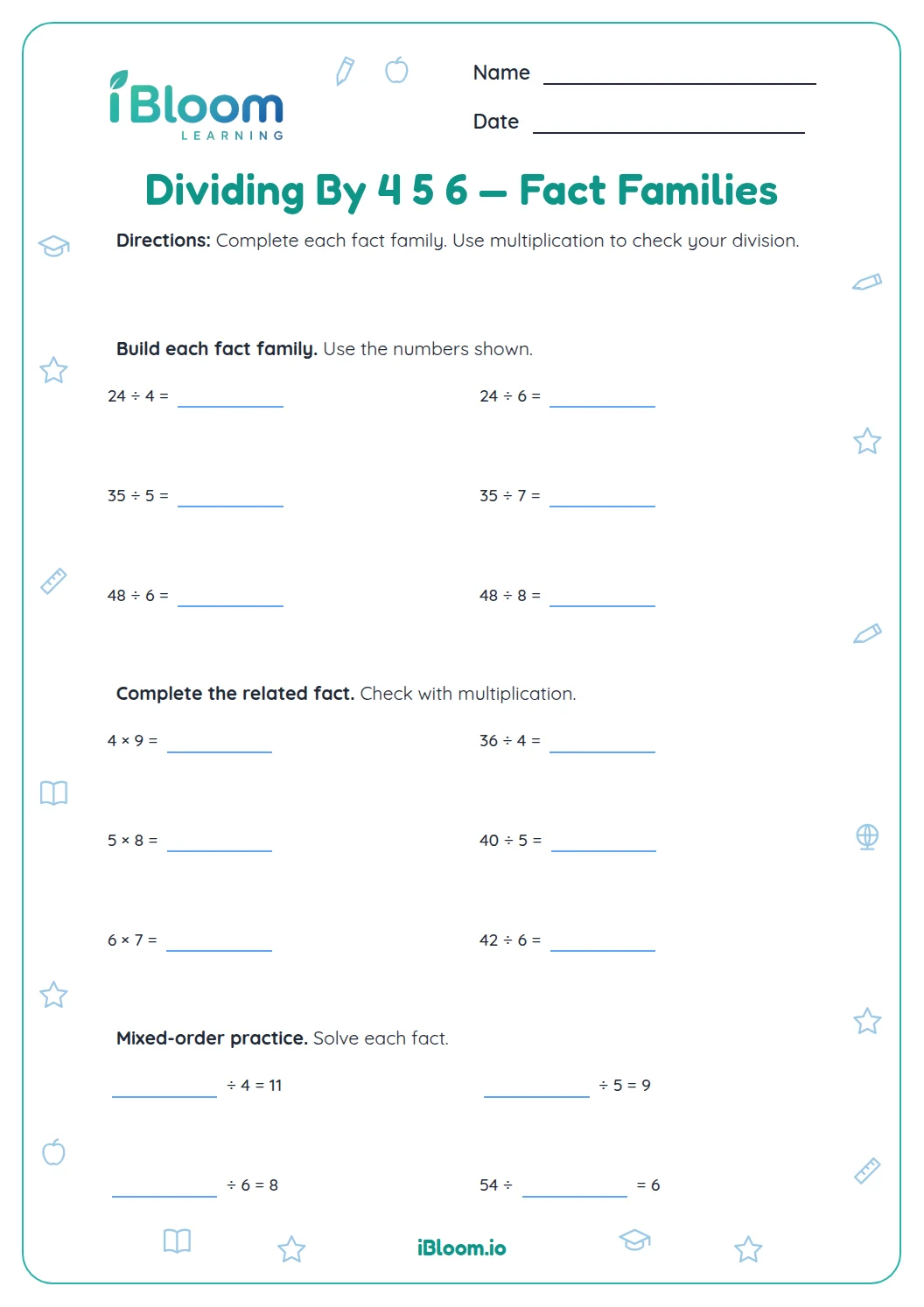
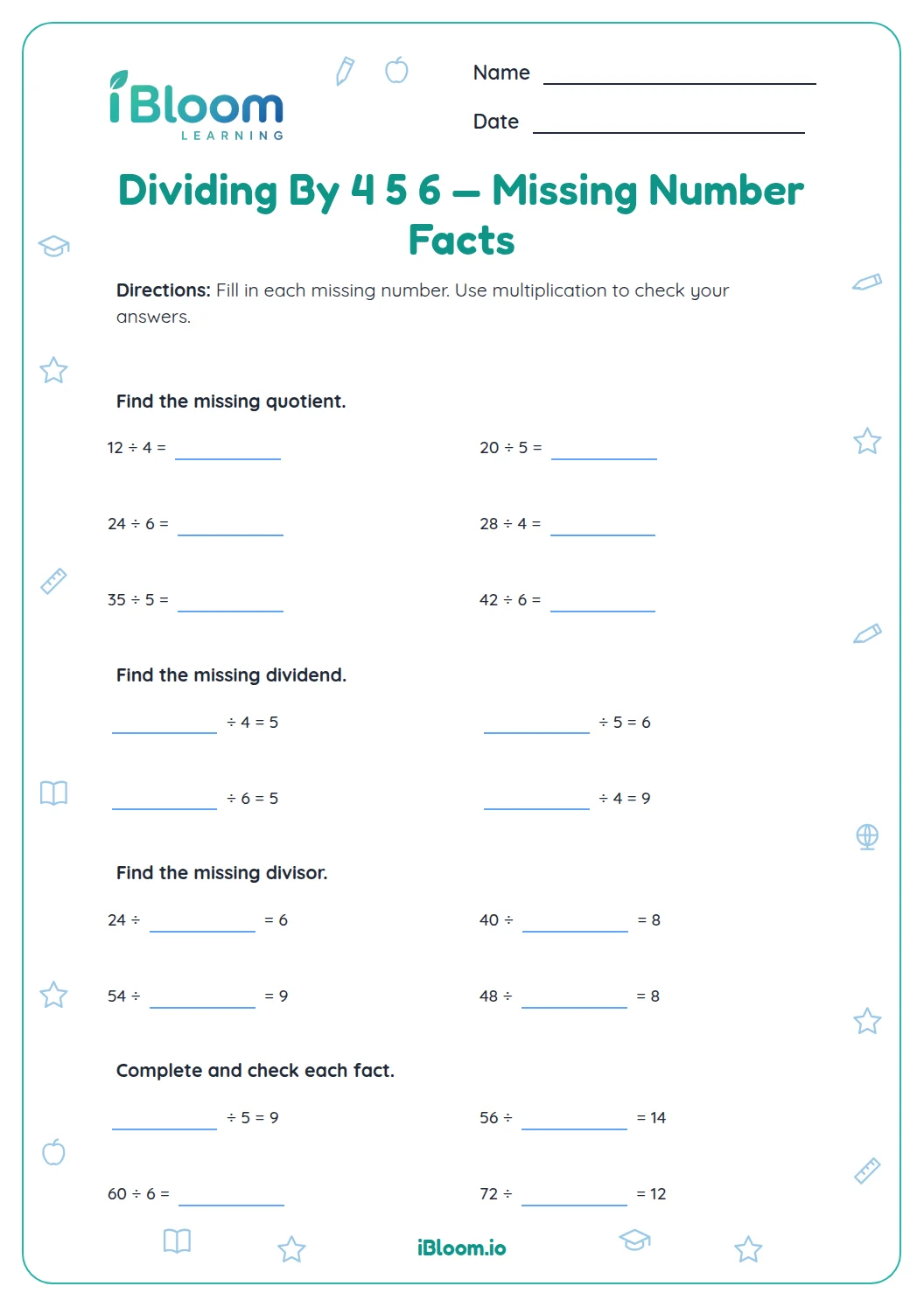
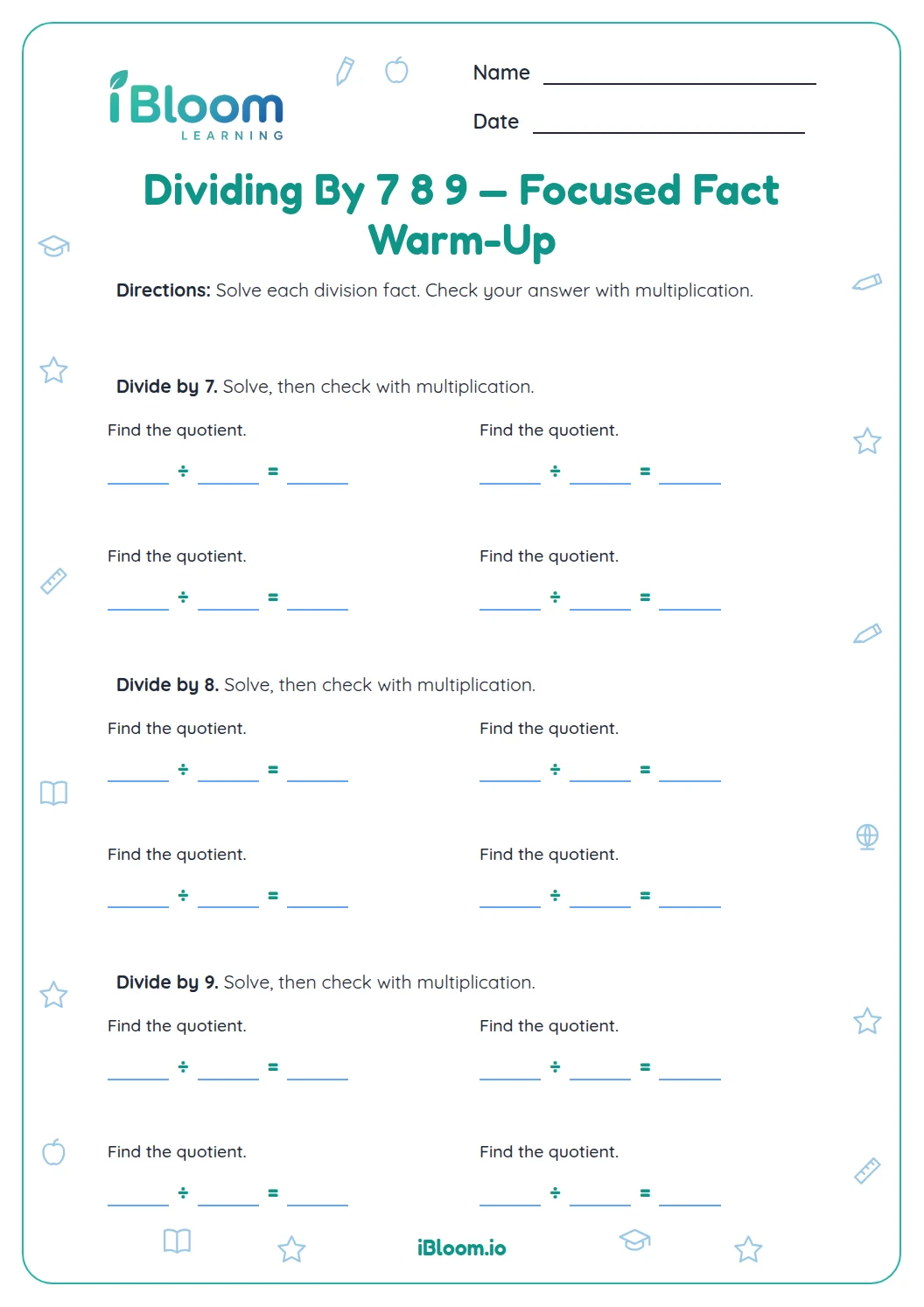
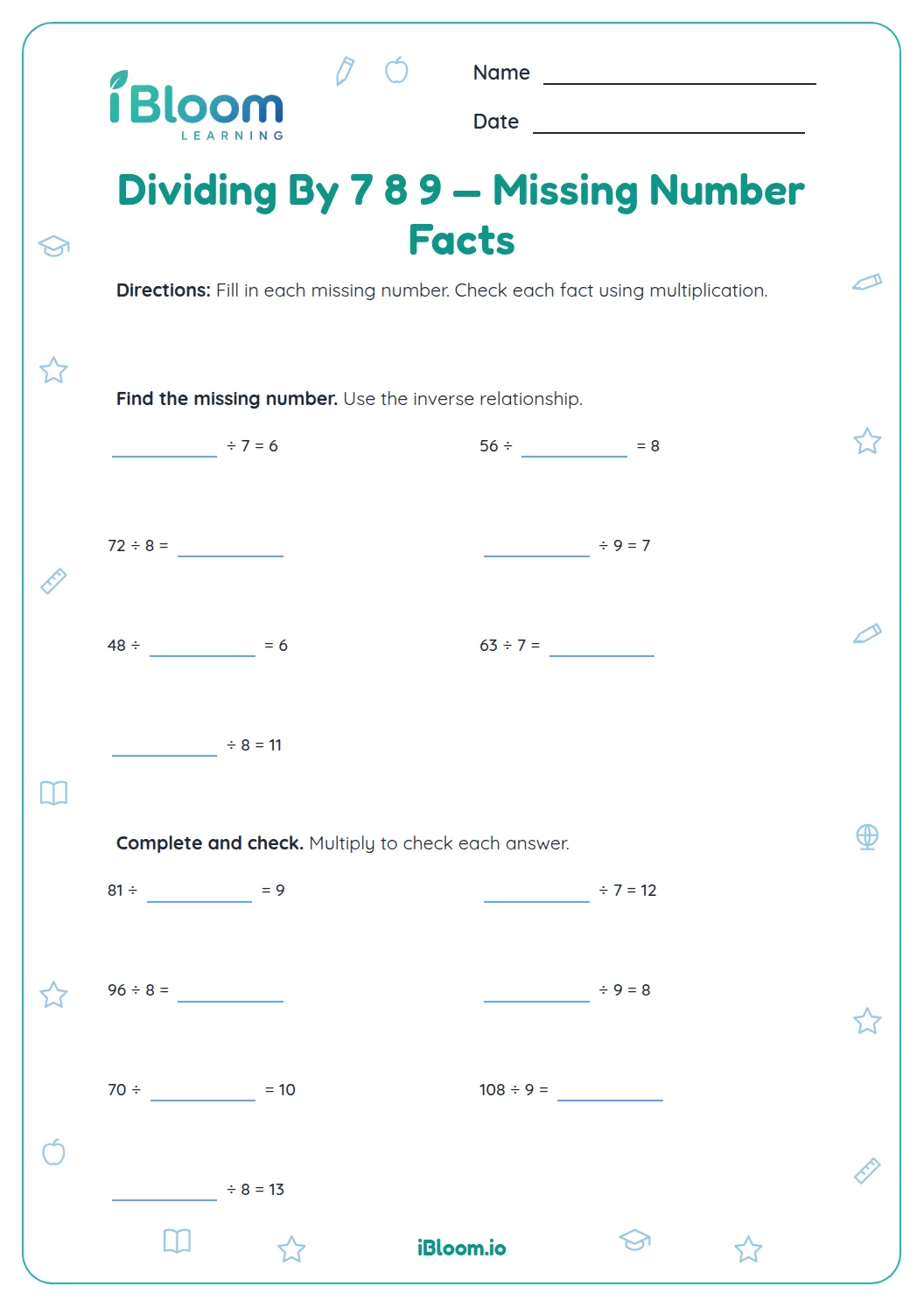
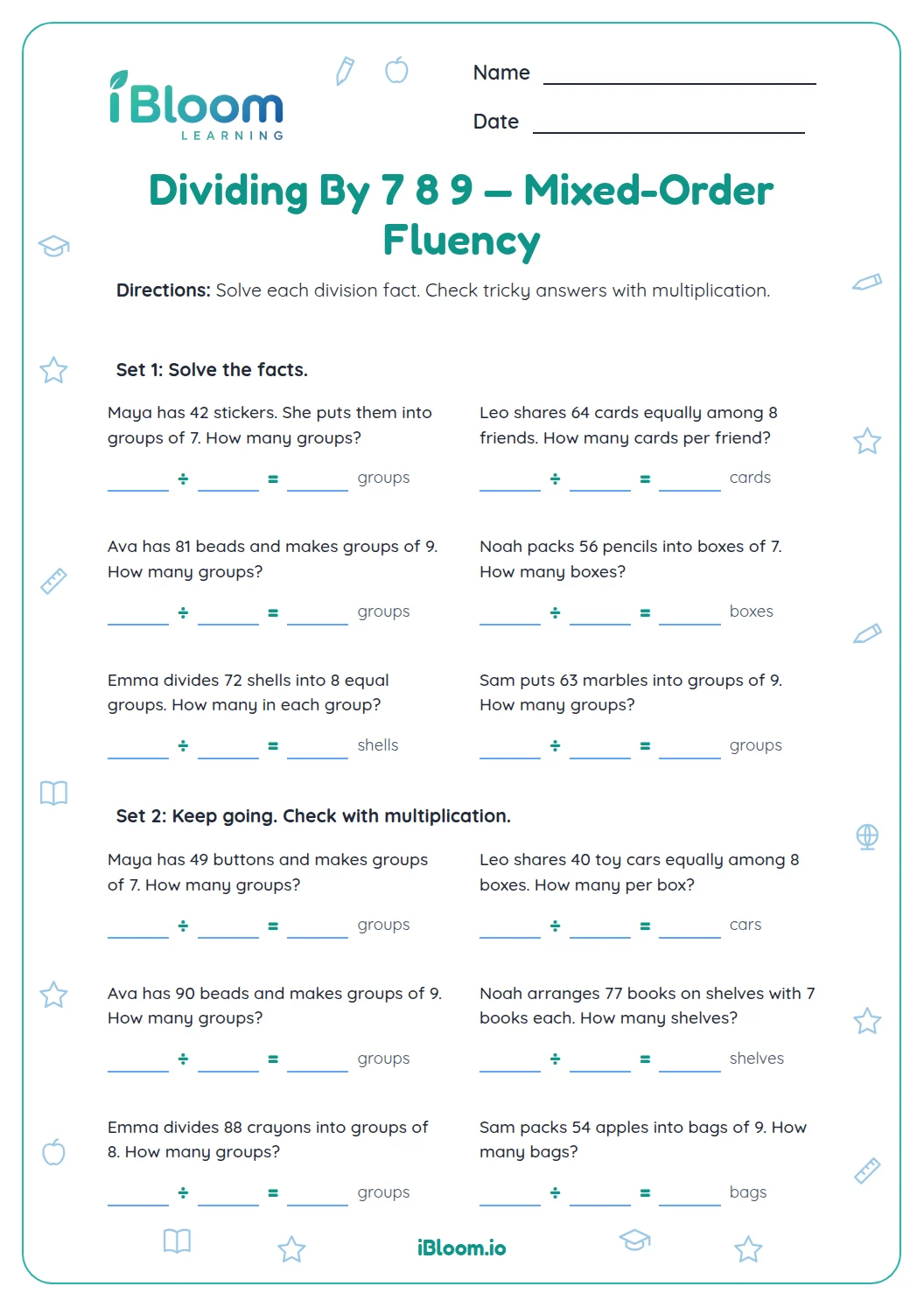
This printable division review gives Grade 3 learners twelve mixed facts and four equal-group stories. The facts use dividends through 72 and divisors from 4 to 9, so each quotient stays within the grade-level fact range. The final four questions connect a known fact to sharing and grouping situations. It practices CCSS 3.OA.C.7, including using multiplication and division relationships, and comes with a separate answer key.
Aligned to 3.OA.C.7
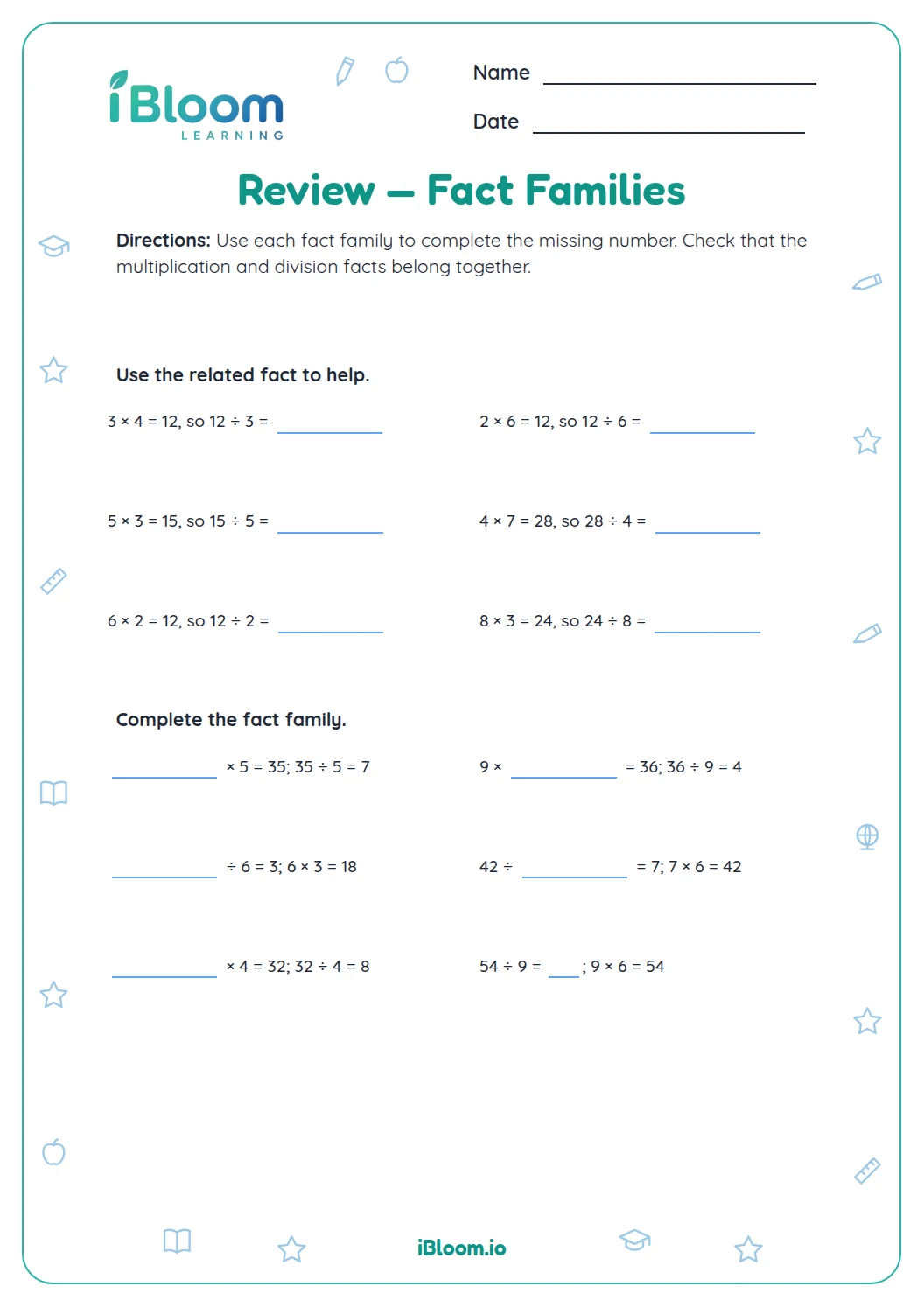
How can multiplication help with a division fact?
Think of division as a missing-factor question. For 42 ÷ 6, ask which number times 6 makes 42. Since 6 × 7 = 42, the quotient is 7. The worksheet mixes divisors so children practice recalling and checking facts.
- 142 ÷ 6 = ___
- 26 × 7 = 42
- 3So 42 ÷ 6 = 7
What changes in the story problems?
The numbers describe real groups, but the same fact strategy applies. In the marker story, 48 markers are shared among 6 tables, so calculate 48 ÷ 6. The answer names how many markers each table receives.
How can a child check a quotient?
Multiply the quotient by the divisor. For example, 48 ÷ 6 = 8 checks because 8 × 6 returns to 48. In a story, also check that the unit makes sense: tables, bags, teams, or bracelets.
How to use this division review
- 1Read the divisor and dividend before solving each fact.
- 2Use a multiplication fact you know to find the quotient.
- 3For story problems, underline the total and the number of equal groups.
- 4Write a division equation in the work space for each story.
- 5Multiply quotient by divisor to check each result.
Division fact slips to watch for
The mistake
Reversing the quotient and divisor in 42 ÷ 6.
The fix
Ask what number times 6 equals 42, then put that number after the equals sign.
The mistake
Using subtraction repeatedly and losing track of the groups.
The fix
Connect the division to a multiplication fact instead.
The mistake
Answering 8 for markers per table but leaving out what 8 counts.
The fix
Add the unit from the story: 8 markers per table.
Common Core alignment
This sheet gives focused practice with the standard below.
Use multiplication facts to solve division facts within 100.
On this sheet: The fact section and equal-group stories use division facts within 100 and related multiplication facts.
Show the official wordingHide the official wording
Fluently multiply and divide within 100, using strategies such as the relationship between multiplication and division (e.g., knowing that 8 × 5 = 40, one knows 40 ÷ 5 = 8) or properties of operations. By the end of Grade 3, know from memory all products of two one-digit numbers.
What to practice next
Make more practice
Further reading
Questions parents and teachers ask
How should a learner solve the division facts?
Use a related multiplication fact. For 42 ÷ 6, ask what number multiplied by 6 equals 42; that number is 7. The worksheet mixes the order of facts so learners need to recall the relationship, not follow a repeating sequence. On the story items, name the equal groups first; that tells you which number belongs as the divisor.
Are these facts appropriate for Grade 3?
Yes. The fact questions use whole-number quotients and dividends below 100. They practice Grade 3 division fluency and the connection between multiplication and division described in CCSS 3.OA.C.7. This is a useful link to multiplication: every division answer completes a related multiplication fact. Children can use that connection even when they do not recall a quotient immediately.
What does “equally” mean in the story problems?
Each group gets the same number. For example, sharing 48 markers among 6 tables means the tables receive equal shares, so 48 ÷ 6 finds the markers at each table. For example, 48 markers split among 6 tables means 48 ÷ 6, not 6 ÷ 48.
Should children write an equation for each story?
Yes. The story section gives room to write a division equation and solve it. A useful check is to multiply the quotient by the number of groups and see whether the product returns to the total. Ask the learner to write the total divided by the number of groups, then say what the quotient measures.
Is an answer key included?
Yes. A separate key lists all 16 answers, including the units for the four story problems. Learners can complete the sheet first, then use the key to check both their quotients and their interpretation of each situation. Check the quotient with its related multiplication fact.