





About this worksheet
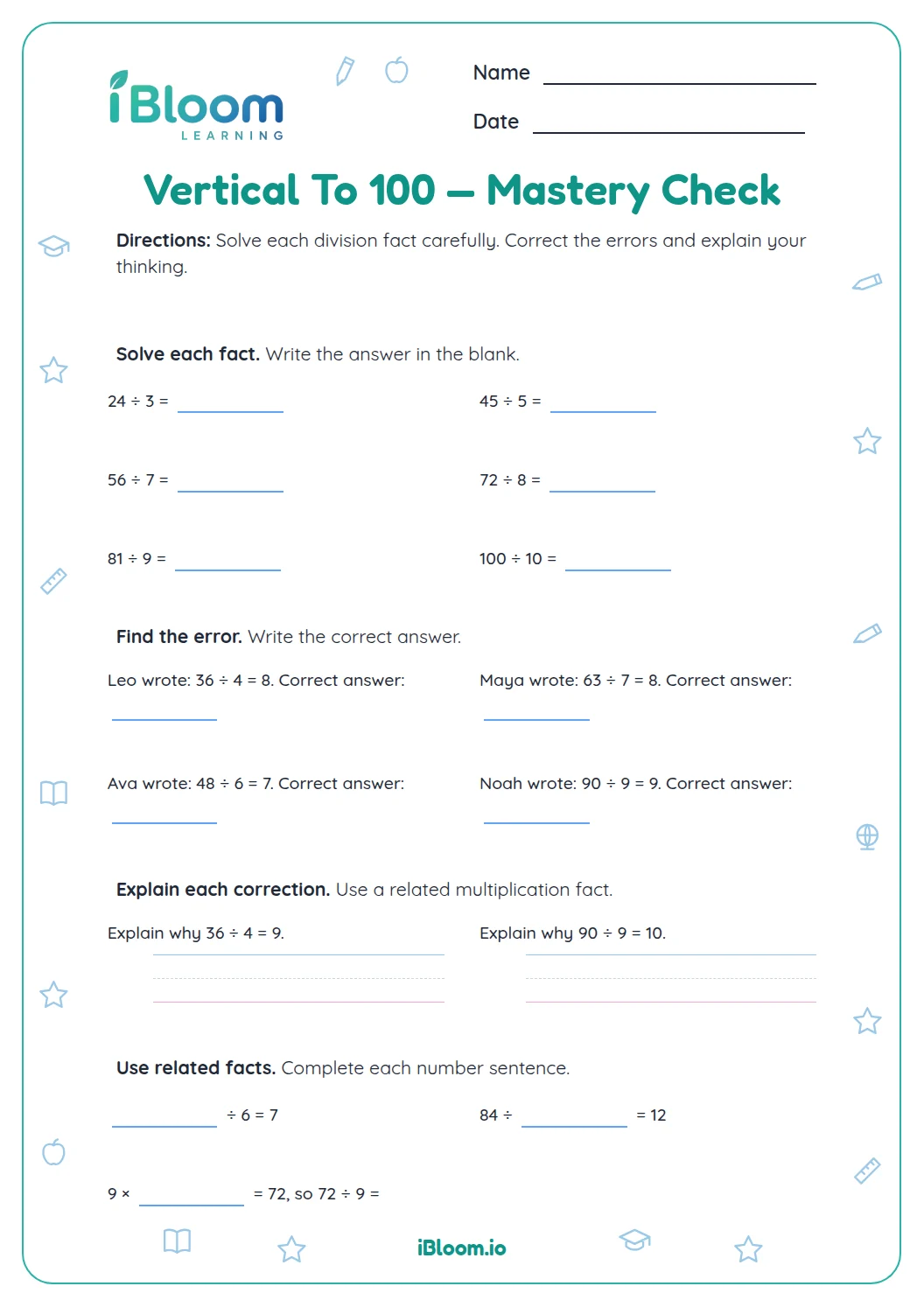
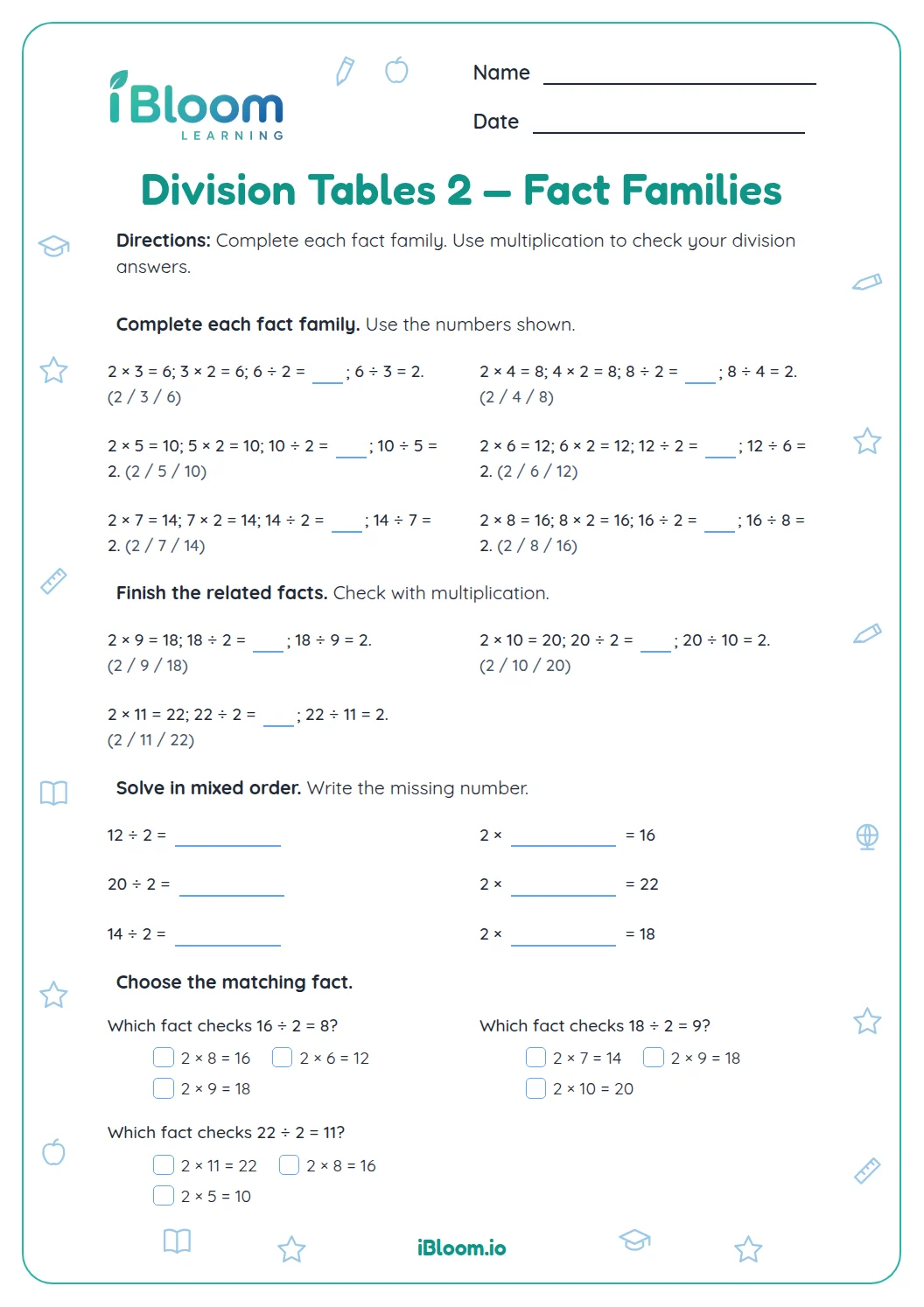
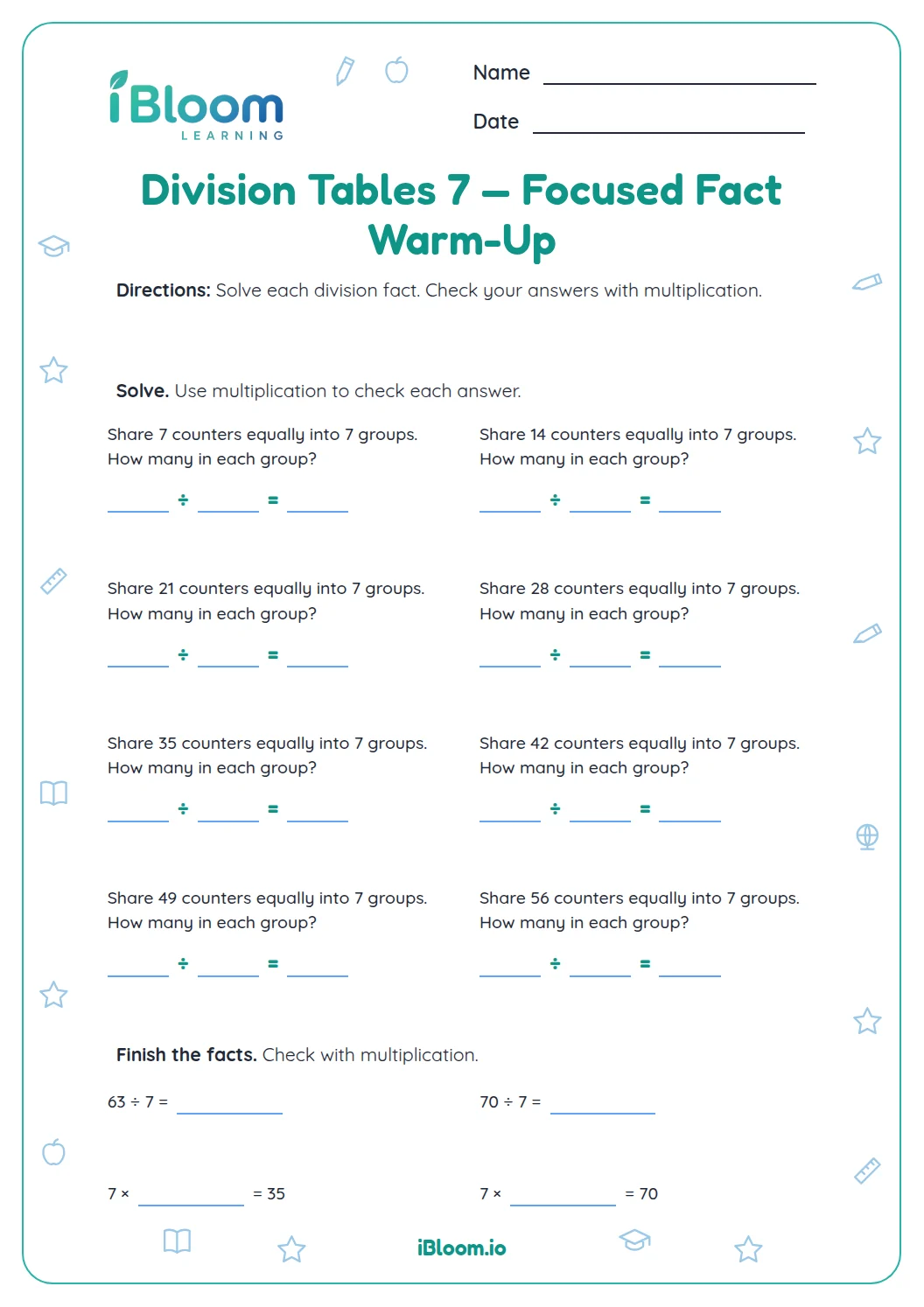
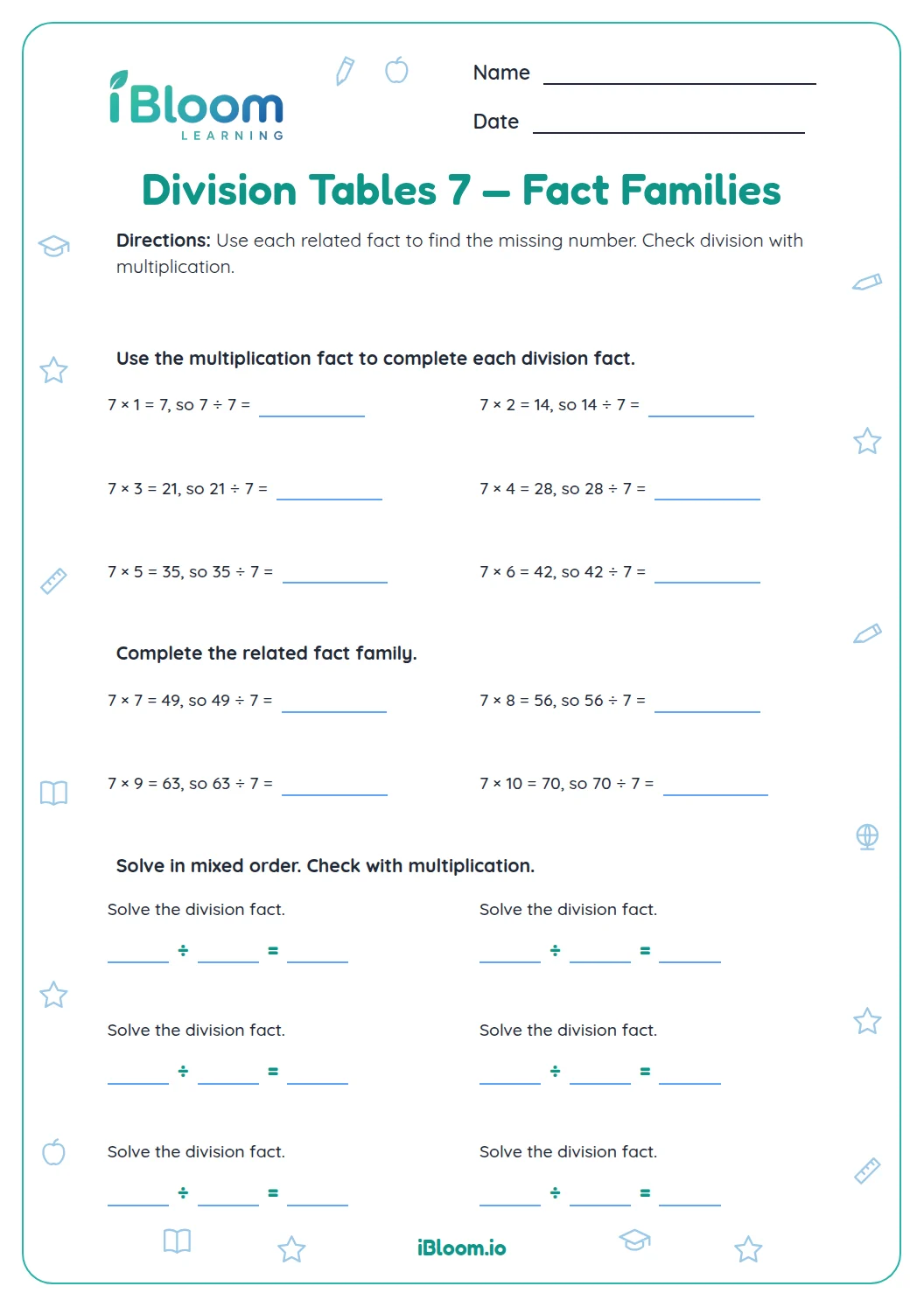
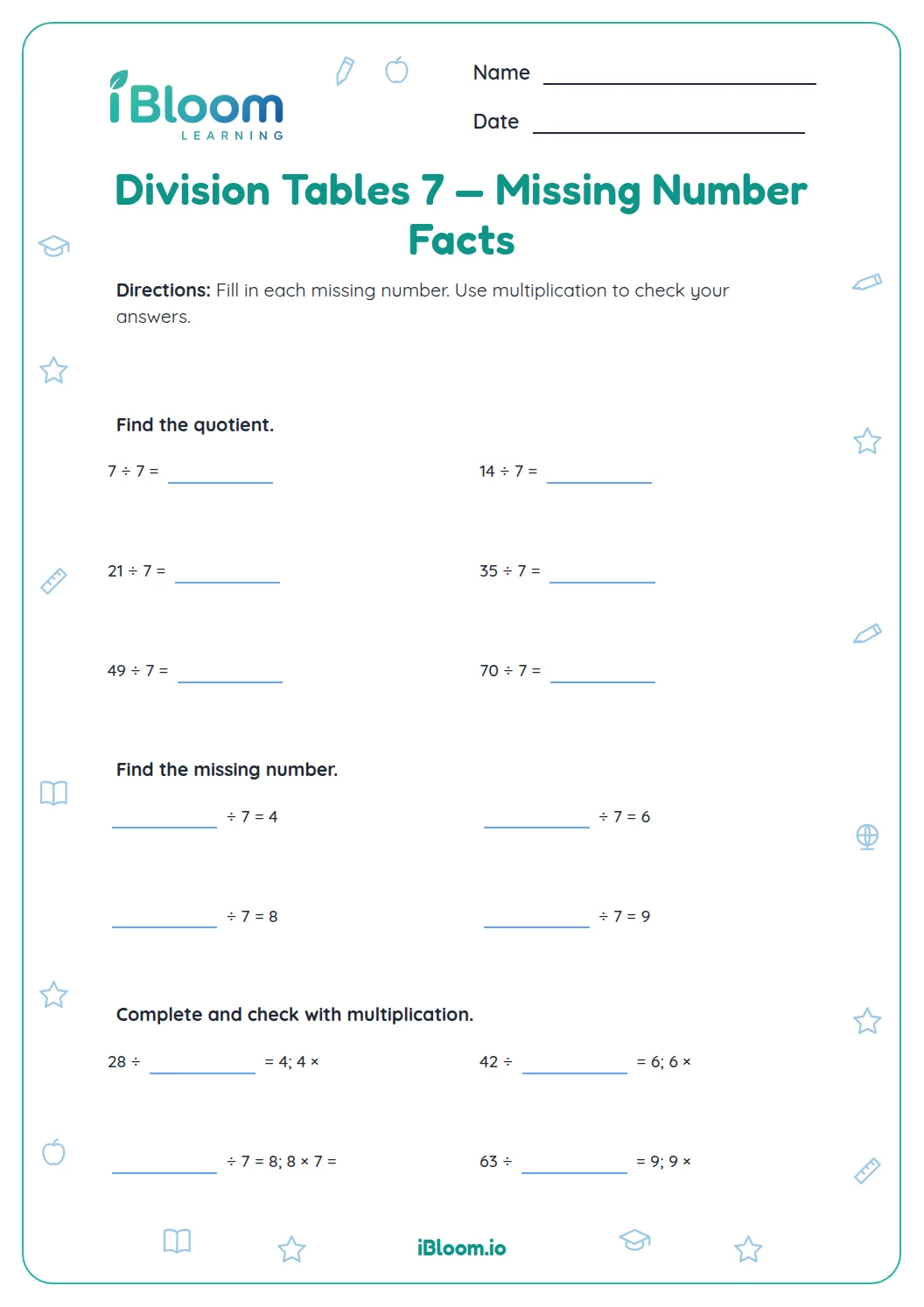
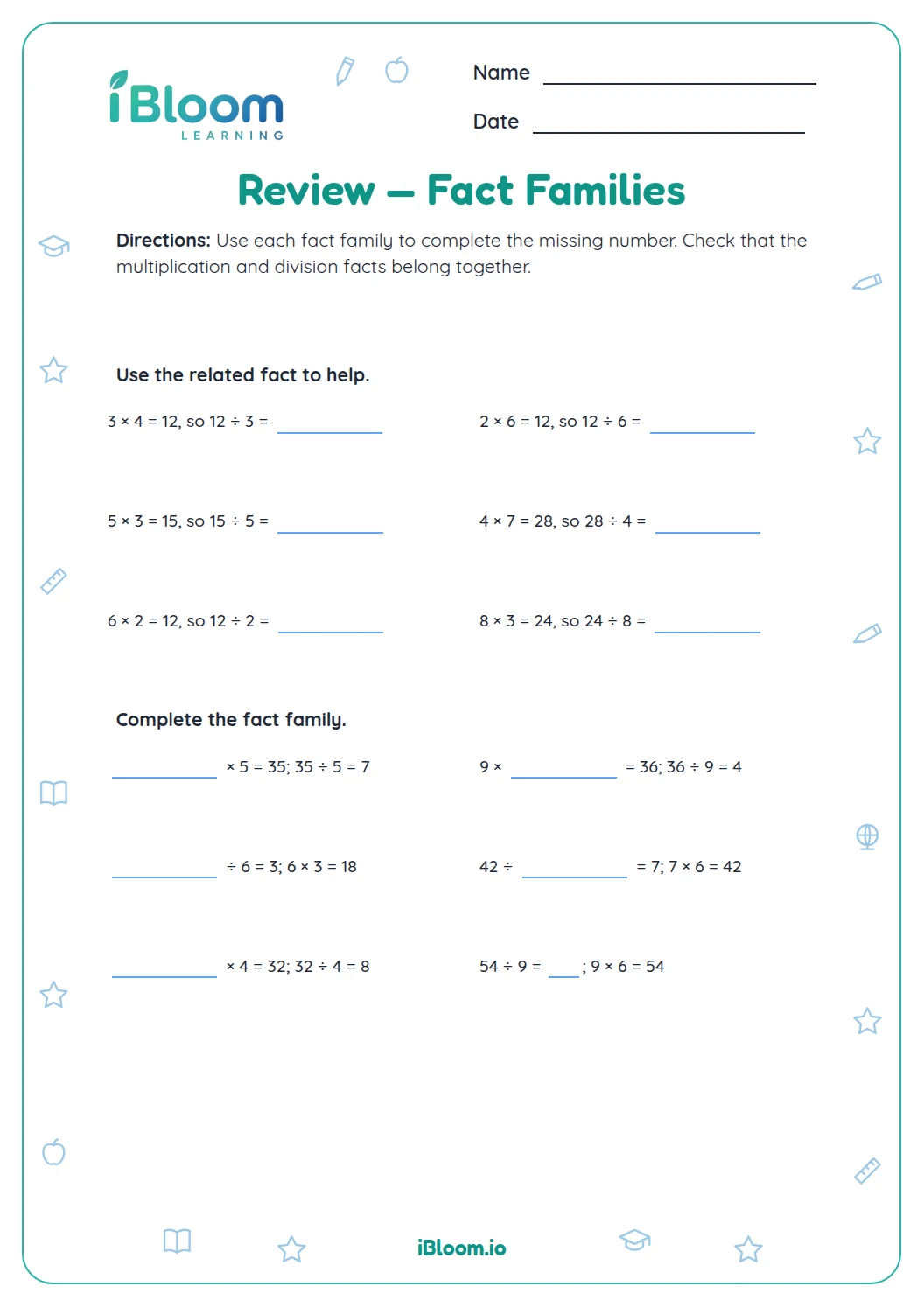
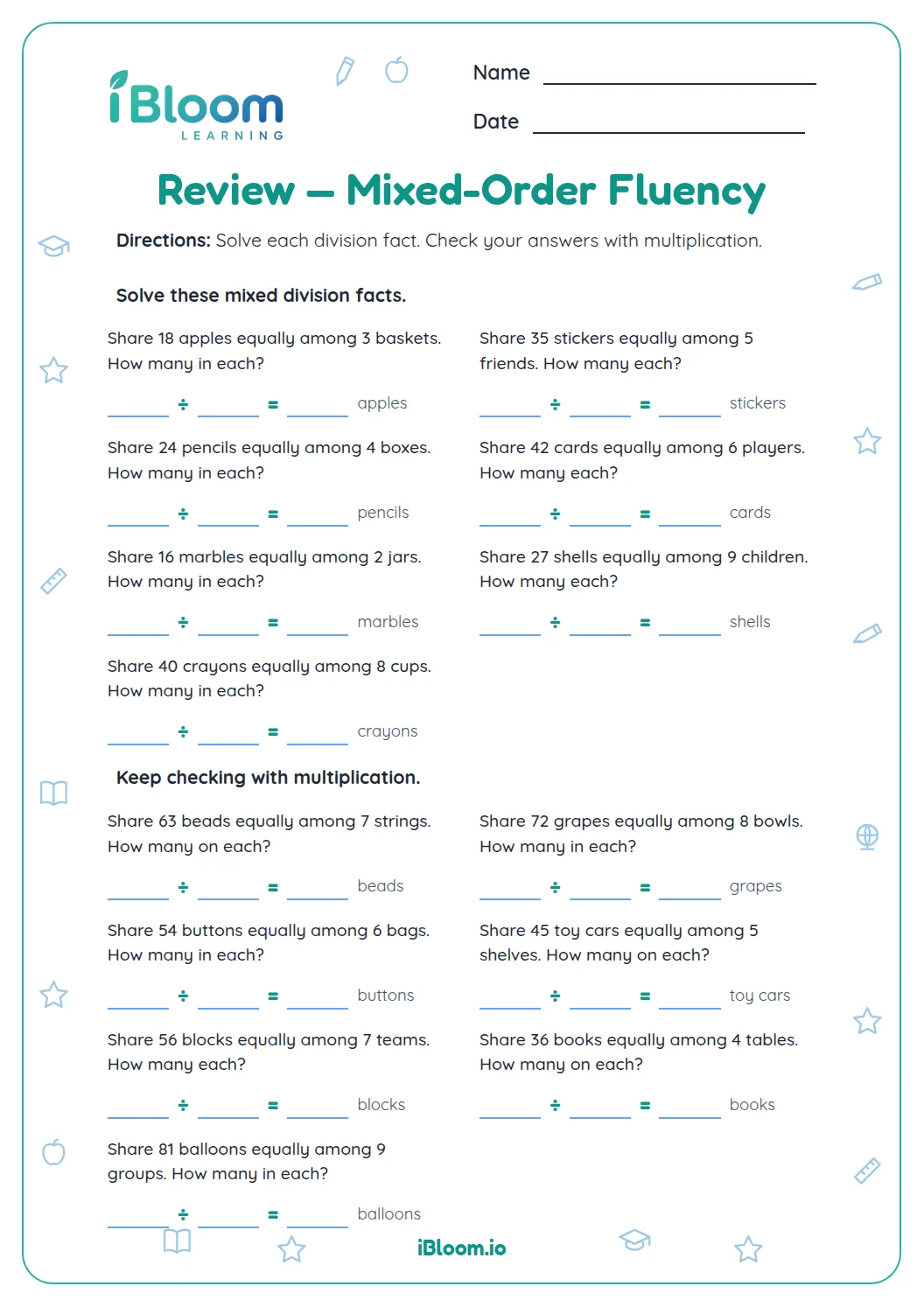
This printable division warm-up has 18 questions in three parts. Students solve exact division facts with dividends up to 100, connect multiplication facts to related division facts, and solve two equal-sharing problems. One question asks students to explain a multiplication check. The practice supports CCSS 3.OA.C.7: fluently multiplying and dividing within 100 using strategies such as the relationship between the operations. A separate key lists each quotient and sample explanation.
Aligned to 3.OA.C.7
How can multiplication check a quotient?
Division asks how many equal groups fit or how many are in each group. Multiply the quotient by the divisor to see whether the product matches the dividend.
- 148 ÷ 6 = 8
- 28 × 6 = 48, so the quotient checks.
How do fact families help with division?
If 8 × 7 = 56, then 56 ÷ 8 = 7 and 56 ÷ 7 = 8. The same three numbers form related multiplication and division facts. Part B gives the multiplication fact so students can use it to find the quotient.
How do the story problems use division?
In an equal-sharing problem, the total is split into the stated number of equal groups. Question 13 shares 72 stickers among 8 friends, so each friend receives 9. Multiplication checks the result: 9 groups of 8 make 72. The same idea finds the number of apples in each basket.
- 172 stickers ÷ 8 friends = 9 stickers per friend
- 29 × 8 = 72
How to use this worksheet
- 1Read the dividend and divisor in order.
- 2Recall or build the related multiplication fact.
- 3Write the quotient on the line.
- 4Multiply quotient by divisor to check the dividend.
- 5For a sharing problem, label the quotient with what each group receives.
Mistakes to watch for
The mistake
Reversing the divisor and quotient in a fact family.
The fix
Read the sentence: dividend divided by divisor equals quotient.
The mistake
Using addition instead of multiplication to check.
The fix
Multiply the quotient by the divisor and compare with the dividend.
The mistake
Writing a quotient that does not divide evenly.
The fix
Check the product; the answer key expects exact whole-number facts.
Use multiplication facts and the inverse relationship to solve division within 100.
On this sheet:
Show the official wordingHide the official wording
Fluently multiply and divide within 100, using strategies such as the relationship between multiplication and division (e.g., knowing that 8 × 5 = 40, one knows 40 ÷ 5 = 8) or properties of operations. By the end of Grade 3, know from memory all products of two one-digit numbers.
What to practice next
Make more practice
Further reading
Questions parents and teachers ask
What division facts are included?
The worksheet has 18 questions: exact division facts, related multiplication and division facts, and short equal-sharing problems. Each dividend is 100 or less and each quotient is a whole number. The answer key also models a multiplication check for one division fact.
How can multiplication check a division answer?
Multiply the quotient by the divisor. If the product equals the dividend, the division fact checks. For example, 48 divided by 6 is 8 because 8 times 6 equals 48. Students can use this inverse relationship on the fact-family questions.
What does “equal sharing” mean in the story problems?
Equal sharing means each group receives the same number of items. To find the amount each friend gets or the number in each basket, divide the total by the number of groups. Include the named item in the answer so the quotient is clear.
Should students race through the warm-up?
No timer is needed. The focus is accurate recall and checking. A student can pause to build a multiplication fact, solve the related division fact, and verify the product. Repeating a few missed facts later is more useful than rushing through the page.
What can a student do after a missed fact?
Use the multiplication family to rebuild the fact. For 56 divided by 8, ask which number multiplied by 8 makes 56. Once the student finds 7, write 7 times 8 equals 56 and compare that product with the original dividend. This checks both the quotient and the operation.