



About this worksheet
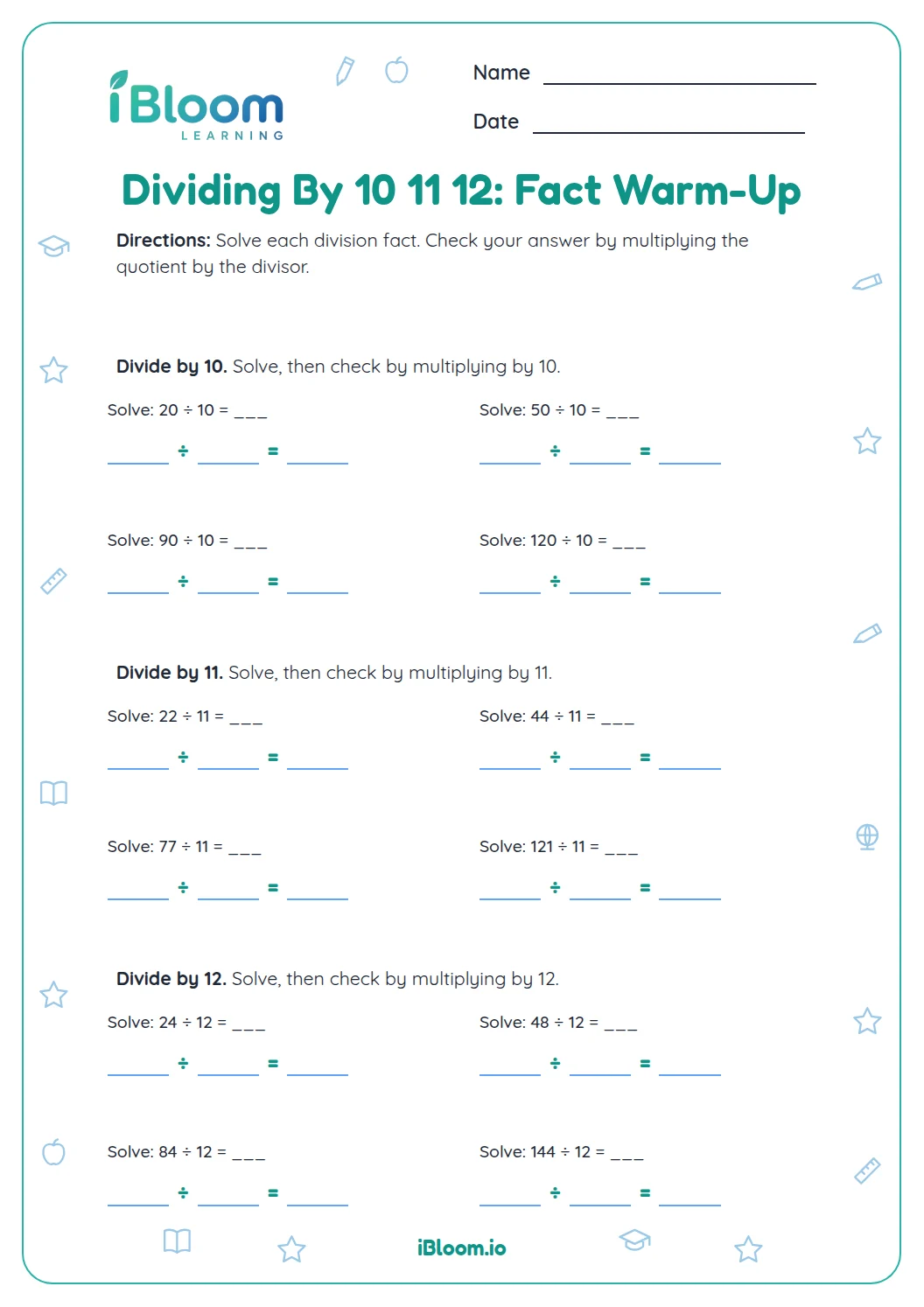
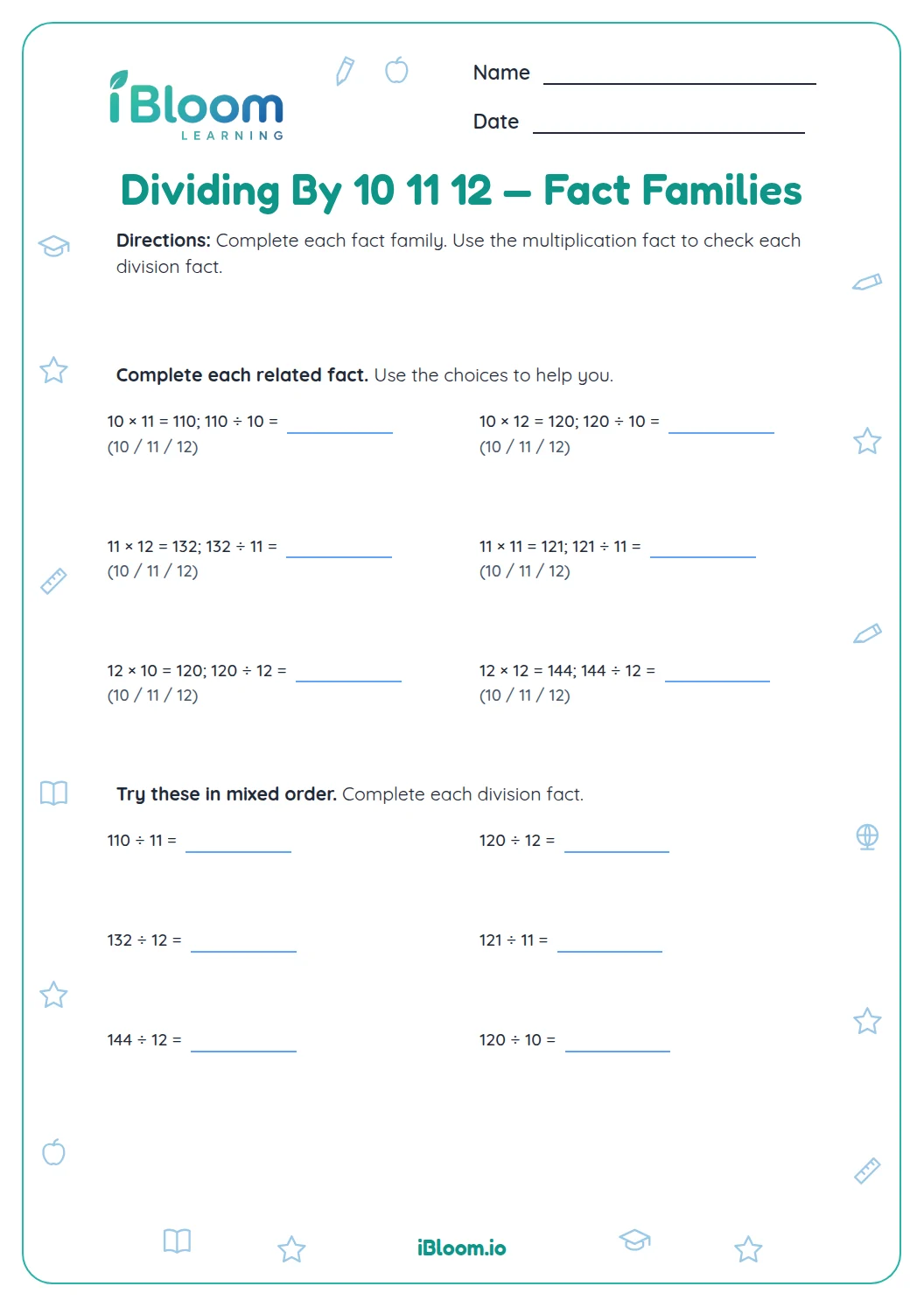
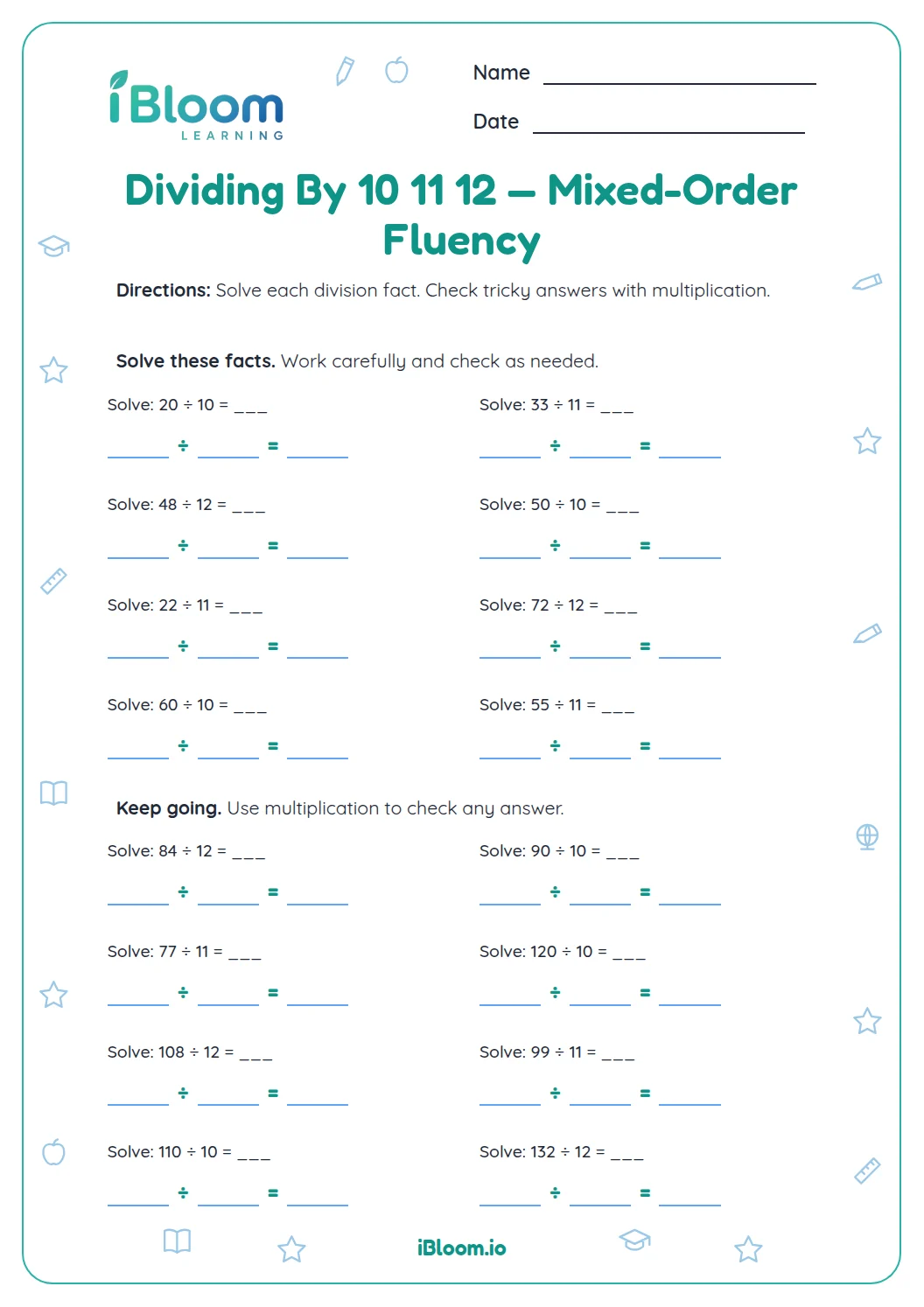
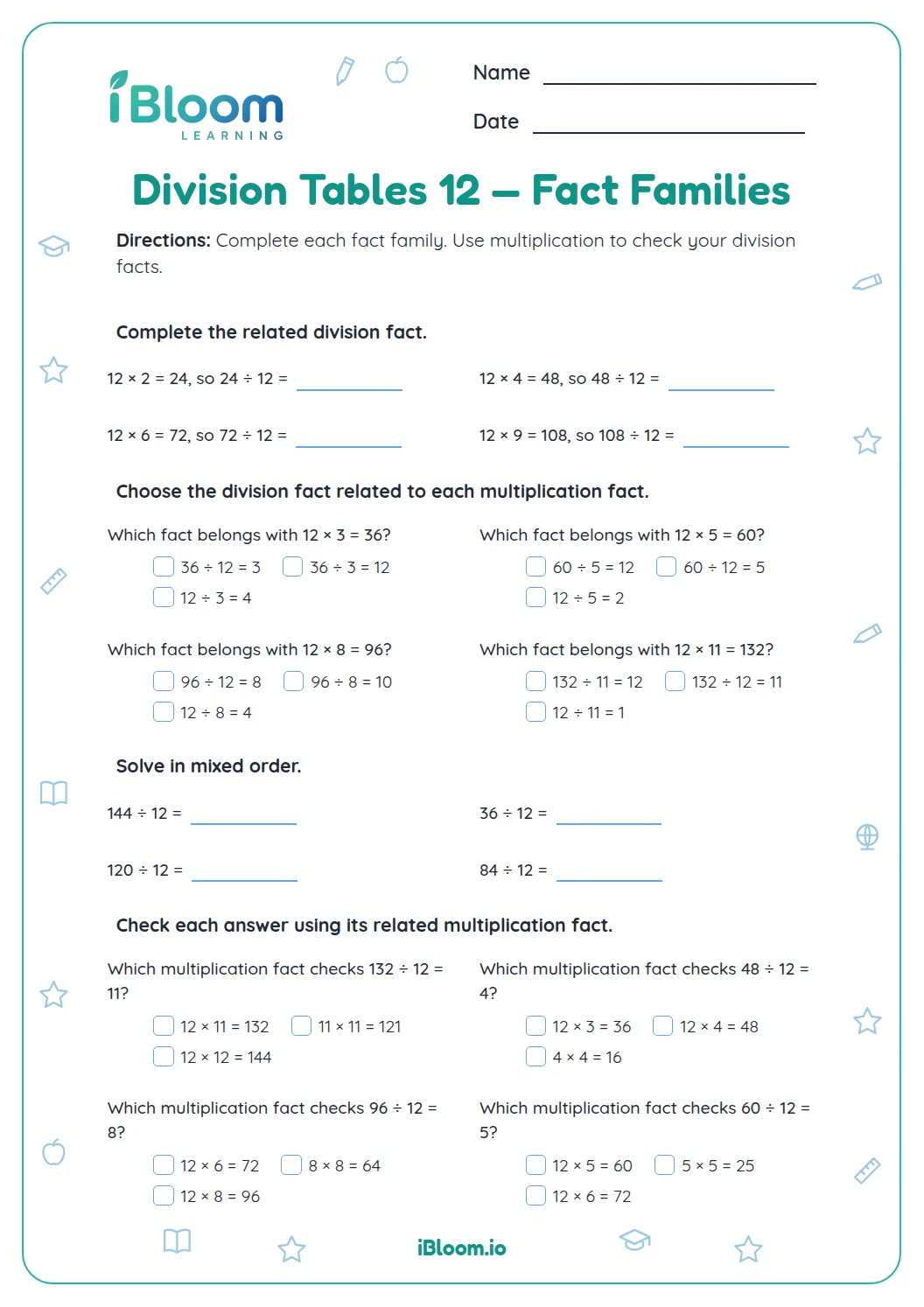
This free printable worksheet helps students in Grades 3–4 use multiplication to solve division facts involving 11. Part A completes two related fact families. Part B mixes missing quotients, factors, and a dividend across the 11 table. Part C asks students to write a whole family using 11, 8, and 88. There are eighteen numbered questions, with four equations to write in the final question. The worksheet practices Common Core 3.OA.B.6 by treating division as an unknown-factor problem. A separate answer key shows the completed facts.
Aligned to 3.OA.B.6
What belongs in a division-by-11 fact family?
A family connects two factors with their product. With 11, 3, and 33, the multiplication equations are 11 × 3 = 33 and 3 × 11 = 33. Starting with the product gives 33 ÷ 11 = 3 and 33 ÷ 3 = 11.
Part A completes that family and a second one using 11, 6, and 66. Read the four equations together after filling the blanks. Students can see that changing the operation changes where the same numbers belong.
How do you find a missing divisor or dividend?
The blank may be the answer, the number being divided, or the divisor. Read the complete equation before deciding what to do. For 44 ÷ ___ = 11, ask what number times 11 equals 44. For ___ ÷ 11 = 9, multiply 11 by 9 to find the starting amount.
Question 11 is useful for checking this distinction. The missing dividend is 99, because 99 divided into groups of 11 makes 9 groups.
- 1___ ÷ 11 = 9
- 2The related multiplication fact is 11 × 9 = 99.
- 3Put 99 in the blank.
- 4Check: 99 ÷ 11 = 9.
What does the final family-writing question check?
Question 18 gives only the three numbers 11, 8, and 88. Students write all four related equations themselves. This checks whether they can organize a family after practicing equations with a blank already placed.
Accept the equations in any order. Check that the two multiplication facts reverse the factors and that the two division facts begin with 88. The key prints the four equations so each can be checked separately.
How to use this worksheet
- 1Review the meaning of 11 × 3 and 33 ÷ 11 aloud before starting.
- 2Complete each group of four equations in Part A and reread it as one family.
- 3In Part B, identify whether each blank is a quotient, divisor, or dividend.
- 4Use a related multiplication fact to check every missing number.
- 5Write and check all four equations for 11, 8, and 88 in Part C.
Mistakes to notice and how to help
The mistake
Writing 11 ÷ 33 = 3 in the family with 33.
The fix
Begin each division fact with the product: 33 ÷ 11 = 3.
The mistake
Putting 9 in the blank for ___ ÷ 11 = 9.
The fix
The blank is the starting amount. Multiply 11 × 9 to get 99.
The mistake
Writing the same multiplication equation twice in question 18.
The fix
Reverse the factors for the second fact: 11 × 8 and 8 × 11 both make 88.
Common Core alignment
Use multiplication by 11 to find missing numbers in related division equations.
On this sheet: The missing-number equations and final family connect each division fact to multiplication.
Show the official wordingHide the official wording
Understand division as an unknown-factor problem. For example, find 32 ÷ 8 by finding the number that makes 32 when multiplied by 8.
What to practice next
Make more practice
Further reading
Questions parents and teachers ask
What numbers are practiced in the 11 table?
The sheet uses multiples of 11 from 11 through 132, with related factors from 1 through 12. Part A completes families for 33 and 66; Part C builds the family for 88. Part B includes the larger facts 121 ÷ 11 = 11 and 132 ÷ 11 = 12.
How many facts does the final question ask children to write?
The final question asks for four facts: two multiplication equations and two division equations using 11, 8, and 88. They can appear in any order. Check that each equation is true and that both division equations begin with the product, 88, as the starting amount.
How should a child solve 44 ÷ ___ = 11?
The missing divisor is 4. Use the related multiplication equation 11 × 4 = 44, then put 4 into the blank and reread 44 ÷ 4 = 11. This check helps students distinguish a missing divisor from a missing quotient, even when the same family numbers appear.
Is this worksheet meant to be timed?
Use it as untimed practice so students can connect the facts and check the position of each blank. The final task asks for four equations, which takes more writing than a single quotient. About fifteen minutes is a planning estimate; allow more time for explaining the relationships.
How can I tell whether my child understands the family?
Ask your child to explain one completed division equation using multiplication. For 77 ÷ 11 = 7, the explanation should connect 11 × 7 to 77. Then review the final family and ask why 88 starts both division equations. The product is the amount being divided.