



About this worksheet
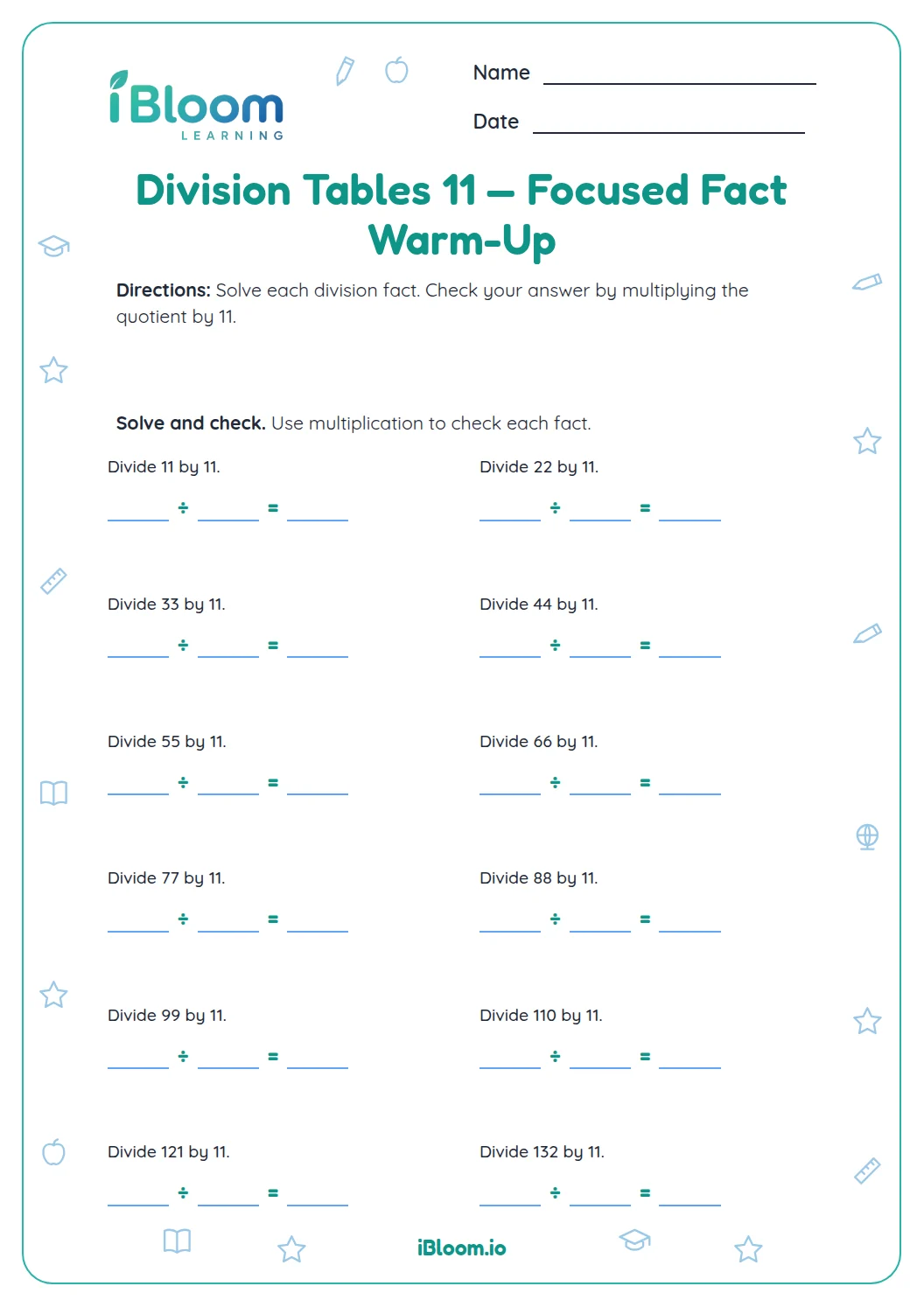
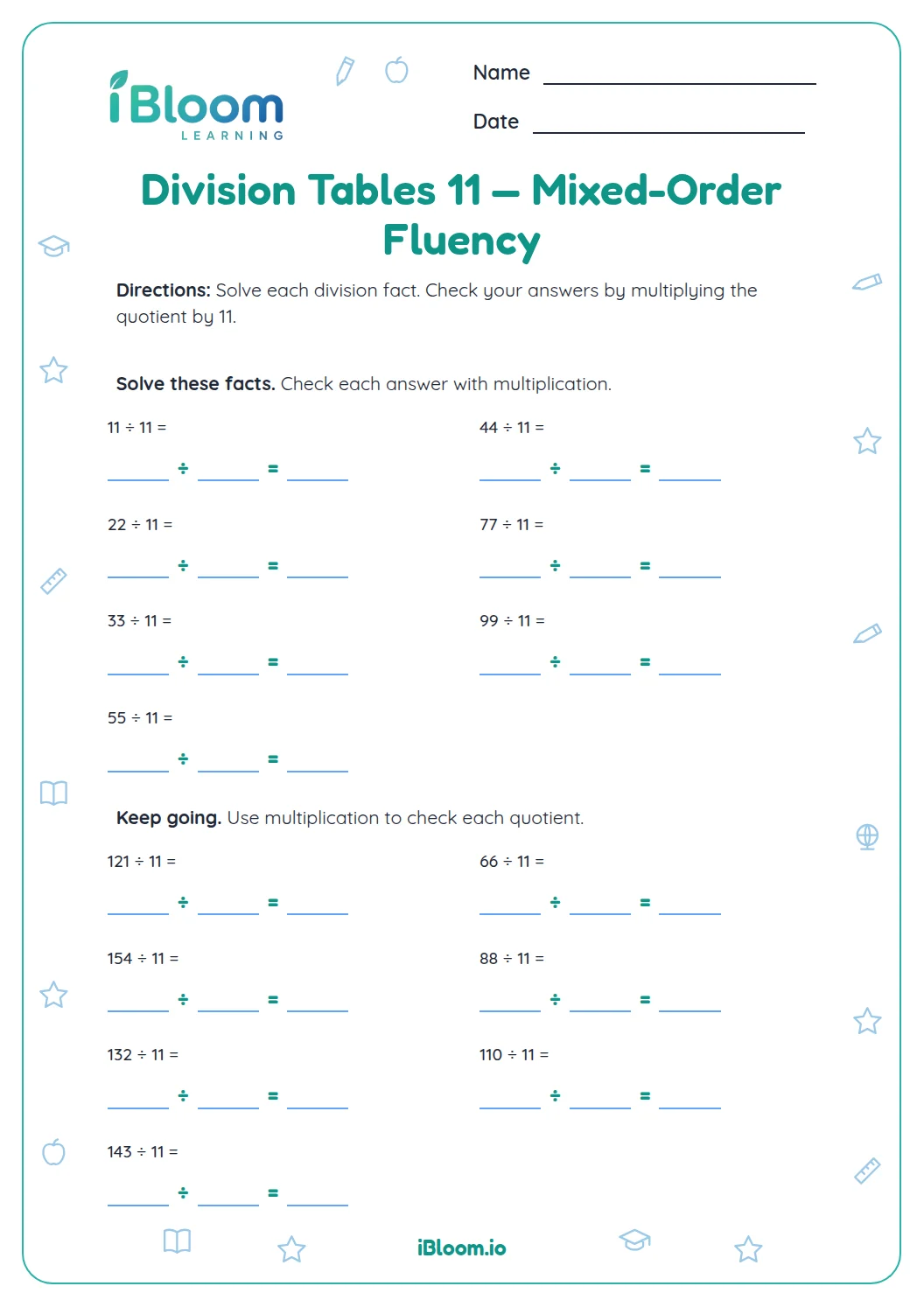
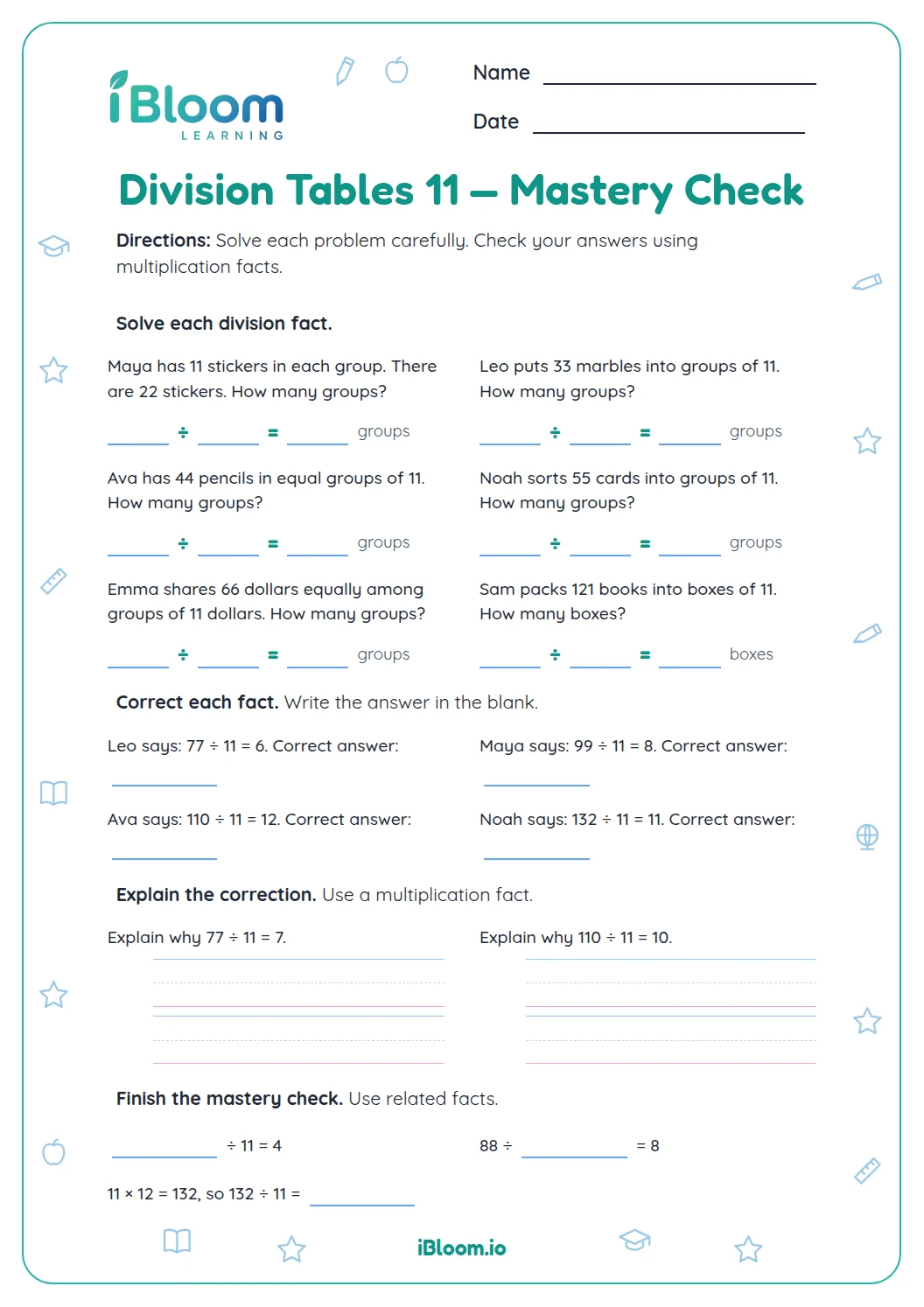
This Grade 3–4 printable practices division facts for 11. Nine untimed items build accuracy, followed by nine additional facts for optional timed practice. Children can use related multiplication facts to check each quotient, and a separate answer key lists the answers in order.
What pattern helps with division by 11?
The facts pair each multiple of 11 with its factor: 11 × 6 = 66, so 66 ÷ 11 = 6. Remembering the related multiplication fact is a quick way to check a quotient.
- 166 ÷ 11 asks how many groups of 11 make 66.
- 2Use 11 × 6 = 66.
- 3Answer: 6.
How should children use the two rounds?
The first nine facts offer untimed accuracy practice. The second nine are an optional timed round; a teacher or family member may choose whether to time it. Compare accuracy first and use the time only as personal information, not as a requirement.
How can the answer key support practice?
Check each quotient after finishing a group. For any missed fact, multiply the quotient shown by 11 and compare the product to the dividend before trying the fact again.
How to use this worksheet
- 1Complete the accuracy round without a timer.
- 2Connect each quotient to a multiplication fact.
- 3Check the quotient by multiplying by 11.
- 4Try the second round with a timer only if desired.
- 5Use mistakes to review the matching facts.
Common mistakes and quick fixes
The mistake
Confusing the divisor and quotient.
The fix
Check which number multiplied by 11 equals the dividend.
The mistake
Skipping a multiple when counting by 11.
The fix
Use the related multiplication fact to verify.
The mistake
Treating speed as more important than accuracy.
The fix
Finish carefully first; the second round timer is optional.
What to practice next
Make more practice
Further reading
Questions parents and teachers ask
How can a child solve division facts with 11?
Think of the related multiplication fact. For 88 ÷ 11, ask what number multiplied by 11 equals 88; since 11 × 8 = 88, the quotient is 8. Each answer on the sheet can be checked this way. For example, 88 ÷ 11 asks how many groups of 11 make 88, and the product check confirms the quotient.
Is the timed round required?
No. Timing is optional and can be skipped. The first nine questions give an untimed accuracy round, and the second nine can be completed with a timer only if the teacher or family chooses. The printed heading calls it an optional timed round, so a child can simply solve those nine facts without tracking seconds.
What is the pattern in the first round?
The dividends increase by 11, beginning at 11 and ending at 99. The quotients therefore increase from 1 through 9. This lets children notice how multiplication and division facts are related. The first round includes every quotient from 1 through 9 exactly once, paired with its multiple of 11.
What is different about the second round?
The optional round uses the next nine multiples of 11, from 110 to 198. Each still divides evenly by 11, with quotients from 10 through 18. For example, 154 ÷ 11 is 14 because 11 × 14 = 154; the fact is included in that second group.
How many questions are on the worksheet?
There are 18 division facts, divided into two groups of nine. The answer key prints separately and lists each quotient in question order. The untimed first round comes first, then the optional round follows on the next worksheet page. Each response is a single quotient.
What should a child do after a wrong answer?
Use multiplication to check the fact. Multiply the proposed quotient by 11 and see whether the product matches the dividend; if not, count by 11 or try a nearby quotient before checking the key. The first round and optional round each have nine questions, with their answer spaces and multiplication checks on the sheet.