

About this worksheet
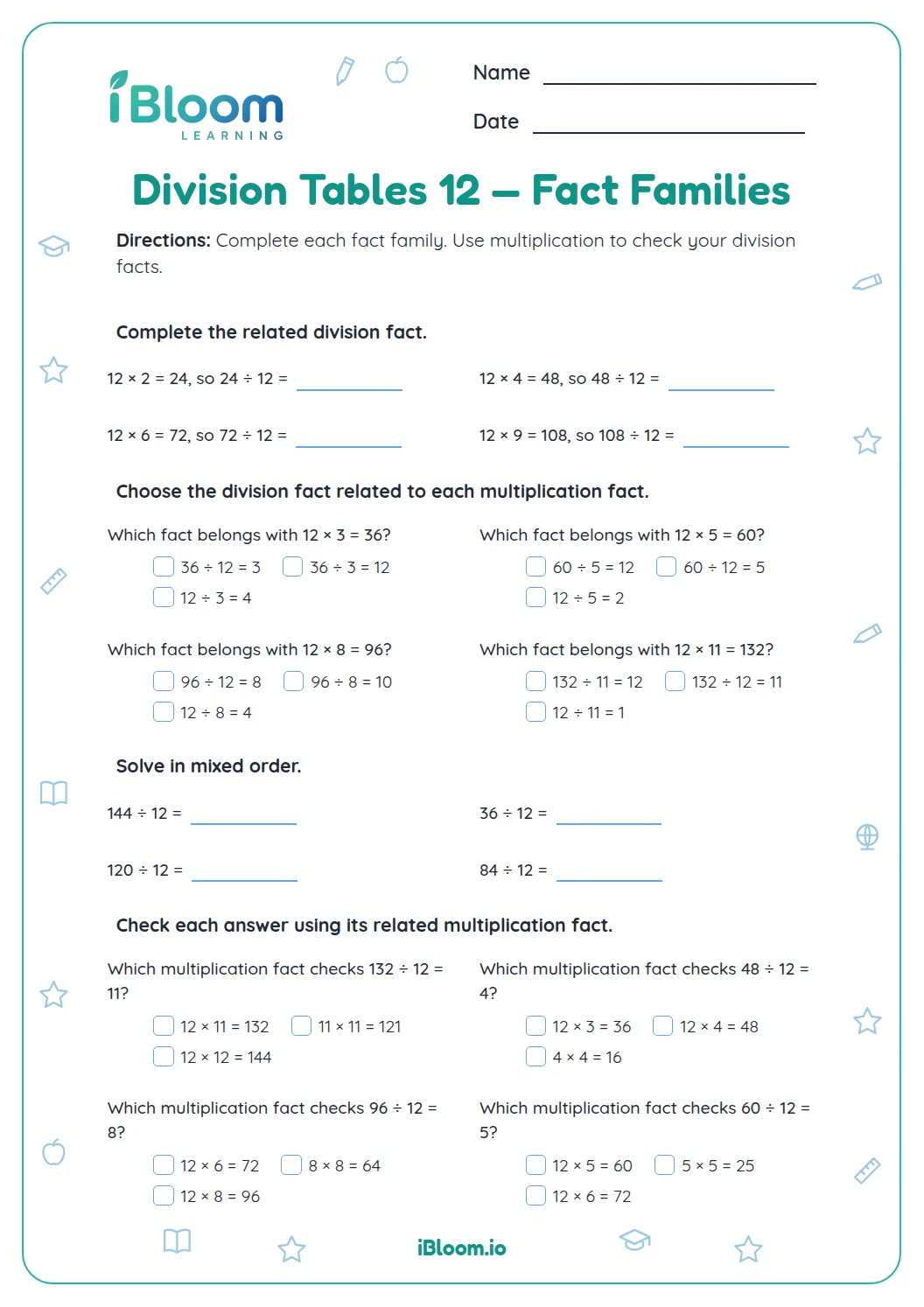
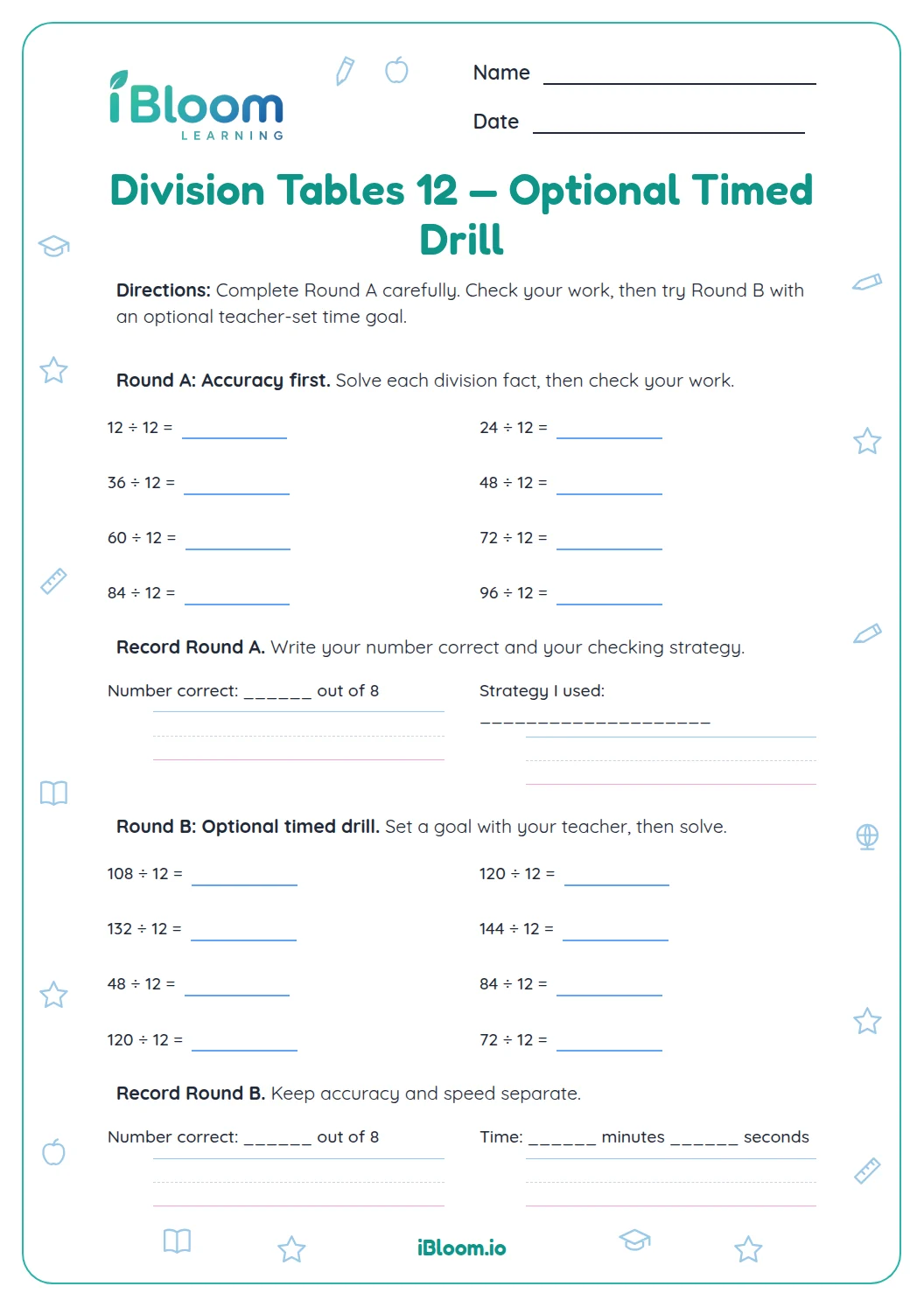
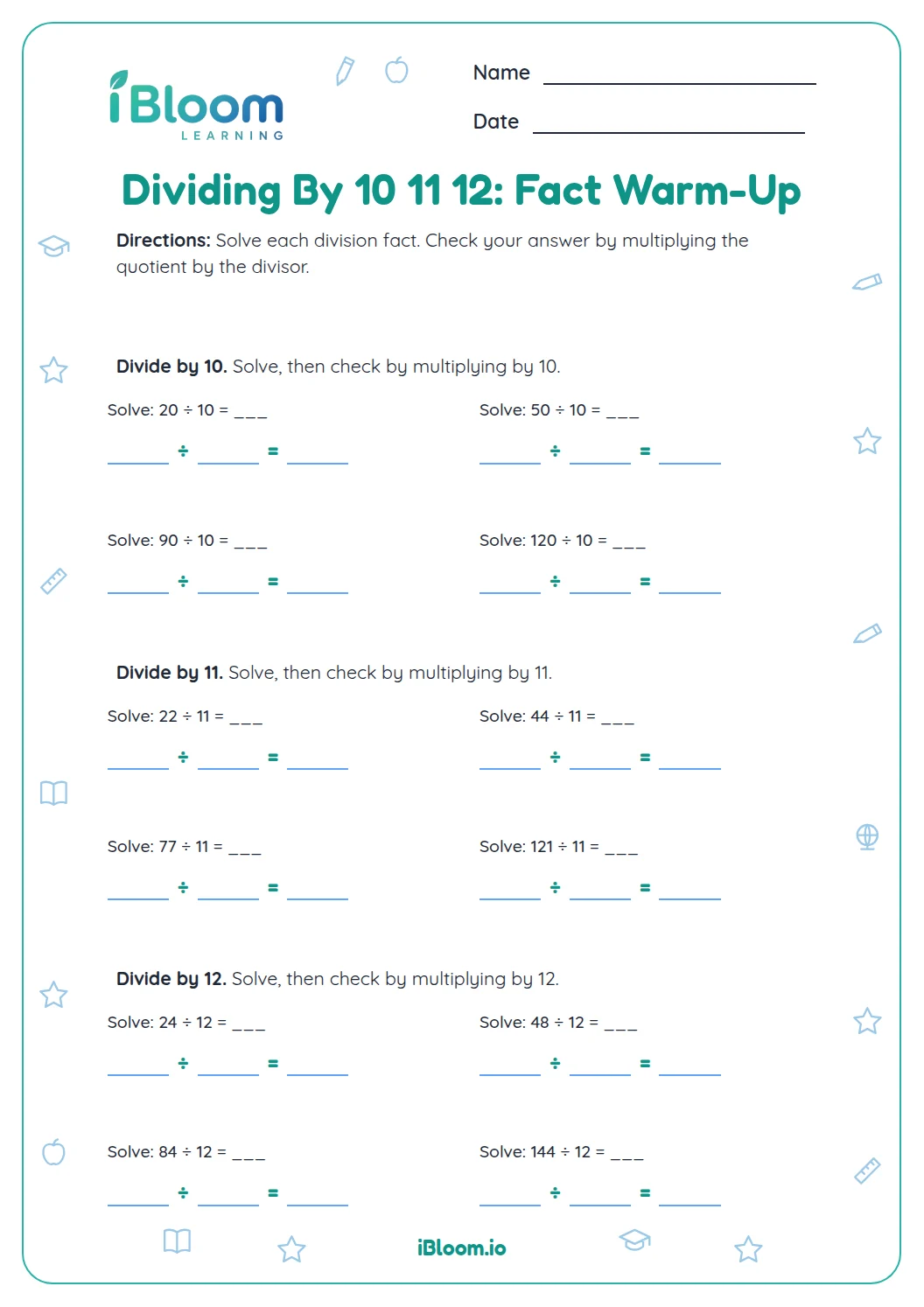
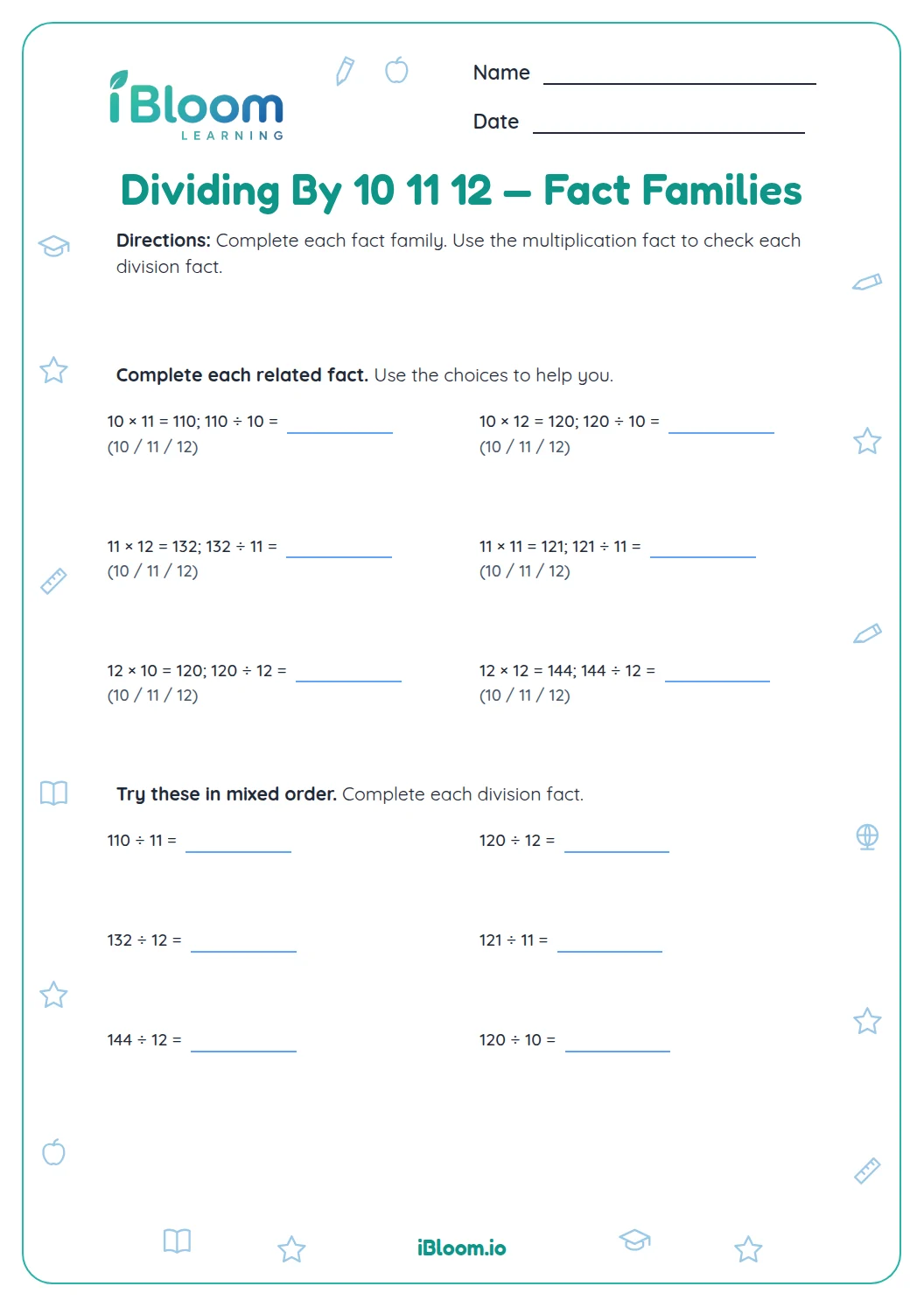
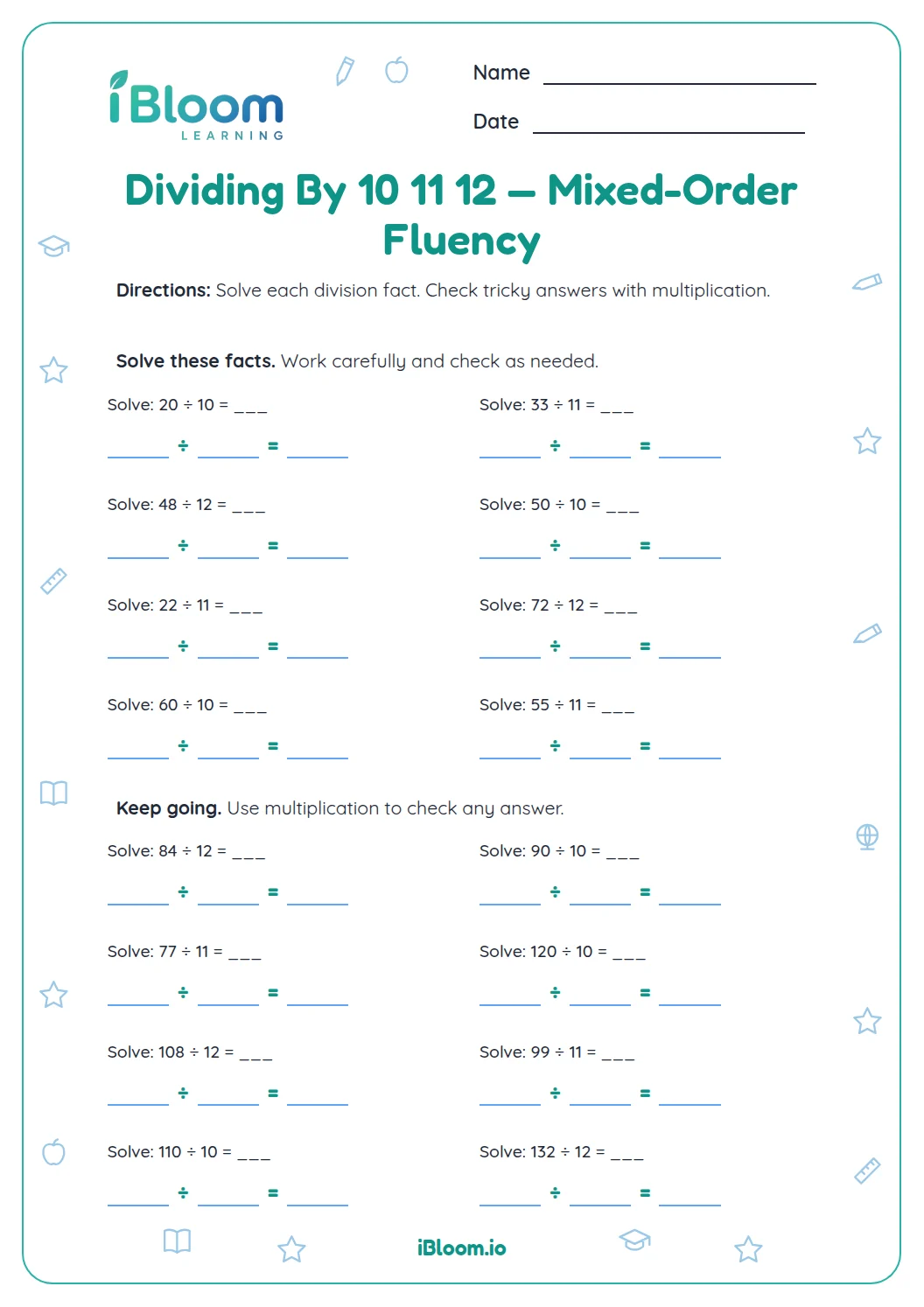
This division worksheet practices the 12s table through 16 missing-number facts. Children find a quotient, dividend, or divisor, then use multiplication to check the relationship between the numbers. The final items provide a multiplication fact to turn back into a division fact. A separate answer key gives each missing number; the worksheet keeps the original page’s focus on division by 12 and checking with multiplication. Finding a missing number in a division equation practices CCSS 3.OA.A.4.
Aligned to 3.OA.A.4
Which number is missing in each fact?
Questions 1–12 vary the blank’s position: children find quotients, dividends, and divisors. Look at the location of the blank before choosing a strategy.
How can multiplication check a quotient?
For question 1, 12 ÷ 12 = ___. Since 12 × 1 = 12, the missing quotient is 1. Multiply the divisor by the quotient to recover the dividend.
What if the divisor is missing?
Use the related multiplication fact. In 36 ÷ ___ = 3, ask what number multiplied by 3 gives 36. The missing divisor is 12.
How do the last questions use the inverse relationship?
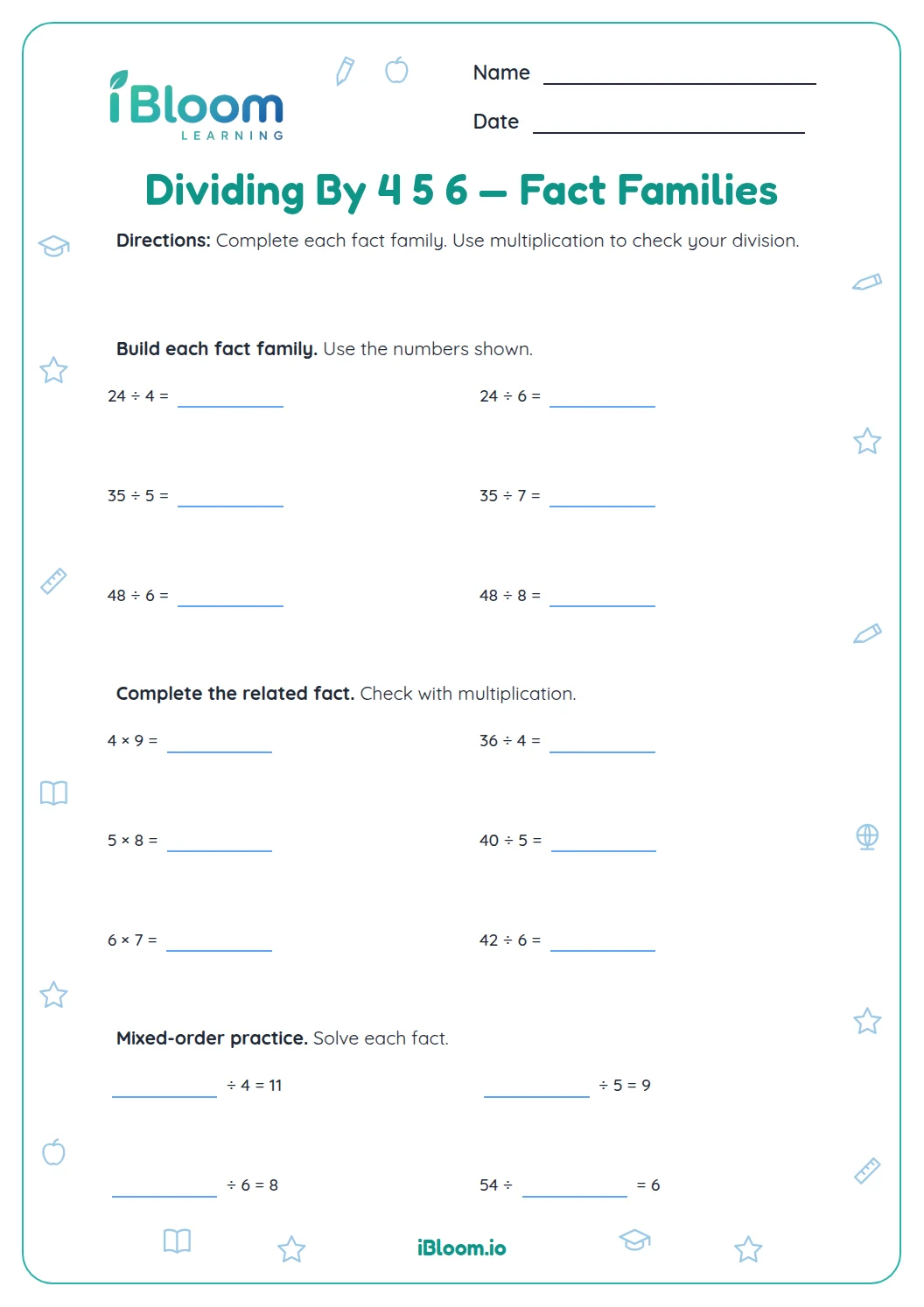
Questions 13–16 give a multiplication fact and ask for the related division answer. For example, 12 × 4 = 48 means 48 ÷ 12 = 4.
How to use this worksheet
- 1Locate the blank: quotient, dividend, or divisor.
- 2Recall the matching fact in the 12s table.
- 3Write the missing number to make a true equation.
- 4For a missing divisor, use the multiplication relationship.
- 5Check by multiplying divisor × quotient to get the dividend.
Common mistakes and quick fixes
The mistake
Treating every blank as the quotient.
The fix
Name the missing position before solving: dividend, divisor, or quotient.
The mistake
Using the quotient as the divisor.
The fix
Check the fact’s order: dividend ÷ divisor = quotient.
The mistake
Skipping the inverse check.
The fix
Multiply the divisor by the quotient and confirm the dividend.
Common Core alignment
Find a missing number in a division equation relating three whole numbers.
On this sheet: Blanks ask for the quotient, dividend, or divisor in division equations.
Show the official wordingHide the official wording
Determine the unknown whole number in a multiplication or division equation relating three whole numbers. For example, determine the unknown number that makes the equation true in each of the equations 8 × ? = 48, 5 = _ ÷ 3, 6 × 6 = ?
What to practice next
Make more practice
Further reading
Questions parents and teachers ask
What numbers does this division worksheet practice?
These 16 facts use the 12s table, with dividends from 12 through 144. Blanks appear in the quotient, dividend, or divisor position. The final four questions connect a multiplication fact to its related division fact. The problems keep the divisor and quotient relationships within the 12s fact family.
How do I find a missing dividend?
Use the divisor and quotient to build the matching multiplication fact. For ___ ÷ 12 = 2, calculate 2 × 12, which equals 24. The missing dividend is 24 because 24 divided by 12 equals 2. This also confirms that 12 × 2 returns the dividend shown by the completed fact.
How do I check a division answer?
Multiply the divisor by the quotient. The product should equal the dividend. For example, if 84 ÷ 12 = 7, check 12 × 7 = 84. This inverse relationship works for the quotient, dividend, and divisor questions on the sheet.
What is a quotient?
A quotient is the answer to a division problem. In 48 ÷ 12 = 4, the quotient is 4. On this worksheet, some blanks ask for the quotient, while others ask for the dividend or divisor, so check the blank’s position.
How long does this page take?
Most learners can complete the 16 facts in about 10 to 15 minutes. The time depends on how quickly the 12s facts come to mind and whether each one is checked with multiplication. Use the separate key after the work is complete.