



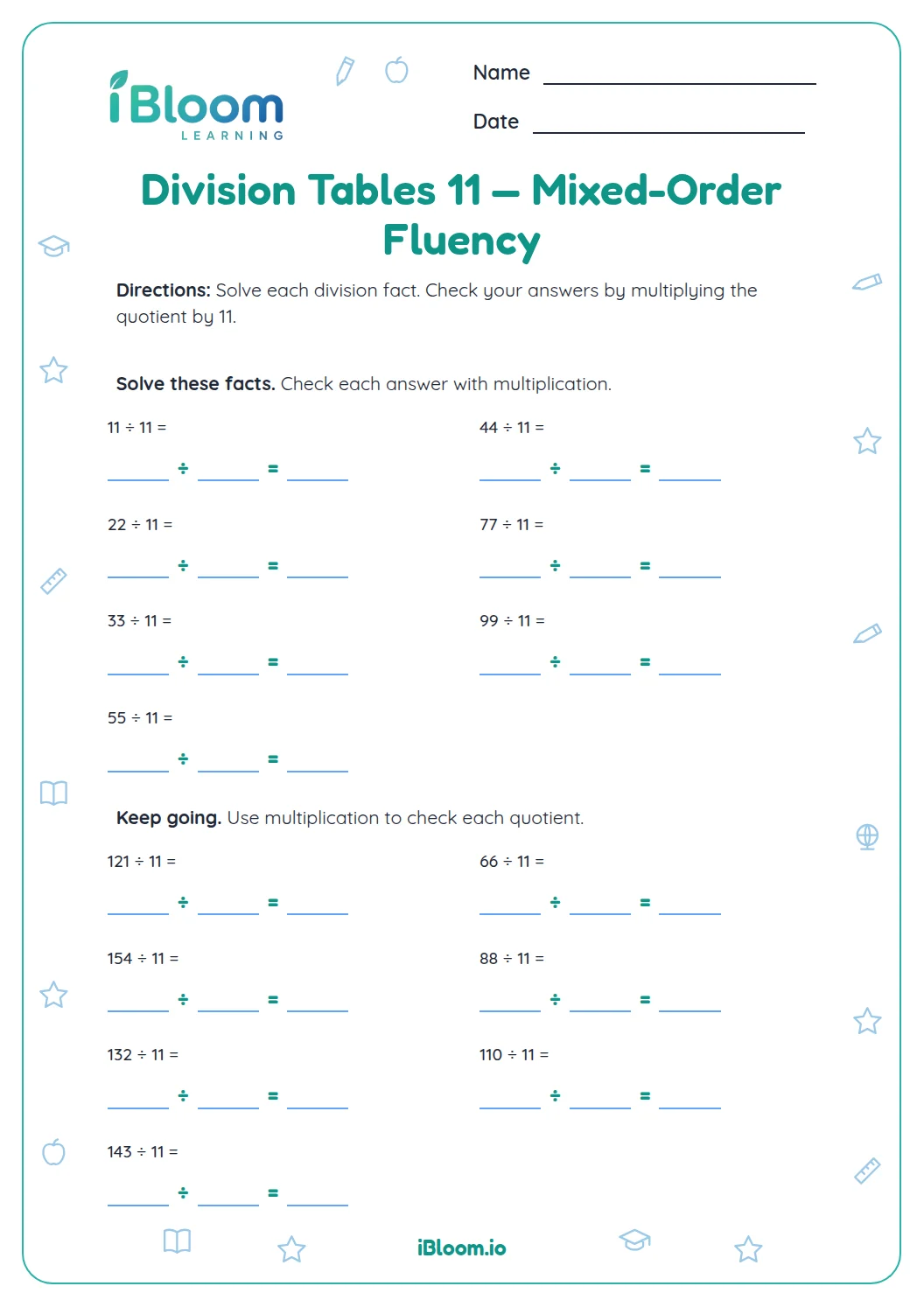
About this worksheet
This printable division worksheet gives Grade 3–4 learners 20 focused questions on the 12s facts. It starts with direct quotients, asks learners to find missing factors and divisors, then extends the same fact relationship to larger dividends. Each answer can be checked by multiplying the quotient by 12. The questions appear in four parts, with a separate answer key.
Aligned to 3.OA.A.4
How does multiplication check division?
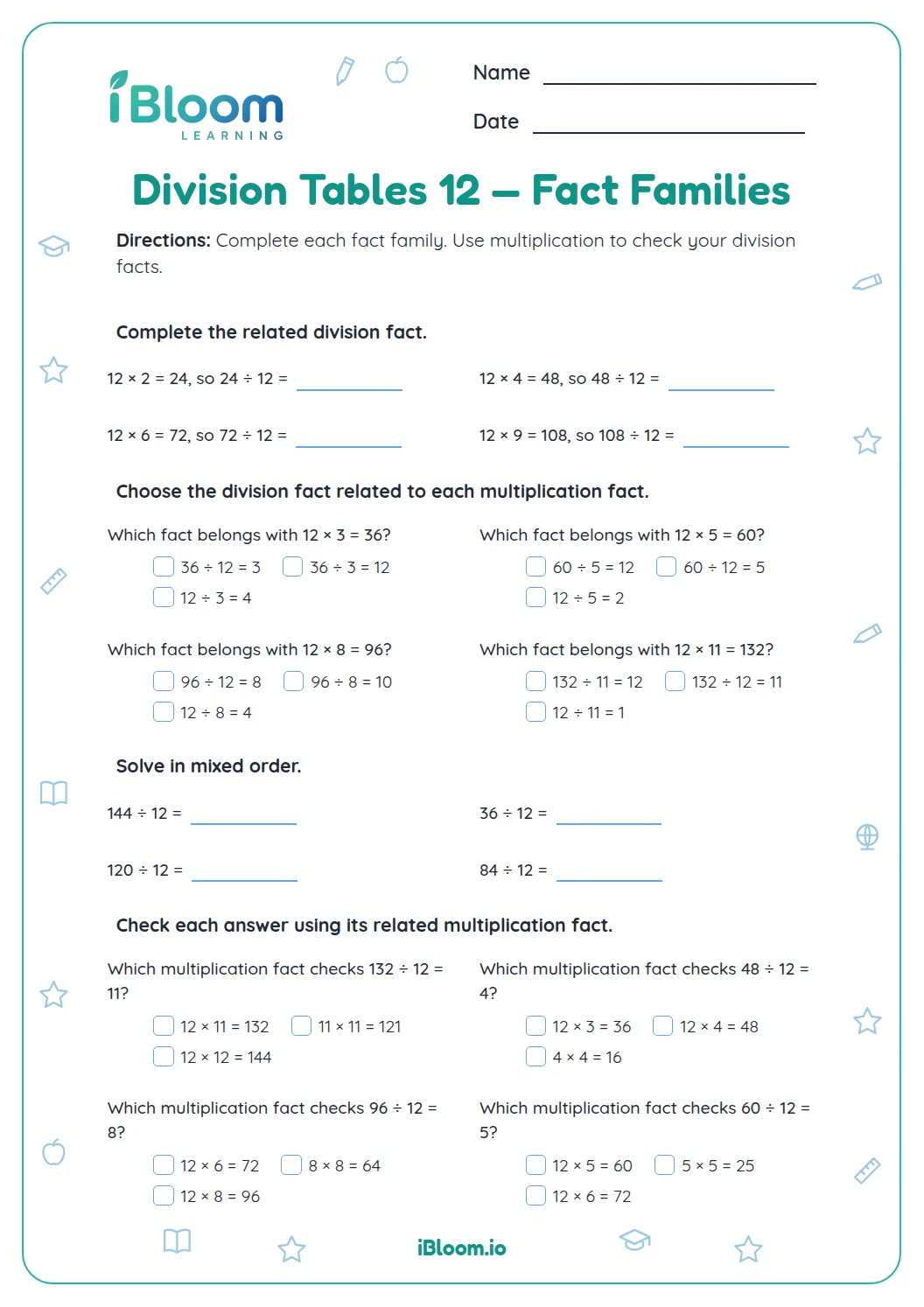
Division and multiplication reverse each other. When 96 ÷ 12 = 8, multiplying 8 × 12 returns 96.
- 196 ÷ 12 = 8
- 2Check: 8 × 12 = 96
- 3The check returns the starting dividend.
How do the four parts build the 12s facts?
Part A practices the first six quotients. Part B completes the quotients through 180 ÷ 12. Part C changes which number is missing. Part D extends the facts to larger dividends and one missing factor.
How can I use the answer key?
Ask the learner to say the related multiplication fact before checking. If an answer differs, circle the dividend and quotient and rebuild the equation with 12 groups.
How to use this worksheet
- 1Read the whole equation before choosing the missing value.
- 2For a quotient, ask how many groups of 12 make the dividend.
- 3For a missing divisor, use the known quotient and dividend to identify 12.
- 4Check each result with multiplication.
Mistakes to watch for
The mistake
Using 12 as the quotient in every problem.
The fix
Multiply the proposed quotient by 12 to check the dividend.
The mistake
Confusing the missing factor with the product.
The fix
In 12 × ___ = 36, the blank is 3 because 12 × 3 is 36.
The mistake
Changing a missing divisor to 12 without checking.
The fix
Use the complete equation: 156 ÷ 12 = 13.
Common Core alignment
The questions practice finding unknown whole numbers in multiplication and division equations.
Find the unknown number in a multiplication or division equation.
On this sheet: The missing-number facts ask learners to determine an unknown factor, divisor, dividend, or quotient.
Show the official wordingHide the official wording
Determine the unknown whole number in a multiplication or division equation relating three whole numbers. For example, determine the unknown number that makes the equation true in each of the equations 8 × ? = 48, 5 = _ ÷ 3, 6 × 6 = ?
What to practice next
Make more practice
Further reading
Questions parents and teachers ask
How many facts are on the sheet?
There are 20 questions in four parts: 16 quotient problems and 4 equations with a missing number. A separate answer key lists the answers in question order. Most quotients use the 12s table, and the last part extends it to larger dividends.
How do I solve 132 ÷ 12?
Use the related multiplication fact: 12 × 11 = 132, so 132 ÷ 12 = 11. The quotient is the number of groups of 12 in 132. Multiplying 11 by 12 is a quick way to check the result.
Why does the sheet include multiplication equations?
A multiplication equation practices the same fact family as division. For 12 × ___ = 36, think of 36 ÷ 12; the missing factor is 3. Rewriting a division fact as multiplication helps check that the numbers belong together.
What if a learner forgets a fact?
Skip-count by 12 or use a known nearby fact, then multiply the proposed quotient by 12. For example, 12 × 10 is 120, so one more group makes 132. The key can show which facts need another practice round.
Is timing required?
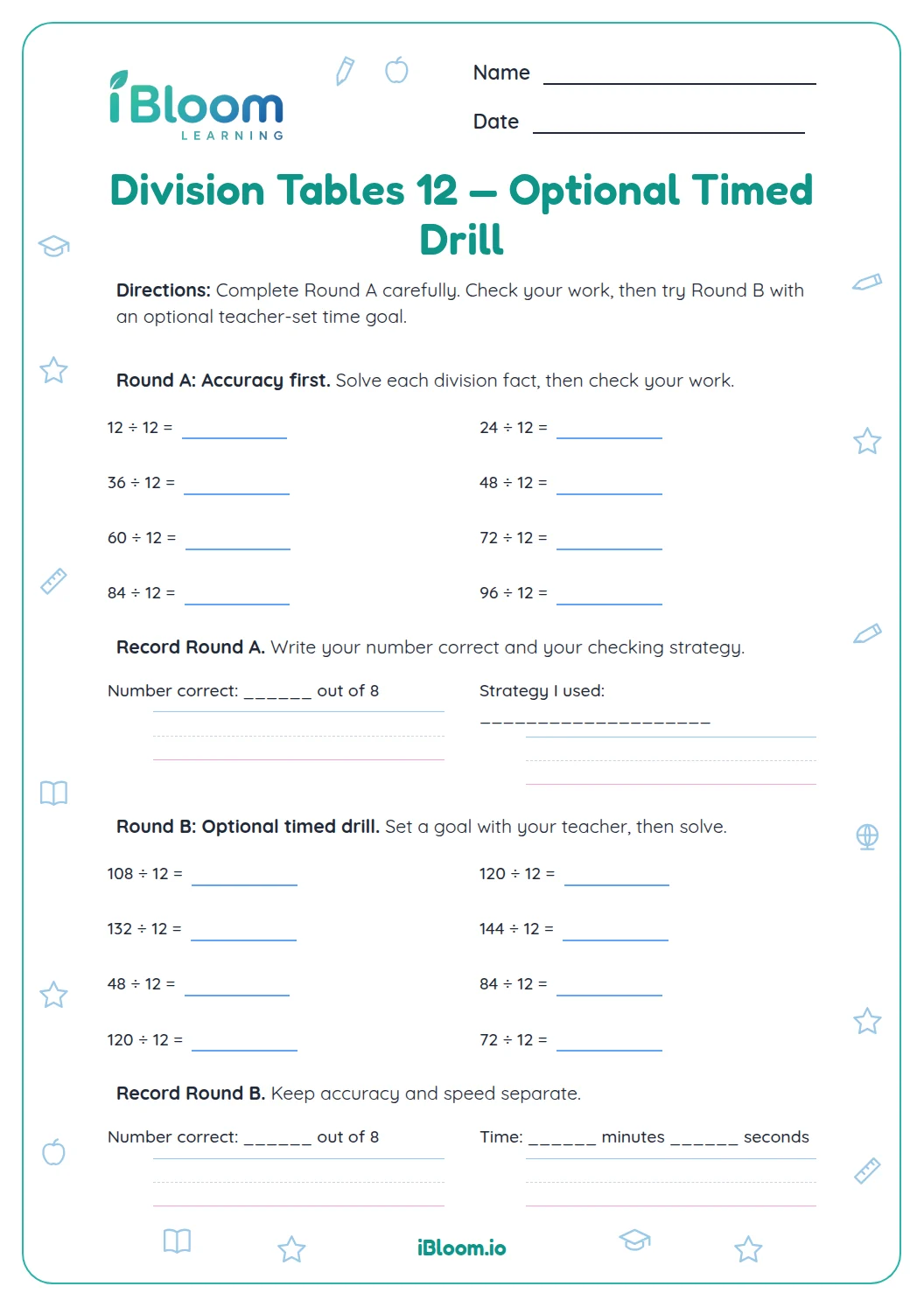
No. Learners can work at a comfortable pace and focus on accurate facts. A parent or teacher may record a time if they want to compare later practice, but the worksheet does not ask children to race or meet a time goal.
What does the answer key include?
The separate answer key gives all 20 quotients and missing values in question order. After checking, ask the learner to pick one missed answer and write its related multiplication fact, such as 12 × 8 = 96. This makes the inverse relationship concrete.