




About this worksheet
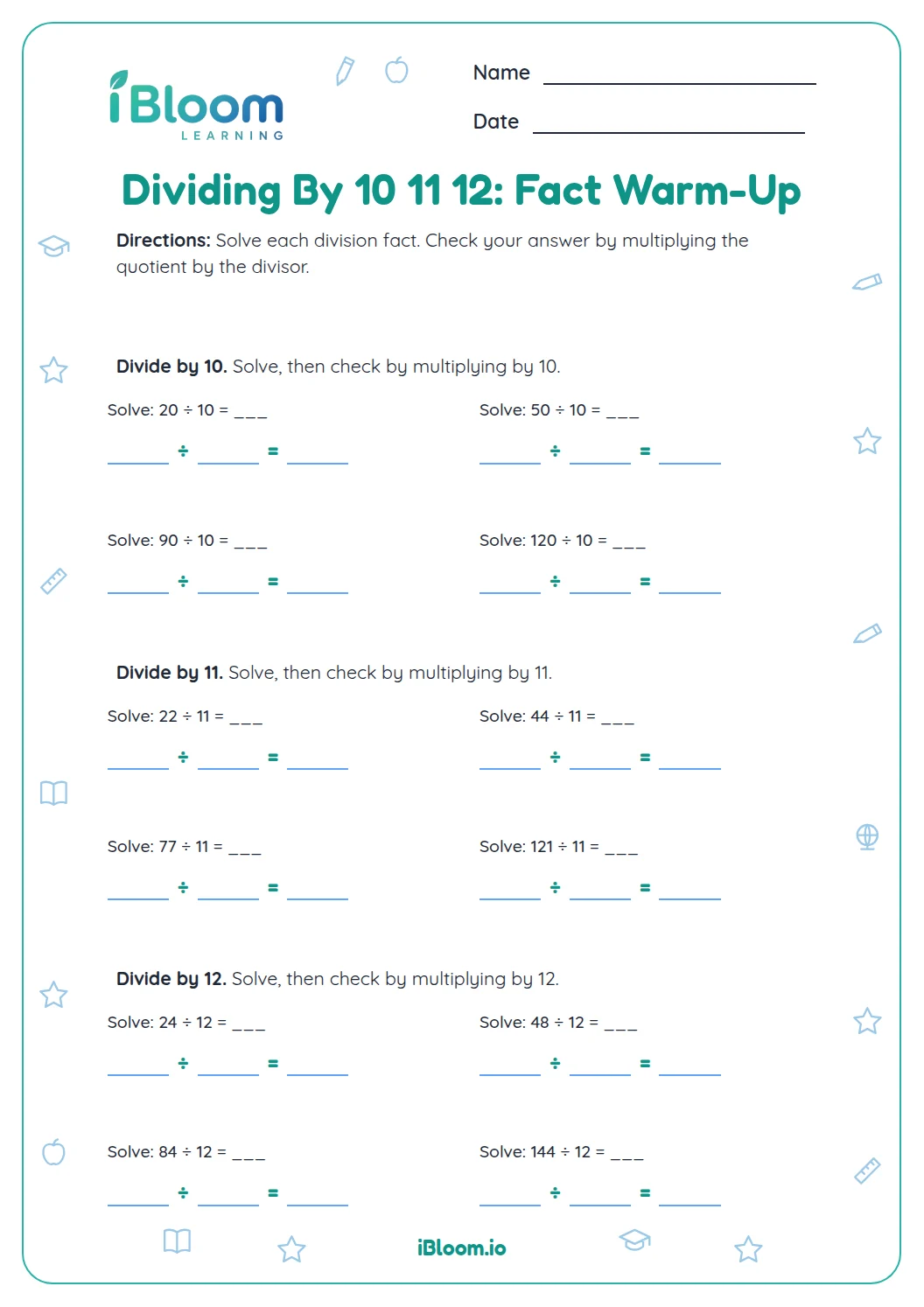
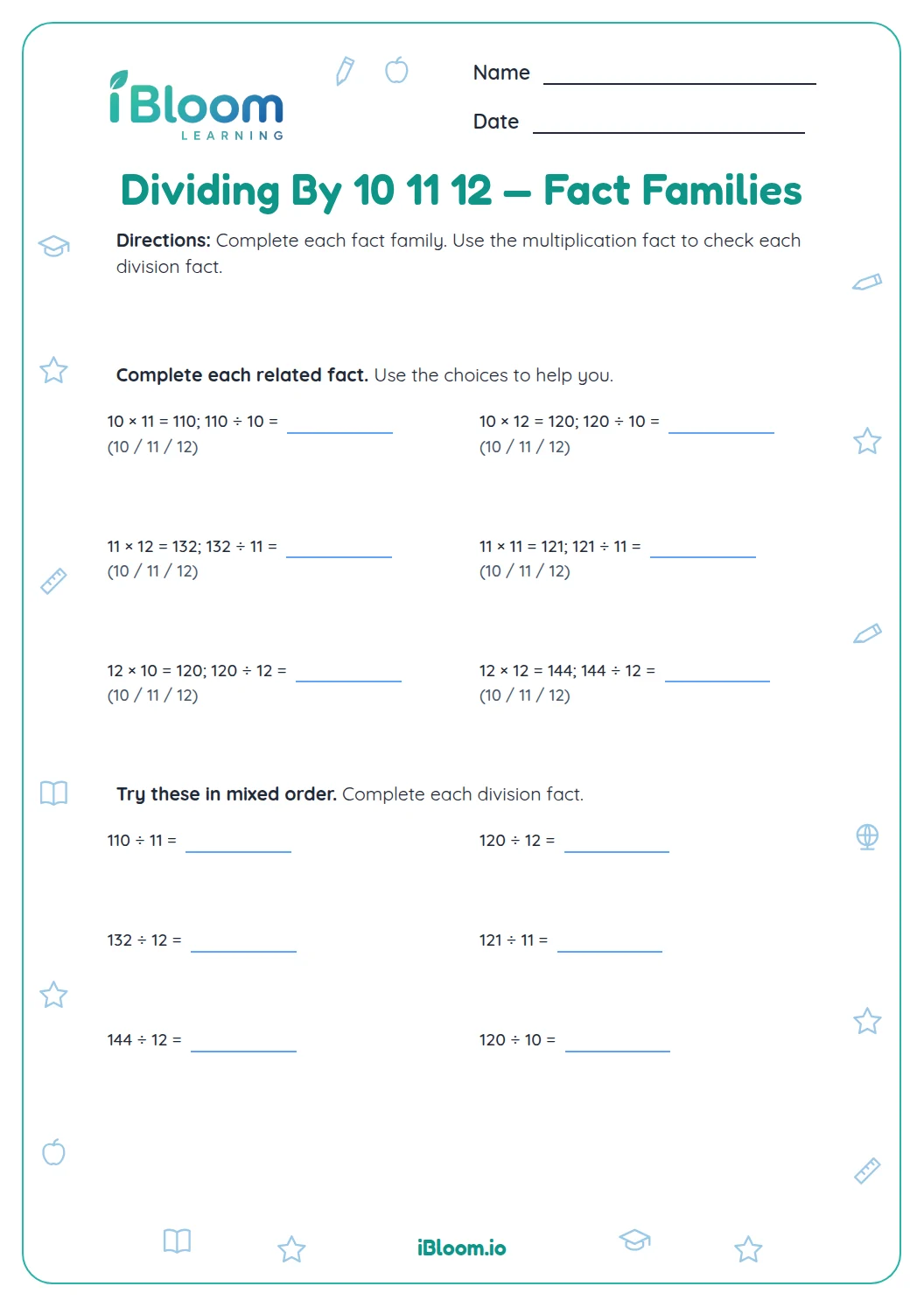
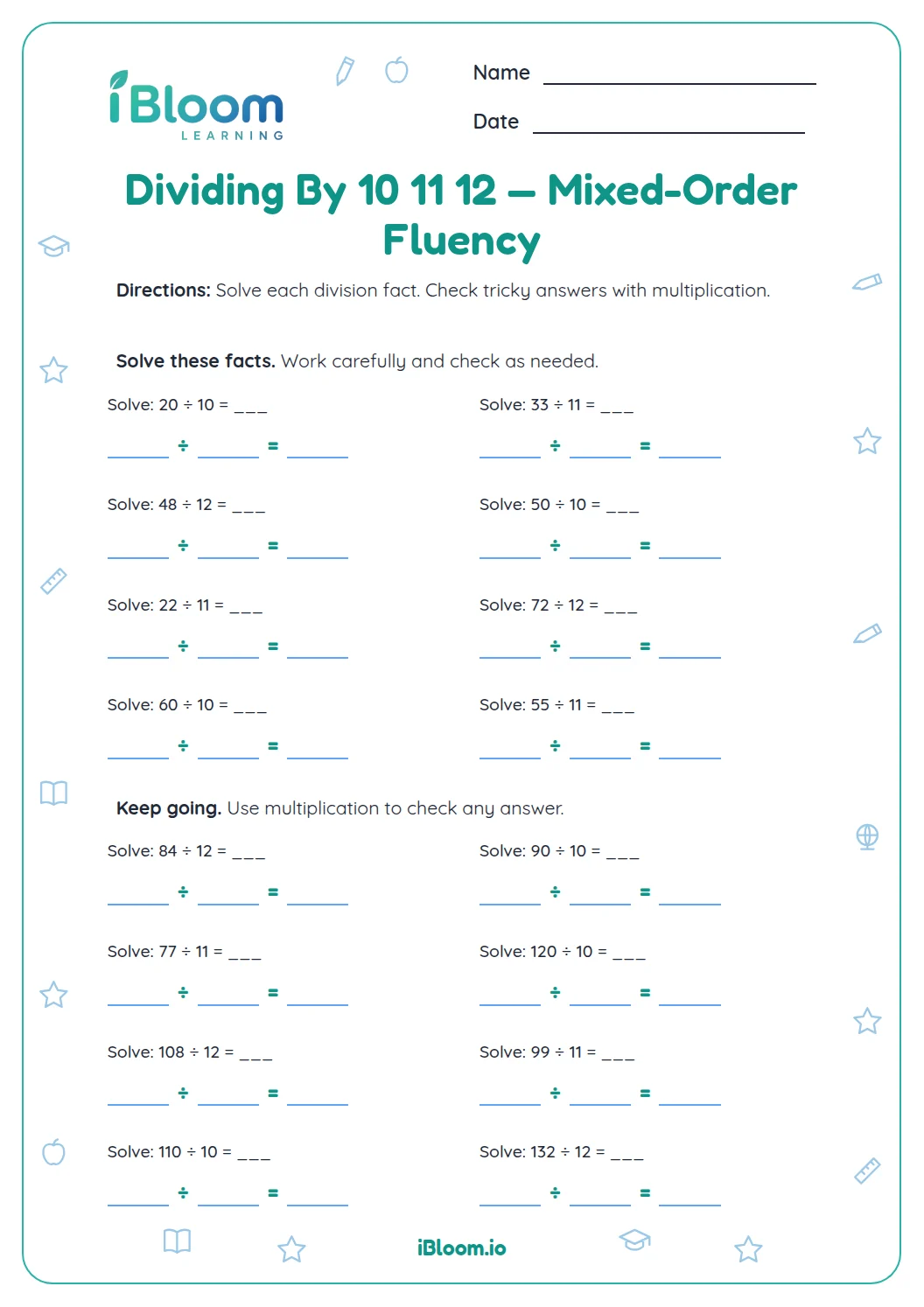
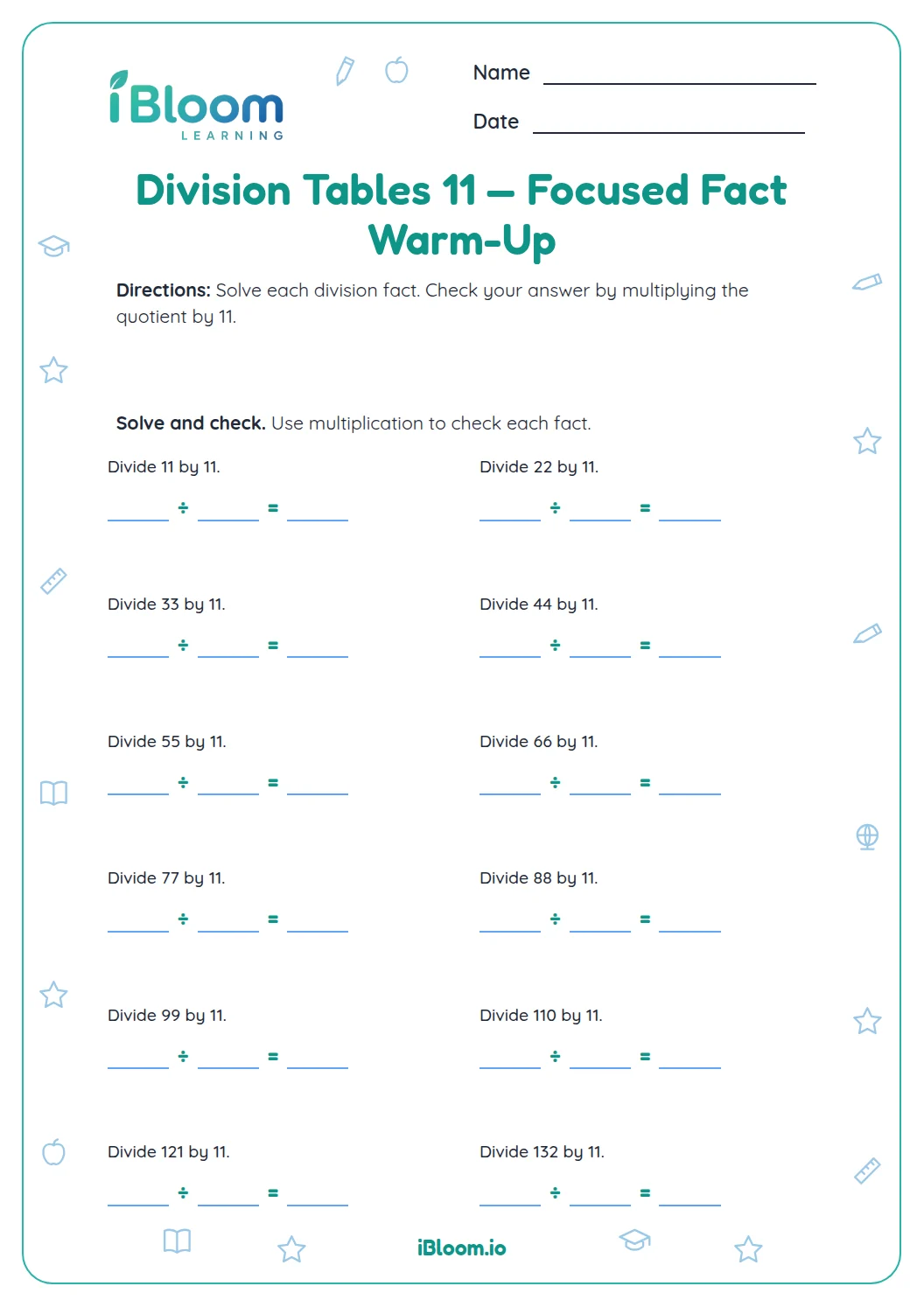
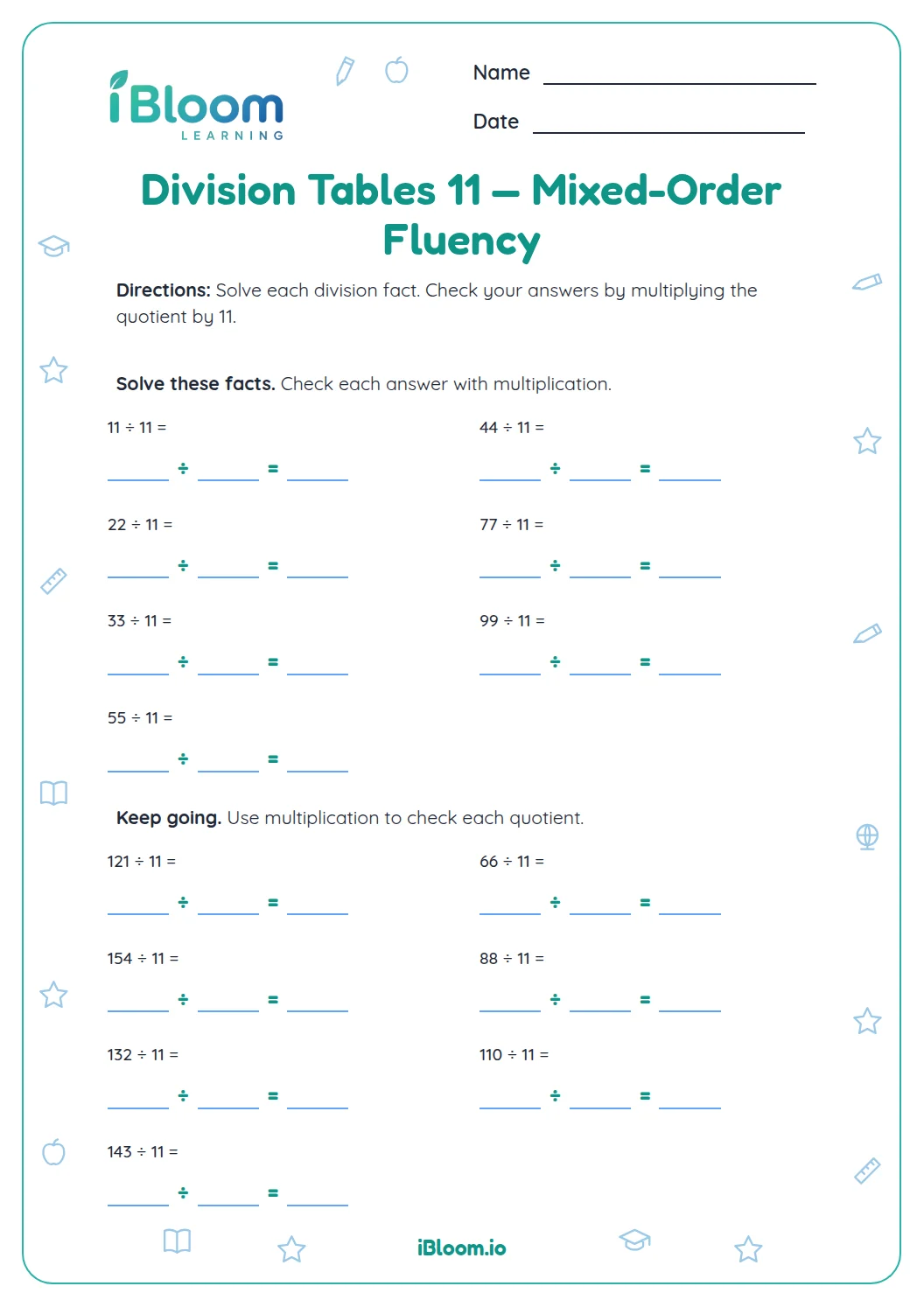
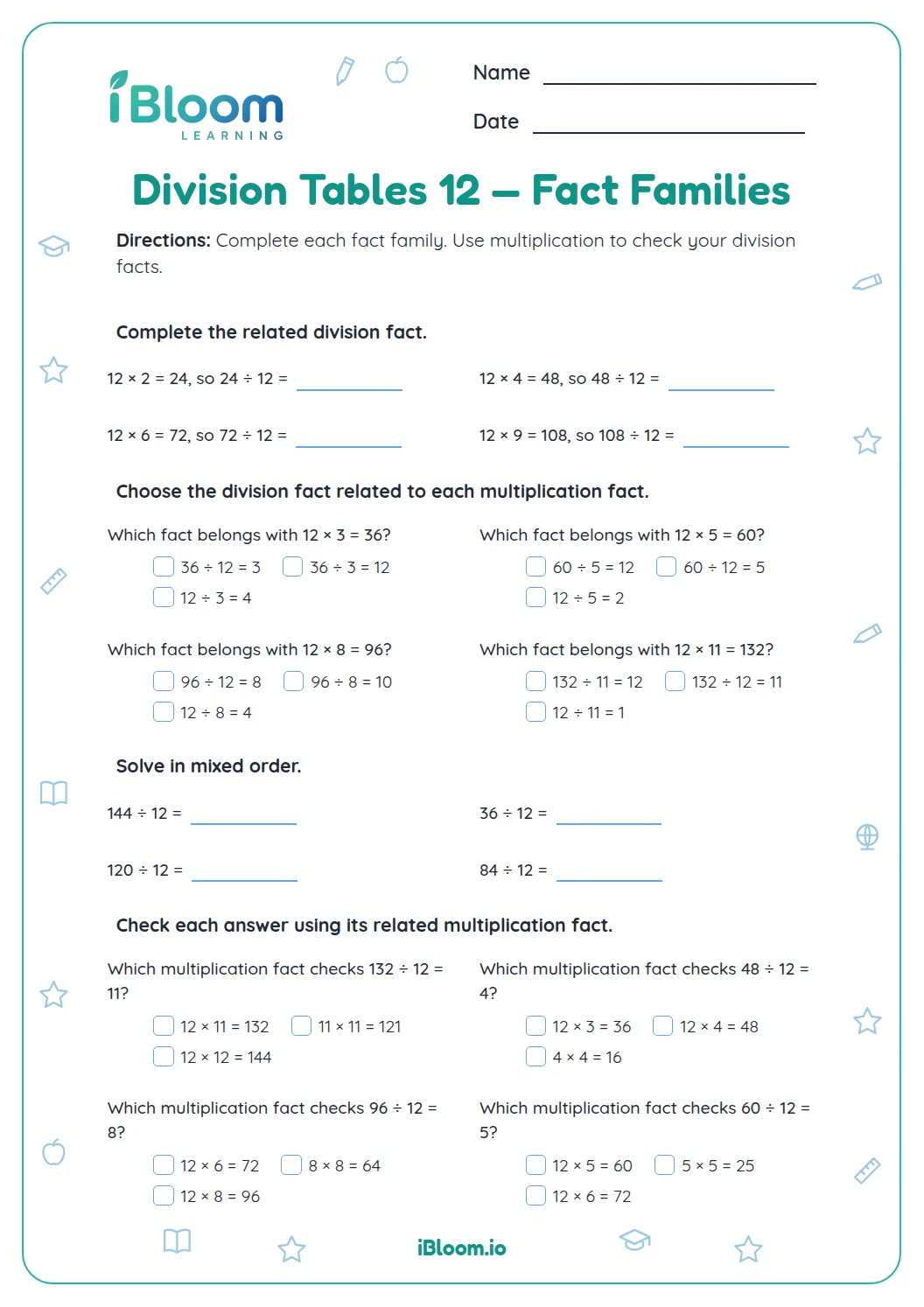
This Grade 3 worksheet gives 18 mixed-order division facts for divisors 10, 11, and 12. Students complete an accuracy round, then may use a timer for the second round. They can check each quotient by multiplying it by the divisor.
Aligned to 3.OA.C.7
How do you find a quotient?
A quotient is the answer to a division equation. Think of the related multiplication fact to find which number makes the dividend.
- 184 ÷ 12 = 7
- 212 × 7 = 84
How can multiplication check division?
Multiply the quotient by the divisor. If the product matches the dividend, the division fact is correct.
- 196 ÷ 12 = 8
- 2Check: 8 × 12 = 96
How should students use the two rounds?
Round 1 is for accuracy and careful checking. Round 2 repeats mixed facts for optional timed practice. The timer can be skipped while students focus on correct quotients.
- 1Round 1: 20 ÷ 10 = 2
- 2Round 2: 120 ÷ 10 = 12
A way to work through the sheet
- 1Read the dividend and divisor before finding a quotient.
- 2Ask which number multiplied by the divisor equals the dividend.
- 3Write one quotient for each equation.
- 4Check each answer by multiplying quotient × divisor.
- 5Use a timer only if it helps; accuracy is the goal.
Check for these slips
The mistake
Dividing by the quotient instead of the divisor
The fix
Identify the two numbers before solving.
The mistake
Guessing from the previous item
The fix
Read each new equation because the facts change order.
The mistake
Accepting a quotient without checking
The fix
Multiply it by the divisor and compare products.
Curriculum alignment
This worksheet gives focused practice with the named skill.
Fluently multiply and divide within 100 using known facts.
On this sheet: The 18 items practice division facts within 100 and multiplication checks.
Show the official wordingHide the official wording
Fluently multiply and divide within 100, using strategies such as the relationship between multiplication and division (e.g., knowing that 8 × 5 = 40, one knows 40 ÷ 5 = 8) or properties of operations. By the end of Grade 3, know from memory all products of two one-digit numbers.
What to practice next
Make more practice
Further reading
Questions parents and teachers ask
How can a student check a division fact?
Multiply the quotient by the divisor. For example, 84 ÷ 12 = 7 is correct because 7 × 12 = 84. If the product does not match the dividend, reread the equation and check which number is being divided and which number is the divisor.
Is the timer required?
No. Timing is optional on this worksheet. Students can solve all 18 facts at a steady pace, then check their answers with multiplication. A teacher or family member can add a time goal later, once the student is comfortable solving the facts accurately.
Why are the facts in mixed order?
Mixed order prompts students to read each dividend and divisor instead of filling answers from a repeated sequence. The page includes facts for 10, 11, and 12, with quotients ranging from 2 to 12. Each item can be checked through its related multiplication fact.
What should a student do when a fact is hard?
Skip it temporarily, solve another fact, and return with a fresh look. A related multiplication question can help: ask what number times the divisor equals the dividend. The separate answer key lets students check their work after attempting the full set.
Which facts are on the page?
The worksheet has 18 division equations using divisors 10, 11, and 12. It includes six facts for each divisor, with the order mixed across two parts. Every dividend is a multiple of its divisor, so each question has a whole-number quotient.