




About this worksheet
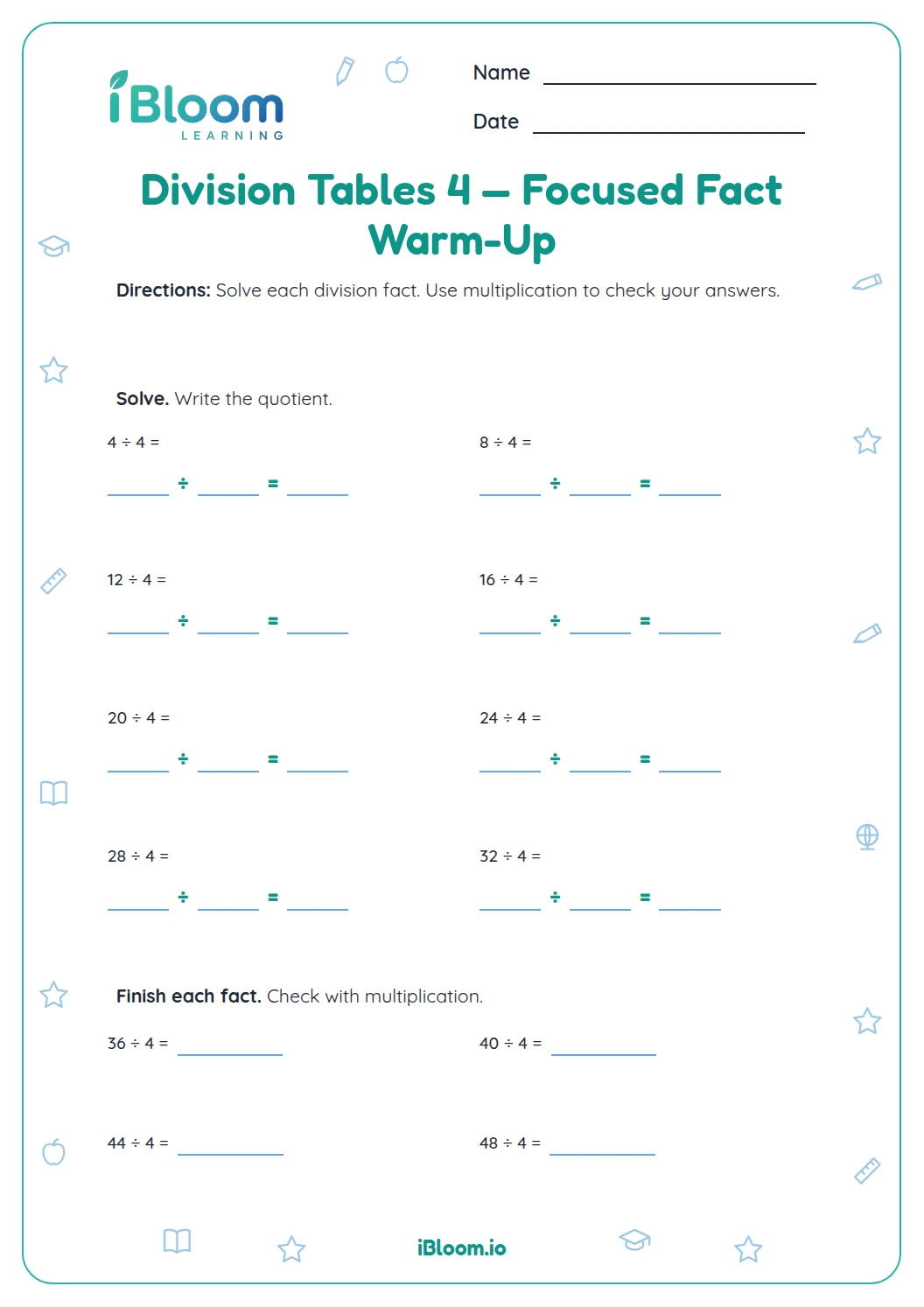
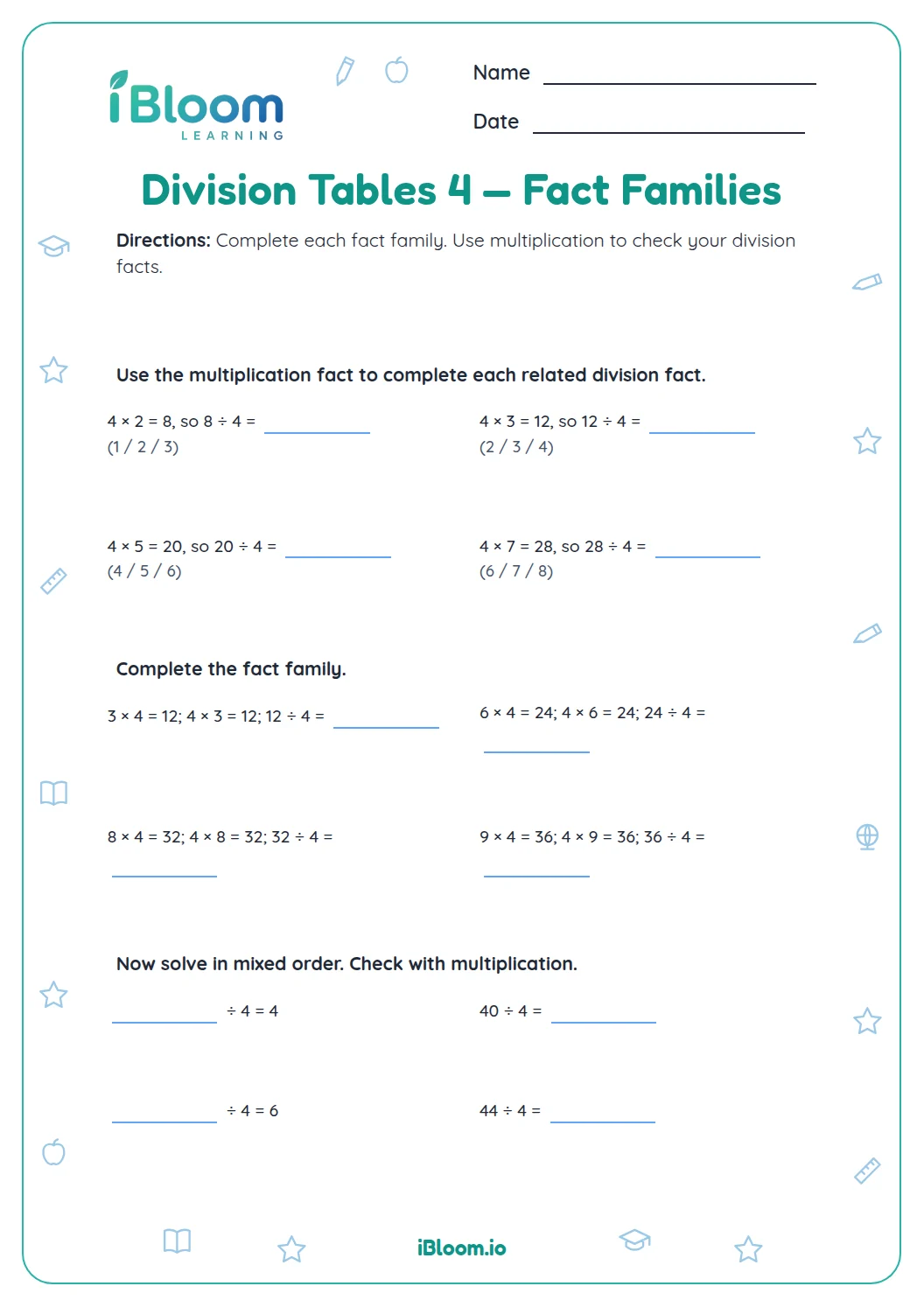
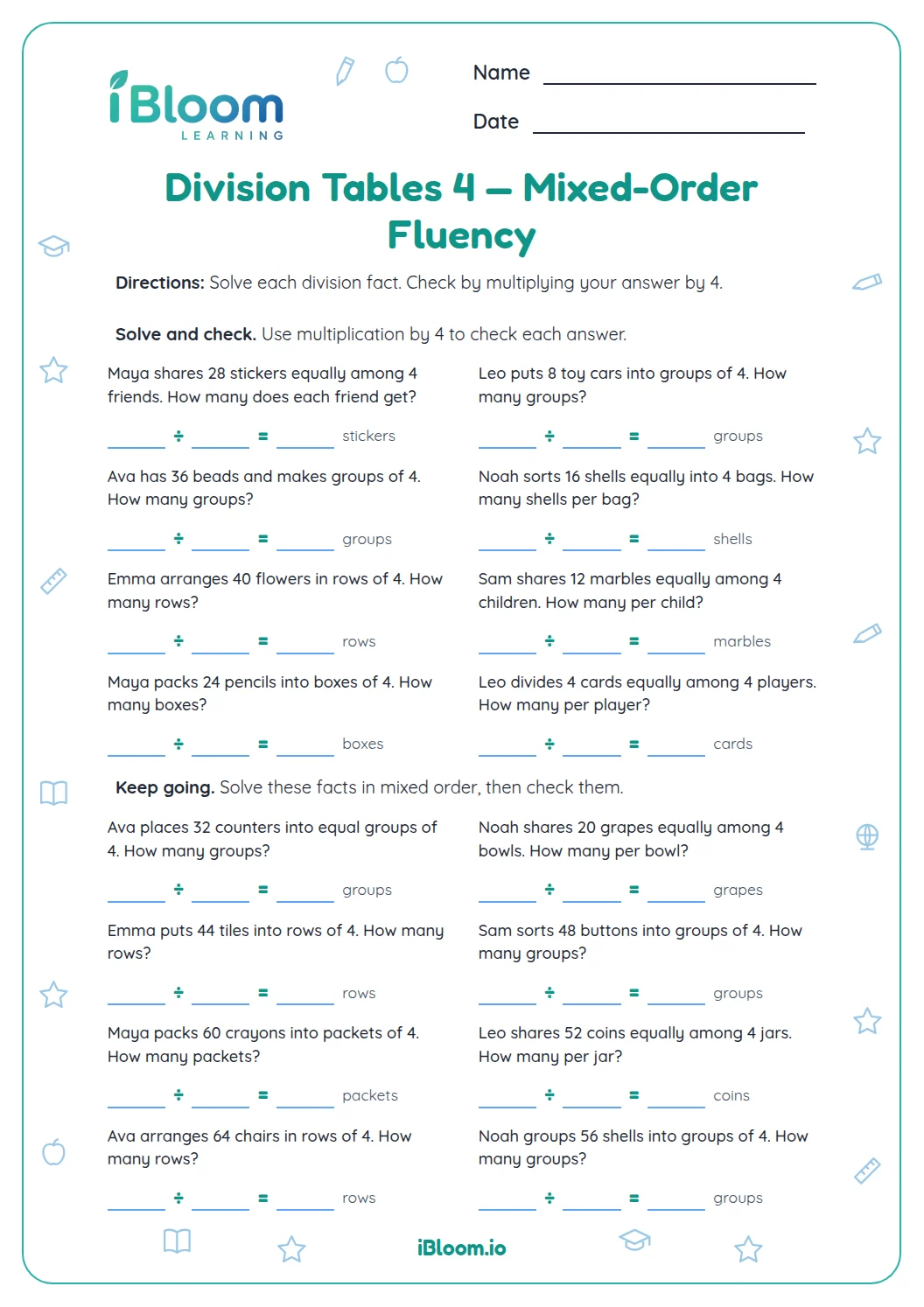
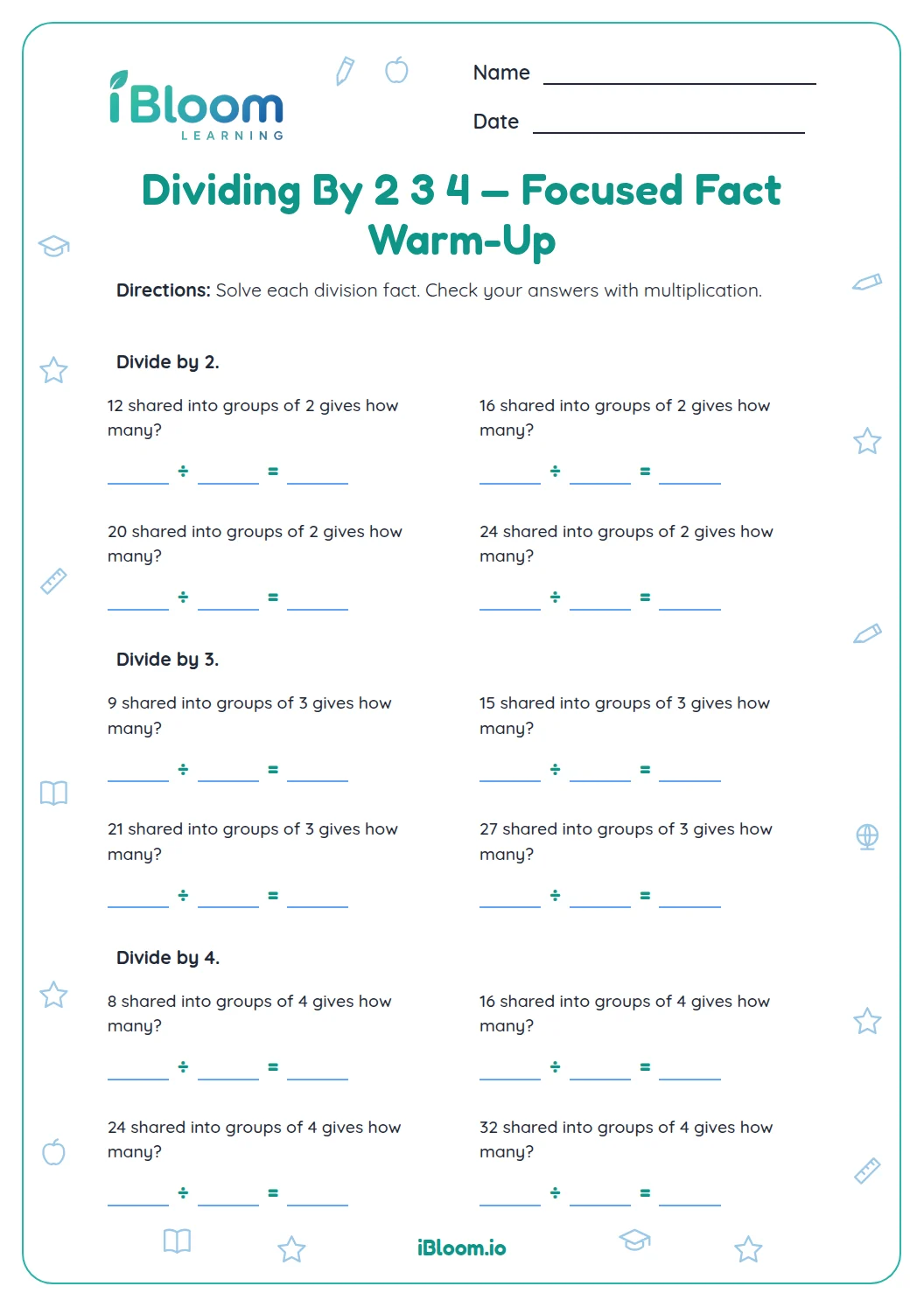
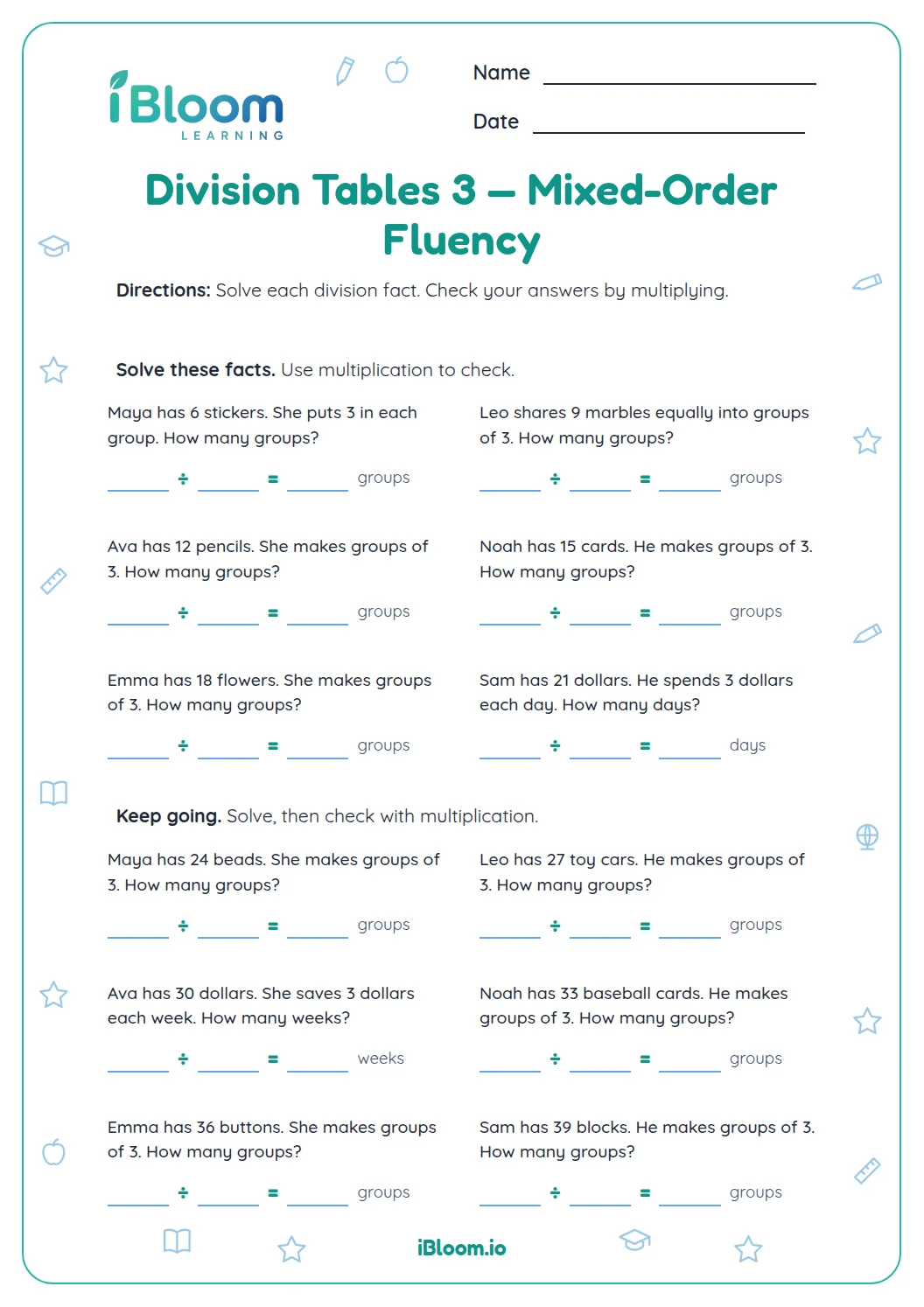
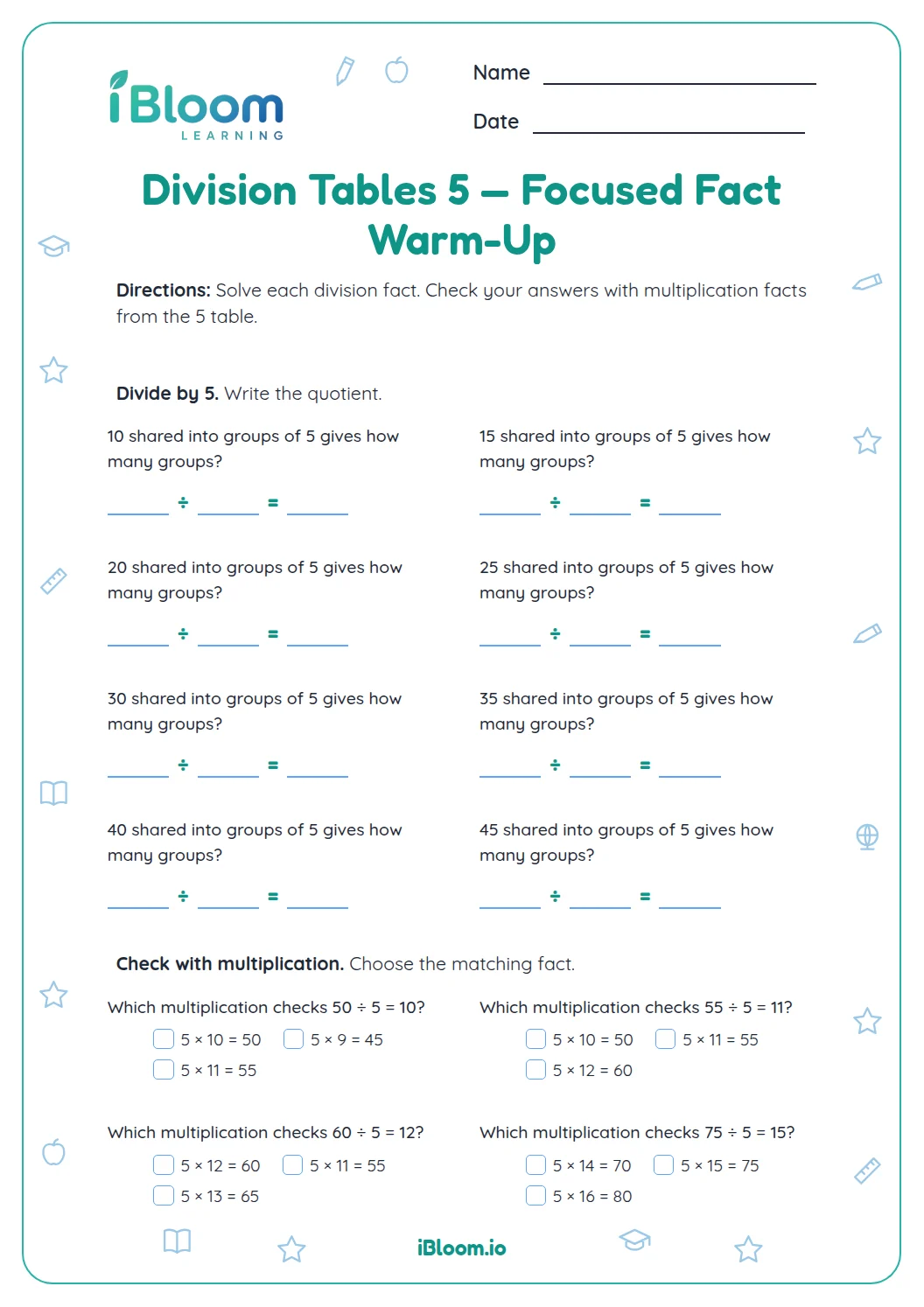
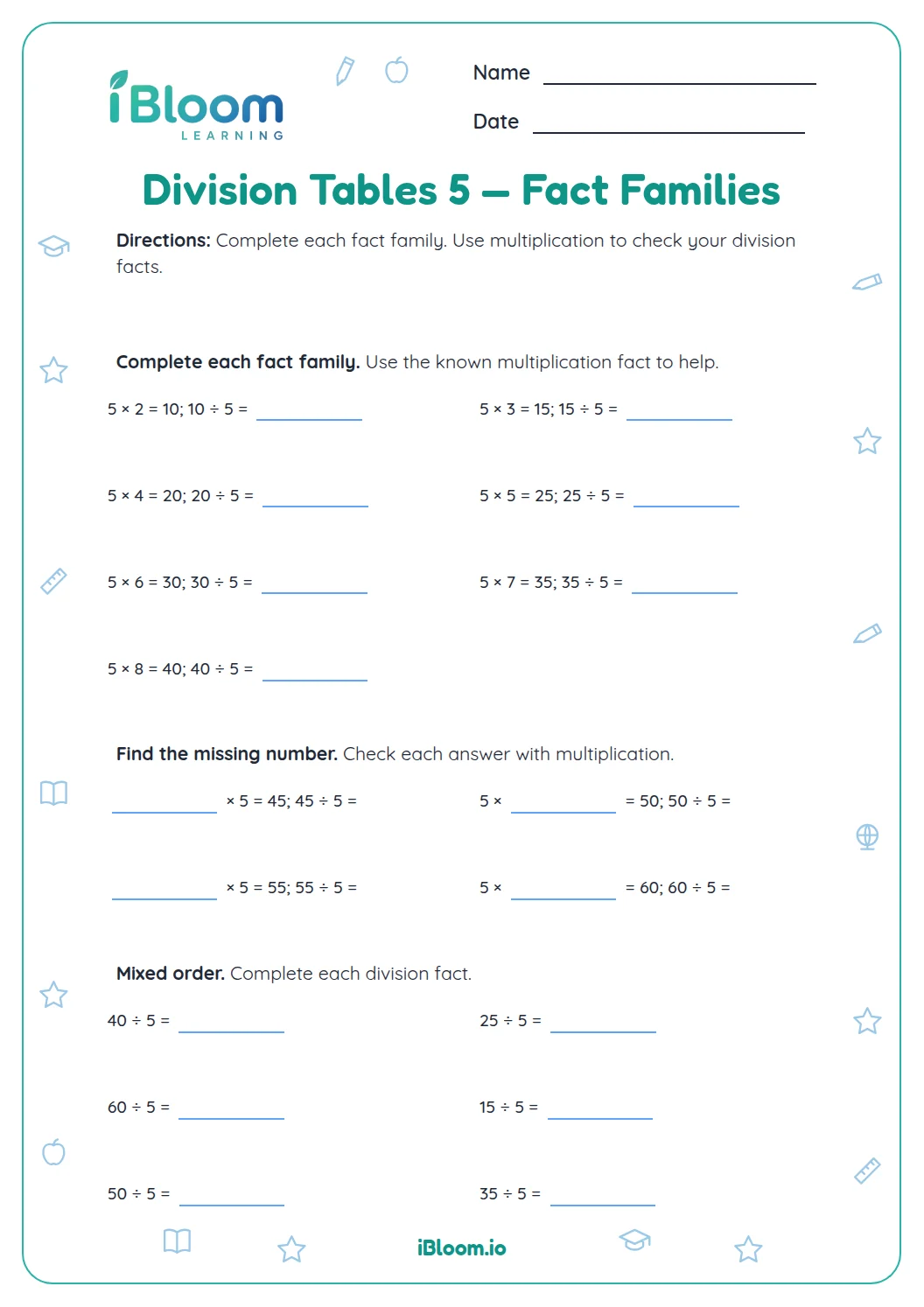
This free Grade 3 worksheet builds fluency with division facts for 4. Students find missing dividends, divisors, and quotients, complete four related multiplication checks, and solve six equal-group problems. The practice supports CCSS 3.OA.C.7 by using the relationship between multiplication and division to solve facts within 100. A separate answer key lists every missing number and word-problem answer.
Aligned to 3.OA.C.7
What kinds of division facts are on the page?
Part A asks students to find a missing dividend, divisor, or quotient in eight division equations using 4. Part B gives four multiplication checks for those facts. Part C applies the 4s facts to six equal-group situations.
For example, 16 ÷ ___ = 4 is completed with 4, because 4 × 4 = 16.
- 116 ÷ ___ = 4 → 4
- 2Check: 4 × 4 = 16
How does multiplication check division?
Division and multiplication reverse each other. The four questions in Part B ask students to complete multiplication sentences that confirm related division facts. For 24 ÷ 4 = 6, the check is 4 × 6 = 24.
How can equal groups become a division equation?
Part C uses equal sharing and equal groups. Find the total, then divide by the number of groups or the number in each group. In the cones problem, 36 cones shared among 4 teams means 36 ÷ 4; each team gets 9 cones.
How to use this worksheet
- 1Read the equation and identify which number is missing.
- 2Use a known 4s multiplication fact to fill the blank.
- 3For each choice, test whether the factors make the stated product.
- 4In a story, divide the total by the group size or group count.
- 5Write a label for each story answer and check by multiplying.
Common mistakes and quick fixes
The mistake
Using the dividend when the blank is the divisor.
The fix
Multiply the quotient by the missing divisor to see if it returns the dividend.
The mistake
Writing a multiplication fact with the wrong product.
The fix
Compute the product before choosing it.
The mistake
Leaving off the unit in a story answer.
The fix
Name what each group receives or how many groups are made.
Common Core alignment
This worksheet practices fluent division facts and the inverse relationship with multiplication.
Use multiplication facts to solve and check division facts within 100.
On this sheet: The missing-number facts and multiplication checks use division and multiplication facts within 100.
Show the official wordingHide the official wording
Fluently multiply and divide within 100, using strategies such as the relationship between multiplication and division (e.g., knowing that 8 × 5 = 40, one knows 40 ÷ 5 = 8) or properties of operations. By the end of Grade 3, know from memory all products of two one-digit numbers.
What to practice next
Make more practice
Further reading
Questions parents and teachers ask
What is the missing number in 16 ÷ ___ = 4?
The missing number is 4, because four groups of 4 make 16. Check the division by multiplying 4 × 4 = 16. The first section uses several forms of this relationship, so students should read carefully to see whether the dividend, divisor, or quotient is missing.
How can multiplication help with division facts?
Multiplication reverses division. For 28 ÷ 4 = 7, multiply 7 × 4 to check that the product is 28. The worksheet asks students to use this matching fact family relationship in the missing-number problems and in the short equal-group situations.
How many questions are on this worksheet?
There are 18 questions: eight missing-number division equations for 4, four multiplication checks, and six equal-group situations. The final six ask for a group size, total, or quotient. Students can verify each whole-number answer with a related multiplication fact as a check.
Is this worksheet timed?
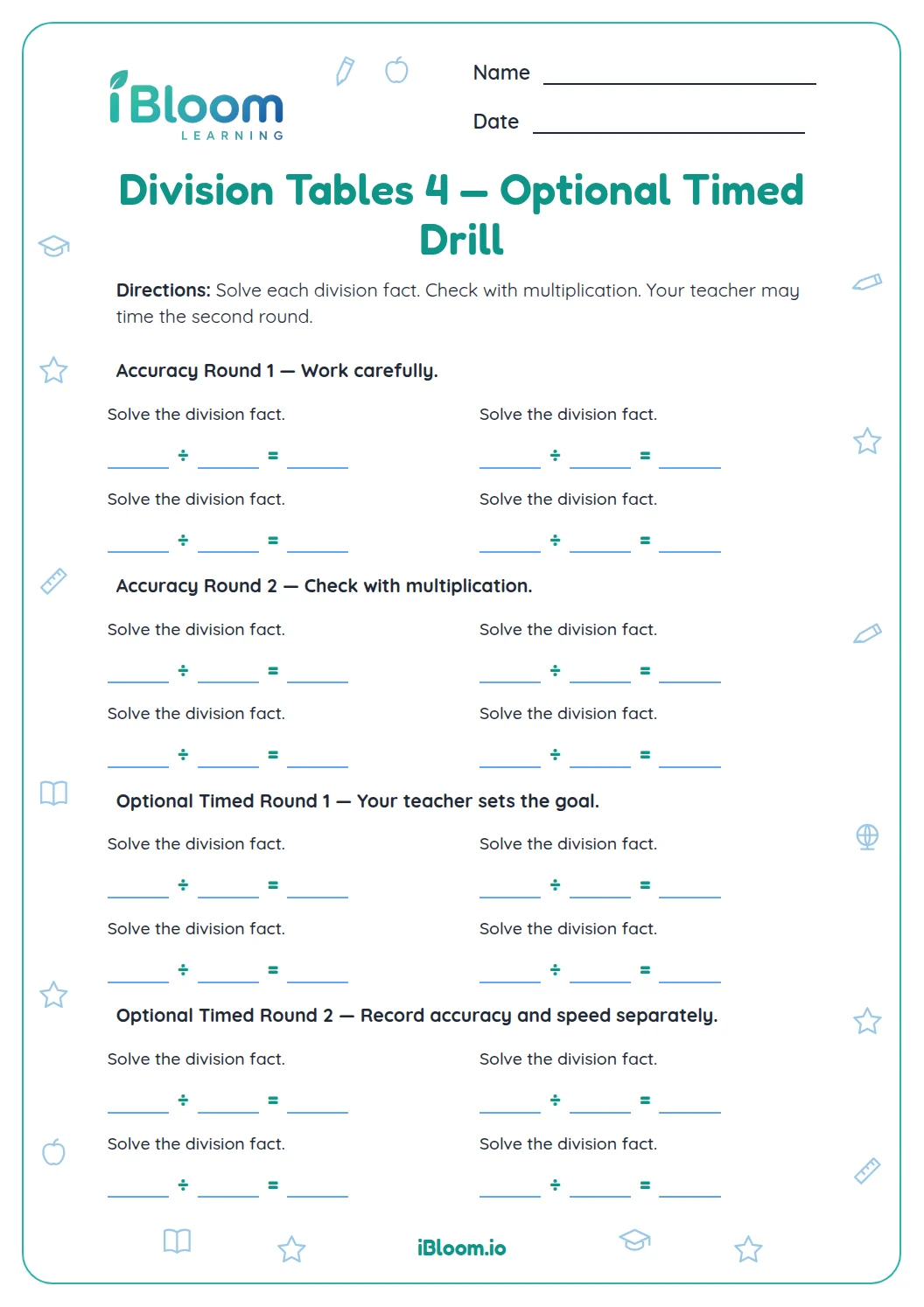
No timer is needed. Students can work at a steady pace, use multiplication facts to check, and correct any errors with the answer key. Practicing each fact accurately is more useful here than rushing through the page. A calm pace gives students time to check facts and correct errors. Accuracy with the 4s table is the goal of the practice.
What should students do after the 4s facts?
Try another division table, such as the 3s or 5s, and continue using multiplication to check each quotient. The linked practice pages move to related divisor groups and add variety while keeping the inverse relationship in view. Students can repeat the same routine with another divisor and use the linked practice pages to build a broader set of division facts.