






About this worksheet
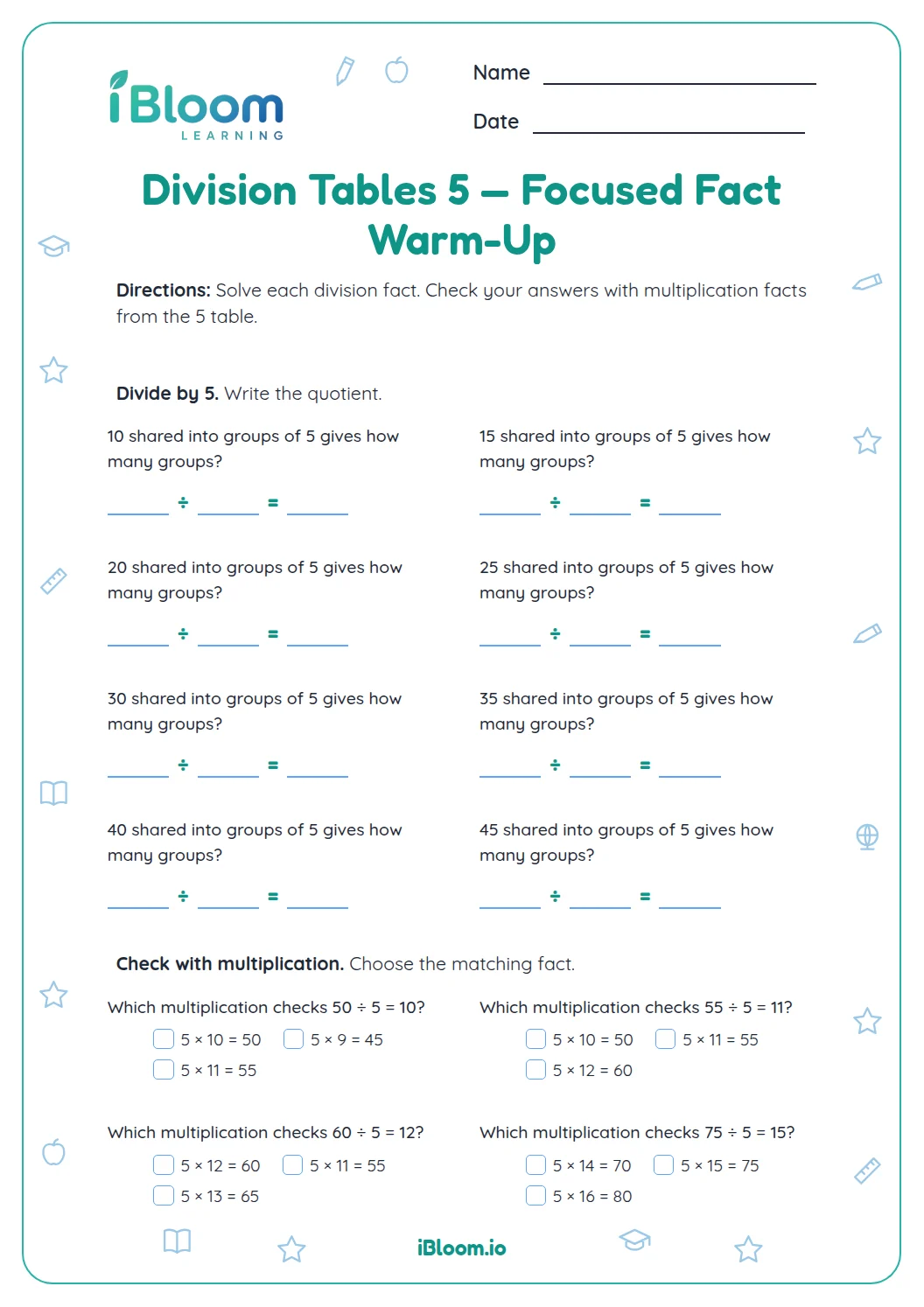
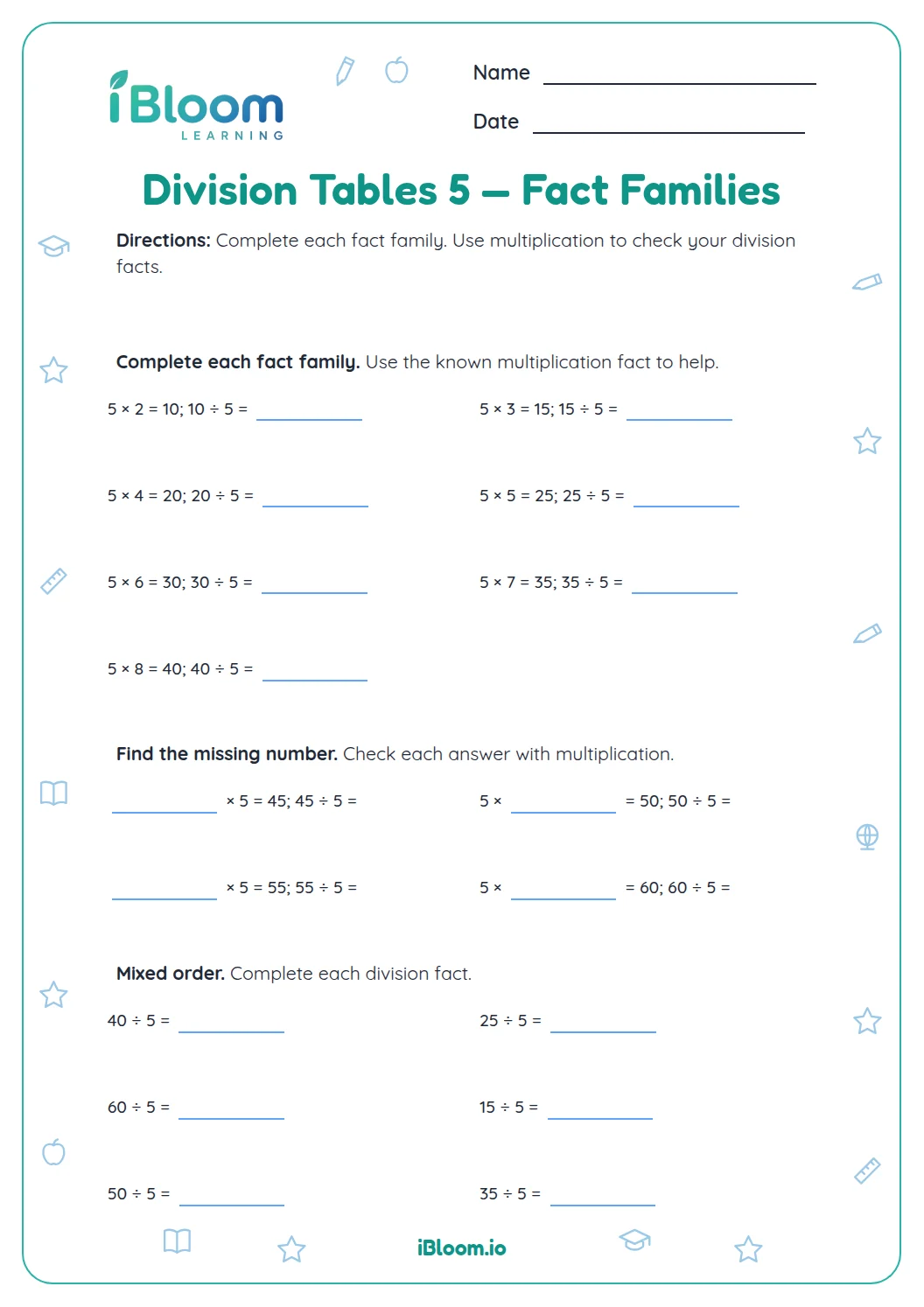
This free Grades 3–4 division drill practices dividing multiples of five by 5. Four opening facts begin in order, then twelve mixed facts cover quotients from 0 through 10. Students can complete the whole page without a timer or record how long Part B takes in the top margin. The 16 questions support Common Core 3.OA.C.7 by connecting division facts with known products in the five-times table. A separate answer key makes it easy to check accuracy before discussing speed or choosing facts for another practice session.
Aligned to 3.OA.C.7
How does multiplication help with division by 5?
For 35 ÷ 5, ask how many groups of five make 35. The related multiplication fact is 5 × 7 = 35, so the quotient is 7. Counting by fives is another way to reach the same answer while the fact becomes familiar.
- 135 ÷ 5 = ___
- 25 × 7 = 35
- 335 ÷ 5 = 7
- 4Check: 7 × 5 = 35
How can I use the optional timer?
Let students complete Part A first. If they choose timing, start a count-up timer when they begin question 5 and stop after question 16. Write the elapsed time in the top margin; there is no required cutoff or target time.
Check all twelve Part B answers. Discuss any missed fact before another attempt. Compare elapsed times only when students have completed the same twelve questions accurately; a shorter time with more errors does not show stronger recall.
Which facts appear in the two rounds?
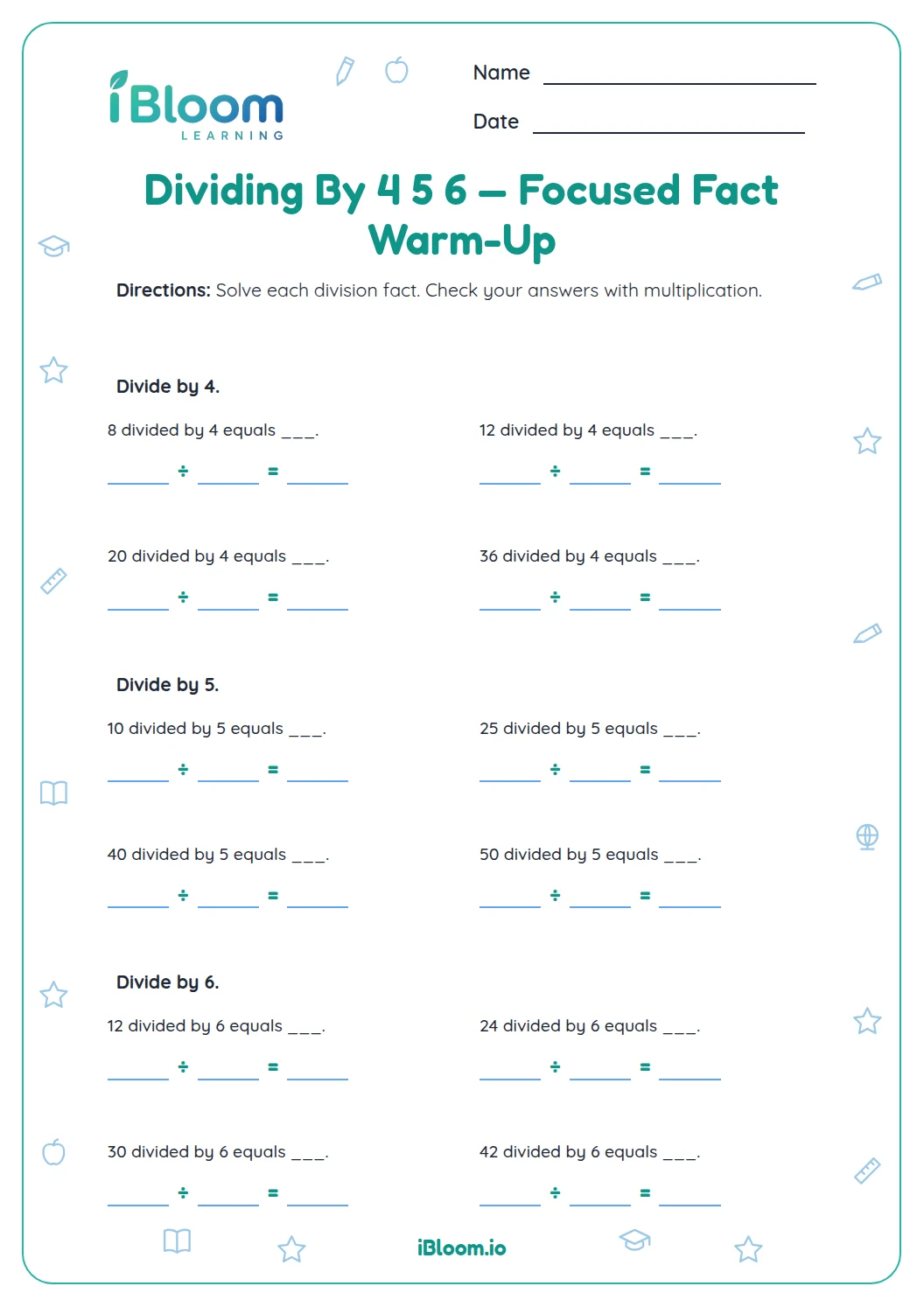
Part A uses 5, 10, 15, and 20 divided by 5. Part B mixes dividends from 0 to 50, covering every quotient from 0 through 10, with 35 ÷ 5 appearing twice. The repeated fact offers a small check of consistency within the drill.
Every divisor is 5. Question 9 is 0 ÷ 5, which equals 0: five equal groups sharing zero objects each receive zero objects. Use the answer key to locate a fact that needs another multiplication connection.
How to use this worksheet
- 1Complete the four Part A facts without a timer.
- 2Decide whether to time Part B; leave the timer off if preferred.
- 3If timing, start at question 5 and stop after question 16, then write the elapsed time in the top margin.
- 4Check all answers with the separate key and count correct Part B answers out of 12.
- 5Rebuild each missed fact using five equal groups or a five-times-table fact.
Mistakes to check together
The mistake
Writing 30 for 35 ÷ 5 after subtracting 5 once.
The fix
Division asks how many groups of 5 fit in 35; use 5 × 7 = 35.
The mistake
Writing 5 for 0 ÷ 5.
The fix
Share zero counters into five groups. Each group has zero counters.
The mistake
Rushing past a question during timing.
The fix
Follow the printed numbers and finish every item before stopping the timer.
Common Core alignment
Use known facts and related multiplication or division facts to build fluency.
On this sheet: Use known facts and related multiplication or division facts to build fluency.
Show the official wordingHide the official wording
Fluently multiply and divide within 100, using strategies such as the relationship between multiplication and division (e.g., knowing that 8 × 5 = 40, one knows 40 ÷ 5 = 8) or properties of operations. By the end of Grade 3, know from memory all products of two one-digit numbers.
What to practice next
Make more practice
Further reading
Questions parents and teachers ask
Is timing required for this worksheet?
No, students may complete every question without a timer. The sheet offers timing only for the twelve mixed facts in Part B. If a student chooses it, use a count-up timer and record the elapsed time in the top margin after finishing all twelve questions.
Which part should I time?
Time Part B only, starting at question 5 and stopping after question 16. Part A is an untimed opening round with four facts in order. Keeping the timed portion the same makes repeat attempts easier to compare, after you have checked that all answers are correct.
What should my child know before starting?
Knowing the five-times table gives a useful starting point. A child can think of 5 × 7 = 35 to solve 35 ÷ 5 = 7. If recall is still developing, count by fives or make equal groups with counters, and leave the timer off.
Why is 0 ÷ 5 on the drill?
It checks that students understand a zero dividend. If zero objects are shared equally among five groups, each group gets zero objects. Question 9 therefore has an answer of 0. The related multiplication fact, 5 × 0 = 0, gives a quick way to check it.
How should I record progress on repeat attempts?
Record the number correct in Part B out of twelve, and add the elapsed time only if timing was used. Review missed facts before repeating the page. Compare time between accurate attempts, keeping the same start and stop points so the comparison has a clear meaning.