






About this worksheet
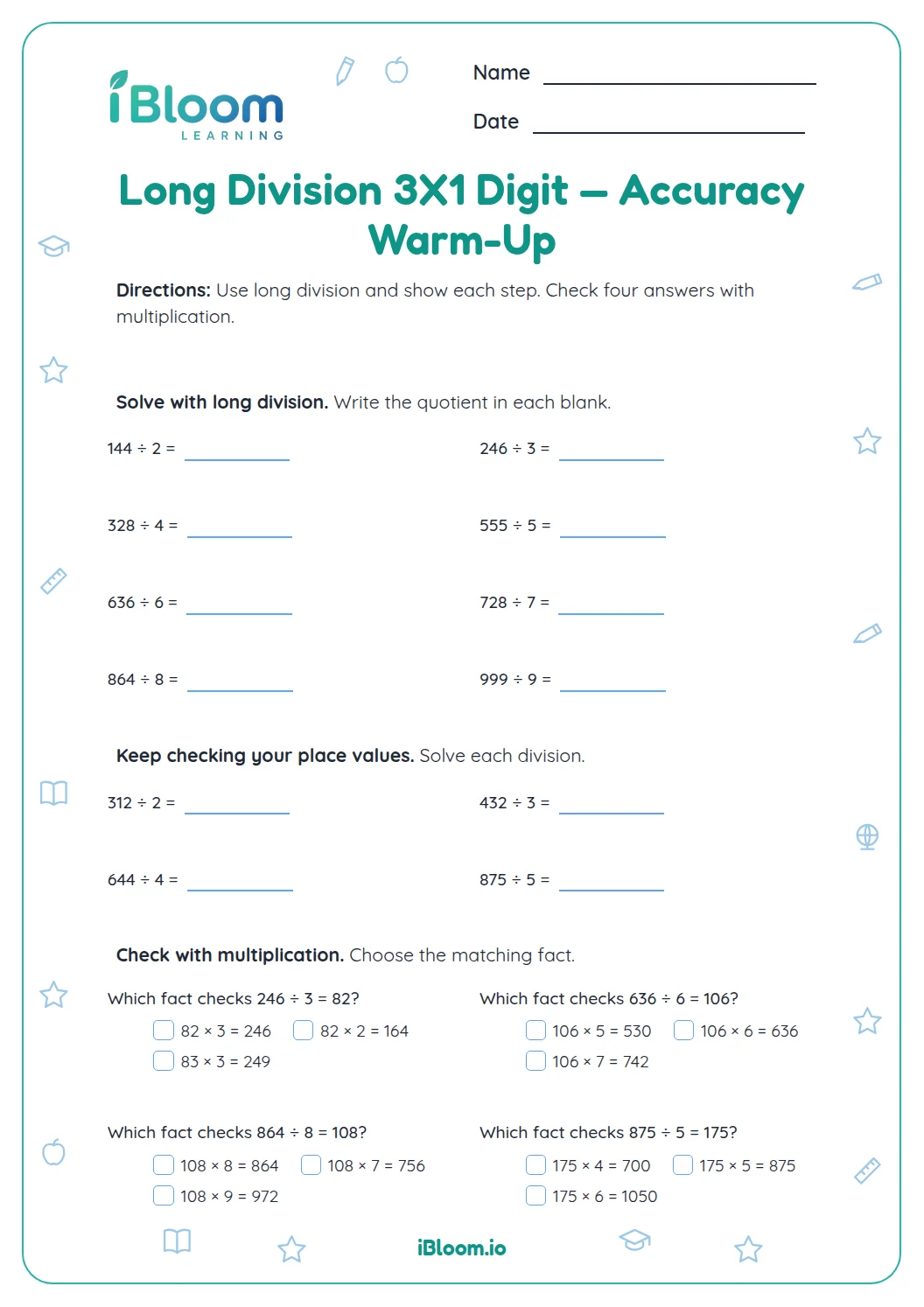
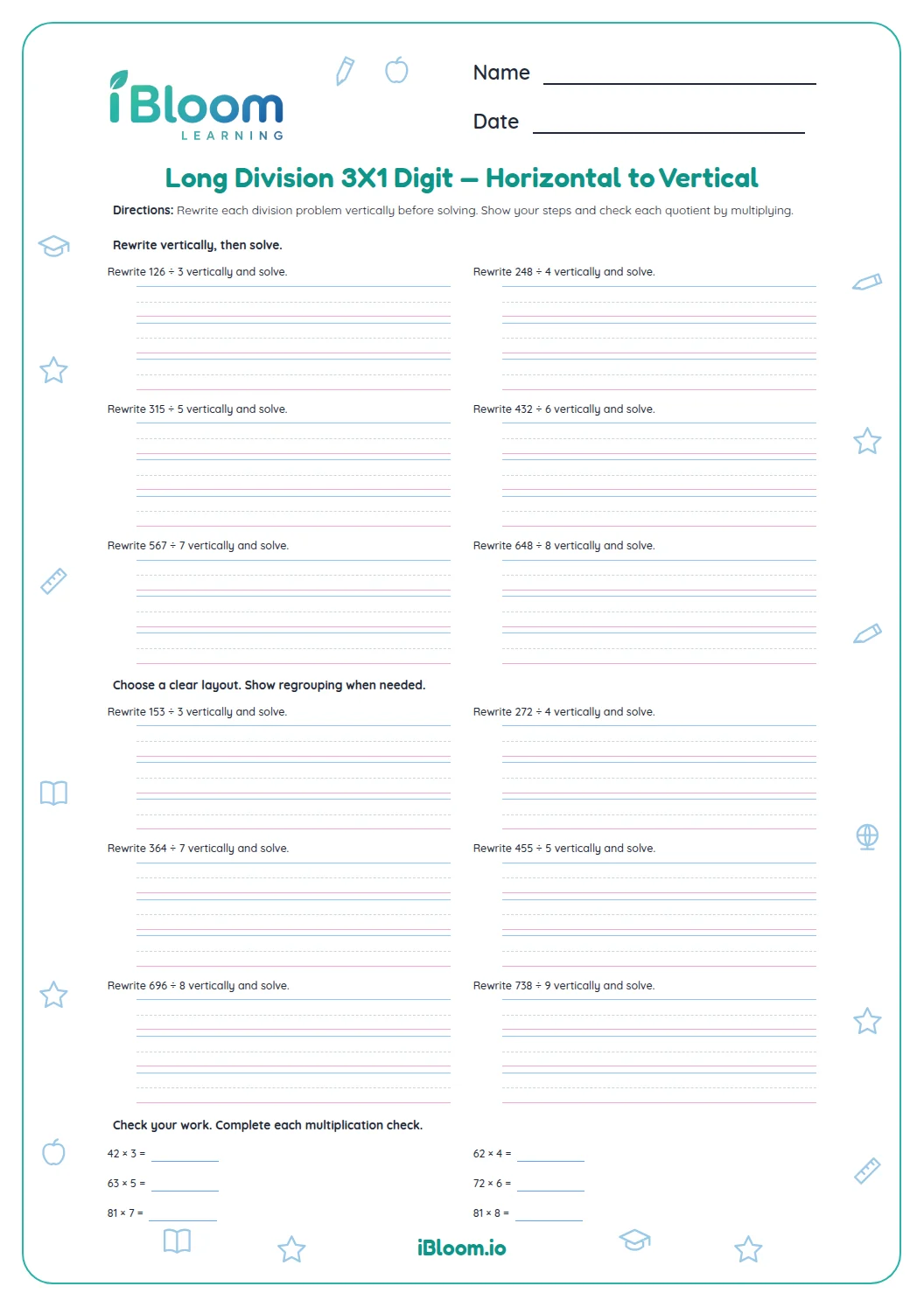
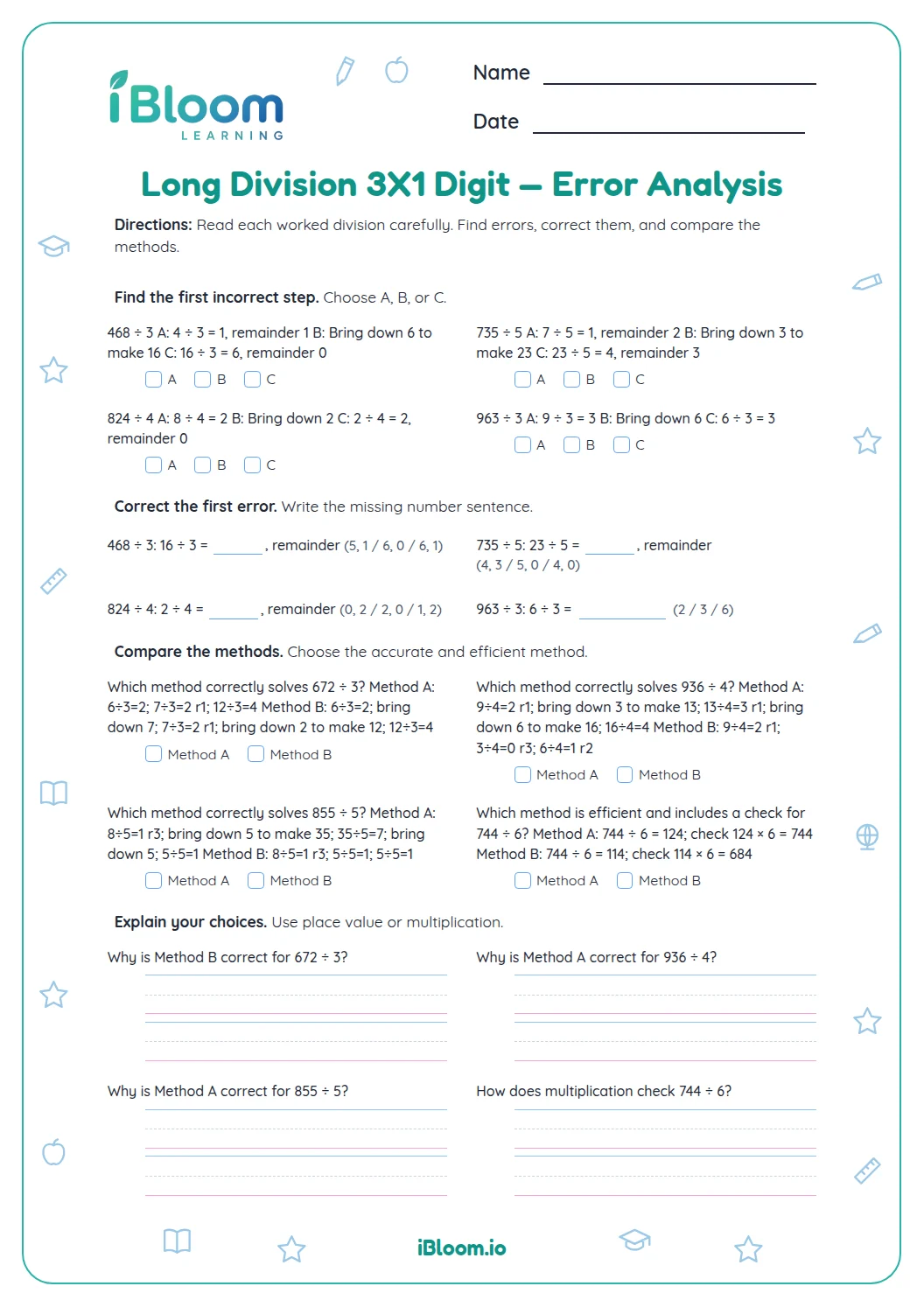
This printable long-division worksheet gives students Grades 4–6 practice with three-digit dividends and one-digit divisors. Students fill in missing dividends, divisors, or quotients, including equations with a zero in the quotient, and use multiplication to check. The 20 number sentences are grouped by the missing value, then mixed for a final check. A separate answer key is included. It practices CCSS 4.NBT.B.6 by finding whole-number quotients and checking with multiplication.
Aligned to 4.NBT.B.6
How do you find a missing quotient?
Use the inverse multiplication fact. For 648 ÷ 6, ask what number times 6 equals 648. The quotient is 108 because 108 × 6 = 648.
Question 2 has a zero in the tens place. Divide the hundreds first, then keep the zero in the quotient before writing the ones digit.
- 1648 ÷ 6 = ___
- 26 × 100 = 600; 48 remains
- 348 ÷ 6 = 8
- 4Quotient: 108
- 5Check: 108 × 6 = 648
How can you spot which value is missing?
Read the full equation before calculating. In 735 ÷ ___ = 105, the blank is the divisor. Ask which one-digit number times 105 gives 735: it is 7. If the blank is the dividend, multiply the quotient by the divisor.
What does this drill practice?
Sixteen number sentences ask for missing dividends, divisors, and quotients, plus related multiplication facts. The division equations use three-digit dividends and one-digit divisors with exact whole-number answers.
How to solve a missing-value division sentence
- 1Read the equation and point to the blank.
- 2Name whether the blank is the dividend, divisor, or quotient.
- 3Use multiplication or division facts to find that value.
- 4Keep hundreds, tens, and ones in their correct places.
- 5Multiply the quotient by the divisor to check.
Common long-division slips
The mistake
Dropping a zero from a quotient such as 648 ÷ 6.
The fix
Track each place as you divide; 648 ÷ 6 is 108, not 18.
The mistake
Filling a dividend blank with the quotient.
The fix
When dividend ÷ divisor = quotient, multiply divisor × quotient to find the dividend.
The mistake
Filling a divisor blank with the dividend.
The fix
Use dividend ÷ quotient to find the divisor and check with multiplication.
Common Core alignment
This sheet practices the standard below through its word and number tasks.
Find whole-number quotients and remainders with one-digit divisors.
On this sheet: All items use three-digit dividends, one-digit divisors, exact quotients, and multiplication to check.
Show the official wordingHide the official wording
Find whole-number quotients and remainders with up to four-digit dividends and one-digit divisors, using strategies based on place value, the properties of operations, and/or the relationship between multiplication and division. Illustrate and explain the calculation by using equations, rectangular arrays, and/or area models.
What to practice next
Make more practice
Further reading
Questions parents and teachers ask
What kinds of missing values are on this worksheet?
The blanks stand for dividends, divisors, or quotients, and a few questions use the related multiplication fact. Reading the equation first helps students identify the missing role. All division problems have three-digit dividends and one-digit divisors with no remainder. It is a quick way to catch an arithmetic slip.
How can I find a missing dividend?
Multiply the divisor by the quotient. For example, if the blank divided by 4 equals 213, multiply 213 by 4 to get 852. Check by dividing 852 by 4; the quotient is 213. The product must match the missing dividend exactly.
Why does 648 ÷ 6 equal 108 instead of 18?
The quotient needs a digit for each place-value step. Six goes into 6 hundreds 1 hundred time, into 4 tens 0 tens times, and into 48 ones 8 times. The zero in the tens place holds its position, giving 108.
How many problems are included?
There are 20 number sentences in four parts. Students find missing quotients, identify missing dividends and divisors, use multiplication facts, and finish with mixed missing-value practice. The answer key lists each value. A multiplication check can confirm each completed sentence.
How should students check their answers?
Multiply the quotient by the divisor. The product should equal the dividend. If the blank was the divisor, check that divisor times quotient equals dividend; if it was the dividend, check the product fills the blank. This works for every exact division fact on the sheet.