




About this worksheet
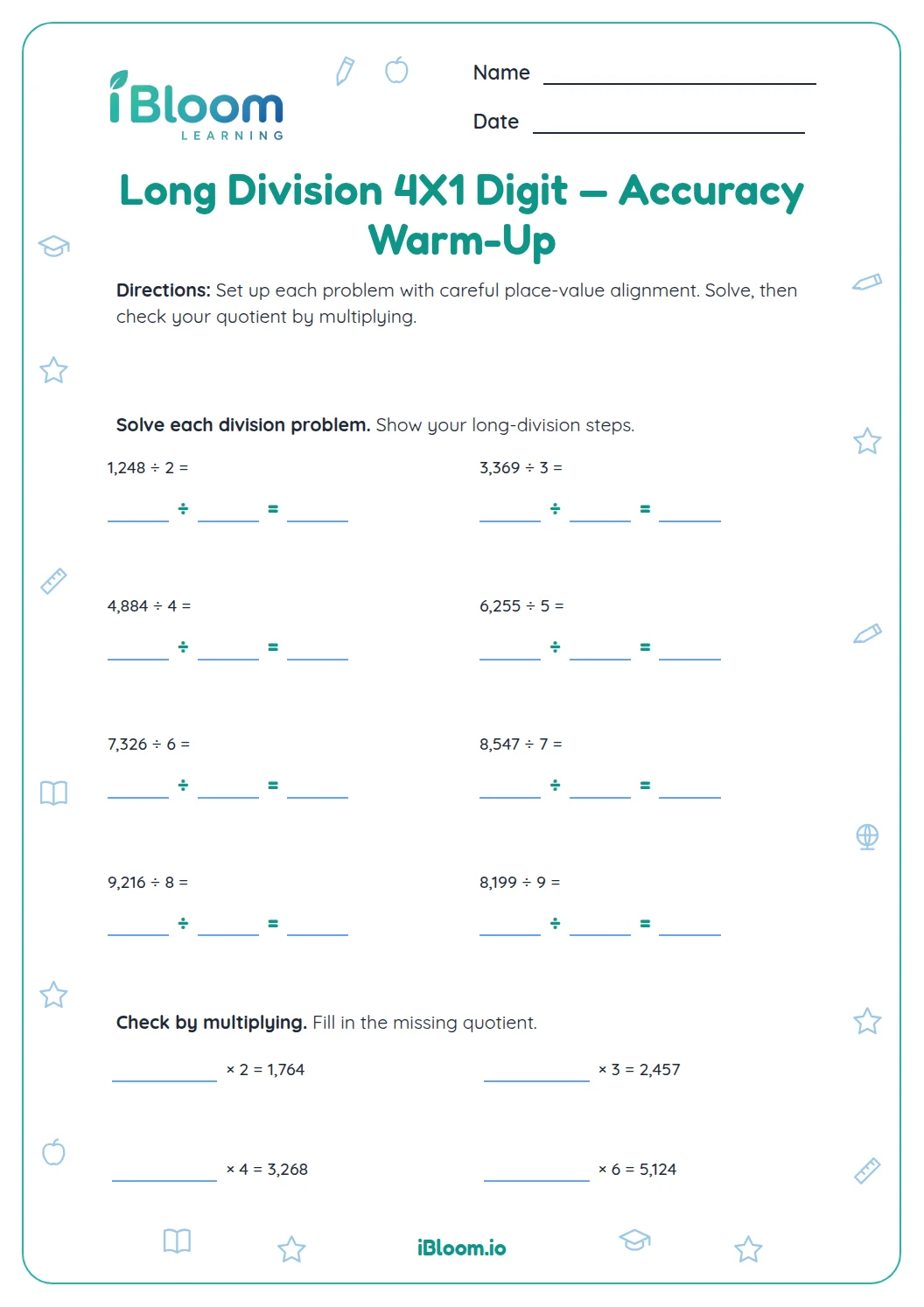
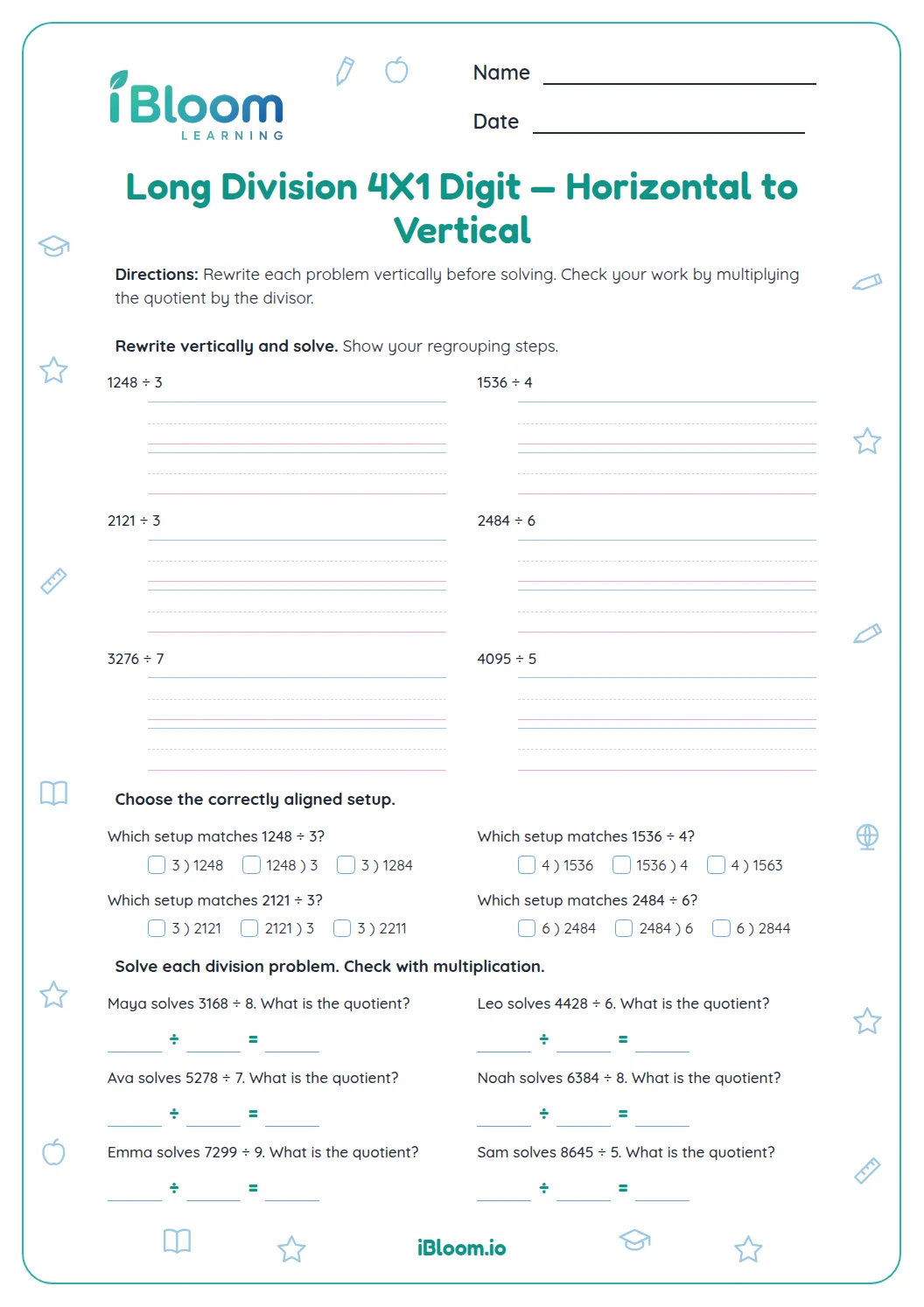
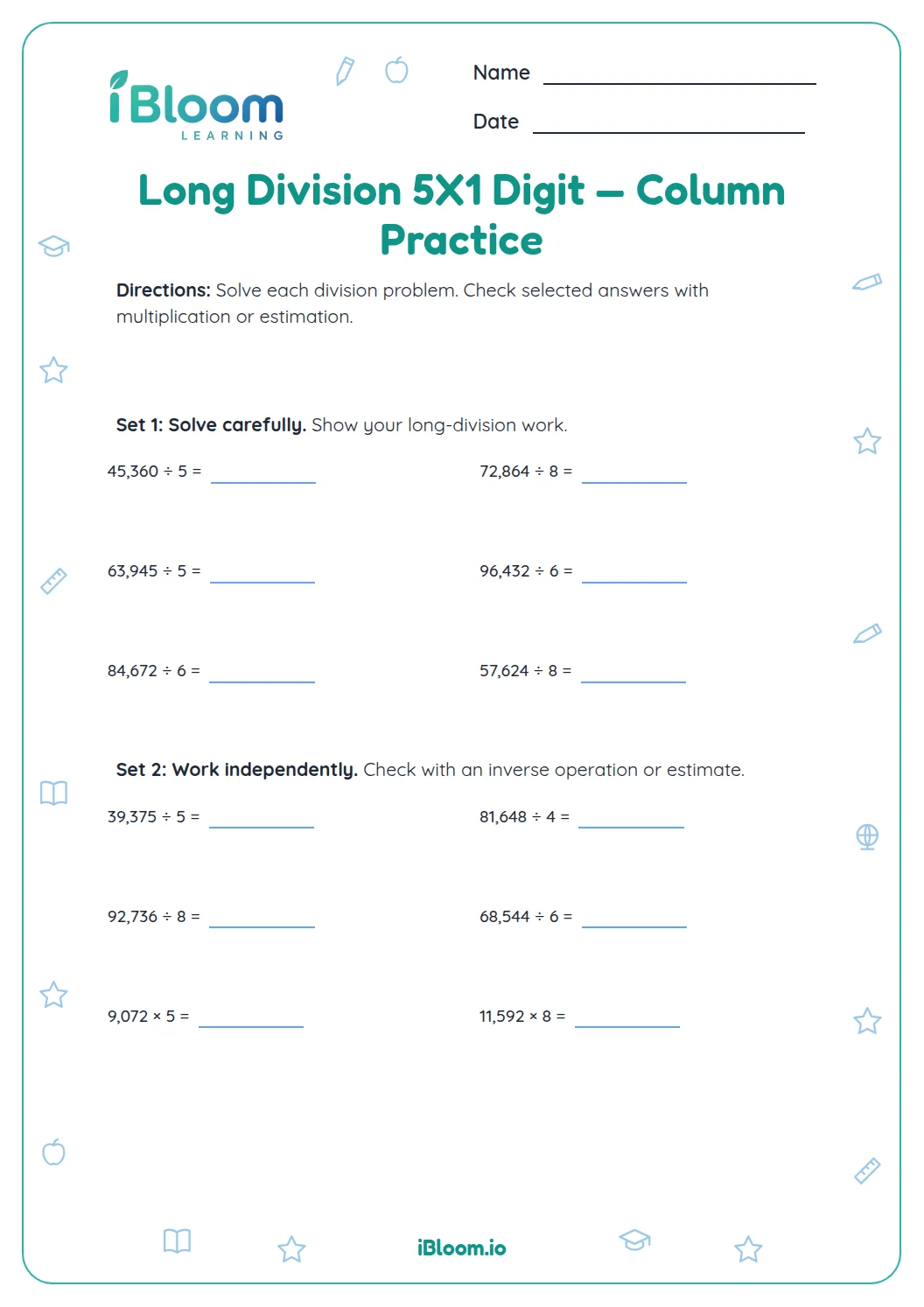
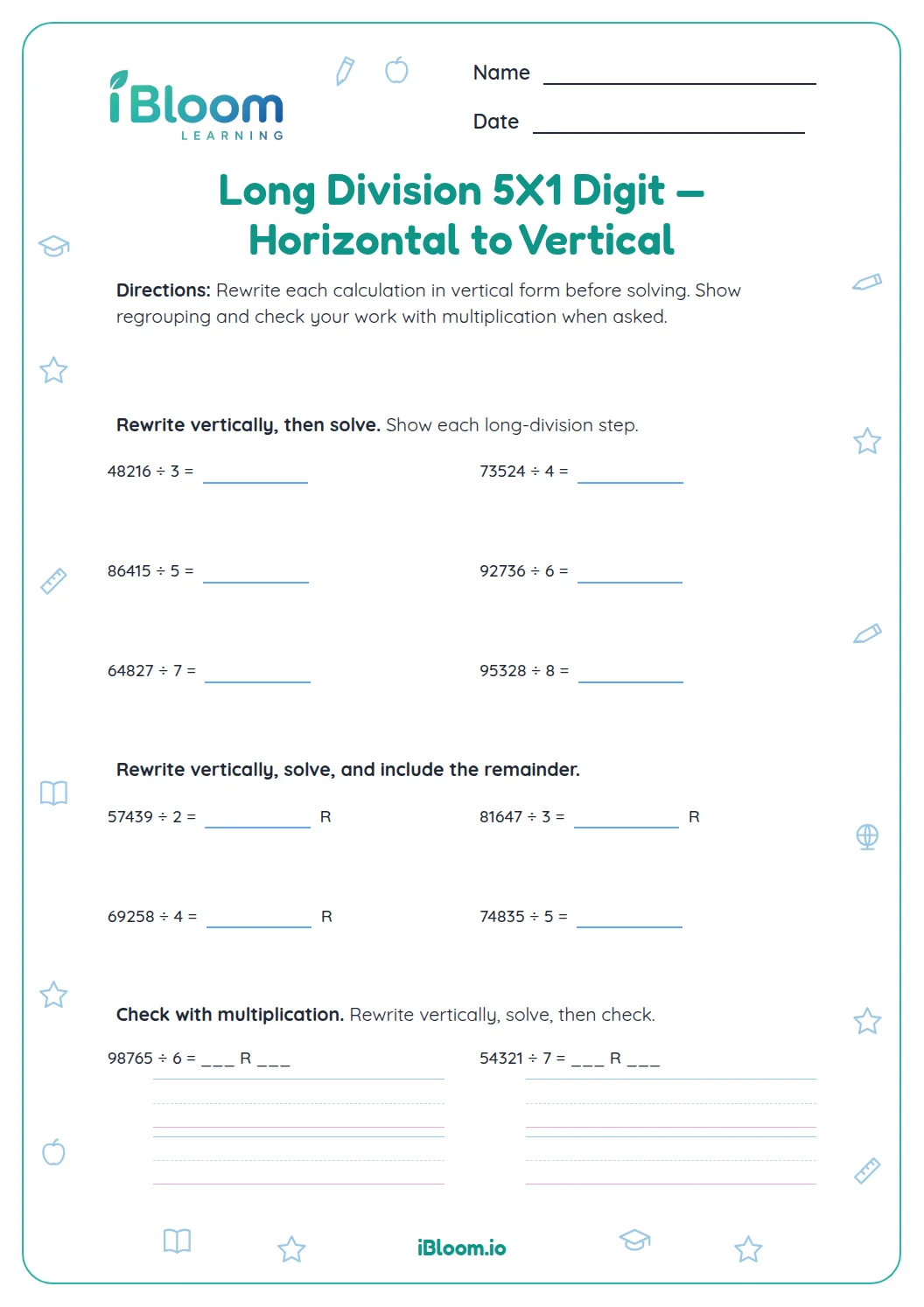
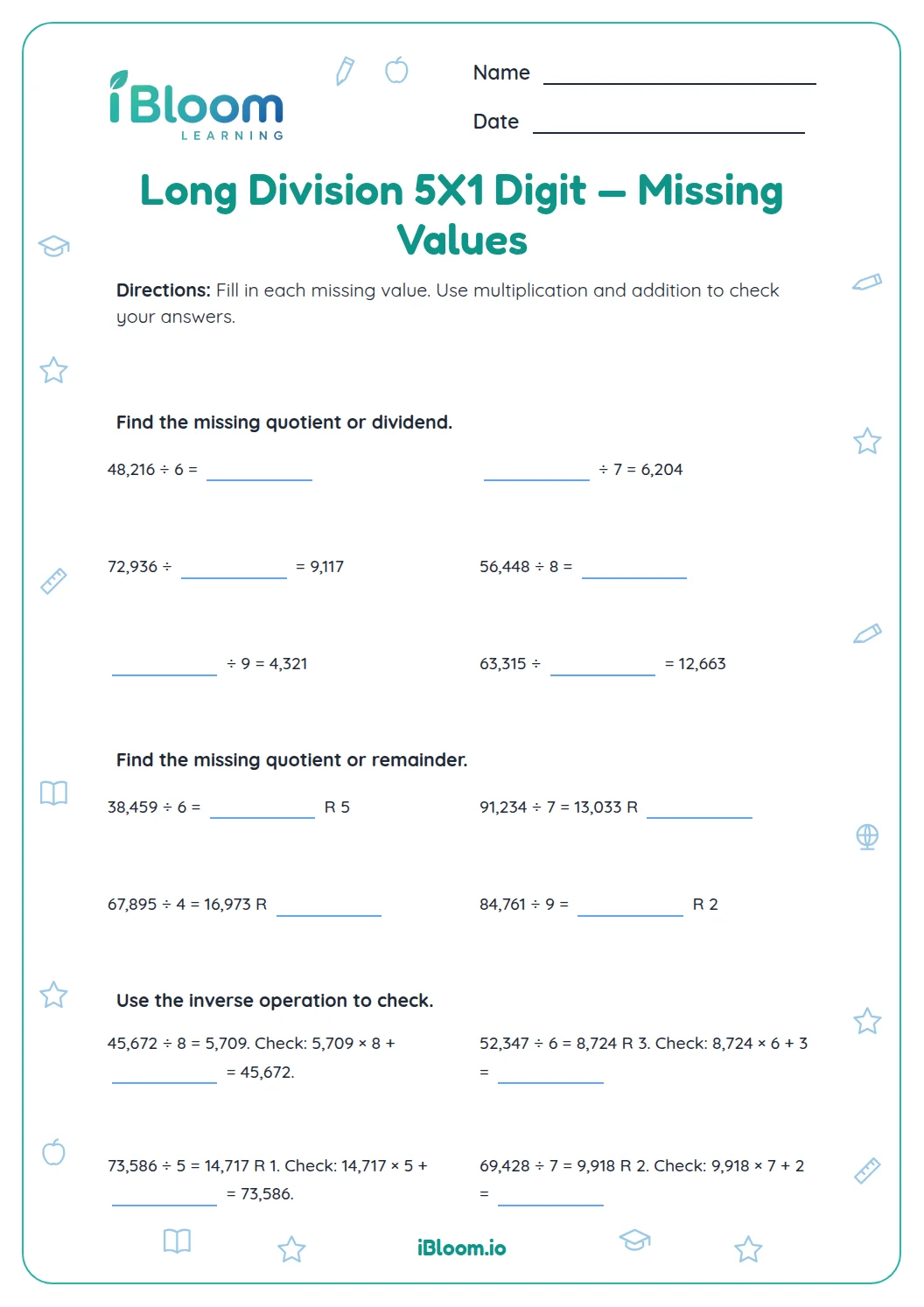
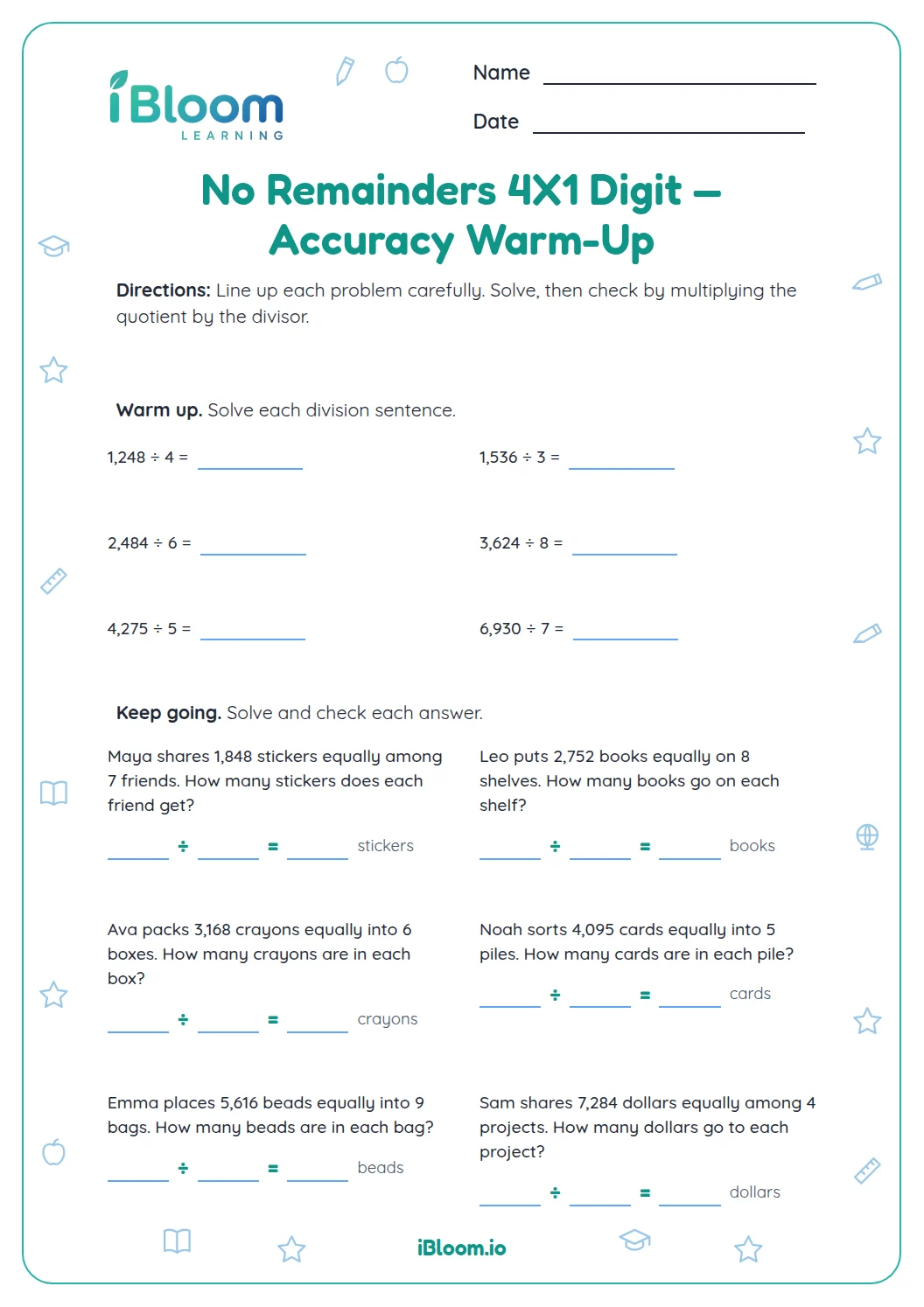
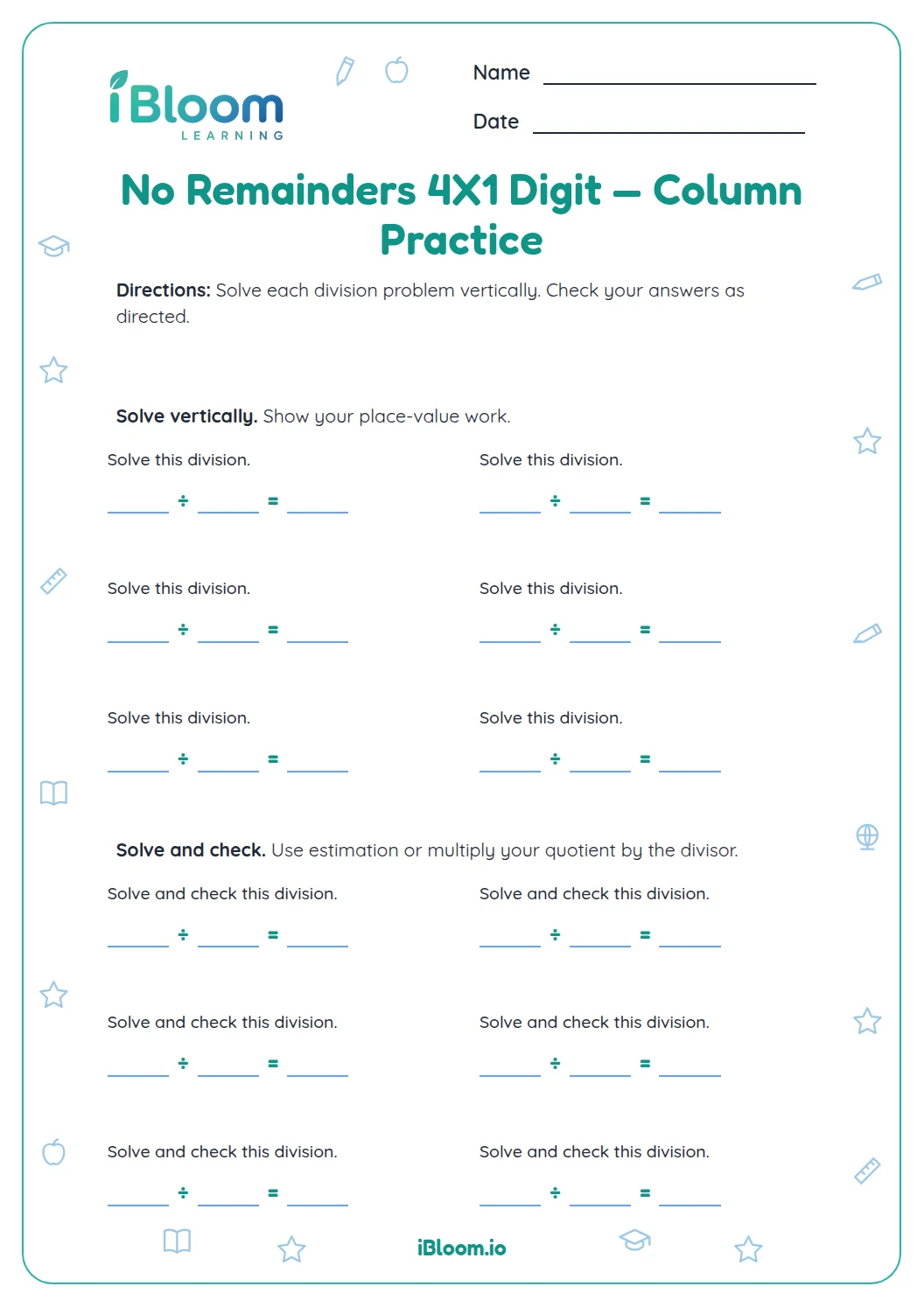
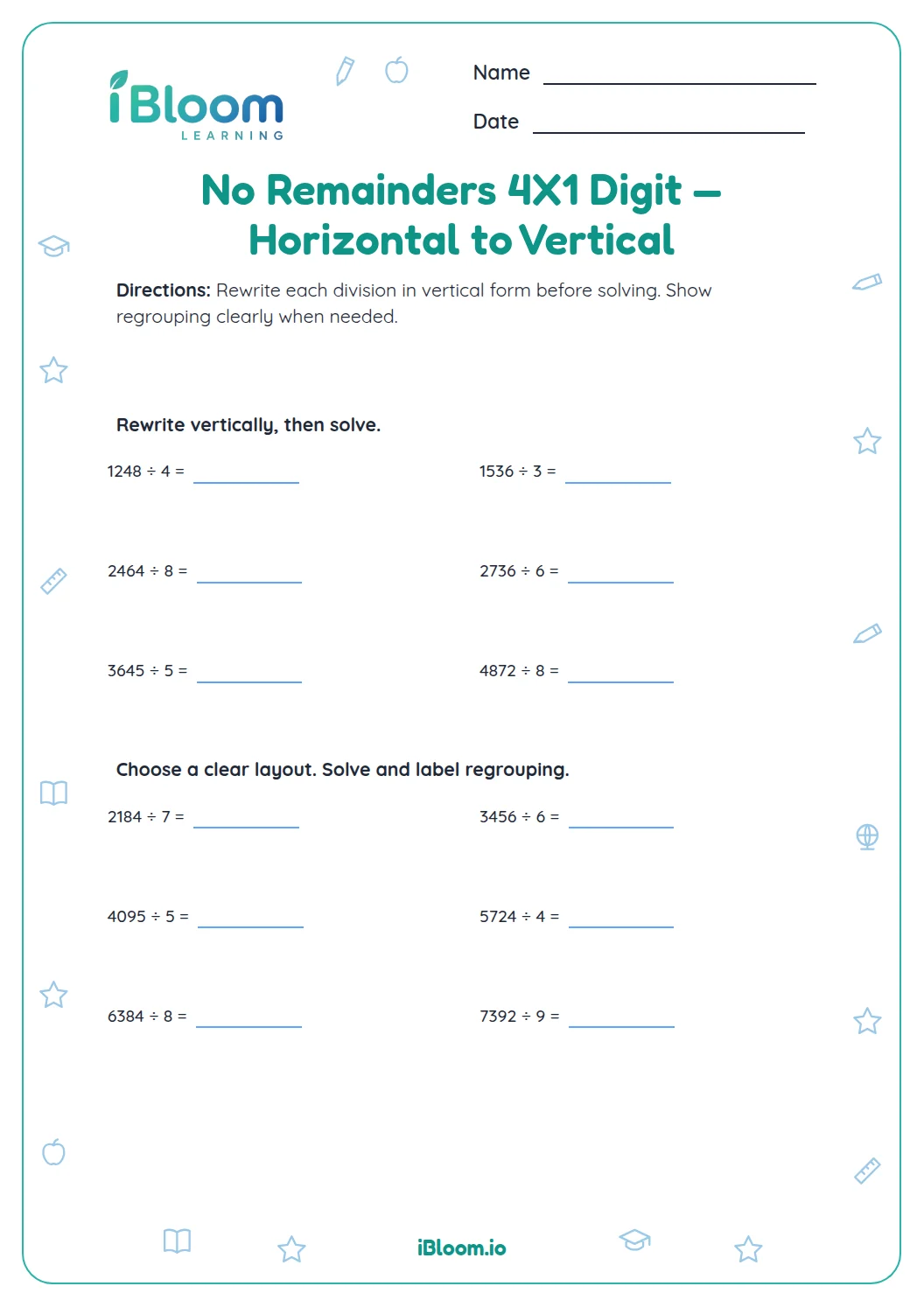
This free Grade 4 long-division worksheet practices dividing four-digit numbers by one-digit divisors. The 16 questions include quotient calculations, missing dividend or divisor values, remainders, and four word problems. Learners can use multiplication and addition to check a quotient: divisor × quotient + remainder equals the dividend. A separate answer key lists the results. The work practices CCSS 4.NBT.B.6.
Aligned to 4.NBT.B.6
How do you divide a four-digit number by one digit?
Work from the greatest place value to the smallest, bringing each remaining amount into the next place as needed. Keep the quotient digits aligned with the dividend’s places. Then check by multiplying the divisor by the quotient and adding any remainder.
For q1, 3,648 ÷ 6 = 608. Check: 608 × 6 = 3,648.
- 13,648 ÷ 6 = 608
- 2Check: 608 × 6 = 3,648
- 3The quotient is 608.
How can multiplication help find a missing value?
Use the relationship between division and multiplication. If 6,408 ÷ ___ = 801, ask which one-digit number times 801 makes 6,408; 801 × 8 = 6,408, so the missing divisor is 8. A remainder must always be less than the divisor.
What does each part ask learners to do?
Part A asks for quotients. Part B asks for missing values in division or multiplication sentences, including remainders. Part C applies division to four situations about equal groups and measurements.
How does this page practice CCSS 4.NBT.B.6?
Learners find whole-number quotients and remainders with up to four-digit dividends and one-digit divisors, using place-value strategies and the relationship between multiplication and division.
How to use this worksheet
- 1Estimate a reasonable quotient before dividing.
- 2Divide one place at a time, keeping quotient digits in the correct places.
- 3For a missing value, use multiplication to reconstruct the dividend.
- 4When there is a remainder, check that it is smaller than the divisor.
- 5Write a division equation for each story and check with the answer key.
Long-division slips and quick fixes
The mistake
Leaving a zero out of the quotient when a place has no groups.
The fix
Keep the place value aligned and write zero in the quotient when needed.
The mistake
Writing a remainder equal to or larger than the divisor.
The fix
Make one more group if possible; the remainder must be smaller than the divisor.
The mistake
Checking only the quotient and ignoring a remainder.
The fix
Multiply divisor by quotient, then add the remainder to recover the dividend.
Curriculum alignment
This worksheet practices the standard below through its questions and worked examples.
Find whole-number quotients and remainders using place-value strategies.
On this sheet: Divide four-digit dividends by one-digit divisors and use the quotient, divisor, and remainder relationship.
Show the official wordingHide the official wording
Find whole-number quotients and remainders with up to four-digit dividends and one-digit divisors, using strategies based on place value, the properties of operations, and/or the relationship between multiplication and division. Illustrate and explain the calculation by using equations, rectangular arrays, and/or area models.
What to practice next
Make more practice
Further reading
Questions parents and teachers ask
How can I check a long-division answer?
Multiply the divisor by the quotient and add the remainder, if there is one. The result should equal the dividend. For example, 3,648 ÷ 6 = 608 because 608 × 6 = 3,648. The remainder must also be less than the divisor.
What does a remainder mean?
A remainder is the amount left after making as many complete equal groups as possible. In 8,507 ÷ 4, the quotient is 2,126 with 3 left because 4 × 2,126 + 3 = 8,507. Three is smaller than the divisor, four.
How do you find a missing divisor?
Use multiplication to find the number that makes the division sentence true. In 6,408 ÷ ___ = 801, calculate 801 × 8 to get 6,408, so the missing divisor is 8. The worksheet includes missing-value items alongside standard quotient problems. Recheck by multiplying the proposed divisor by the quotient.
Why is there a zero in some quotients?
A zero can hold a place when a partial dividend has fewer than one divisor group. Keeping that zero preserves the place value of the digits that follow. Learners should align the quotient above the correct places and use multiplication to check it.
What word problems are included?
The final part uses division in situations involving books packed into boxes, muffins placed in trays, equal trail sections, and beads shared among groups. Each story asks for an equal-group result, and some ask learners to report a remainder. The contexts give learners practice deciding what the quotient represents.
Which standard does this worksheet practice?
The page practices CCSS 4.NBT.B.6: finding whole-number quotients and remainders with up to four-digit dividends and one-digit divisors. Learners use place-value strategies and the relationship between multiplication and division to find and check answers. The examples ask learners to apply both ideas across several problem types.