





About this worksheet
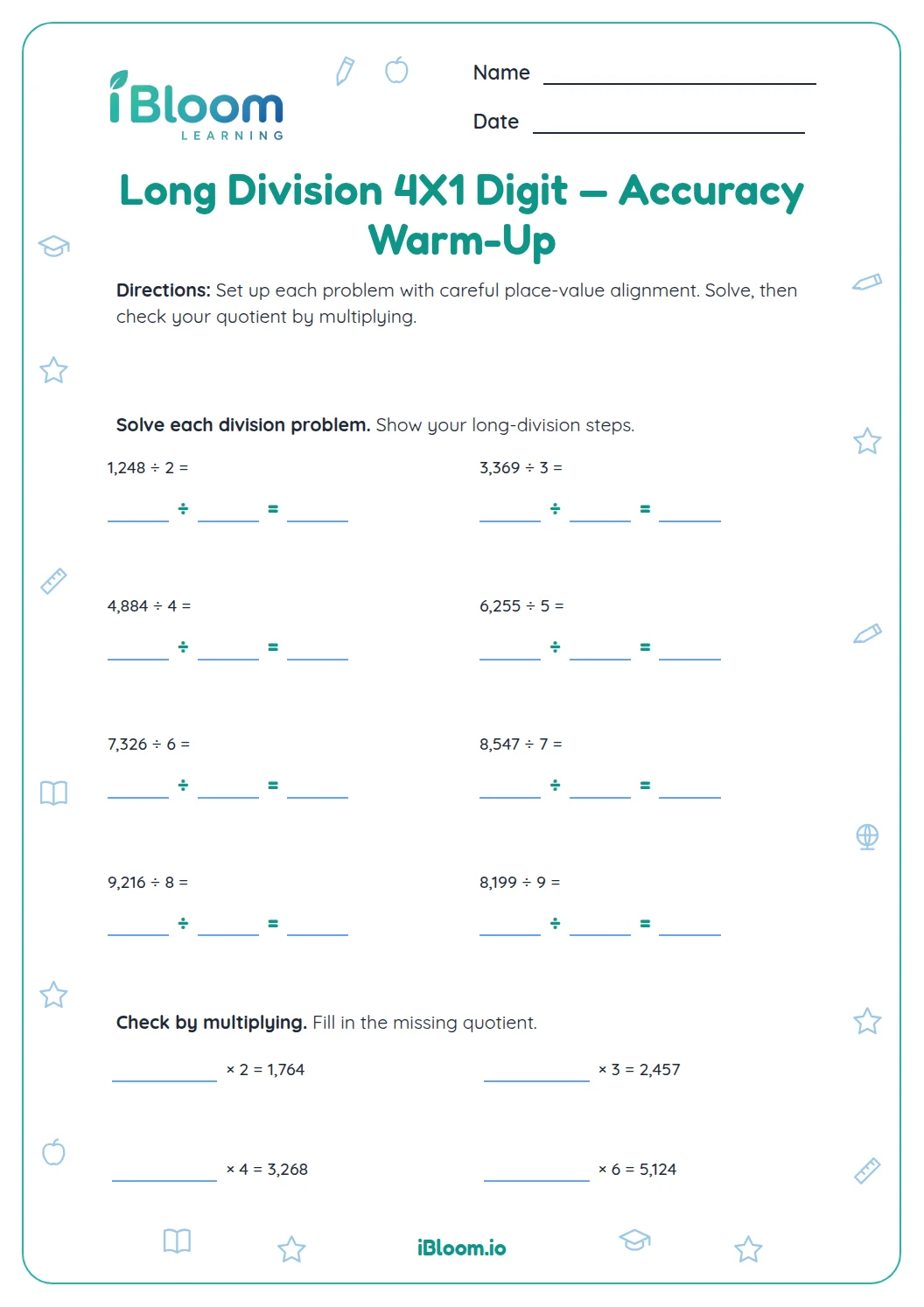
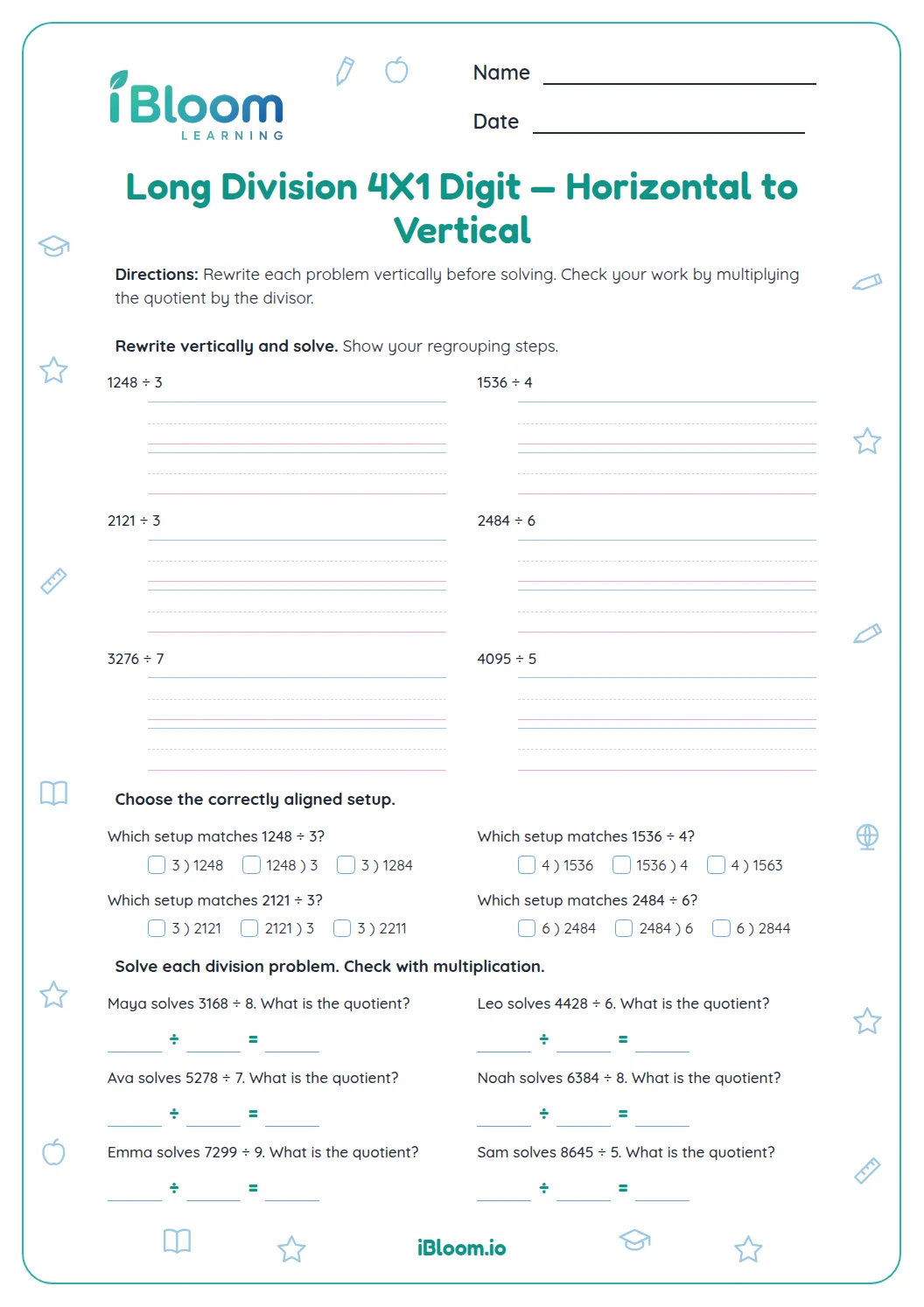
This printable gives learners practice dividing four-digit whole numbers by one-digit divisors. Eight calculations build fluency, four error-analysis questions ask learners to correct a quotient, and four final problems require a multiplication check. All divisions have whole-number answers. The answer key shows each quotient and supports checking work. The worksheet practices CCSS 4.NBT.B.6: finding whole-number quotients with up to four-digit dividends and one-digit divisors.
Aligned to 4.NBT.B.6
How does multiplication check a quotient?
Multiply the quotient by the divisor. If the product equals the dividend, the division is correct. For 1,368 ÷ 4 = 342, the check is 342 × 4 = 1,368.
- 11,368 ÷ 4 = 342
- 2342 × 4 = 1,368
What does error analysis ask learners to do?
Read the claimed quotient, calculate the division independently, and compare the results. A nearby wrong quotient can reveal a place-value error. Questions 9–12 ask for the correct quotient rather than asking learners to repeat the incorrect work.
How is the practice organized?
The 16 questions move from direct division to evaluating another learner’s quotient and then verifying a result by multiplication. All are four-digit dividends divided by one-digit divisors, with exact whole-number quotients.
How to use this worksheet
- 1Read the dividend and one-digit divisor carefully.
- 2Work through the quotient one place at a time.
- 3For an error-check item, solve independently before comparing with the claimed answer.
- 4Multiply the quotient by the divisor on the final four items.
- 5Check that the product matches the original dividend.
- 6Use the answer key to locate and correct any arithmetic slip.
Common mistakes and quick fixes
The mistake
Starting a quotient digit before bringing down the next digit.
The fix
Keep the place-value steps in order and bring down one digit at a time.
The mistake
Accepting a quotient because it looks close.
The fix
Multiply it by the divisor and compare the product with the dividend.
The mistake
Misplacing a zero in the quotient.
The fix
Check each place as you divide and bring down; verify the full quotient by multiplication.
Curriculum alignment
This worksheet gives practice with the Common Core skill below.
Divide up to four-digit whole numbers by one-digit divisors and verify with multiplication.
On this sheet: Each problem divides a four-digit whole number by a one-digit divisor; learners calculate and verify quotients.
Show the official wordingHide the official wording
Find whole-number quotients and remainders with up to four-digit dividends and one-digit divisors, using strategies based on place value, the properties of operations, and/or the relationship between multiplication and division. Illustrate and explain the calculation by using equations, rectangular arrays, and/or area models.
What to practice next
Make more practice
Further reading
Questions parents and teachers ask
What is the divisor in these problems?
Every question divides a four-digit dividend by a one-digit divisor. The worksheet starts with eight direct quotient calculations, then asks learners to analyze four incorrect results and finish with four multiplication checks. Work one sample aloud first. Learners can then check their quotient.
How many questions are included?
The sheet contains 16 questions: eight direct divisions, four error checks, and four problems that ask learners to solve and verify. All divisions have exact whole-number quotients, so the multiplication check should reproduce the full dividend. The key is separate.
How does multiplication check division?
Multiply the quotient by the divisor. For question 1, 1,368 ÷ 4 = 342, and 342 × 4 returns 1,368. If the product differs from the original dividend, revisit the quotient and the place-value steps before checking the key.
What does the error-analysis section practice?
Questions 9 through 12 show a learner’s claimed quotient and ask for the correct result. The child should calculate independently, compare, and select the corrected quotient. This focuses attention on place-value slips instead of simply repeating an answer.
Is an answer key included?
Yes. The separate key lists all 16 quotients and the correct choices for the error-analysis items. The last four questions include multiplication checks, so learners can compare both their quotient and the verification product after completing their work.