




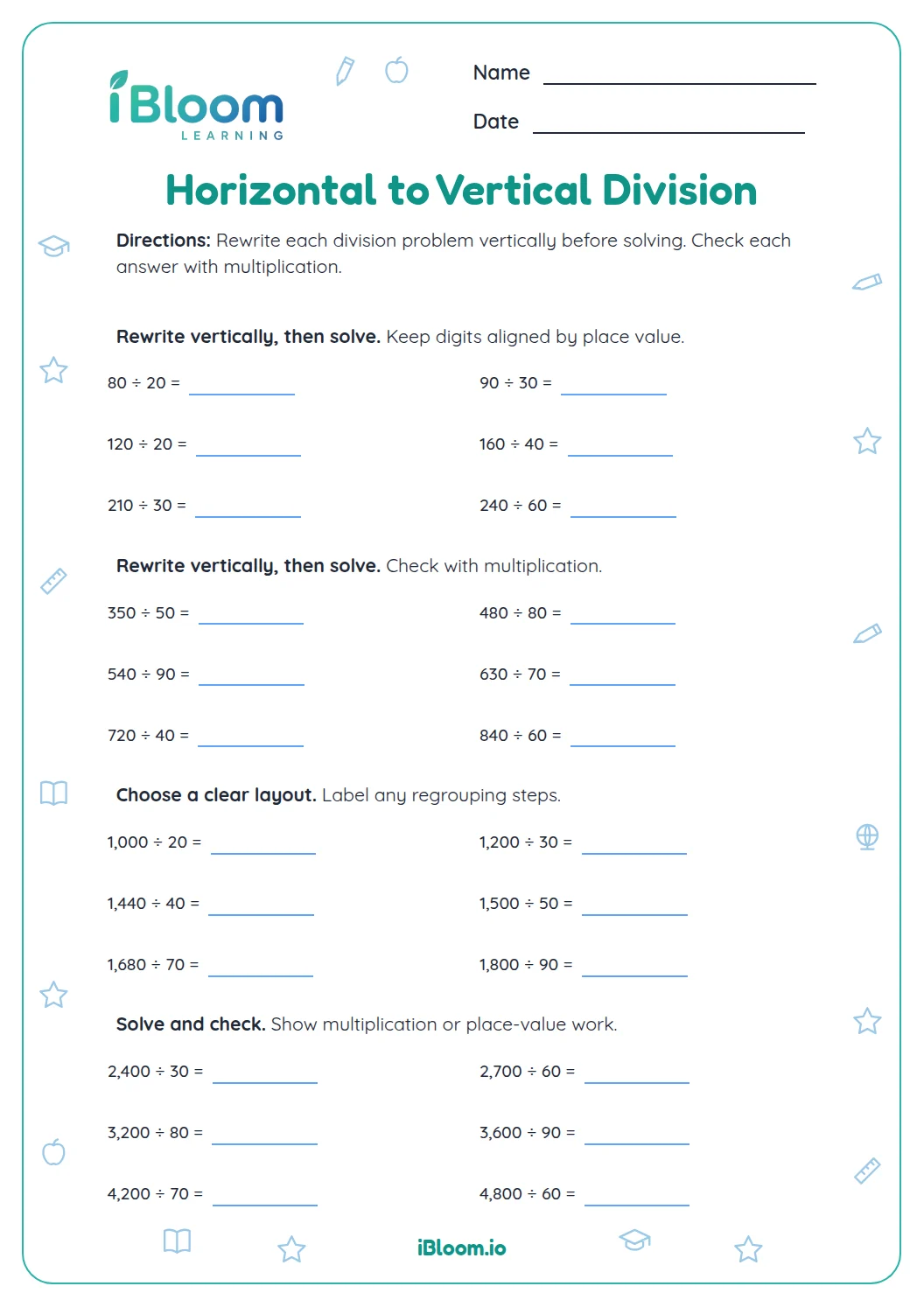


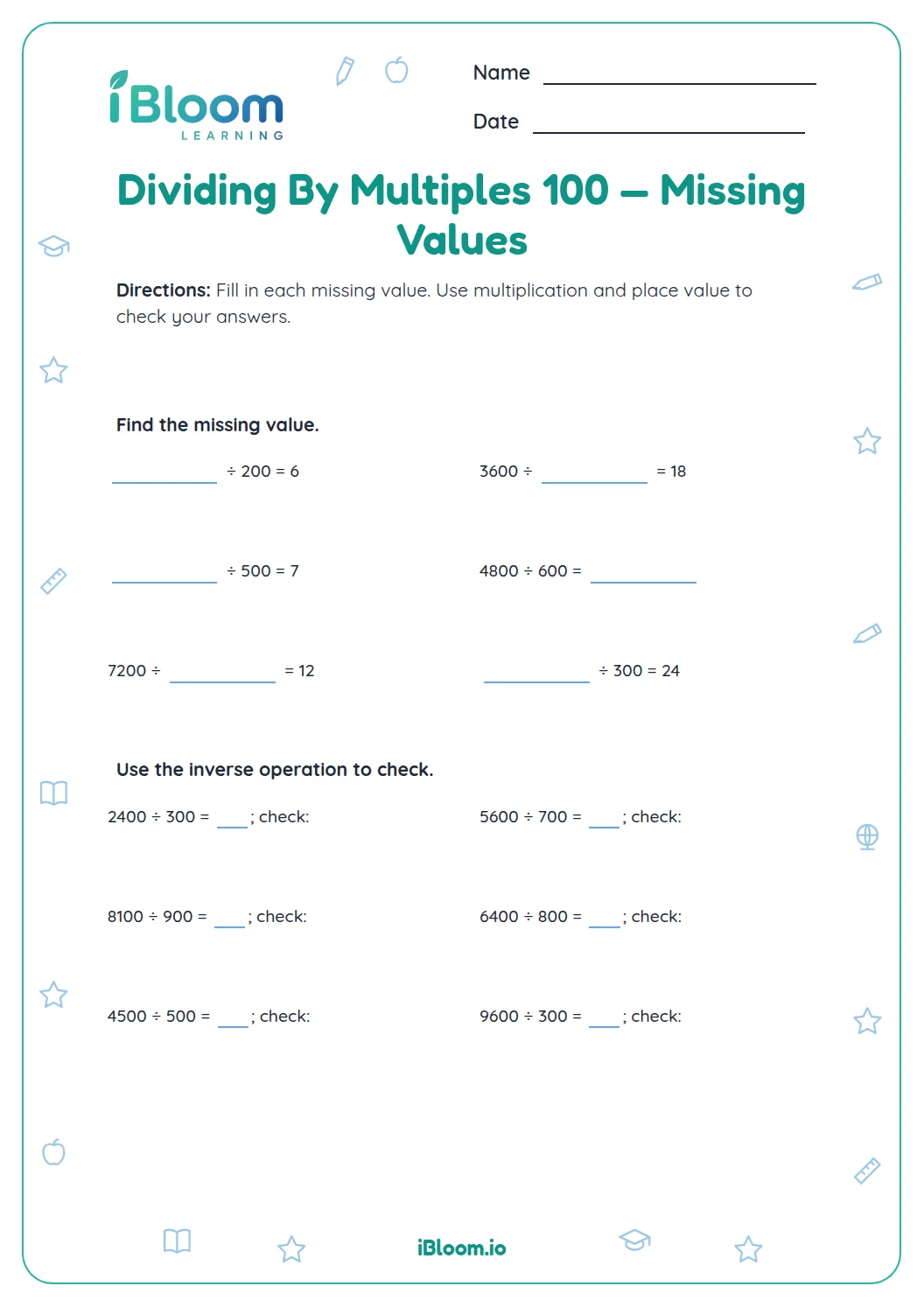
About this worksheet
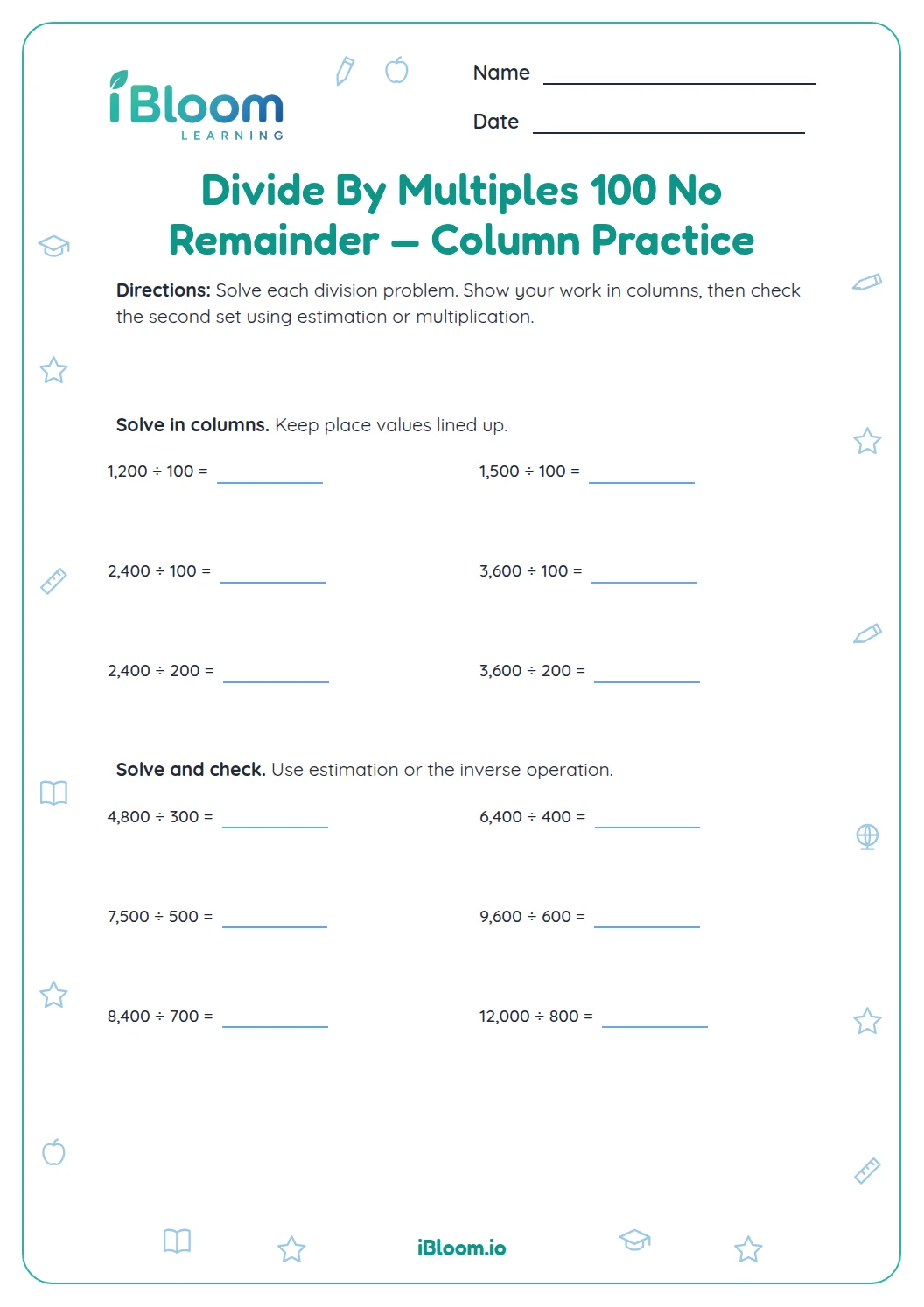
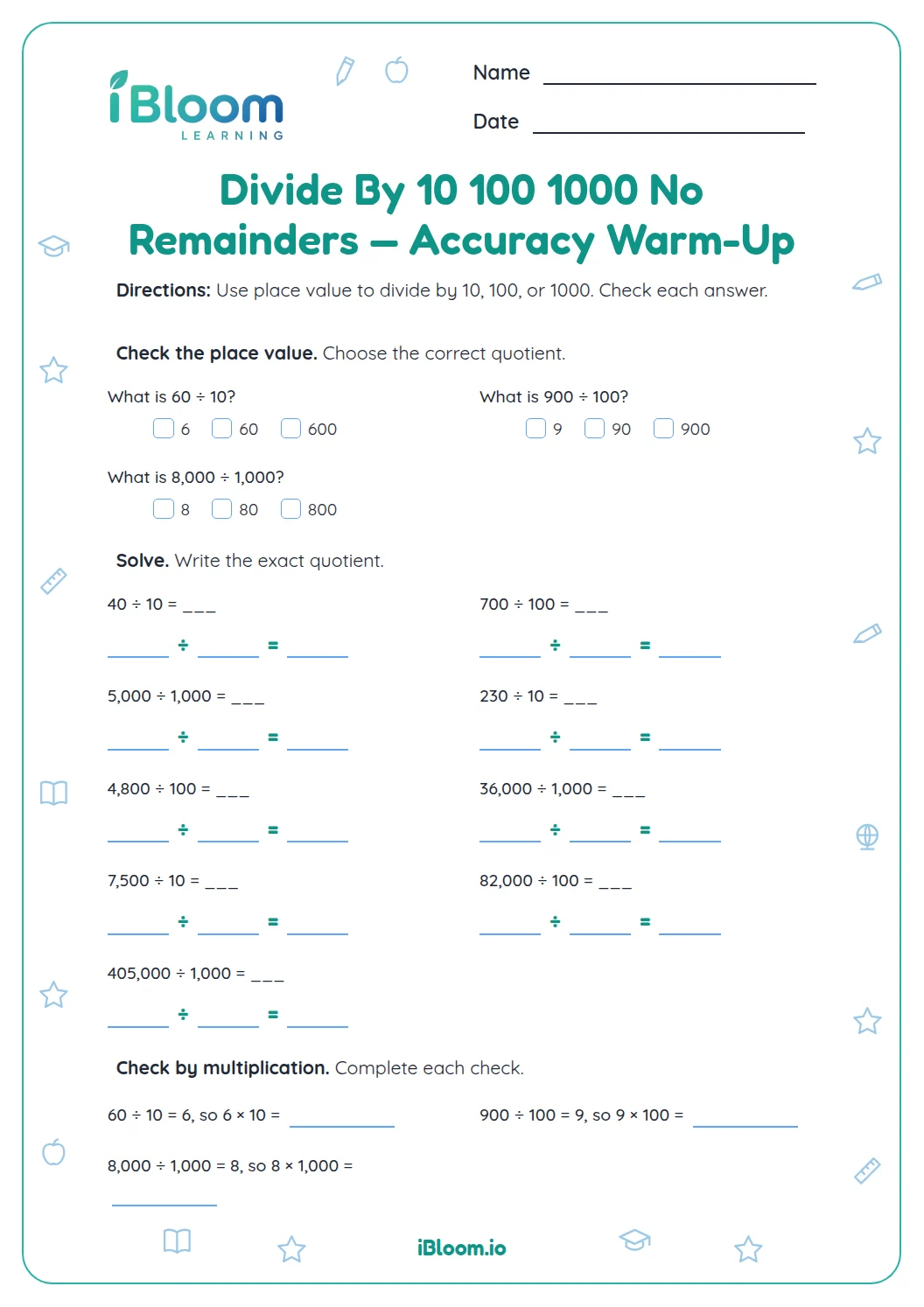
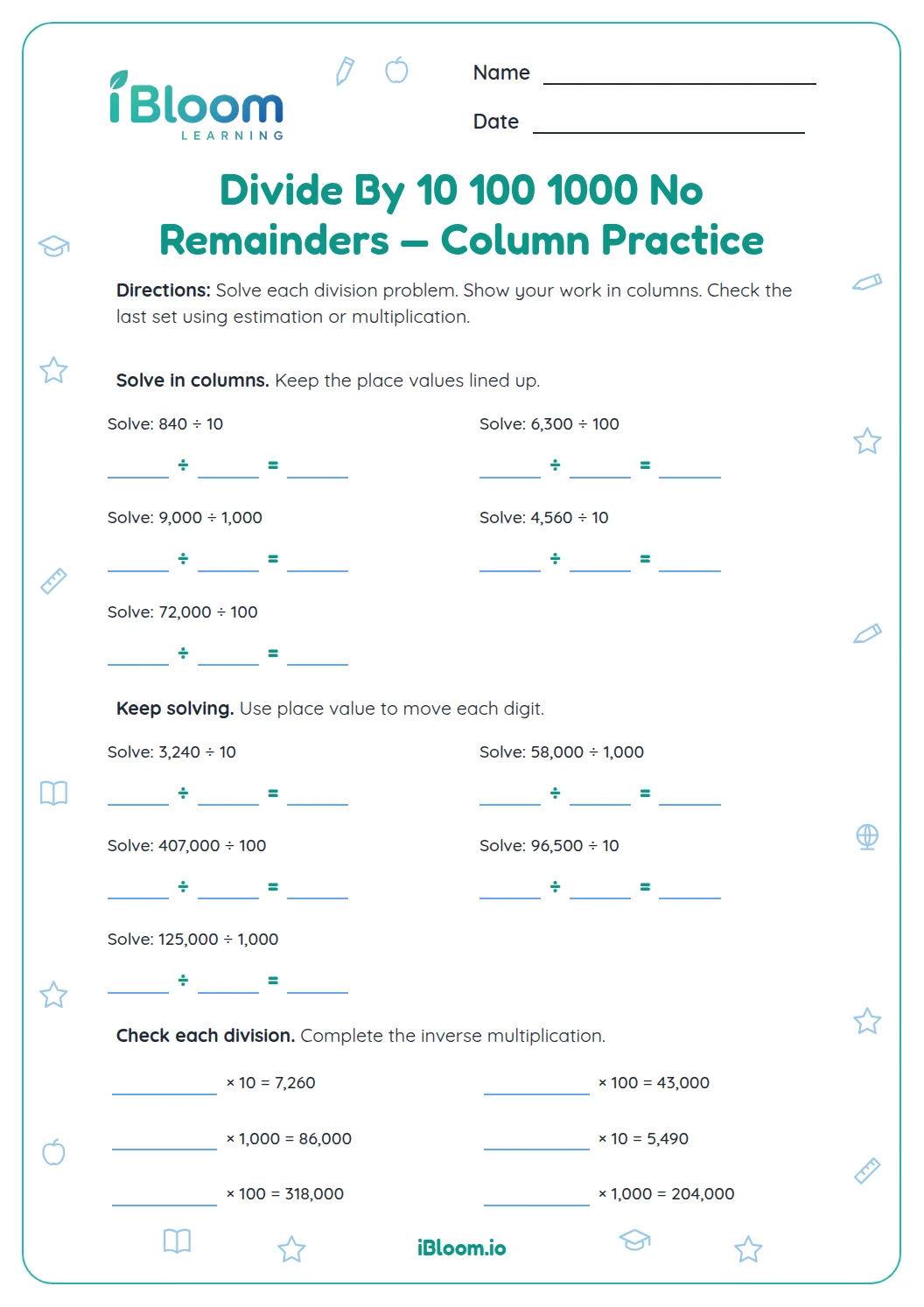
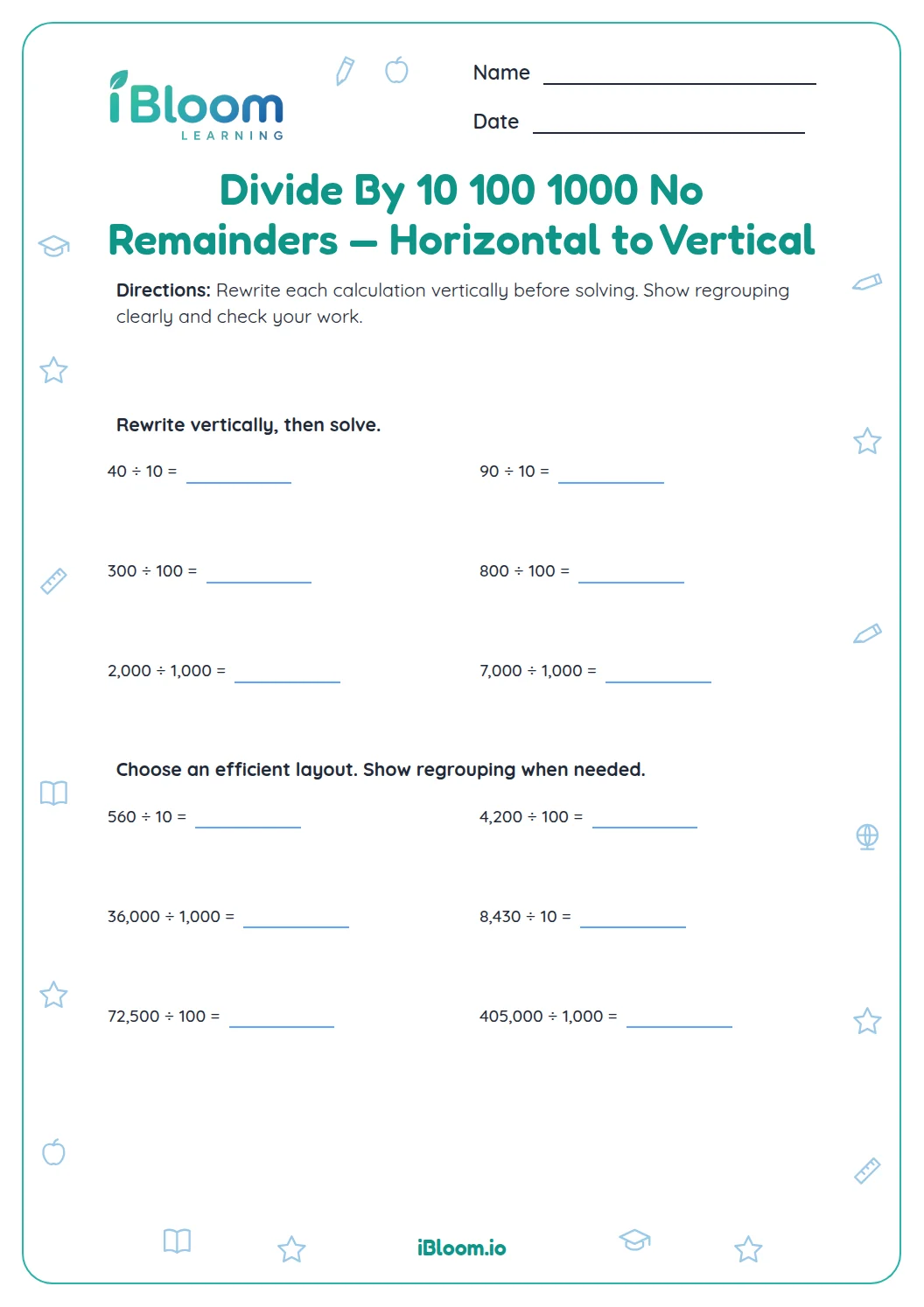
This Grade 6 worksheet rebuilds the old missing-value division drill with 16 equations and three kinds of unknown: quotient, dividend, and divisor. Every problem divides by or uses a multiple of 100, and every quotient is a whole number. Students can use place-value reasoning to find an unknown, then check each fact with multiplication. The separate answer key lists every missing value. It practices CCSS 6.NS.B.2.
How do you find a missing quotient?
Divide the dividend by the divisor. For 3,600 ÷ 300, divide both numbers by 100 to see the basic fact 36 ÷ 3. The quotient is 12, and 300 × 12 returns the original dividend.
- 13,600 ÷ 300 = ___
- 236 ÷ 3 = 12
- 3Answer: 12
What if the dividend or divisor is missing?
Use the relationship between the three numbers. If the dividend is missing, multiply the divisor by the quotient. If the divisor is missing, divide the dividend by the quotient.
How can multiplication check the result?
Multiply the divisor by the quotient. The product should equal the dividend. This check works for all three types of missing value and helps catch place-value errors with hundreds.
How to use this worksheet
- 1Circle the blank and name the missing part: dividend, divisor, or quotient.
- 2For a missing quotient, divide the dividend by the divisor.
- 3For a missing dividend, multiply the divisor by the quotient.
- 4For a missing divisor, divide the dividend by the quotient.
- 5Multiply divisor × quotient to check the original fact.
Common mistakes and quick fixes
The mistake
Treating a missing dividend like a missing quotient.
The fix
Name the unknown before calculating.
The mistake
Dropping two zeros from only one number.
The fix
Scale both dividend and divisor by the same factor when simplifying.
The mistake
Checking by dividing again instead of multiplying.
The fix
Multiply the quotient by the divisor and compare with the dividend.
What to practice next
Make more practice
Questions parents and teachers ask
How many problems are included?
There are 16 equations in three parts: eight missing quotients, four missing dividends, and four missing divisors. Every quotient is a whole number. Students can use written division and then check each result with the related multiplication fact. The equations use different division facts across the three parts.
How do you find the missing dividend?
Multiply the known divisor by the known quotient. For example, in ___ ÷ 400 = 12, calculate 400 × 12 to get 4,800. Put that product in the blank, then check that 4,800 divided by 400 equals 12. Students can use the multiplication fact as a final check.
How do you find a missing divisor?
Divide the known dividend by the quotient. In 6,300 ÷ ___ = 9, divide 6,300 by 9 to find 700. Check the result by multiplying 700 by 9; the product returns 6,300. Keeping the place-value zeros aligned helps prevent a tenfold error.
Why can both numbers sometimes be divided by 100?
Dividing the dividend and divisor by the same nonzero factor preserves the quotient. For 3,600 ÷ 300, the equivalent basic fact is 36 ÷ 3. The original values remain important, so multiply the quotient by 300 to verify the original division.
What does the answer key show?
The separate answer key lists the missing value for all 16 equations. Students can compare their answer and use multiplication to check it. For example, a missing dividend is checked by multiplying the shown divisor by the shown quotient. The values are grouped by which part of the division fact is missing.