







About this worksheet
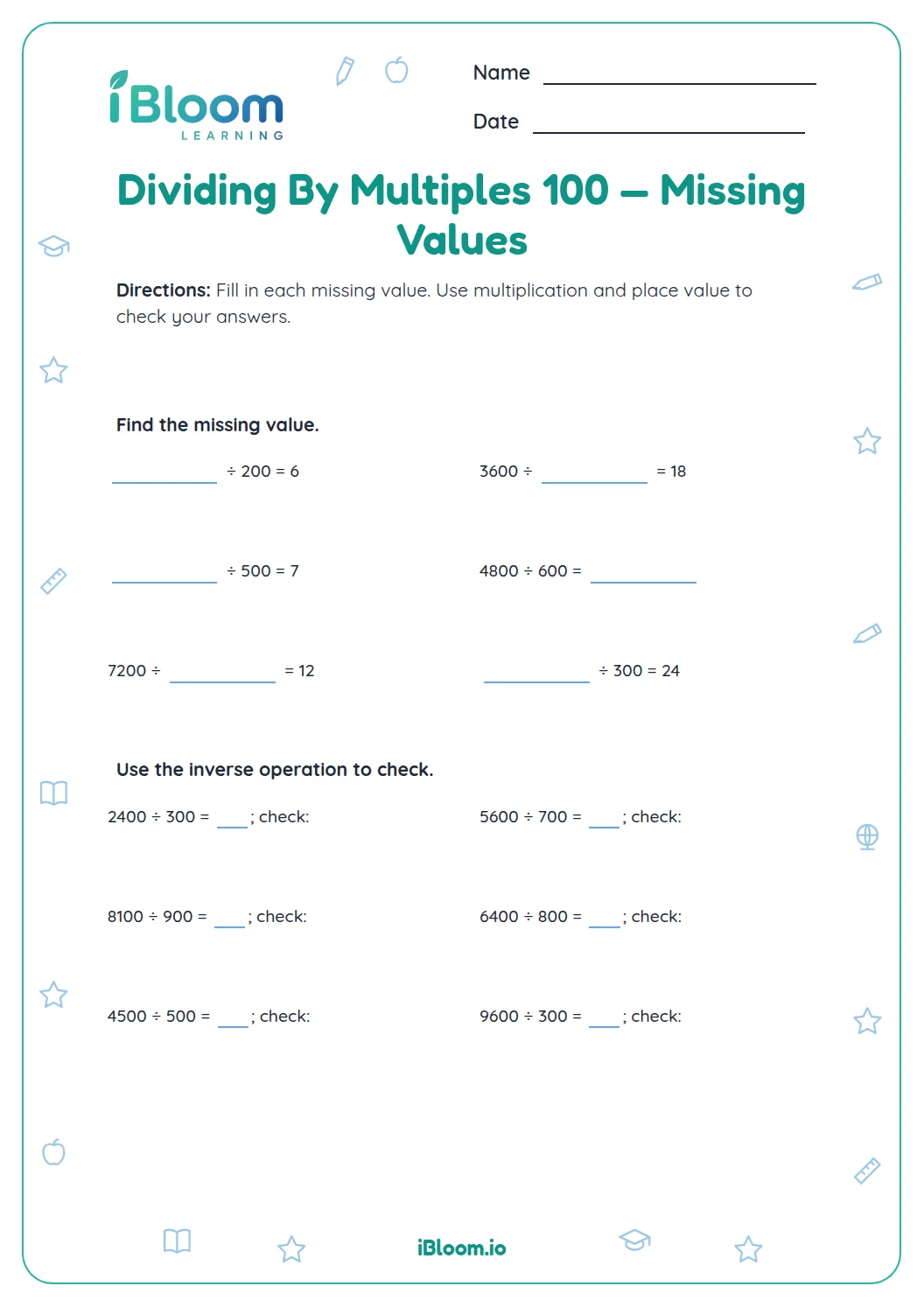
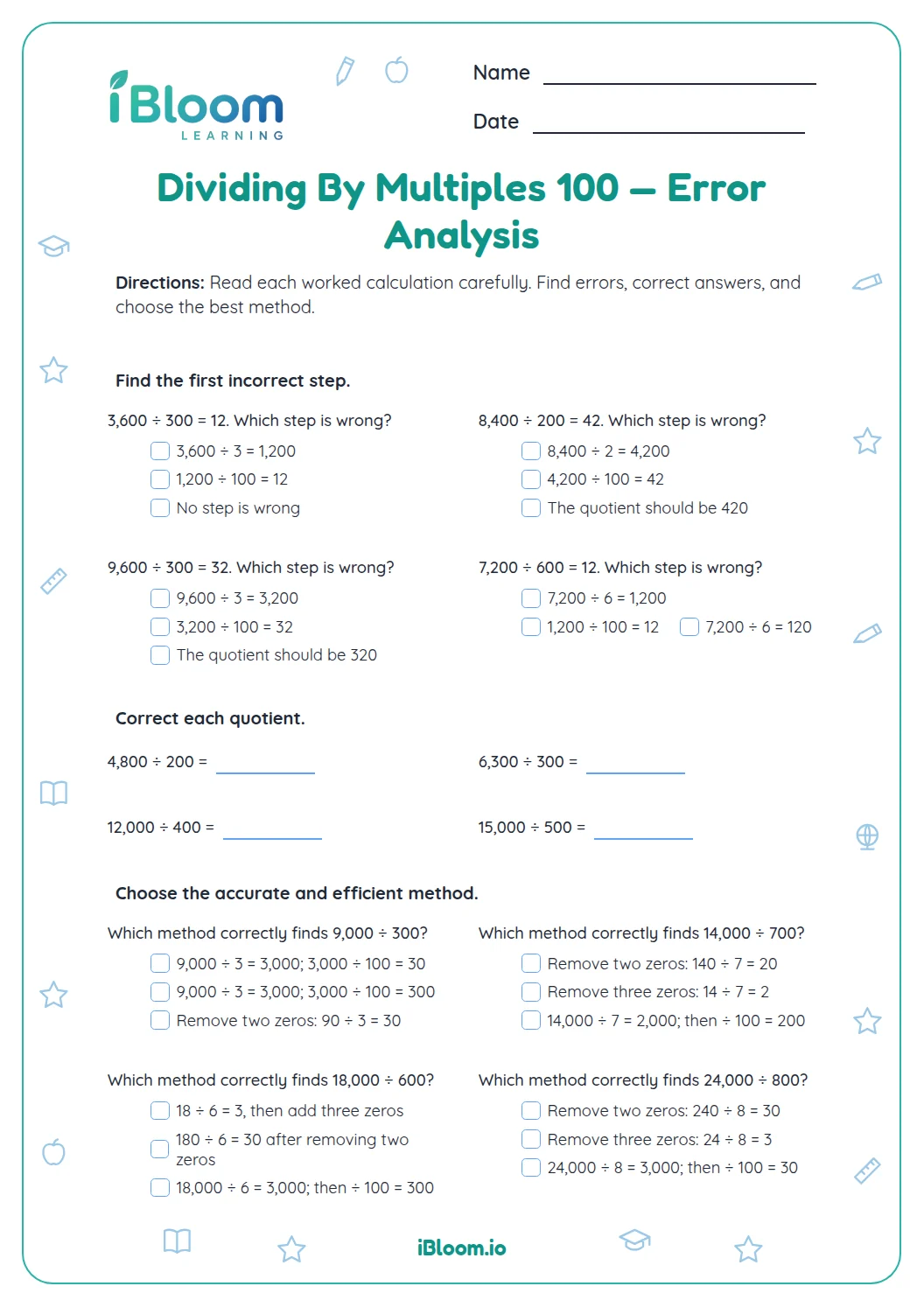
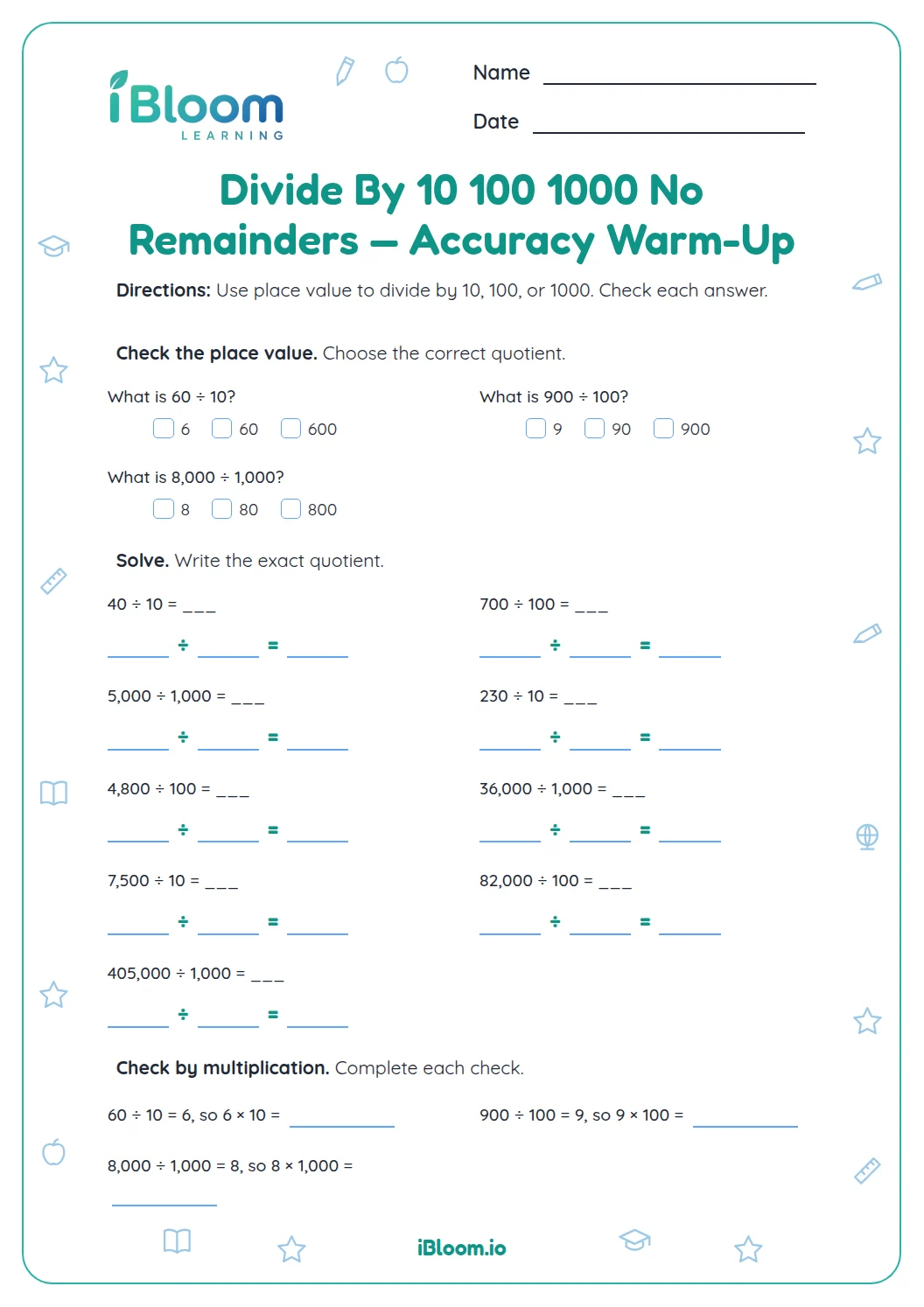
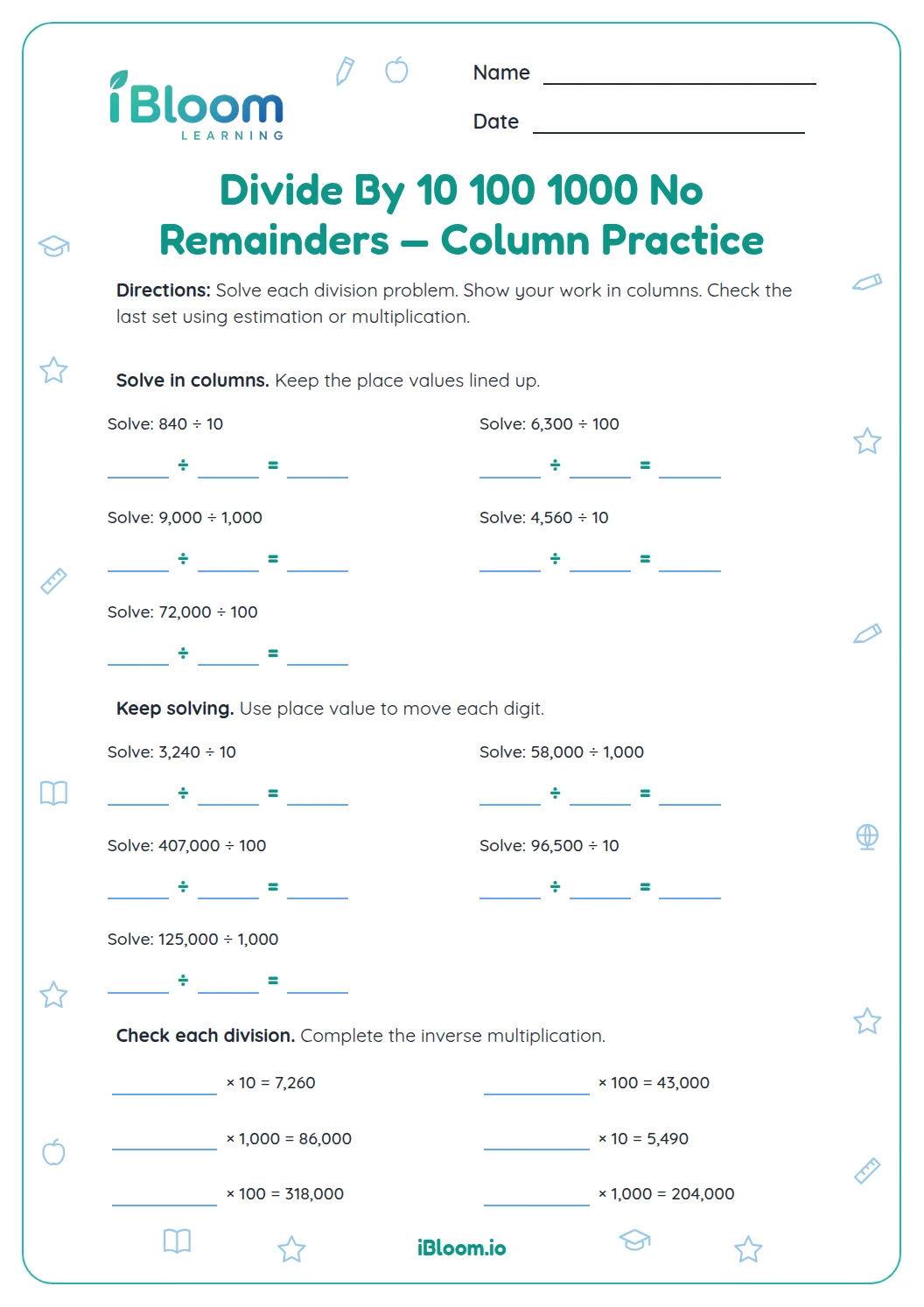
This printable warm-up gives Grades 4–6 practice dividing whole numbers by multiples of 100. Students solve exact quotients, find missing dividends or divisors, and apply division to equal-group situations. The 16 questions emphasize place value and multiplication checks, with a separate answer key for independent review.
How can you divide by a multiple of 100?
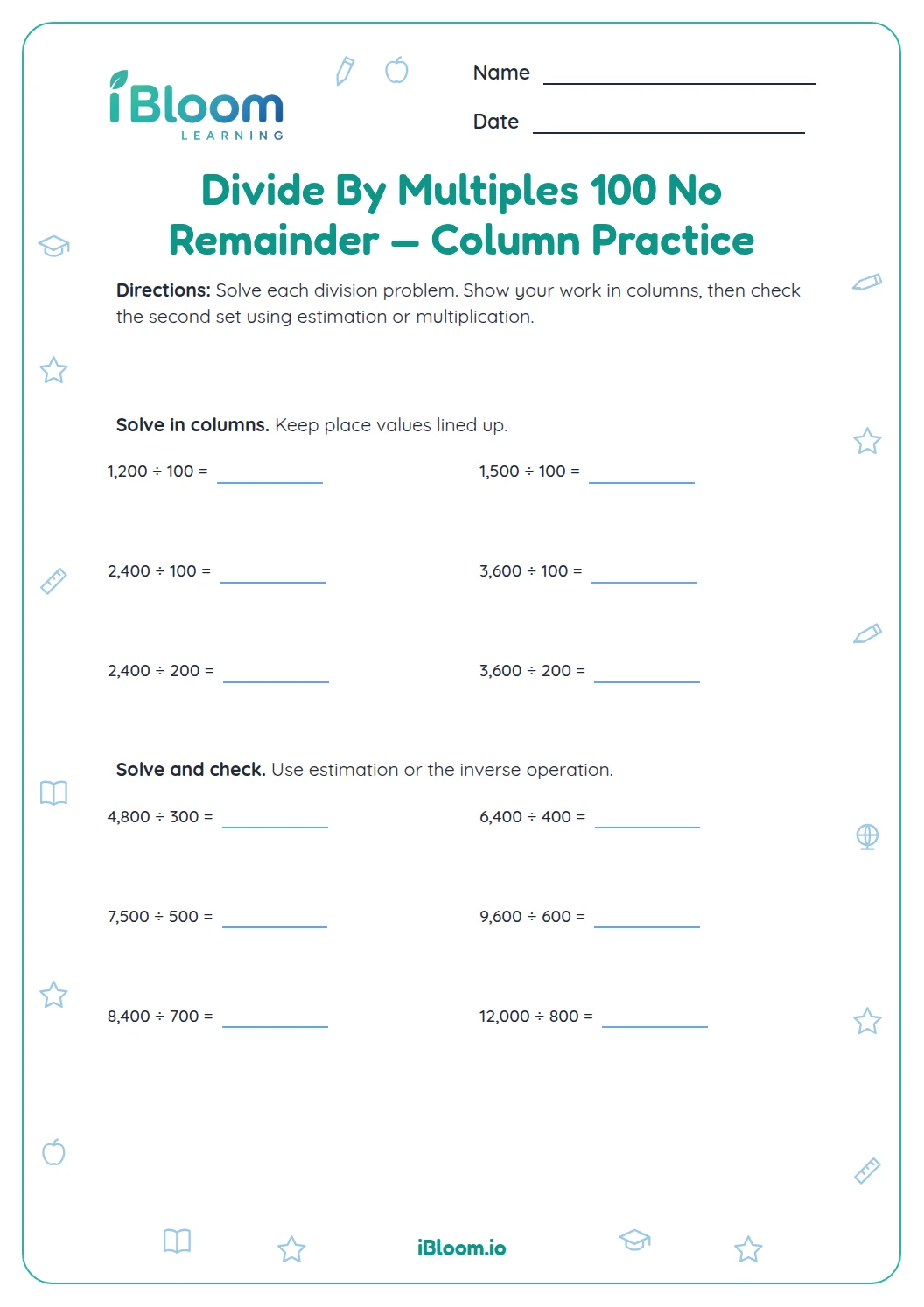
Think of the dividend and divisor in hundreds. For 2,400 ÷ 300, there are 24 hundreds divided into groups of 3 hundreds, so the quotient is 8. Multiplication checks it: 300 × 8 = 2,400.
- 12,400 ÷ 300 = 24 hundreds ÷ 3 hundreds
- 224 ÷ 3 = 8
How do you find a missing value?
Use the inverse relationship. If ___ ÷ 400 = 6, multiply 400 by 6 to get 2,400. If 4,500 ÷ ___ = 5, divide 4,500 by 5 to find 900.
How do you interpret the word problems?
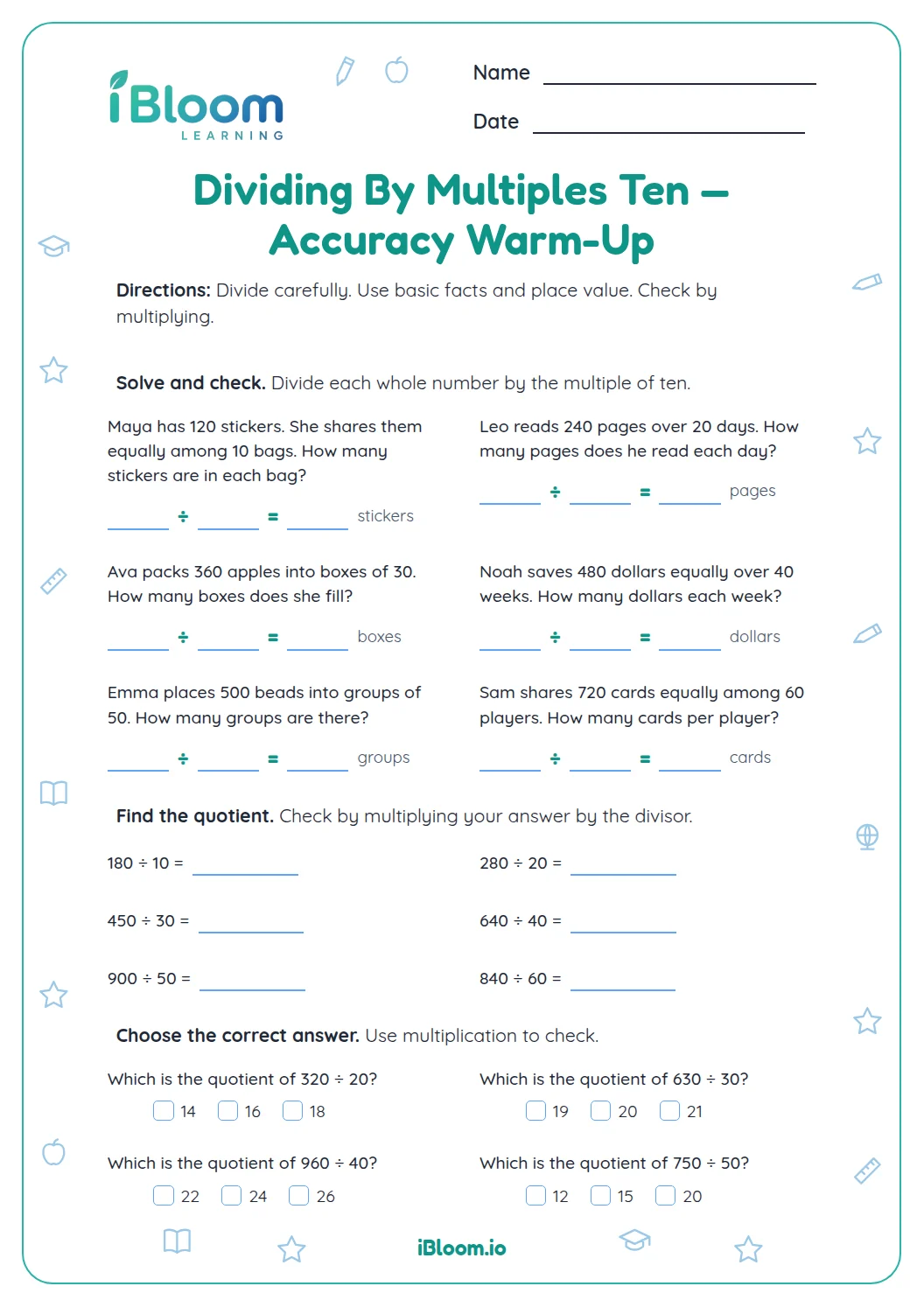
Identify the total and the size of each equal group, then divide. Include the unit in the answer so “8” becomes “8 stickers” or “8 beads.” Check that the number of groups or items makes sense in context.
How to use this worksheet
- 1Circle or underline the divisor and dividend in each equation.
- 2Rewrite the numbers as hundreds when that makes the quotient clear.
- 3For a missing dividend, multiply divisor by quotient.
- 4For a missing divisor, divide dividend by quotient.
- 5For a story problem, include the requested unit and check by multiplication.
Common mistakes and quick fixes
The mistake
Removing zeros without removing the same place-value factor from both numbers.
The fix
Rewrite both numbers in hundreds and divide those values.
The mistake
Using addition to check a division answer.
The fix
Multiply divisor by quotient and see whether you recover the dividend.
The mistake
Giving only a number for a story problem.
The fix
Add the unit named in the question, such as stickers, beads, boxes, or groups.
What to practice next
Make more practice
Questions parents and teachers ask
What does dividing by a multiple of 100 mean?
A multiple of 100 is a number such as 300, 600, or 900. This worksheet asks students to divide whole-number totals by those divisors and reason about the hundreds in both numbers. Multiplication provides a useful way to check each quotient.
How many problems are included?
The worksheet has 16 questions across four parts: six quotient facts, six equations with a missing dividend or divisor, and four equal-group word problems. Each word problem asks for a quotient with a unit, and the separate answer key includes all results.
Why can 2,400 divided by 300 be treated as 24 divided by 3?
Both 2,400 and 300 contain a factor of 100. Thinking of them as 24 hundreds and 3 hundreds preserves the quotient, so 24 ÷ 3 = 8. The units of hundreds cancel because both amounts are expressed in the same unit.
How can students check a division result?
Multiply the divisor by the quotient. For example, 300 × 8 equals 2,400, so 2,400 ÷ 300 is 8. For a missing value, use the same relationship to rebuild the number that belongs in the blank, then check the original equation.
Should a word problem answer include a unit?
Yes. The unit tells what the quotient counts. If 2,400 stickers are divided among 300 bags, the answer is 8 stickers per bag. If 3,600 pages are grouped into boxes of 400, the answer describes boxes and shows how many groups are filled.
What should students do if a quotient is not immediate?
Write a multiplication fact for the missing number or rewrite both quantities in hundreds. This often makes the place-value relationship easier to see. Students can then multiply their quotient by the divisor to confirm the original dividend and check the quotient.