






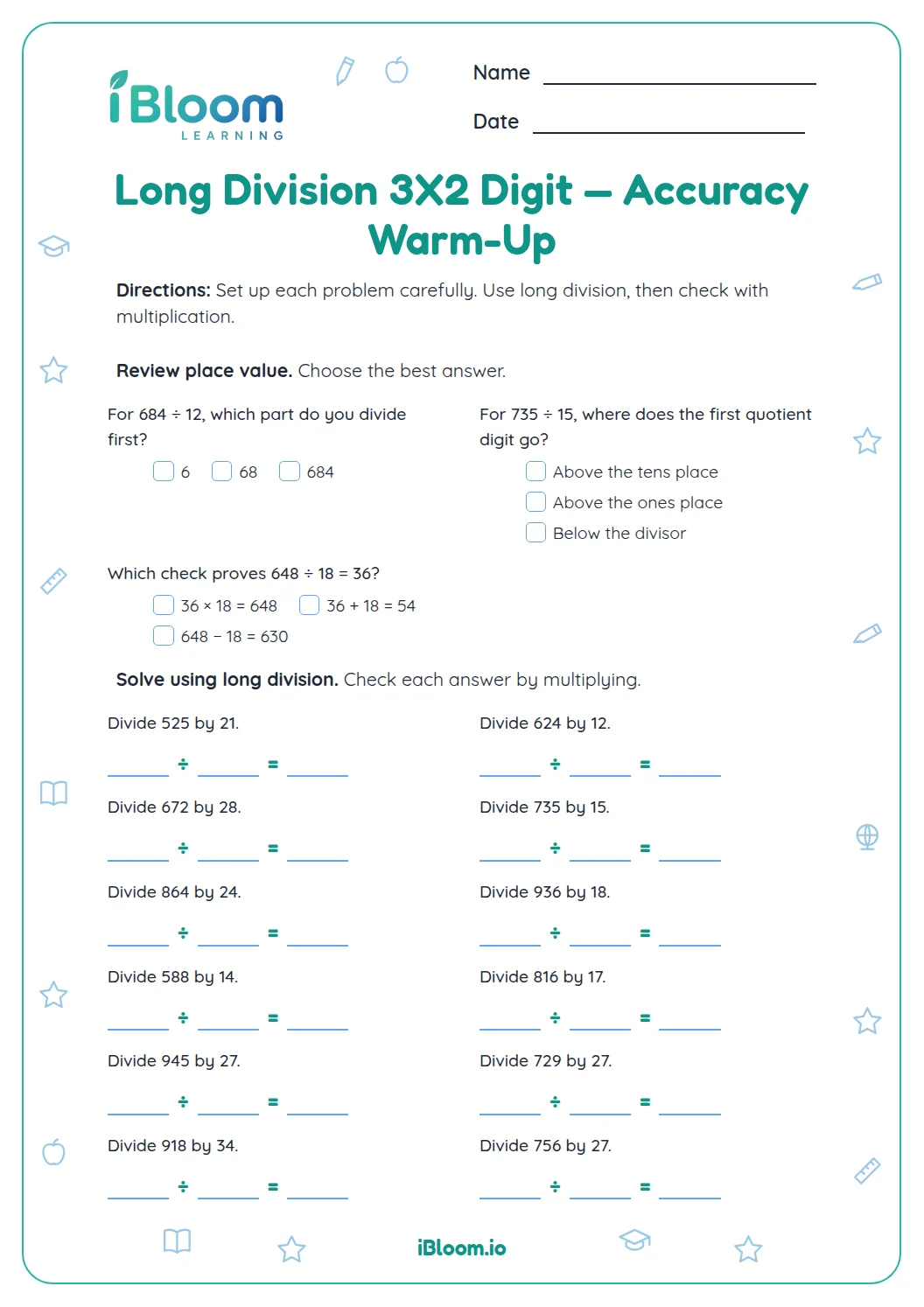
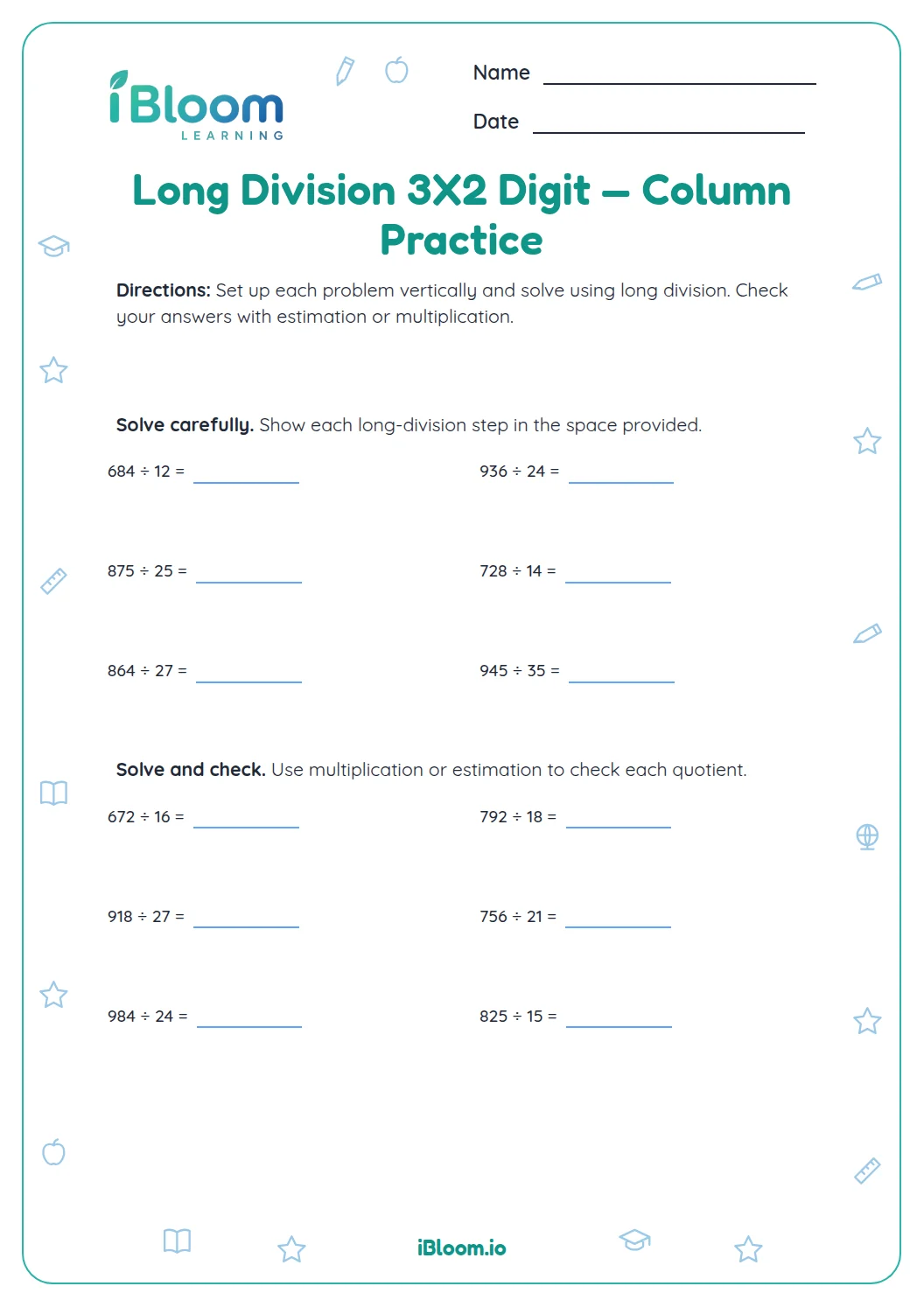

About this worksheet
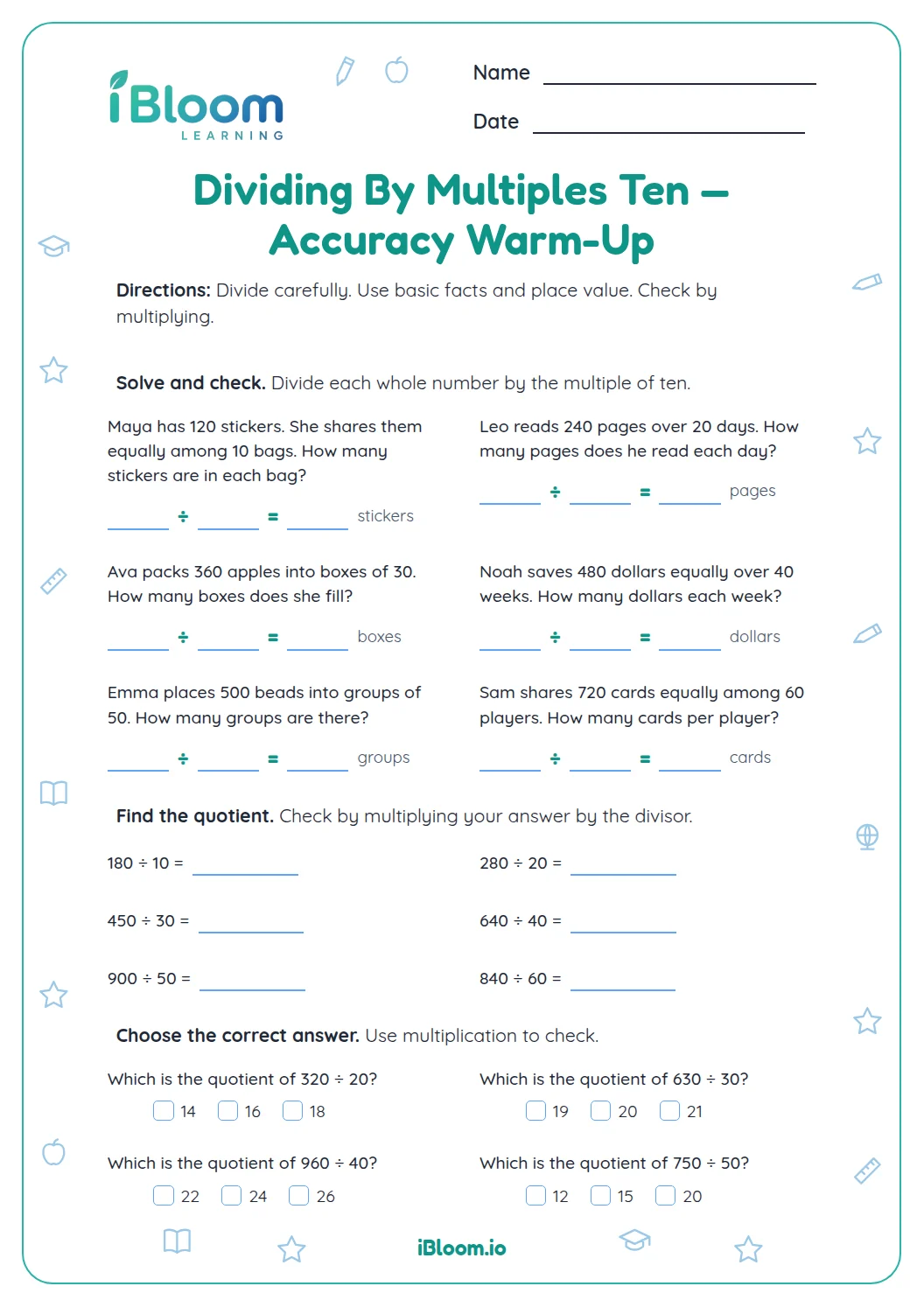
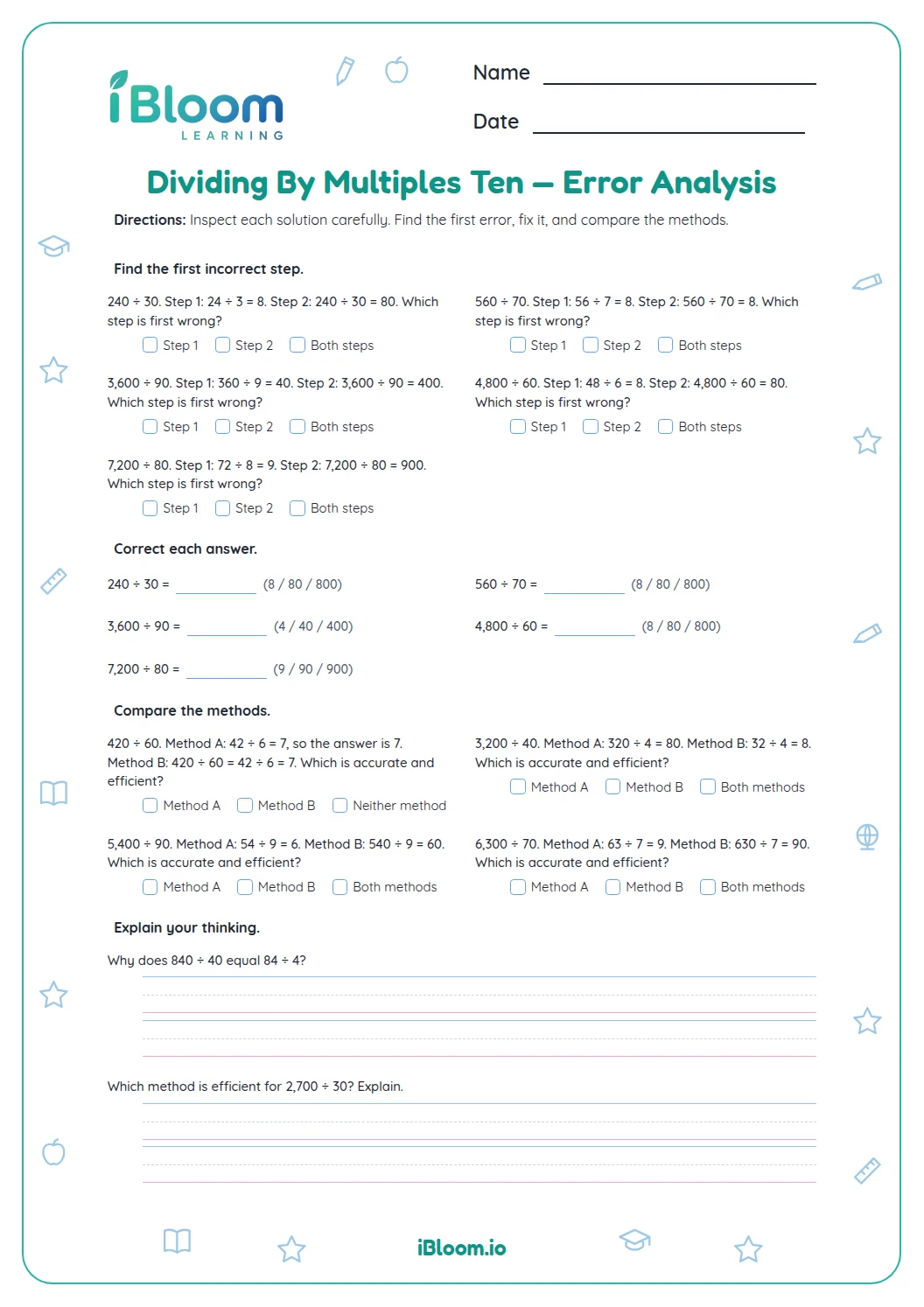
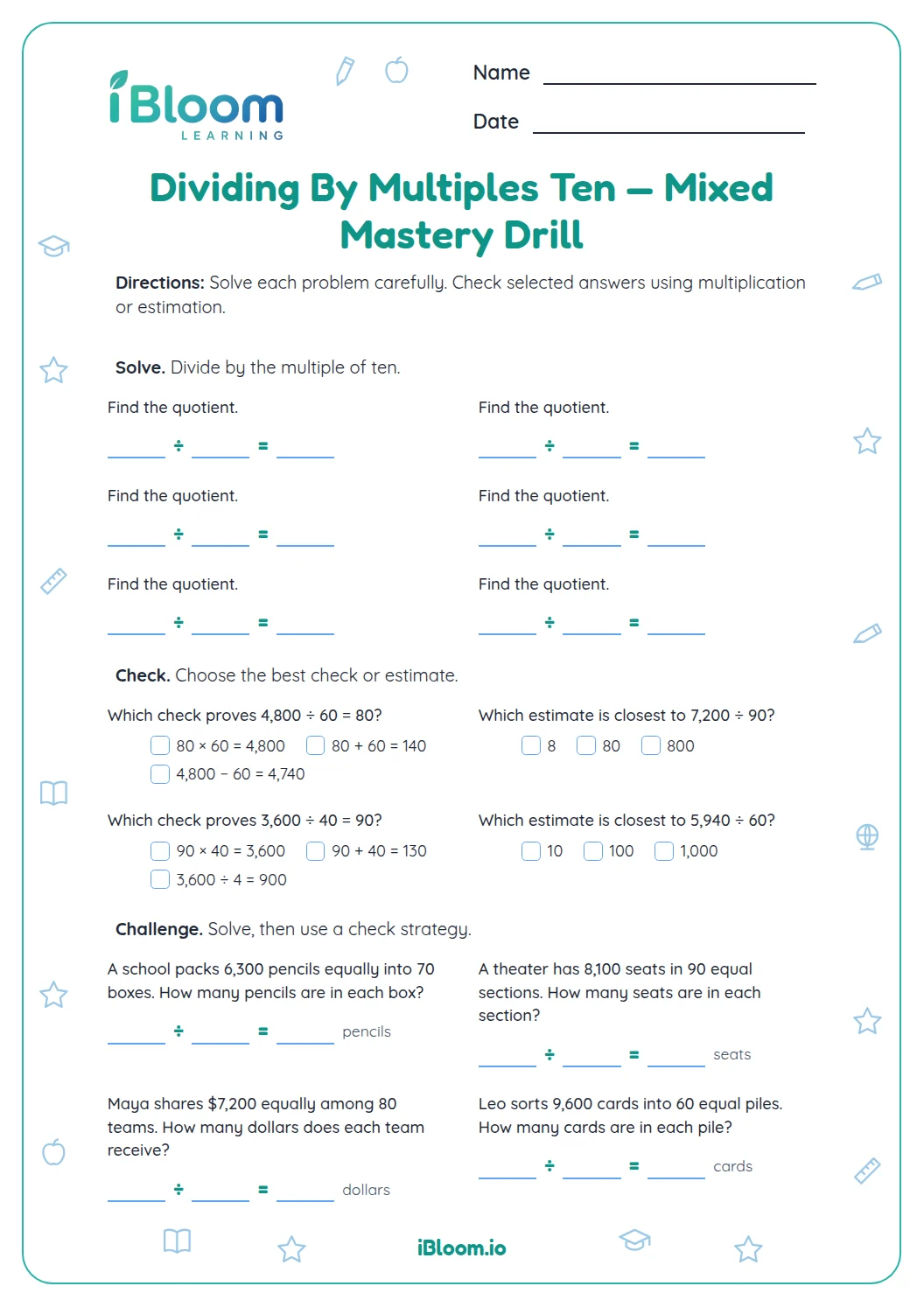
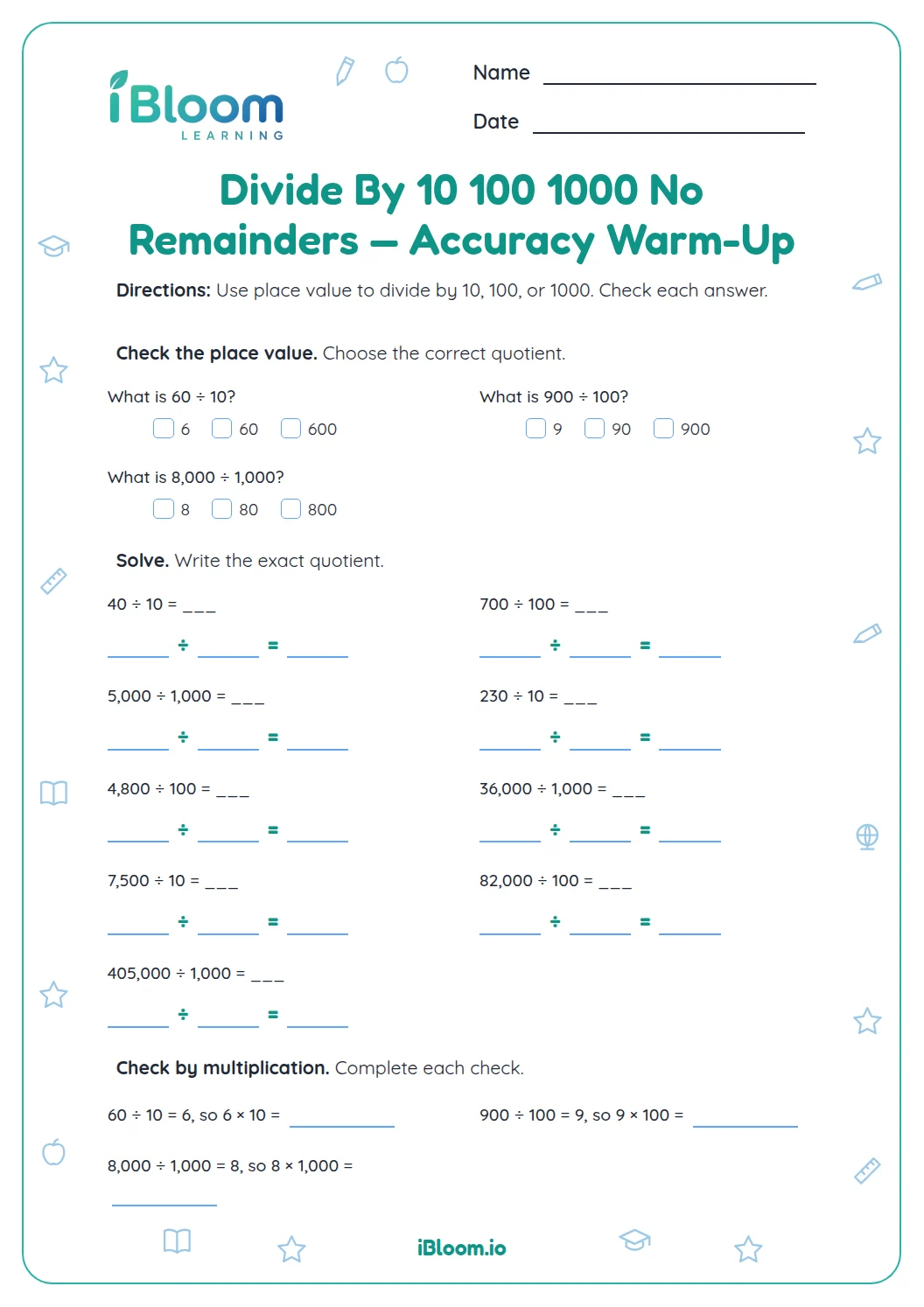
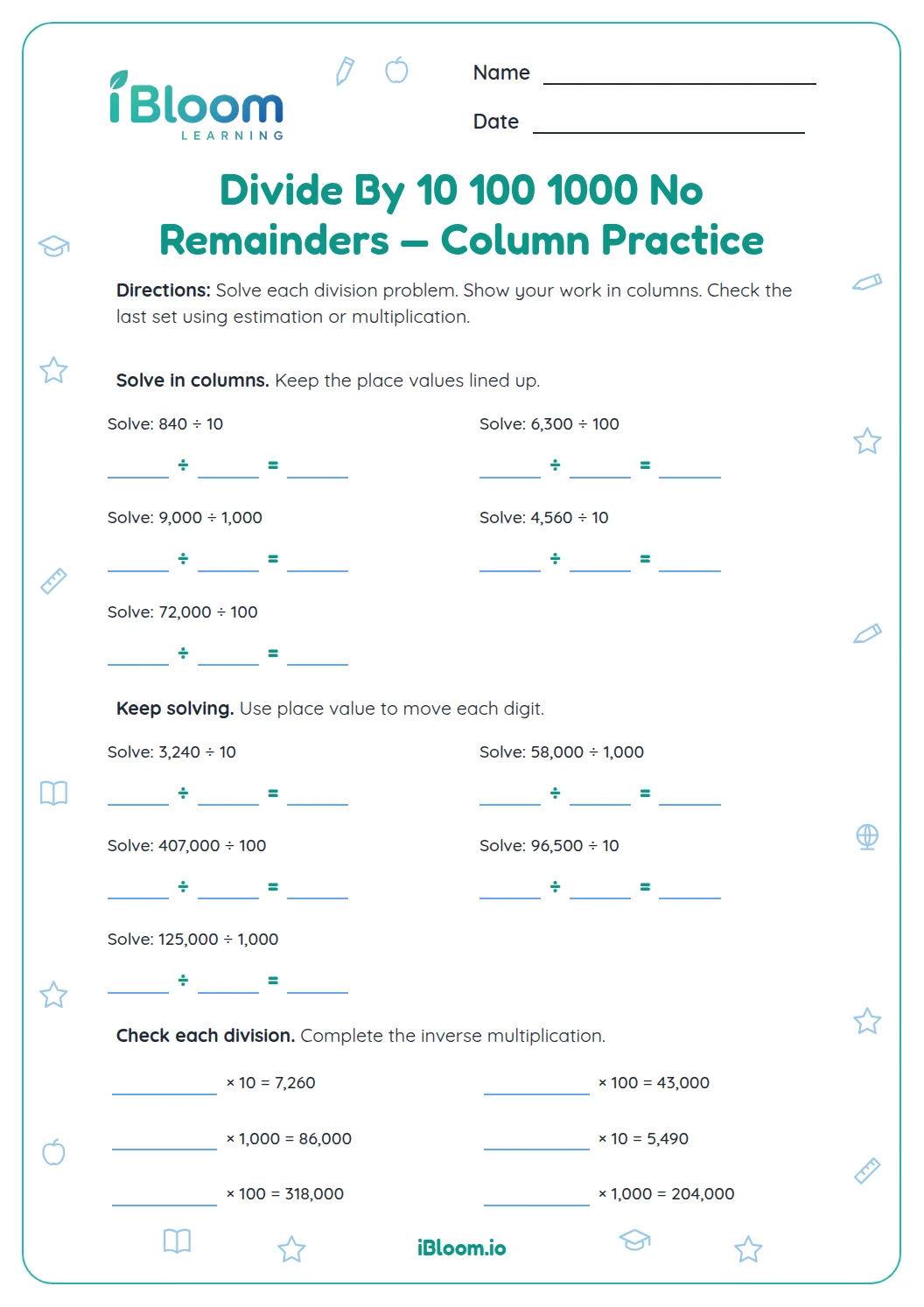
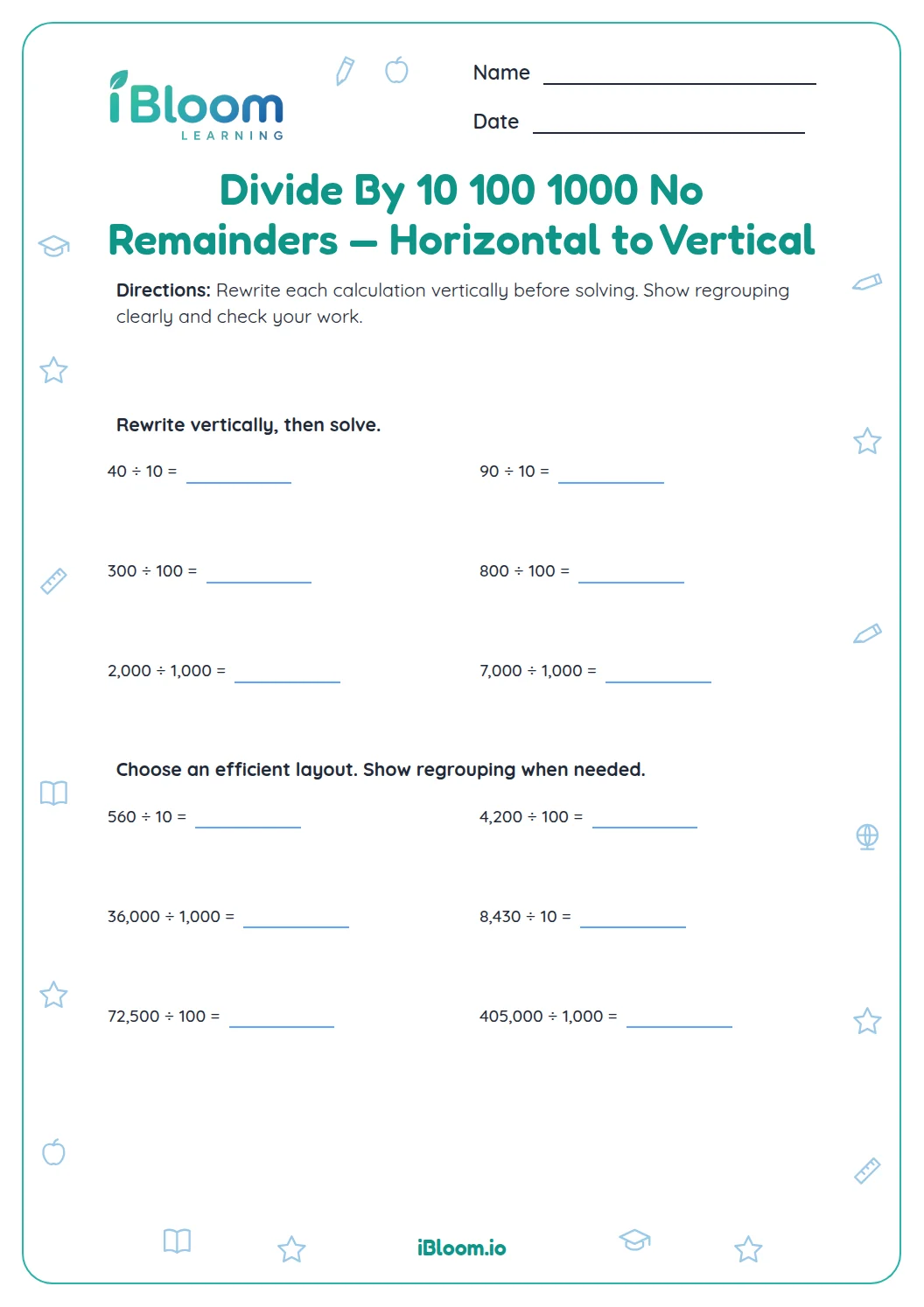
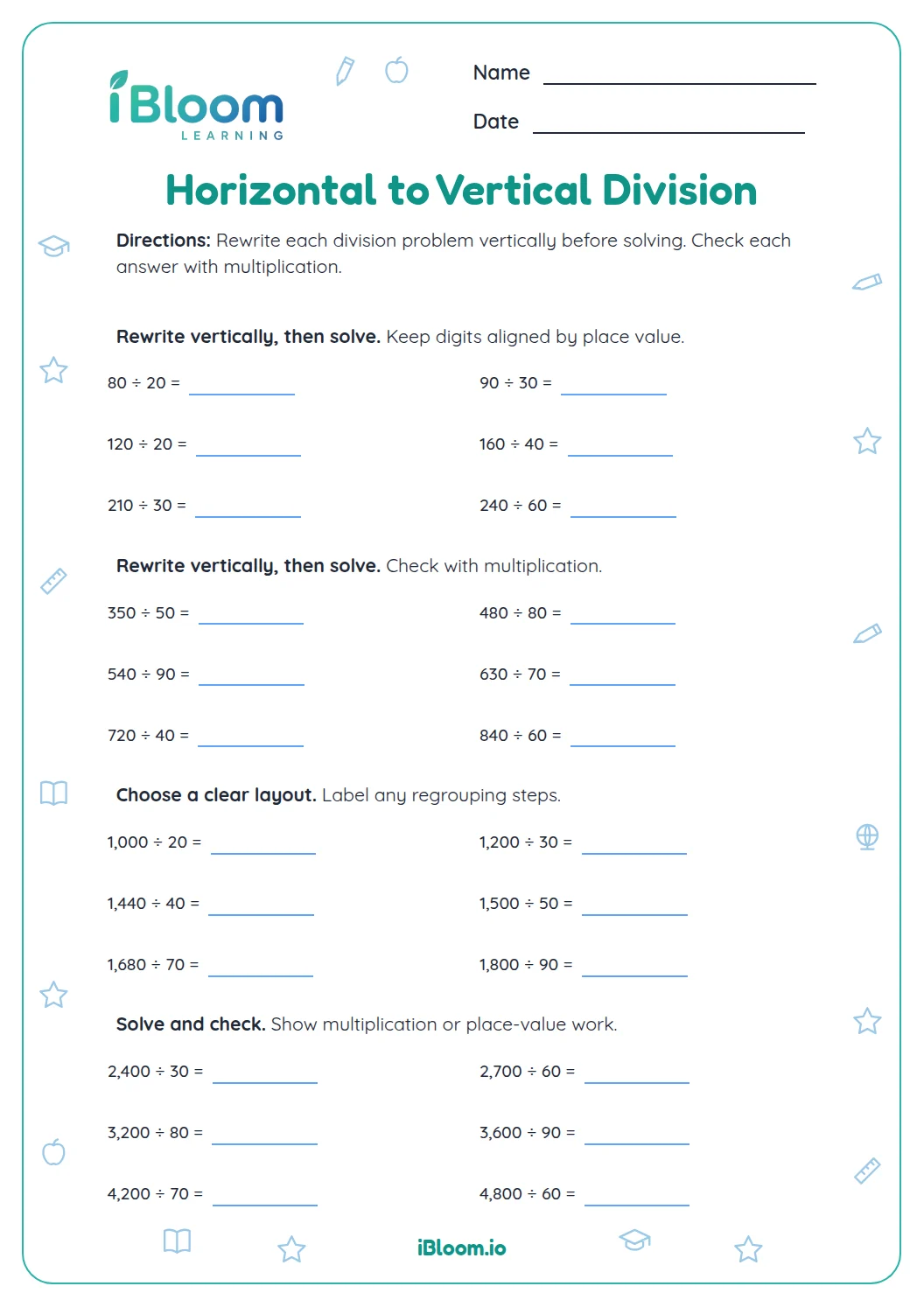
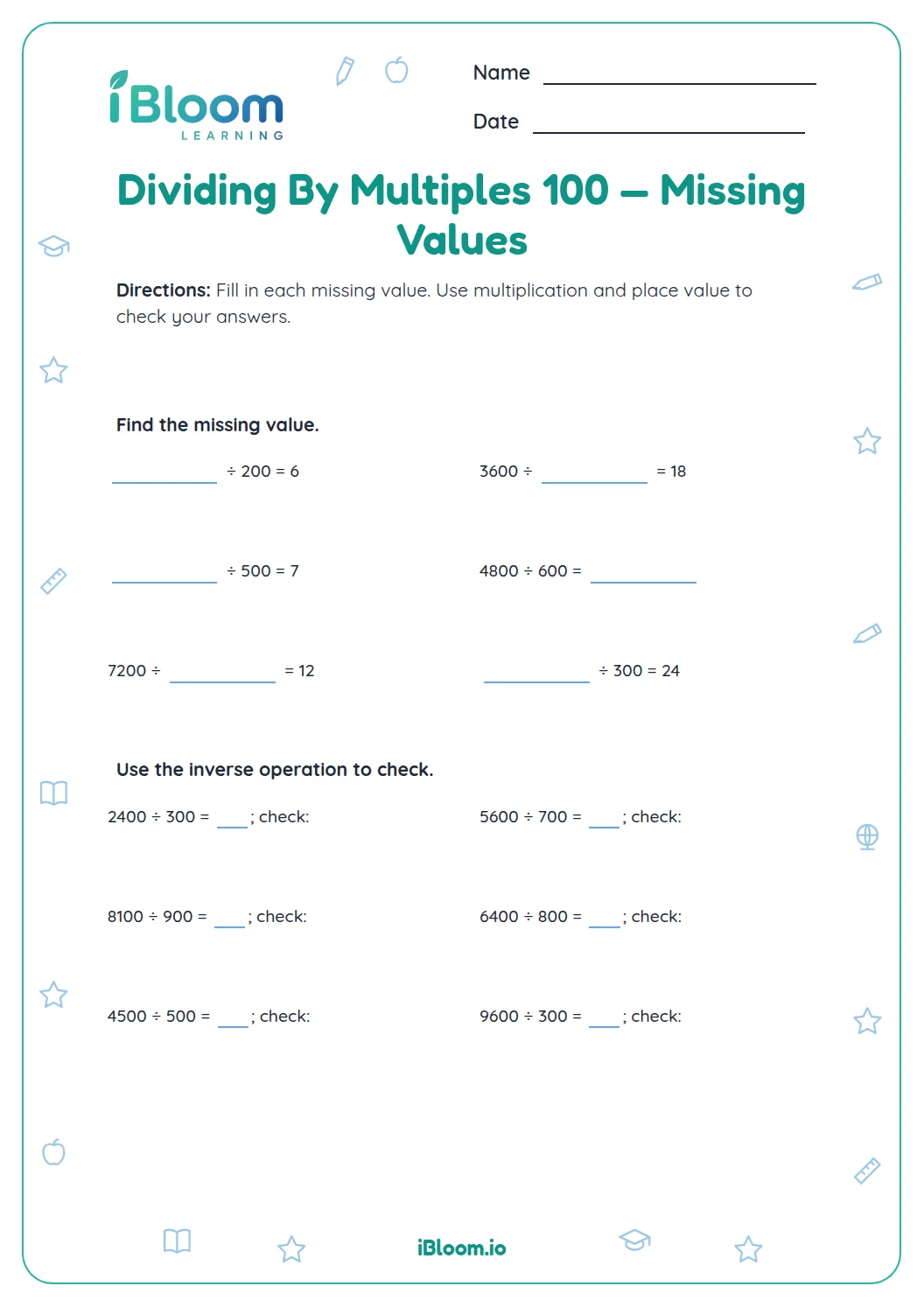
This free worksheet gives students in Grades 4–6 twenty-four division equations and one explanation task. Divisors are multiples of ten from 20 to 90. Part A hides the quotient, Part B hides the dividend, and Part C mixes blank positions. In Part D, students explain 960 ÷ 80 using tens and write a multiplication check. This practices Common Core 5.NBT.B.6 through place value and the relationship between multiplication and division. A separate answer key supplies every missing number and a model explanation.
Aligned to 5.NBT.B.6
How does thinking in tens help?
In 120 ÷ 20, think of 12 tens divided into groups of 2 tens. There are 6 groups. Both amounts were renamed in tens, so the quotient stays 6.
The same idea works for 960 ÷ 80: 96 tens divided by 8 tens gives 12 groups. Keep track of what each number means instead of adding a zero to the quotient.
How does the blank position change the work?
For a missing dividend, multiply the two known numbers. Question 9, ___ ÷ 20 = 9, asks what total makes nine groups of twenty: 180.
For a missing divisor, divide the dividend by the quotient. The result is the size of each group, which is a multiple of ten on this sheet.
- 1420 ÷ ___ = 7
- 2Missing divisor = 420 ÷ 7 = 60
- 3Check: 60 × 7 = 420
What practice is in each part?
Part A has eight missing quotients. Part B has six missing dividends. Part C has ten mixed equations: six missing divisors, two missing quotients, and two missing dividends. Part D asks for an explanation using tens and a multiplication check.
All missing values are whole numbers and every division is exact. For the final question, students explain why 96 tens divided into groups of 8 tens makes 12 groups, then verify that 80 × 12 = 960.
Solve each equation in two directions
- 1Point to the blank and name it: dividend, divisor, or quotient.
- 2Use tens to simplify a division such as 350 ÷ 50.
- 3Multiply divisor by quotient when the dividend is missing.
- 4Divide the dividend by the known factor when the divisor is missing.
- 5Put the answer back into the original equation and check with multiplication.
- 6In Part D, explain the groups of tens in words and write the multiplication equation that checks them.
Mistakes to notice and fix
The mistake
Writing 60 for 120 ÷ 20 because the numbers end in zero.
The fix
Rename both numbers in tens: 12 tens ÷ 2 tens = 6.
The mistake
Dividing 9 by 20 in ___ ÷ 20 = 9.
The fix
The blank is the total. Multiply 20 × 9 to get 180.
The mistake
Multiplying 420 by 7 in 420 ÷ ___ = 7.
The fix
The blank is a factor of 420. Find 420 ÷ 7, then check 60 × 7.
Common Core alignment
Use place value and multiplication to find missing values in division equations.
On this sheet: Students find missing values with two-digit divisors, then explain a quotient using tens and multiplication.
Show the official wordingHide the official wording
Find whole-number quotients of whole numbers with up to four-digit dividends and two-digit divisors, using strategies based on place value, the properties of operations, and/or the relationship between multiplication and division. Illustrate and explain the calculation by using equations, rectangular arrays, and/or area models.
What to practice next
Make more practice
Further reading
Questions parents and teachers ask
Which numbers can be missing?
A quotient, dividend, or divisor can be missing. Part A has eight missing quotients, Part B has six missing dividends, and Part C mixes blank positions across ten equations. Part D asks for an explanation and a multiplication check. Name each missing quantity before choosing an operation.
Why does 120 divided by 20 equal 6?
There are six groups of twenty in one hundred twenty. You can also rename the amounts as 12 tens and 2 tens, then calculate 12 divided by 2. Checking with 20 times 6 gives 120 and confirms that the quotient is six groups.
How should students solve a missing divisor?
Divide the dividend by the quotient to find the missing divisor. In question 15, 420 divided by the blank equals 7, so 420 divided by 7 gives 60. Substitute 60 into the original equation, then multiply 60 by 7 to verify the total.
Should this worksheet be timed?
Timing is optional; use the first attempt to check accuracy and reasoning. Students can pause to identify each blank, think in tens, and verify a multiplication fact. Complete the explanation in Part D before checking the key, so you can see how the student arrived at the quotient.
What should I check besides the final answers?
Check whether the student chose an operation that matches the blank position. A correct multiplication check is especially helpful for missing divisors and dividends. Ask the student to explain one example from each part, using the completed equation to show how its three numbers fit together.