






About this worksheet
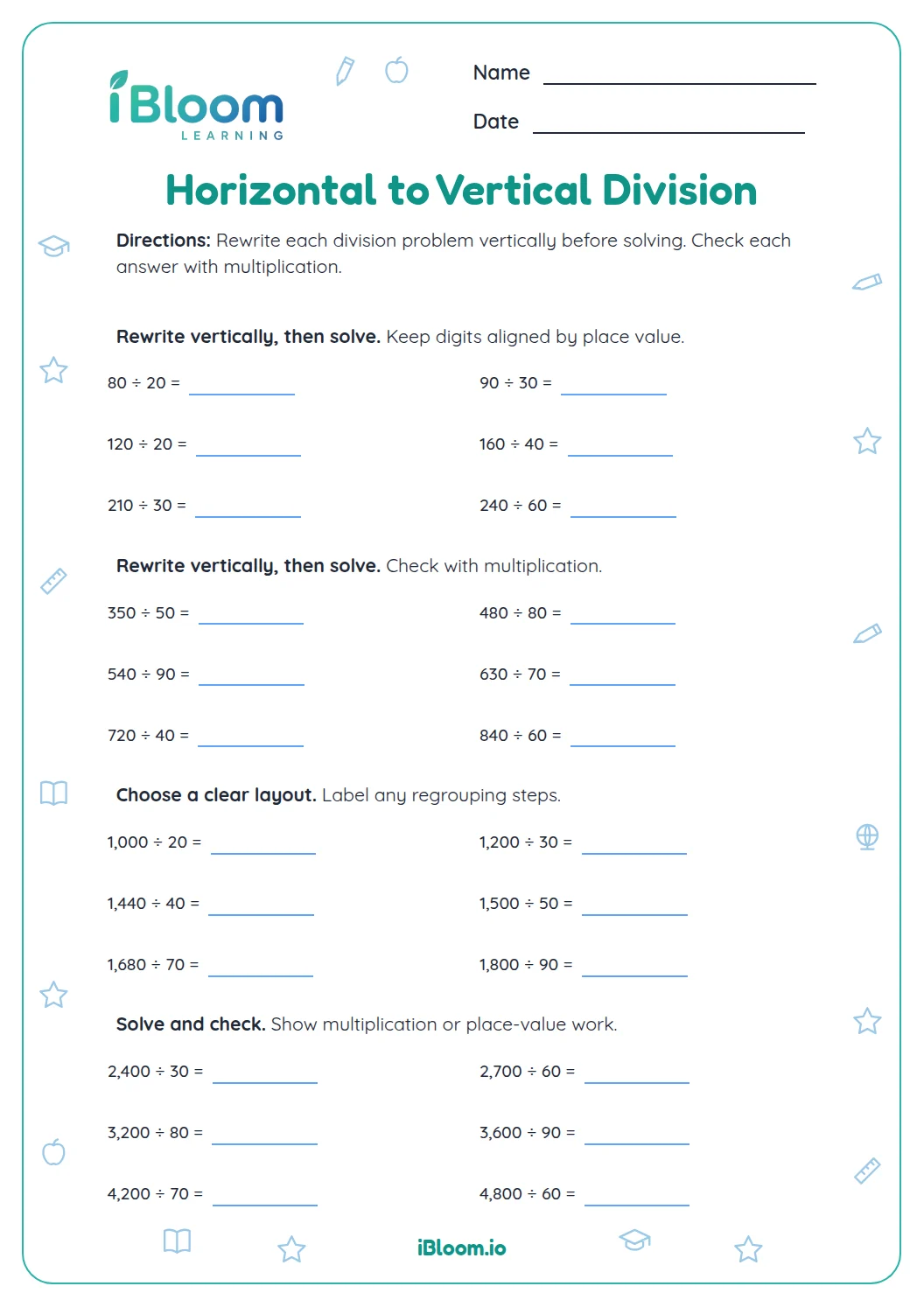
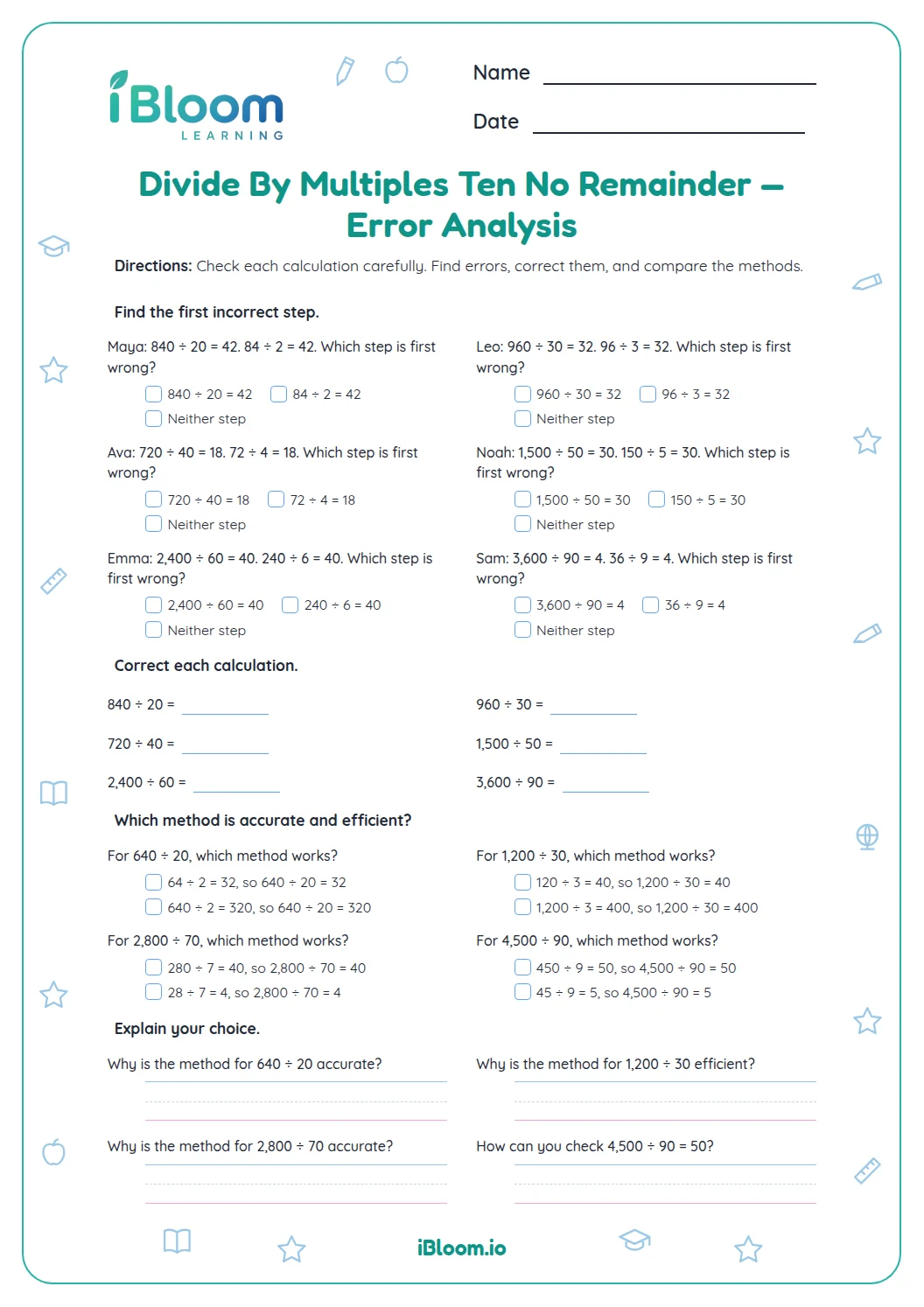
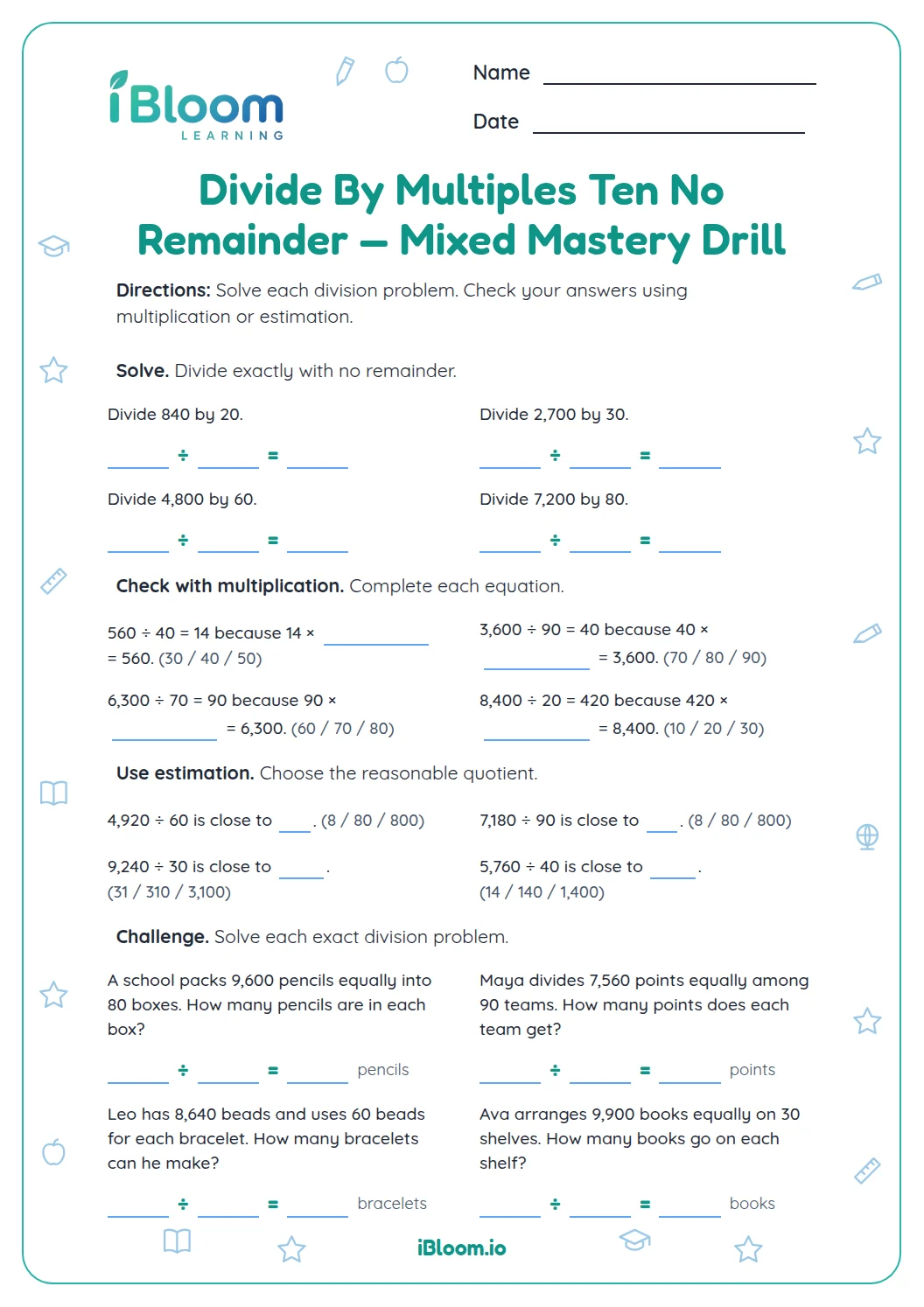
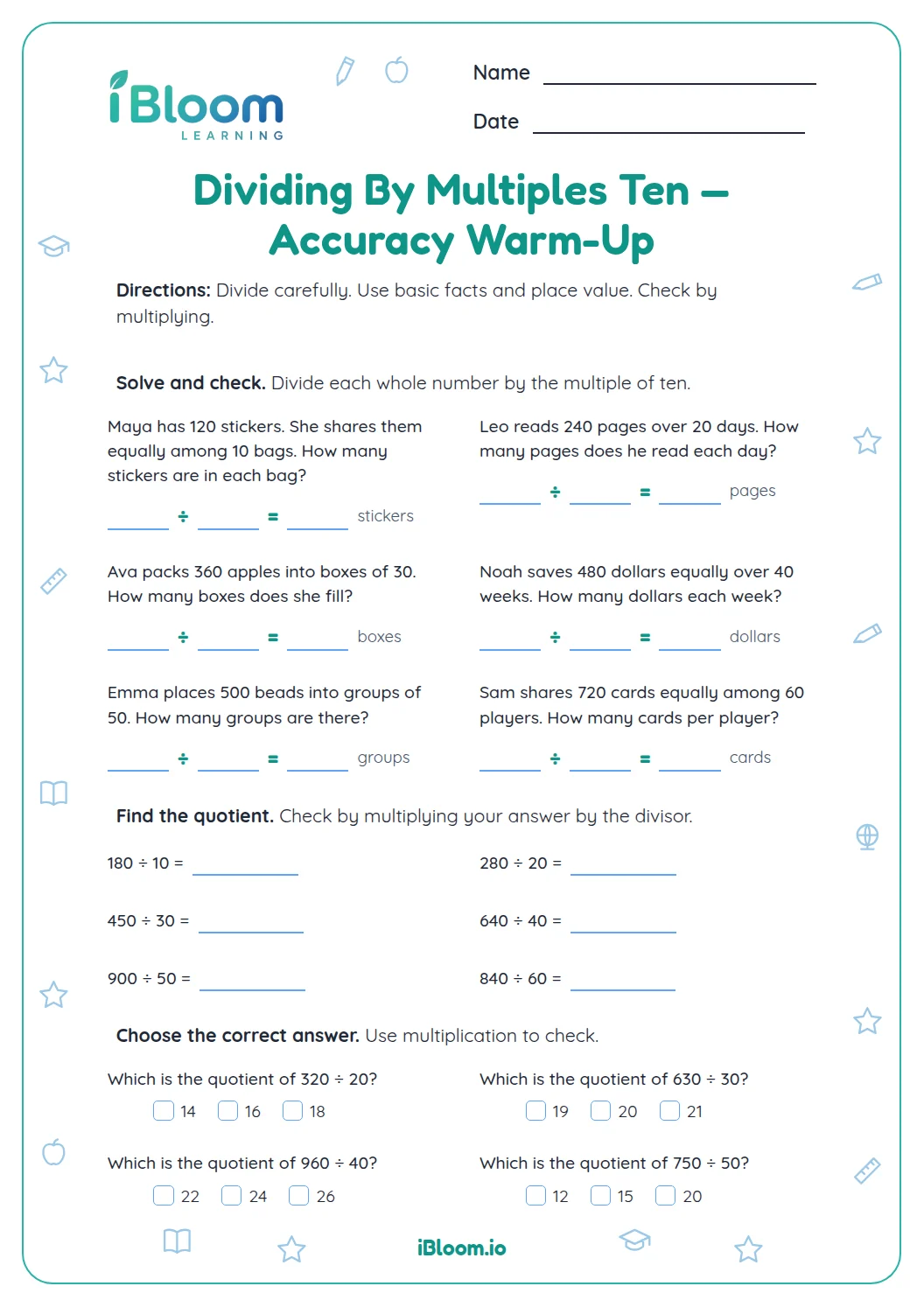
This printable division warm-up gives students 18 chances to divide whole numbers by multiples of ten without remainders. The first 16 items are equations; two final problems apply the skill to boxes of pencils and theater rows. Students can use place value, related multiplication facts, and a multiplication check. The practice aligns with CCSS 5.NBT.B.6, which connects whole-number quotients to place value and multiplication.
Aligned to 5.NBT.B.6
What does division by a multiple of ten ask?
Each equation divides a whole number by 30, 40, 50, 60, 70, 80, or 90. A useful strategy is to think of the divisor as a digit times ten, then check the quotient with multiplication.
The set moves from three-digit to four-digit dividends, and the last two questions put the same skill into familiar school and theater situations.
How can place value make a quotient easier?
For 840 ÷ 40, think 84 tens ÷ 4 tens. Since 84 ÷ 4 = 21, the quotient is 21. Check: 21 × 40 = 840.
- 1840 ÷ 40 = 21
- 2Check: 21 × 40 = 840
How can students avoid dropping a zero?
Keep the divisor’s tens in view while solving. Dividing both numbers by ten can help reveal an easier fact, but the quotient stays 21 in the example, not 2.1 or 210. Multiplication confirms the scale.
How does division answer the story questions?
The pencil and theater questions ask for equal groups: boxes of 30 pencils, or rows holding 40 people. Identify the total and group size, write the division equation, and state the quotient with the requested unit.
How to use this worksheet
- 1Solve each equation and write the quotient in the blank.
- 2For divisors such as 40, relate the problem to a smaller fact such as 84 ÷ 4.
- 3Check by multiplying the quotient by the original divisor.
- 4For each story, identify the total and group size before writing the equation.
- 5Include boxes or rows in the two context answers.
Common mistakes and quick fixes
The mistake
Dividing by 4 instead of 40 and leaving the quotient too large.
The fix
Keep the divisor’s zero in the related fact, or check with multiplication.
The mistake
Changing the quotient when canceling a zero from both numbers.
The fix
Dividing both dividend and divisor by ten preserves the number of groups.
The mistake
Giving a number without the unit in a story problem.
The fix
Name boxes or rows so the answer describes what was counted.
Common Core alignment
These problems build quotient accuracy with multiples of ten and multiplication checks.
Use place value and multiplication to find whole-number quotients.
On this sheet: Every problem divides a whole-number dividend by a multiple of ten with no remainder; students can use place value and multiplication to check.
Show the official wordingHide the official wording
Find whole-number quotients of whole numbers with up to four-digit dividends and two-digit divisors, using strategies based on place value, the properties of operations, and/or the relationship between multiplication and division. Illustrate and explain the calculation by using equations, rectangular arrays, and/or area models.
What to practice next
Make more practice
Further reading
Questions parents and teachers ask
What kinds of division problems are included?
The worksheet has 18 problems: 16 number sentences and two short word problems. Every divisor is a multiple of ten, and each division is exact. The dividends range from three digits to four digits so students can practice both smaller and larger whole-number quotients.
How can a student divide by 40 or 70?
Use a related fact while keeping place value in mind. For 840 ÷ 40, think 84 tens divided into groups of 4 tens, which gives 21 groups. Then multiply 21 × 40 to check that the product returns to 840. This method also works for each divisor here.
Why does the quotient not change when both numbers are divided by ten?
Dividing both the dividend and divisor by the same nonzero amount keeps the number of equal groups the same. For example, 840 ÷ 40 becomes 84 ÷ 4, and both equal 21. The multiplication check helps students confirm that the original values were handled correctly.
Are there any remainders on this sheet?
No. Each dividend is a whole-number multiple of its divisor, so every quotient is a whole number with no remainder. Students can check each one by multiplying the quotient by the divisor and comparing the result with the original dividend.
How should students show work on the last problems?
Write a division equation from the story, then solve and include the unit in the answer. For the pencils, use 1,800 ÷ 30 and report 60 boxes. For the theater, use 2,400 ÷ 40 and report 60 rows. This makes each quotient clear.
What worksheet is a good next step?
Students who are comfortable with multiples of ten can try dividing by multiples of 100 or move to long division with larger dividends. The related pages in the division collection keep the quotient strategy familiar while changing the divisor or the amount of written work.