






About this worksheet
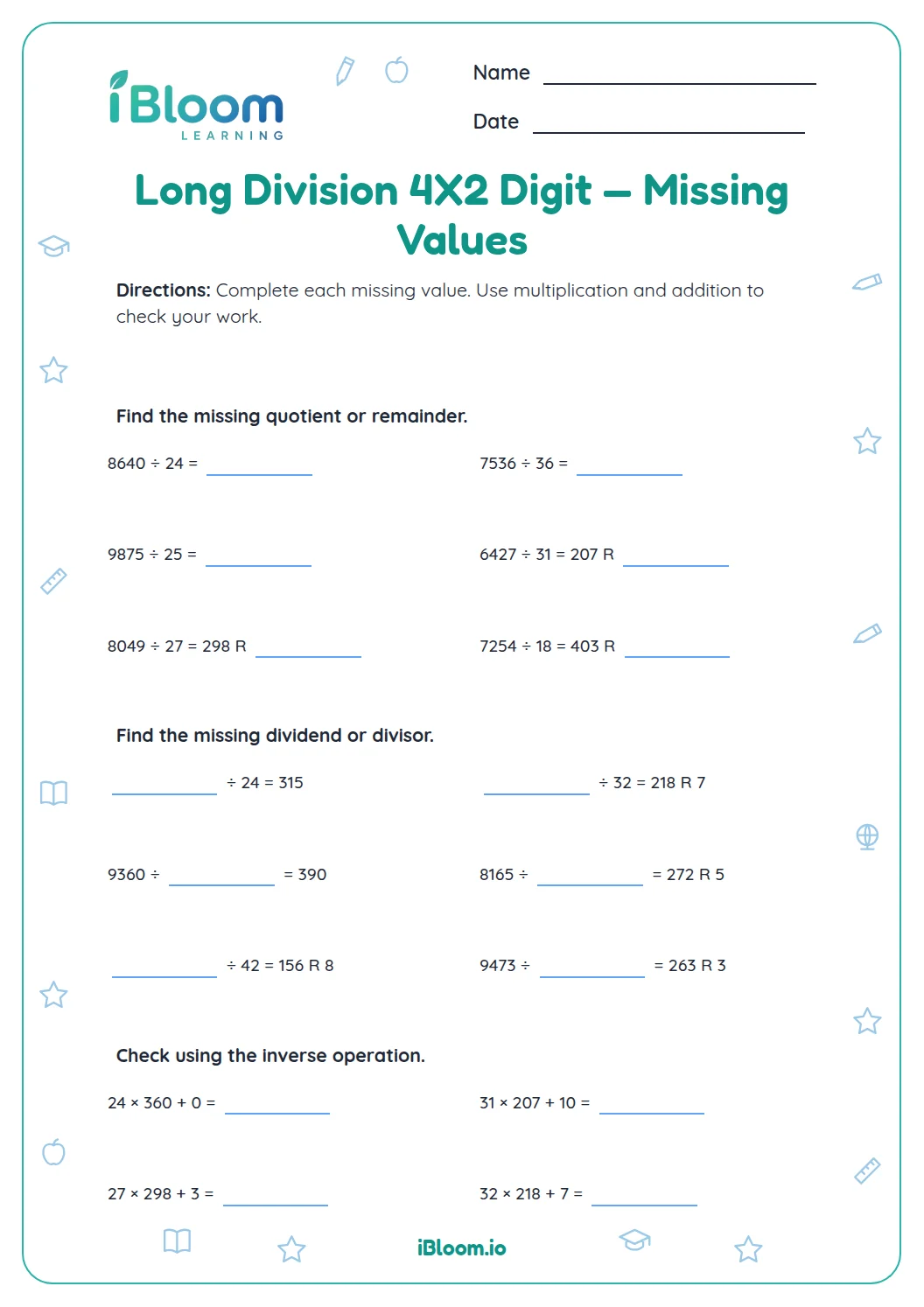
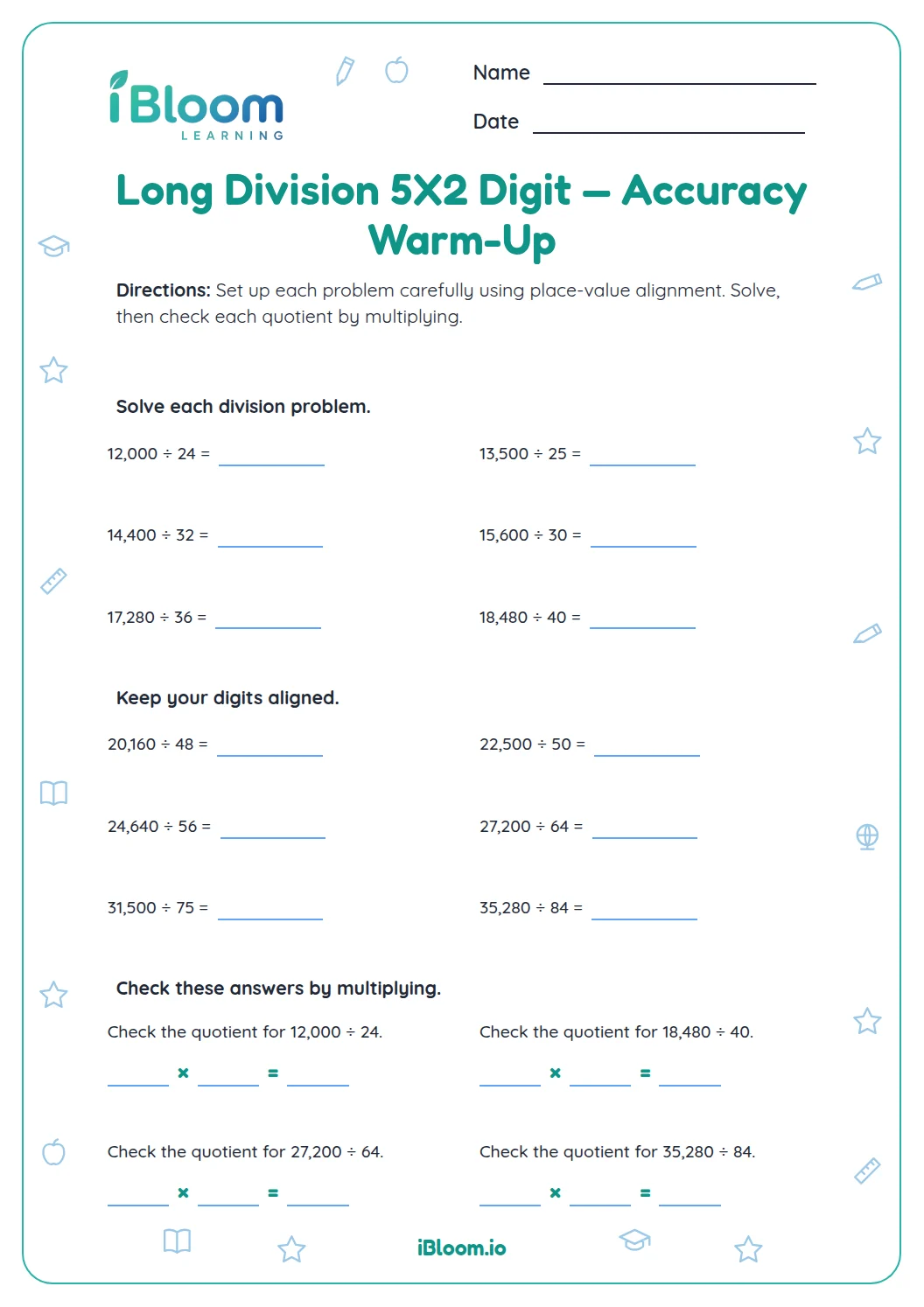
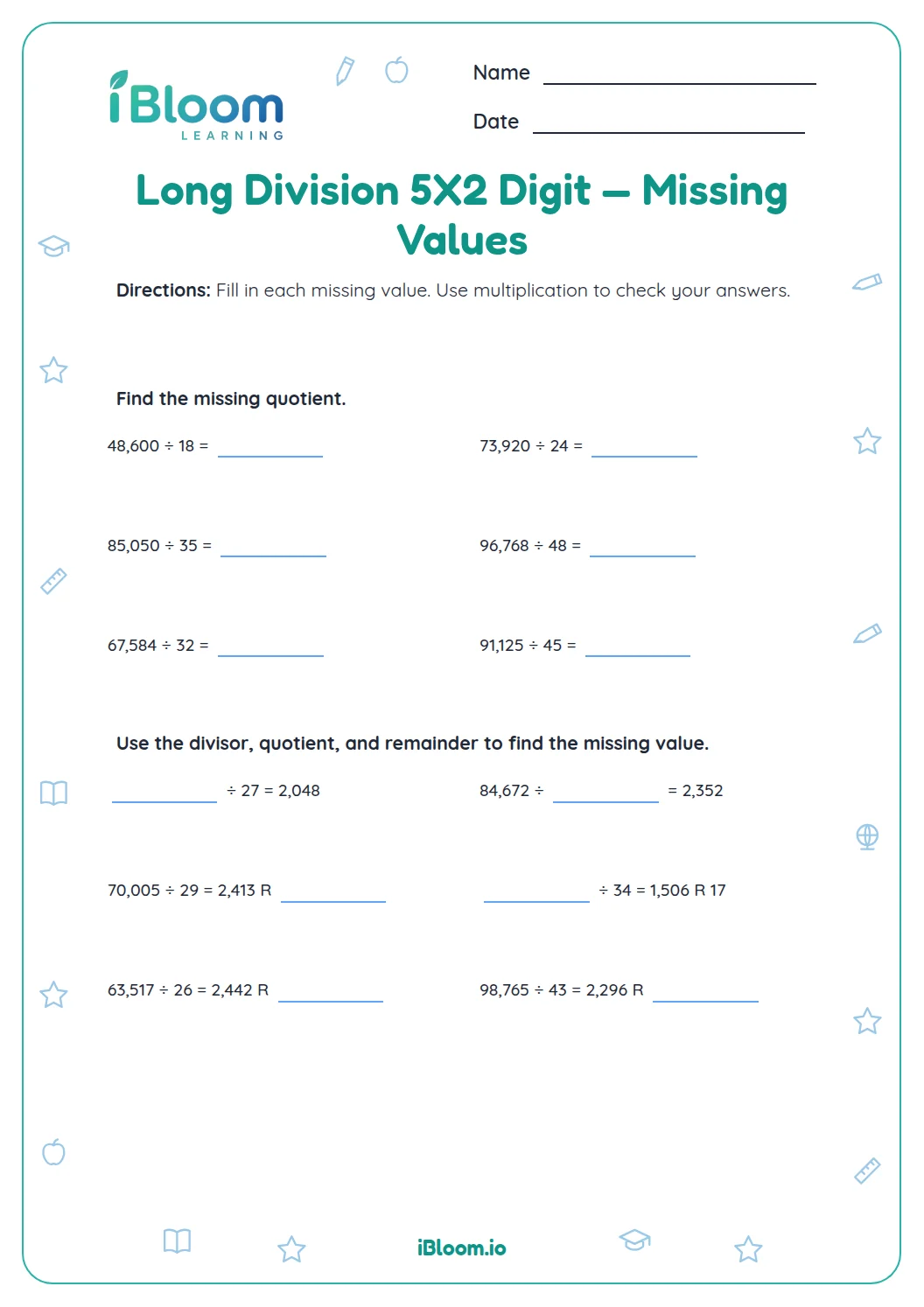
This free printable math drill gives children a 3-digit number divided by a 2-digit number and hides a different piece each time. Part A hides the quotient (504 ÷ 18 = ___), Part B hides the dividend or the divisor (612 ÷ ___ = 18), Part C finds two remainders and checks each one with multiply-and-add, and Part D has three word problems. It practices Common Core 5.NBT.B.6 and suits students in Grades 4 to 6 who are learning to use multiplication as the check for division. A separate answer key is included.
Aligned to 5.NBT.B.6
What does a missing value in long division mean?
Every division sentence has four pieces: the dividend (the number being shared out), the divisor (what it is divided by), the quotient (the answer) and sometimes a remainder. Usually the quotient is the blank. On this sheet any piece can be the blank, so children have to think about how the pieces connect, not only run the steps.
The connection is multiplication. If 504 ÷ 18 = 28, then 18 × 28 = 504. Knowing that lets a child find a missing dividend by multiplying and a missing divisor by asking what times 18 makes 612.
- 1612 ÷ ___ = 18
- 2Turn it around: 18 × ___ = 612
- 318 × 30 = 540, and 612 − 540 = 72
- 472 ÷ 18 = 4, so the missing number is 30 + 4 = 34
- 5Check: 34 × 18 = 612
How do remainders fit into the multiplication check?
When a division does not come out even, the check has one more step: multiply the divisor by the quotient, then add the remainder to get the dividend back. For 389 ÷ 27 = 14 R 11, that is 27 × 14 = 378, and 378 + 11 = 389.
Part C puts the two halves side by side. Question 9 asks for the remainder when 389 is divided by 27: 14 groups of 27 make 378, so 11 is left. Question 10 puts the pieces back together: 27 × 14 + 11 = 389. Questions 11 and 12 do the same for 615 ÷ 32, with a remainder of 7.
What is on this worksheet?
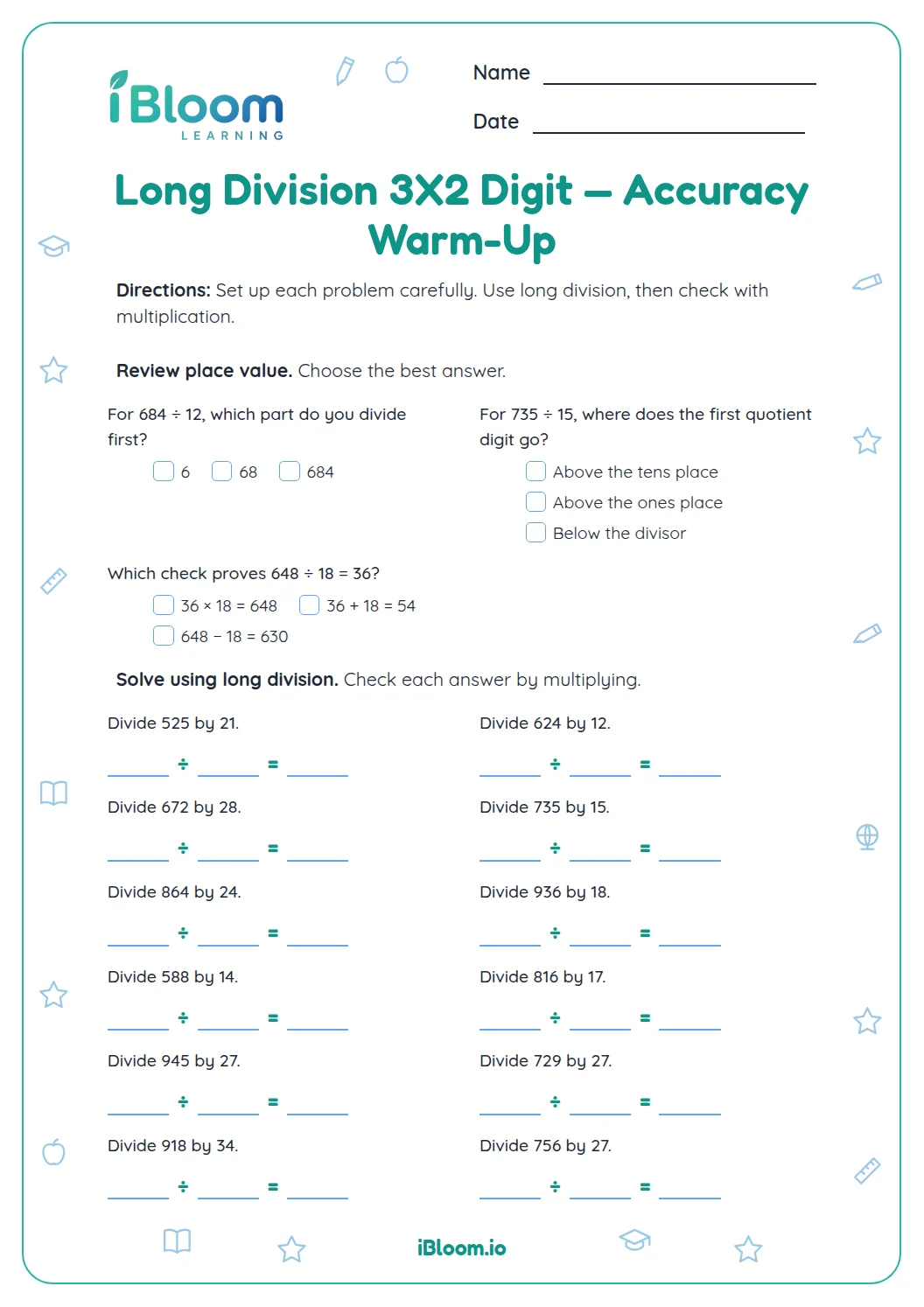
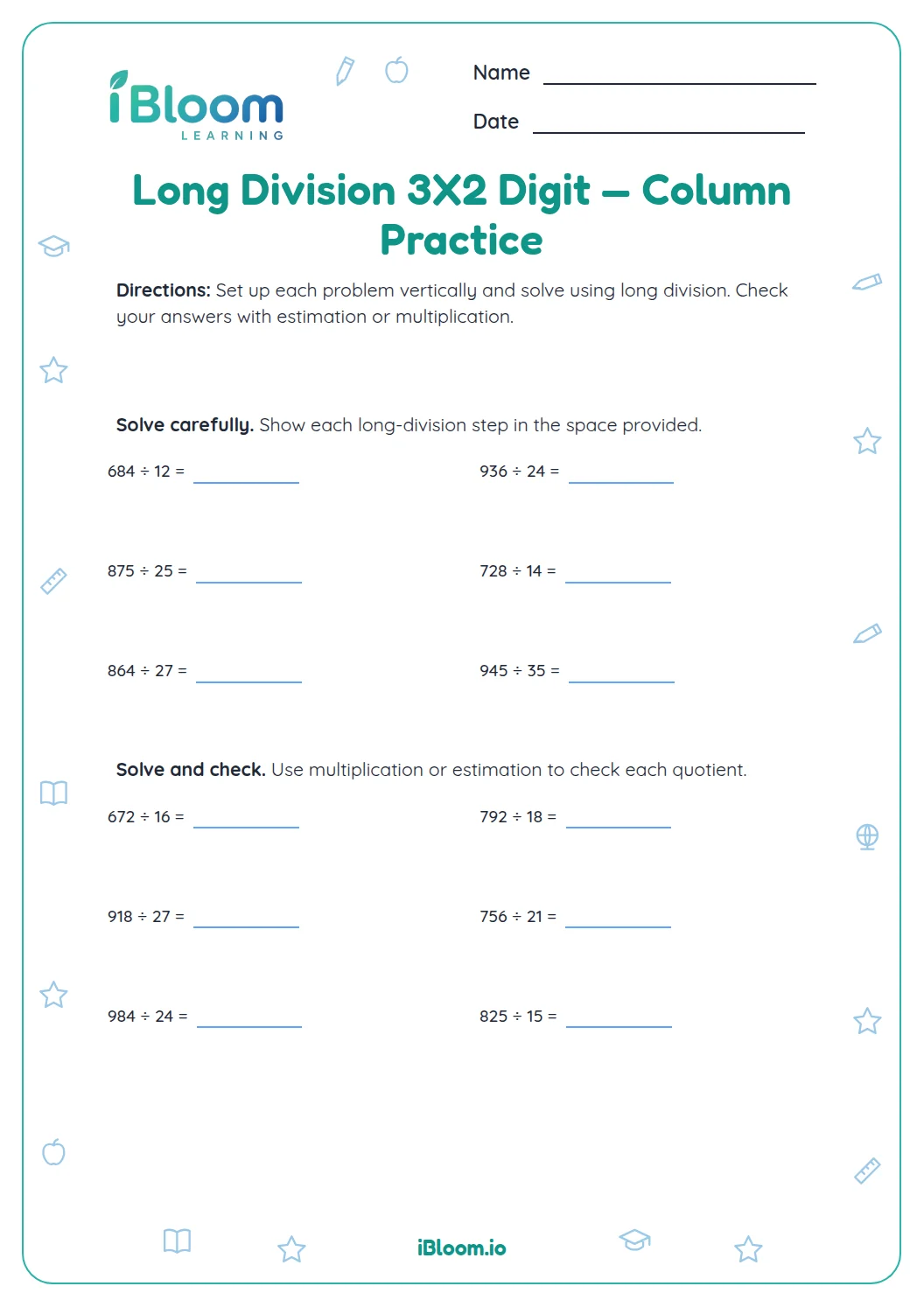
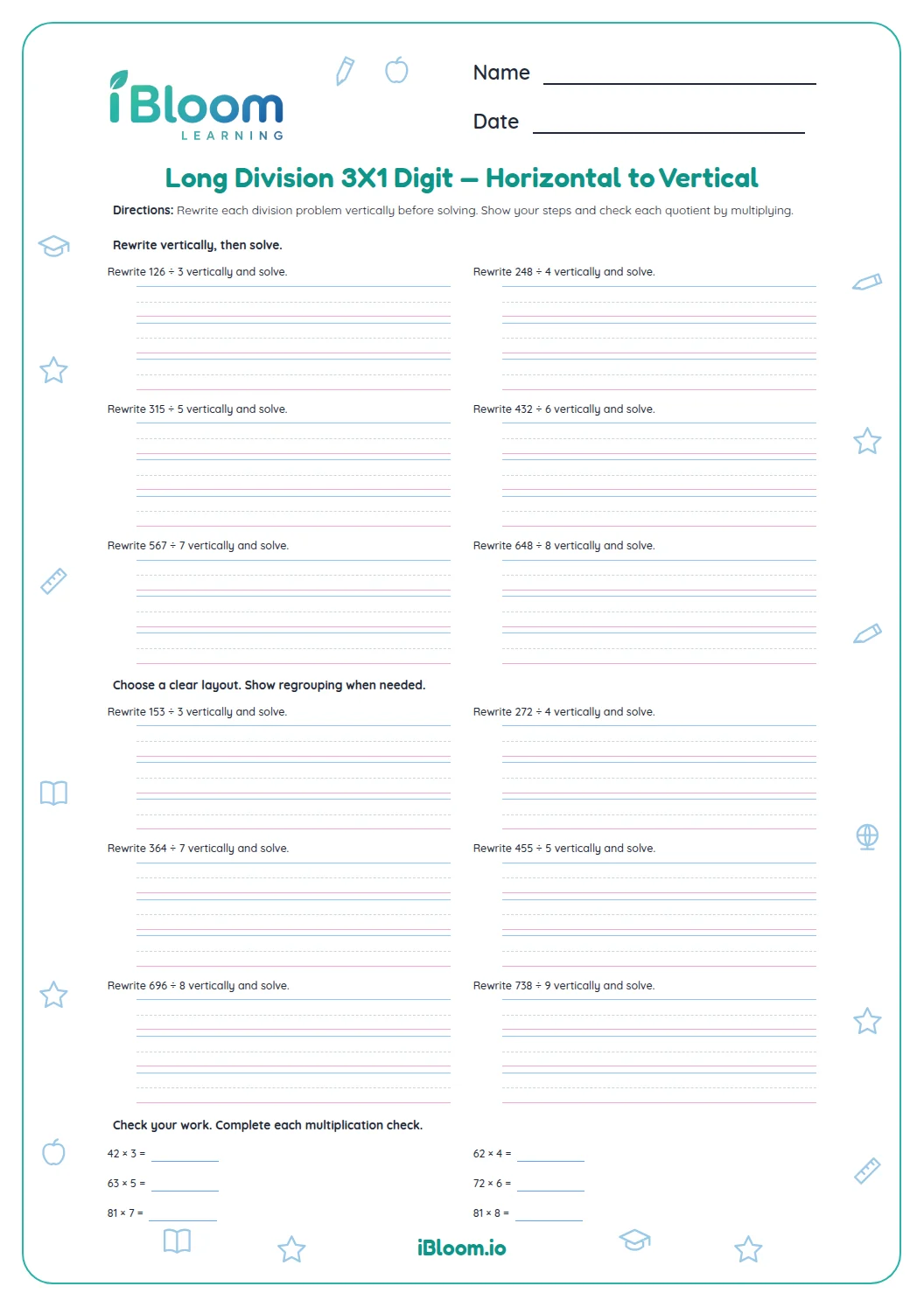
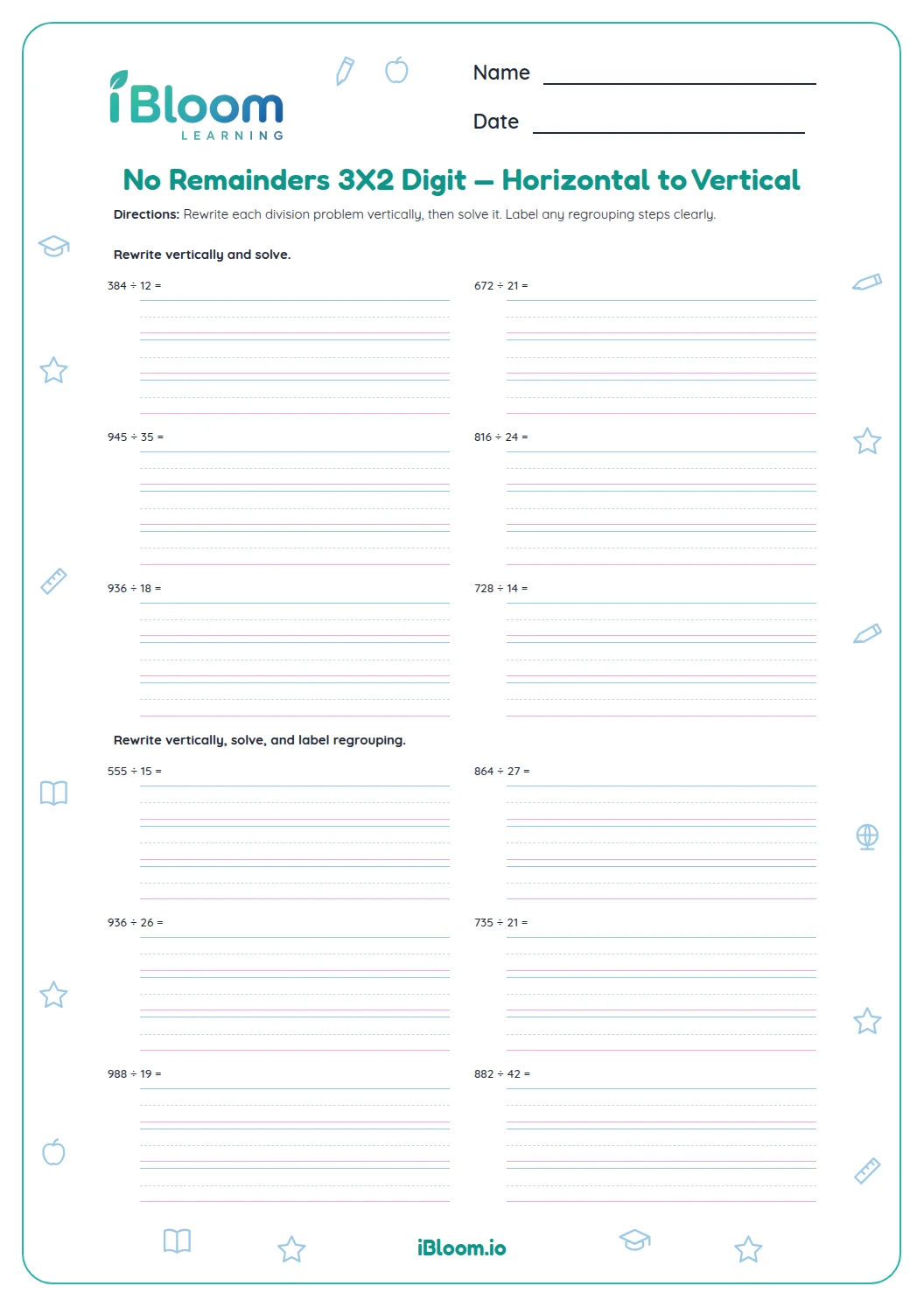
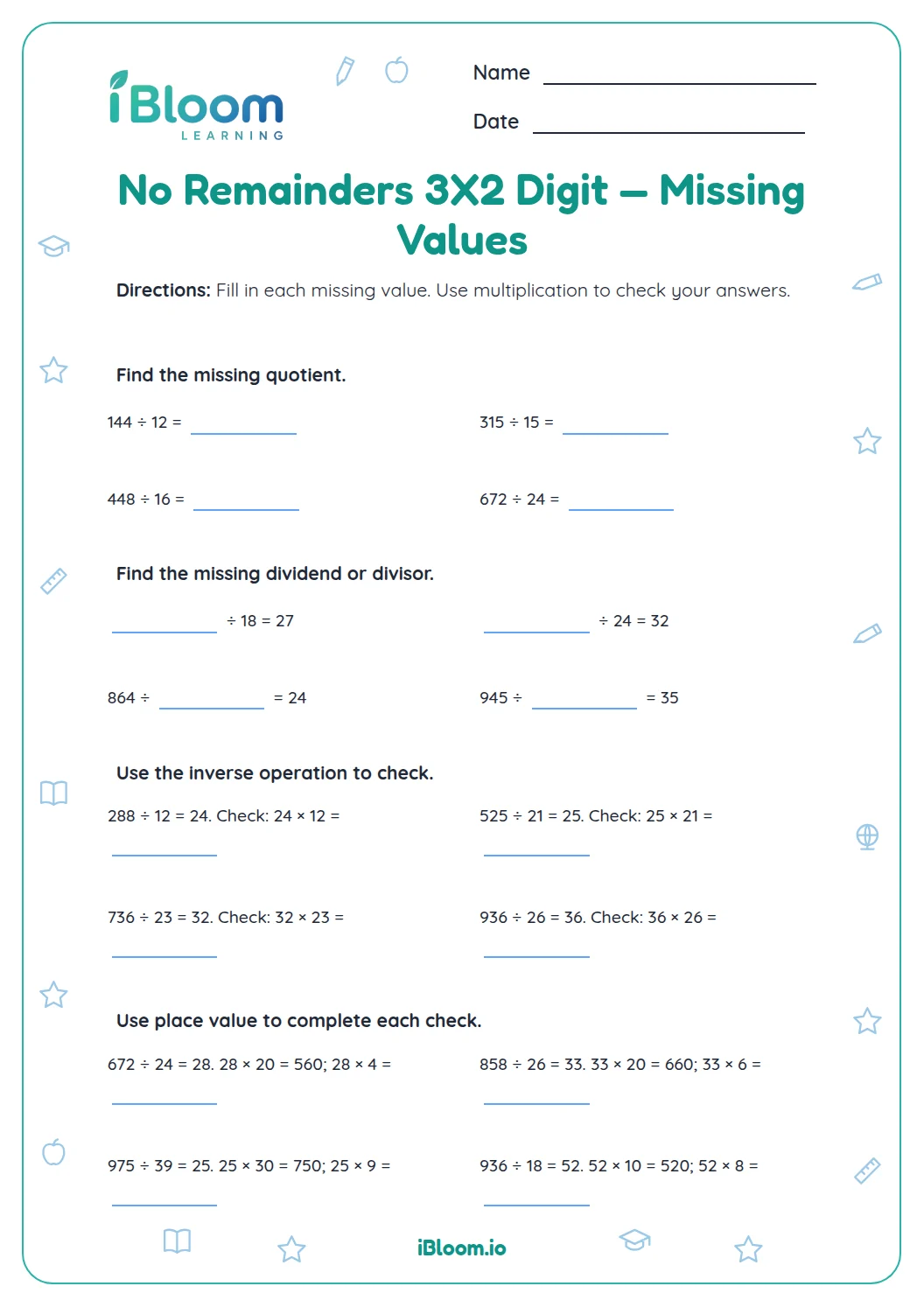
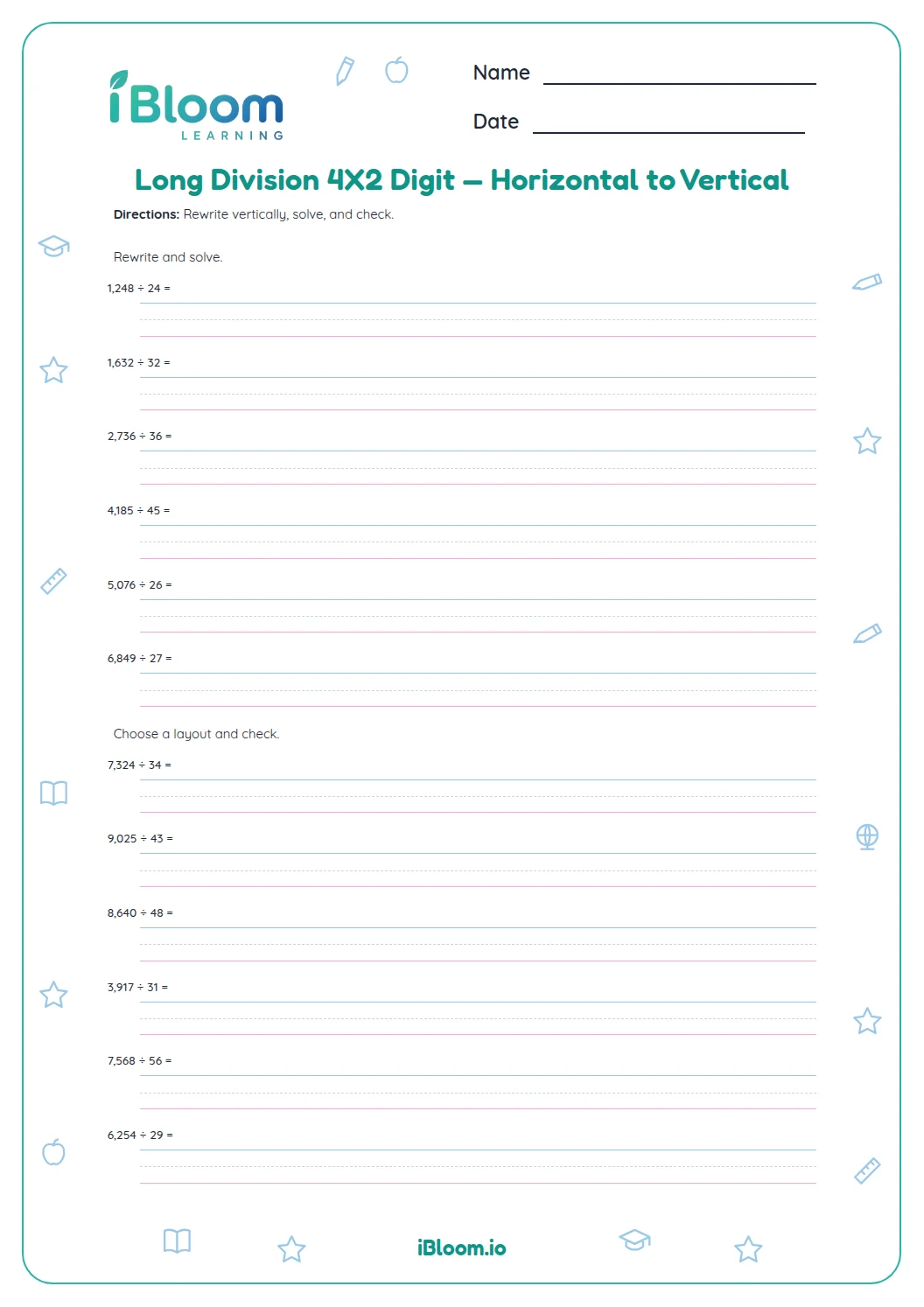
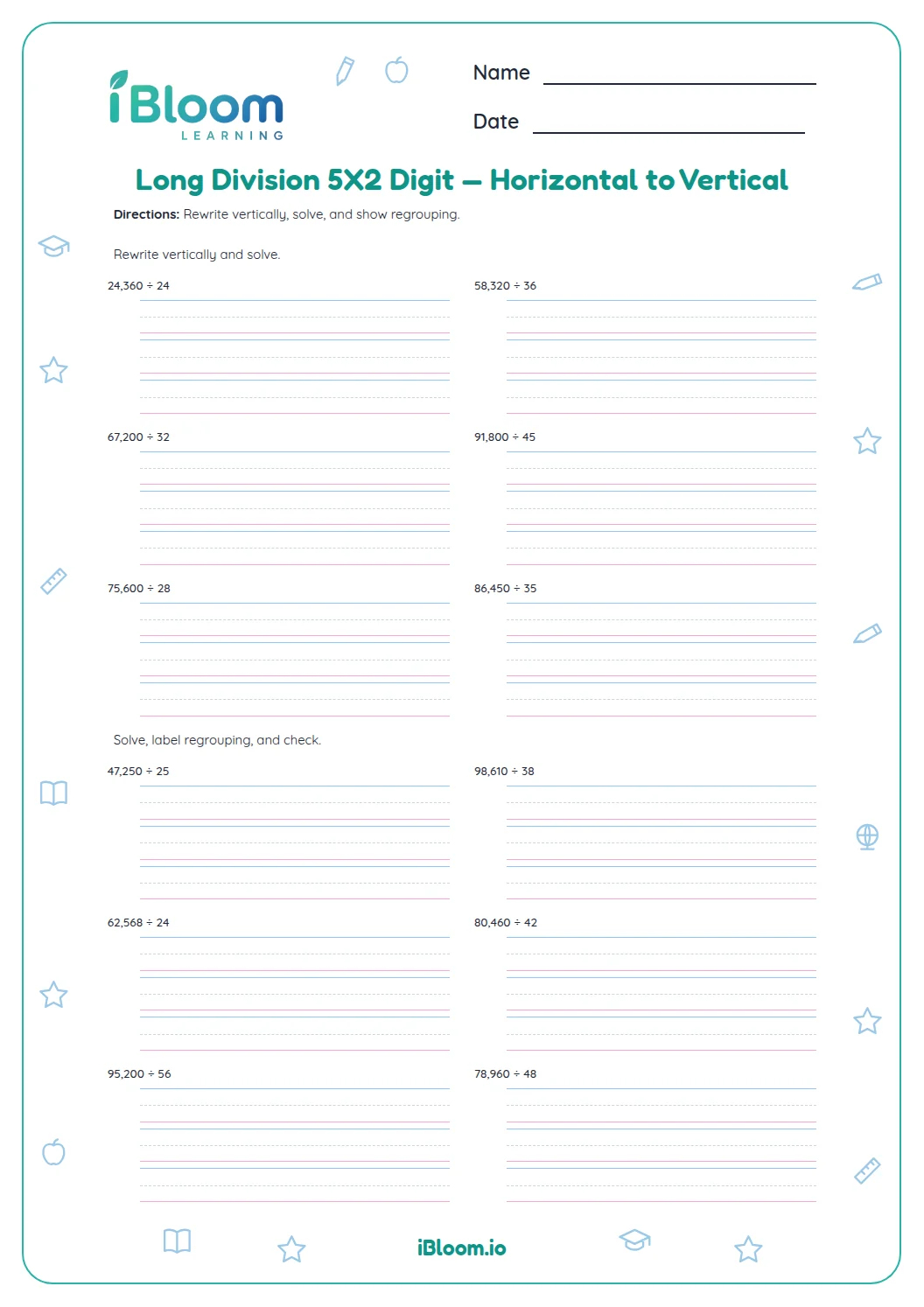
Fifteen questions on two pages, in four parts that move from the familiar to the less familiar. Every dividend is a 3-digit number and every divisor is a 2-digit number between 15 and 36. There is a working grid under each word problem, and the answer key shows every answer.
- Part A, Find the quotient: 504 ÷ 18, 765 ÷ 15, 884 ÷ 26 and 972 ÷ 36
- Part B, Find the missing number: two missing dividends and two missing divisors
- Part C, Remainders and checks: find the remainders for 389 ÷ 27 and 615 ÷ 32, then check each with multiply-and-add
- Part D, Word problems: buses of students, stickers shared equally and cartons of eggs
How can estimating help before dividing?
Round the divisor to a friendly number and ask how many fit. For 884 ÷ 26, think 26 is close to 30 and 884 is close to 900, so the answer should be near 30. The exact quotient, 34, is a little more, because 26 is a little less than 30.
A quick estimate catches slips such as a quotient that is ten times too big or too small. Ask your child to say an estimate aloud before each long division.
How to use this worksheet at home or in class
- 1Warm up with one fact family out loud: 18 × 28 = 504, 504 ÷ 18 = 28, and 504 ÷ 28 = 18.
- 2Do question 1 together, asking for an estimate first. Then work the long division and check it with 18 × 28.
- 3Let your child finish Part A alone, using scrap paper for the long division steps.
- 4In Part B, ask your child to rewrite each blank sentence as a multiplication sentence before solving it.
- 5In Part C, find the remainder first, then use the matching check beside it. If the check does not give the dividend back, look for the slip.
- 6Mark with the answer key. For a miss, redo it with the multiplication check, not just a new try at the steps.
Common mistakes and quick fixes
The mistake
Dividing the wrong way round in Part B, such as working out 24 ÷ 15 for ___ ÷ 15 = 24, or 18 ÷ 612 for 612 ÷ ___ = 18.
The fix
Say the sentence in words: "Some number shared into groups of 15 gives 24." The missing dividend is bigger, so multiply: 15 × 24 = 360.
The mistake
Putting the first quotient digit in the wrong place, so 765 ÷ 15 comes out as 5 or 510 instead of 51.
The fix
Estimate first. 15 × 50 = 750, which is close to 765, so the answer is a little over 50. Then place digits carefully above the dividend.
The mistake
Forgetting to add the remainder when checking, so 27 × 14 gives 378 instead of 389.
The fix
After multiplying the divisor by the quotient, always add the remainder: 378 + 11 = 389. Write "× then +" at the top of the working space.
Common Core alignment
Most US states use the Common Core standards or a close state version. This sheet practices the Grade 5 division standard below.
Divide 3-digit numbers by 2-digit numbers and explain it with equations.
On this sheet: Every question uses a 3-digit dividend and a 2-digit divisor and uses the link between multiplication and division to find or check the answer.
Show the official wordingHide the official wording
Find whole-number quotients of whole numbers with up to four-digit dividends and two-digit divisors, using strategies based on place value, the properties of operations, and/or the relationship between multiplication and division. Illustrate and explain the calculation by using equations, rectangular arrays, and/or area models.
What to practice next
Make more practice
Further reading
Questions parents and teachers ask
What should my child know before this worksheet?
Your child should know multiplication facts and be able to multiply a 2-digit number by a 2-digit number, such as 18 × 28. The checks in Parts B and C use that skill. Children who still need help can try the 3-digit by 1-digit worksheet first.
What is the answer to 612 ÷ ___ = 18?
The answer is 34. Rewrite the sentence as 18 × ___ = 612 and solve it: 18 × 30 = 540, and the remaining 72 is 4 groups of 18, so the missing divisor is 34. This is question 6 on the sheet, and the check is 34 × 18 = 612.
Why does the sheet pair each remainder with a check?
The check shows children that division can be undone. For 389 ÷ 27 = 14 R 11, multiplying 27 × 14 gives 378, and adding the remainder 11 returns 389. When the check does not match the dividend, children know to look for a mistake in the quotient or remainder.
Can children use a calculator or a multiplication chart?
This sheet is meant to build skill with the steps and the multiplication check, so pencil and scrap paper work best. A list of multiples of the divisor is a good support: write 18, 36, 54, 72 and so on down the margin, then use it to pick each digit of the quotient.
Are the word problems missing values too?
Yes. Question 13 hides the quotient: 468 students on 18 buses is 26 per bus. Question 14 hides the divisor: 432 stickers with 18 each means 24 children. Question 15 asks for full cartons, so the 10 leftover eggs are not counted. Children write the division sentence in the working space.
Is there an answer key for this worksheet?
Yes. Two separate answer key pages show every missing number, including both remainders and the totals in the multiply-and-add checks. Print the worksheet pages for your child and keep the key for checking, or use it to talk through any check that did not give the dividend back.