


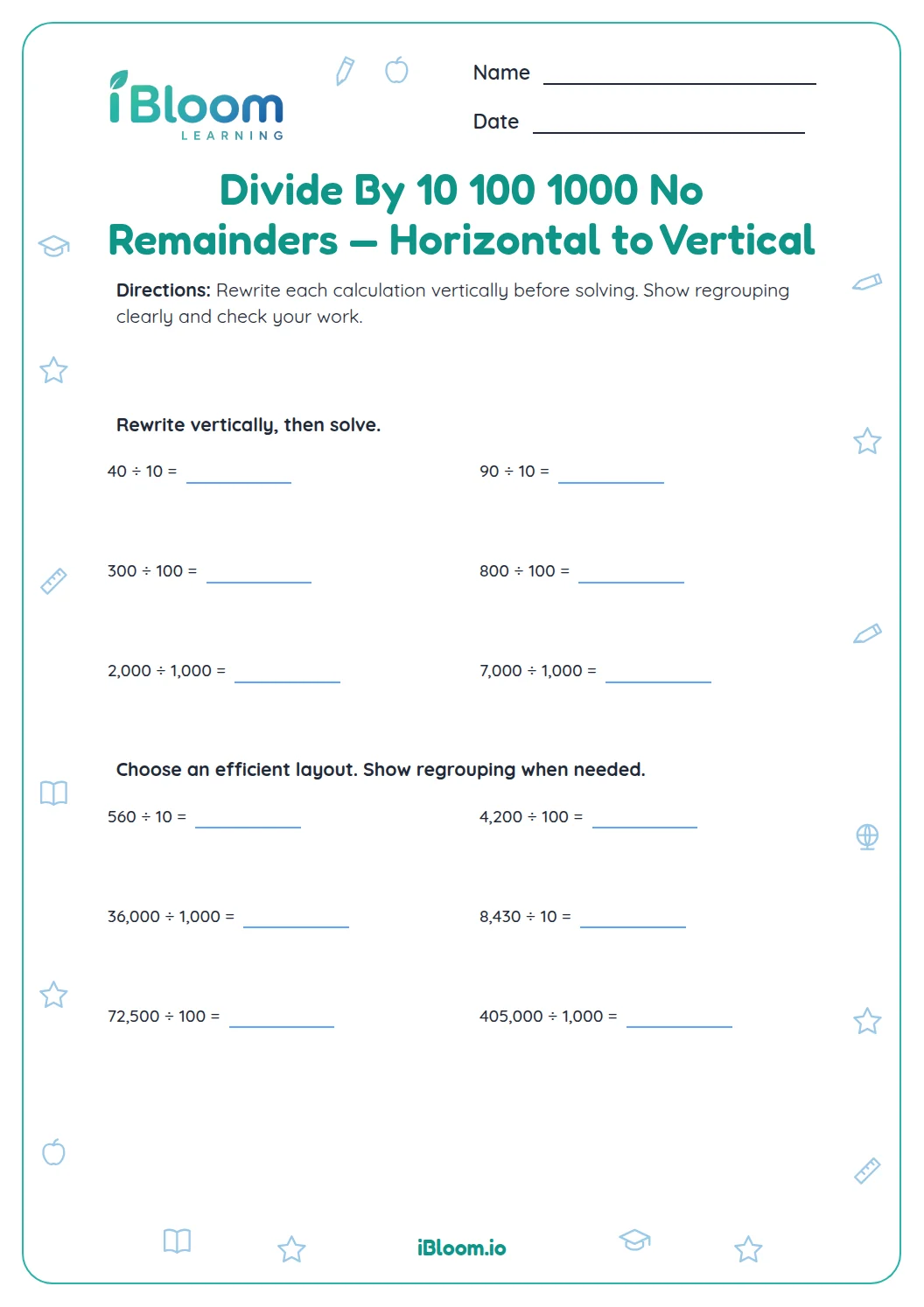

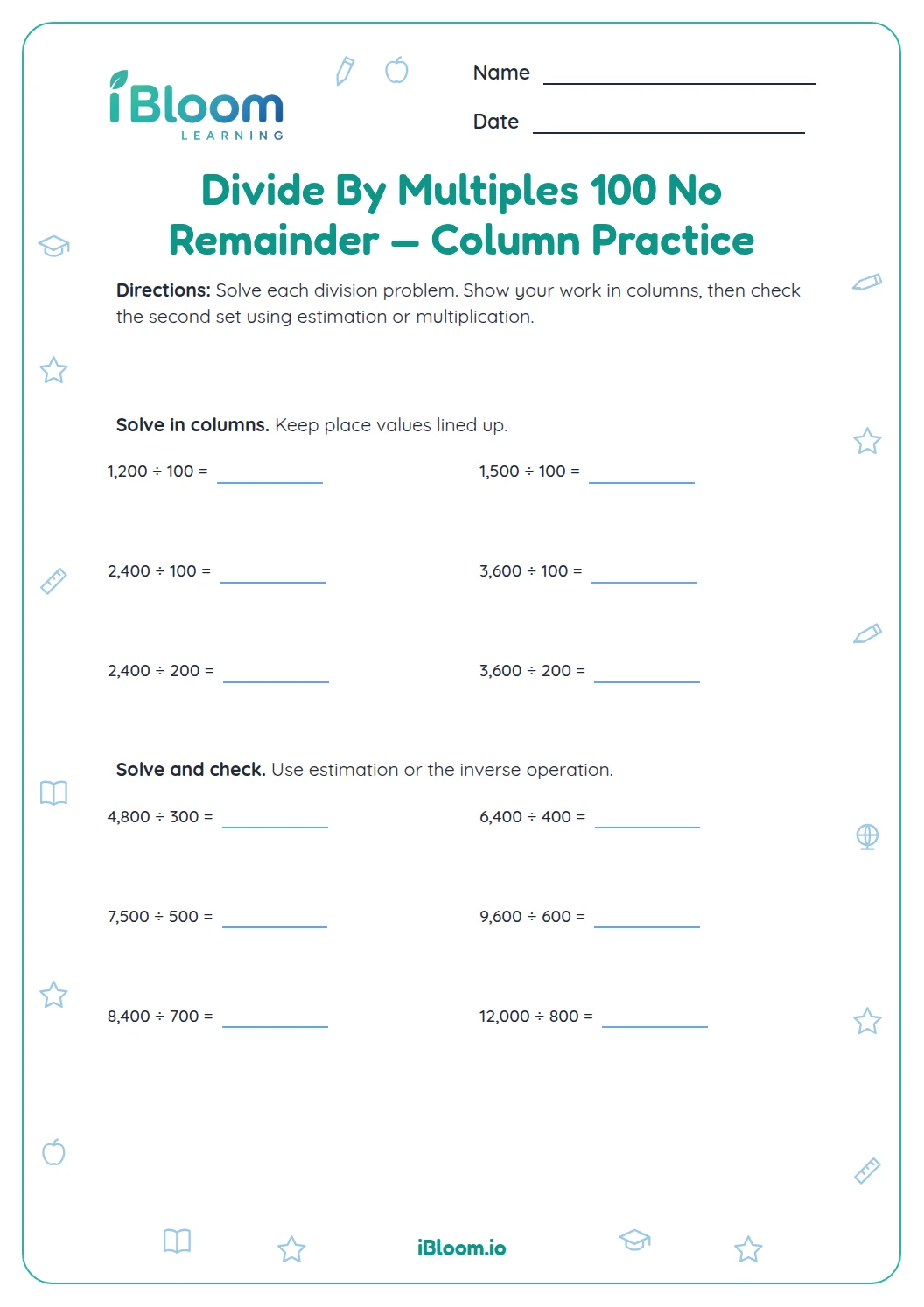


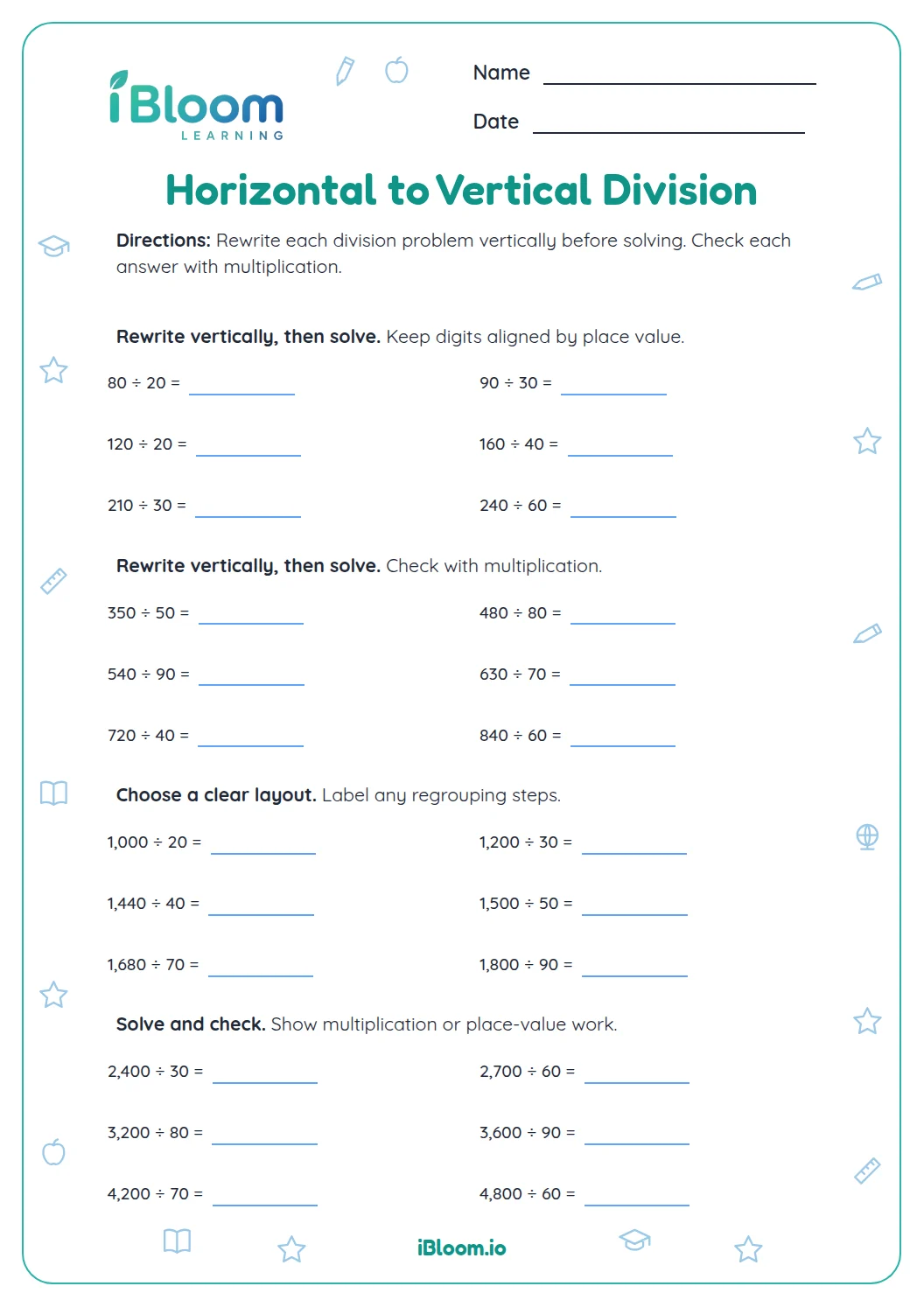

About this worksheet
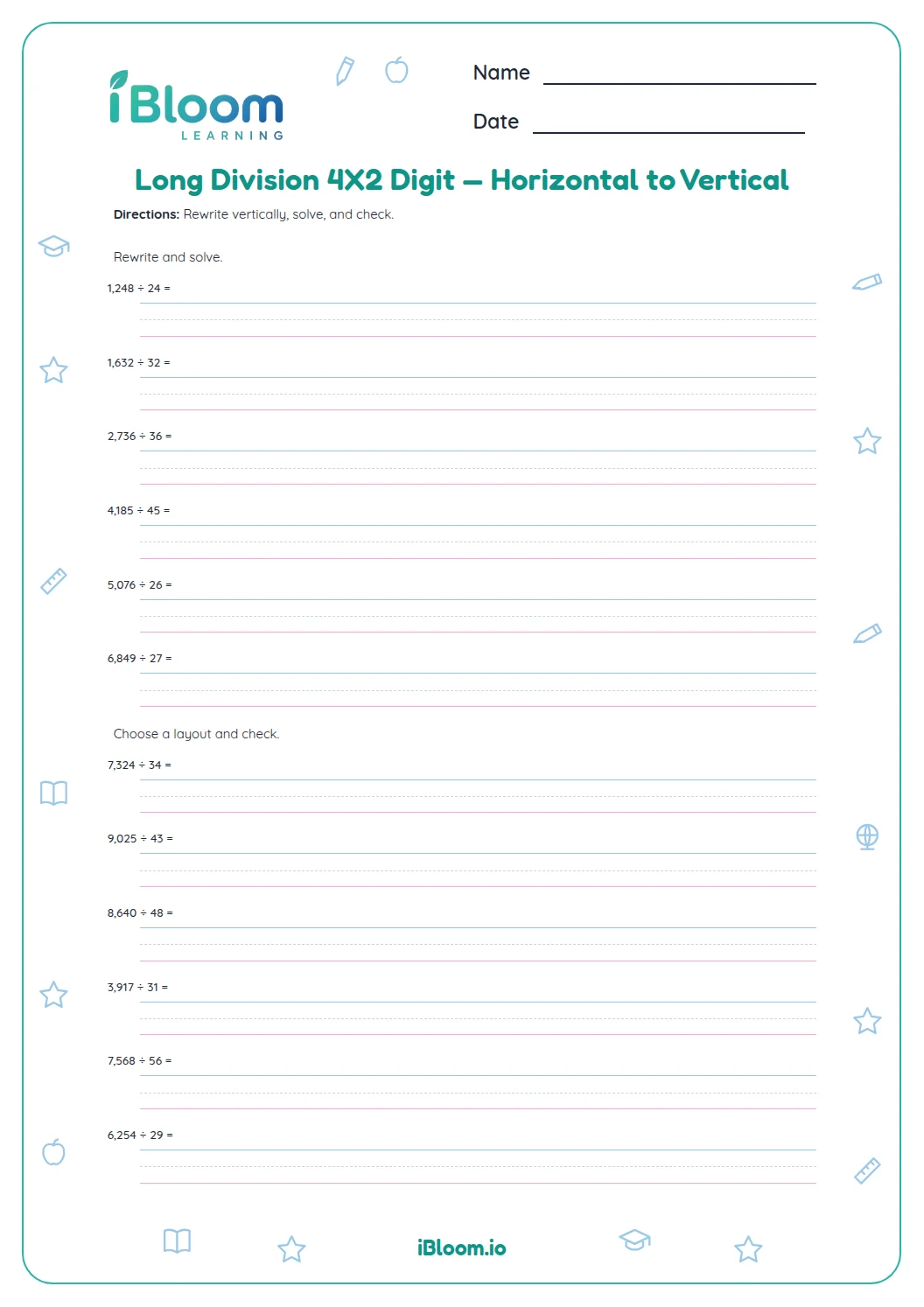
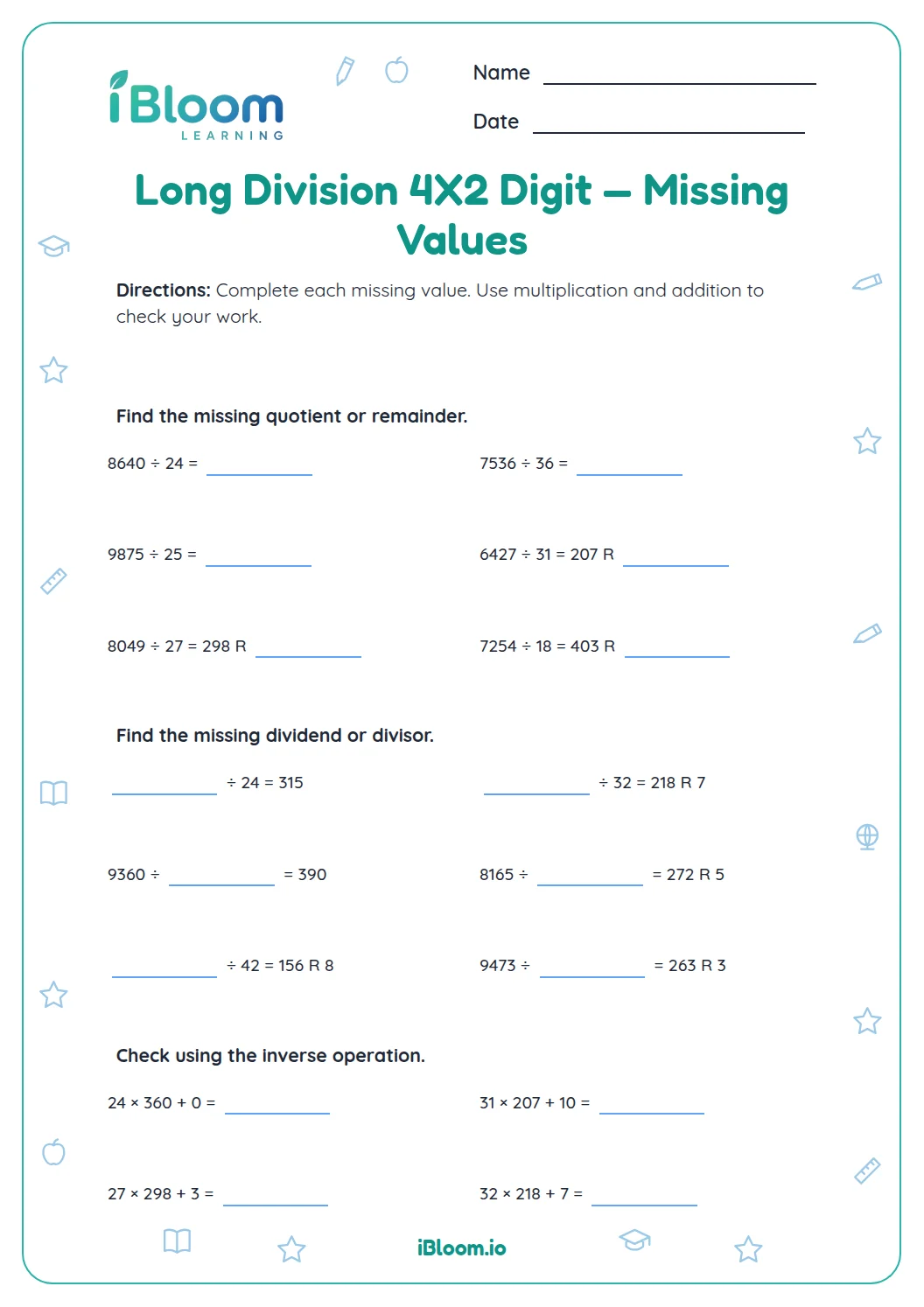
This Grade 5 worksheet provides 16 four-digit dividend and two-digit divisor problems for long-division column practice. Every item gives space to work through place-value steps and record a quotient with its remainder. Most divide evenly; one includes a nonzero remainder, so students can check that the remainder is less than the divisor. A separate answer key lists each quotient and remainder.
Aligned to 5.NBT.B.6
How do I divide a four-digit number by a two-digit number?
Set up the dividend and divisor in long-division form. Estimate each quotient digit, multiply, subtract, and bring down the next digit. Repeat until no digits remain.
- 13,128 ÷ 16 = 195 R 8
- 2Check: 16 × 195 = 3,120, and 3,120 + 8 = 3,128.
How can I check a quotient with a remainder?
Multiply the divisor by the quotient and add the remainder. The result should equal the dividend, and the remainder must be smaller than the divisor.
What should I check in each column?
Keep digits aligned by place value, subtract accurately at each step, and bring down one digit at a time. Record zero as a quotient digit when a place has no groups.
How to use this worksheet
- 1Set up the dividend and divisor in long-division form.
- 2Estimate the next quotient digit.
- 3Multiply, subtract, and bring down the next digit.
- 4Continue until all dividend digits have been used.
- 5Check divisor × quotient + remainder = dividend.
Check your editing
The mistake
Writing a remainder as large as the divisor.
The fix
Trade it for another group; the final remainder must be smaller than the divisor.
The mistake
Skipping a zero quotient digit.
The fix
Use zero when the current place value cannot hold another group.
The mistake
Losing place-value alignment while subtracting.
The fix
Keep each product and difference under the digit it belongs to.
Curriculum alignment
This worksheet practices 5.NBT.B.6 through the listed tasks.
Divide four-digit dividends by two-digit divisors and show the long-division steps.
On this sheet: All 16 questions ask students to find quotients for four-digit dividends and two-digit divisors, using long division with a check.
Show the official wordingHide the official wording
Find whole-number quotients of whole numbers with up to four-digit dividends and two-digit divisors, using strategies based on place value, the properties of operations, and/or the relationship between multiplication and division. Illustrate and explain the calculation by using equations, rectangular arrays, and/or area models.
What to practice next
Make more practice
Further reading
Questions parents and teachers ask
How many division problems are on the page?
There are 16 problems, each with a four-digit dividend and a two-digit divisor. Students solve them using long division and record a quotient and remainder in the answer space. Use the key to check each quotient and remainder after completing the work.
Does every problem have a remainder?
Most divide evenly, and one problem has a nonzero remainder. The answer key shows the quotient and remainder for each problem. When checking, the remainder must be smaller than the divisor. Use the key to check each quotient and remainder after completing the work.
How can students check a division answer?
Multiply the quotient by the divisor, then add the remainder. The total should match the dividend. For example, 16 × 195 + 8 equals 3,128, so 3,128 ÷ 16 is 195 R 8. Use the key to check each quotient and remainder after completing the work.
Why should students show column work?
Column work makes each quotient digit and place-value step visible. Students can review their estimates, multiplication, subtraction, and digits brought down to find where an error occurred. Use the key to check each quotient and remainder after completing the work.
How long should this worksheet take?
About 25 minutes is a reasonable estimate for 16 multi-digit division problems. Time varies with students’ fluency and whether they check each quotient. Encourage accurate steps and a final multiplication check. Use the key to check each quotient and remainder after completing the work.