



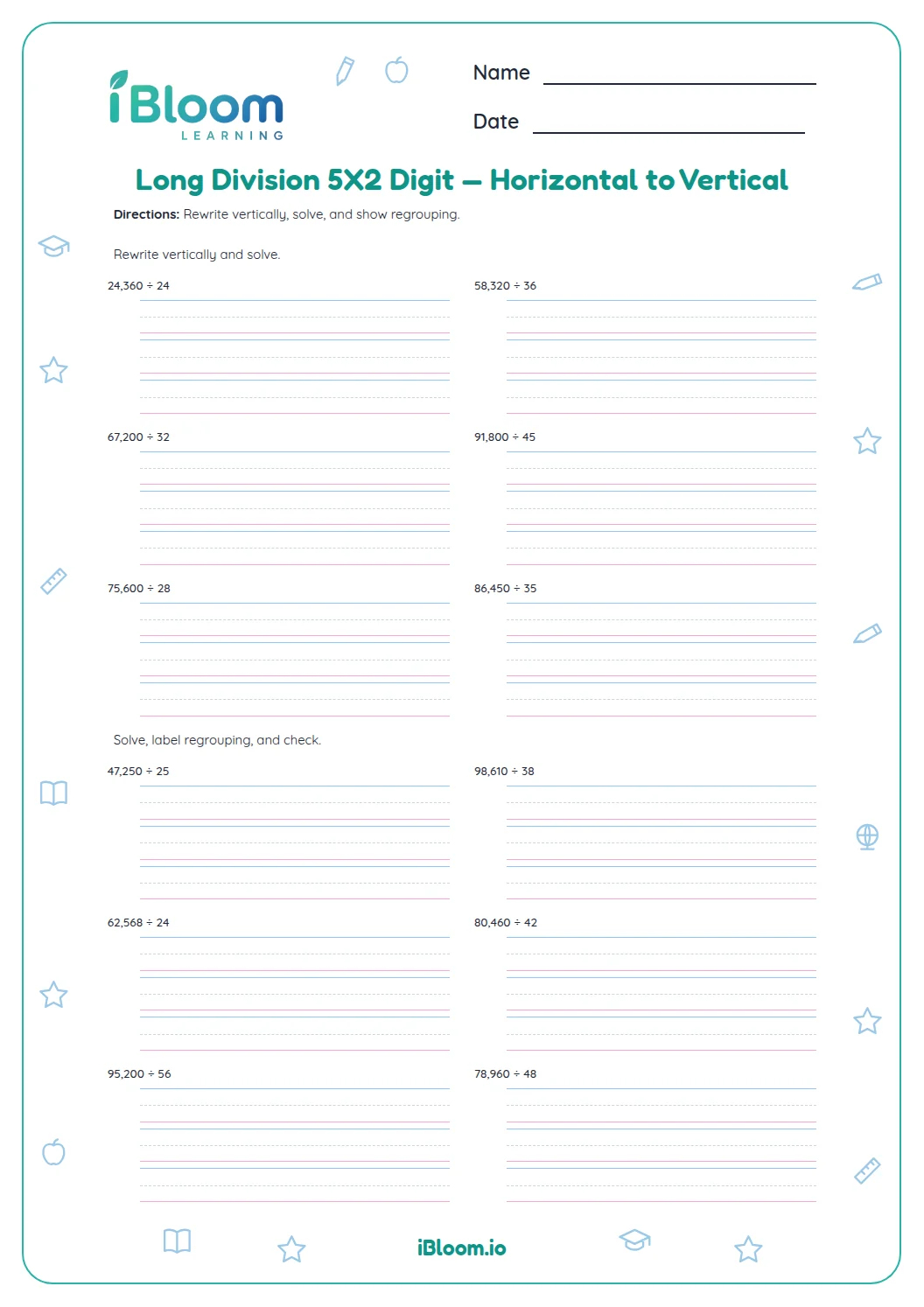
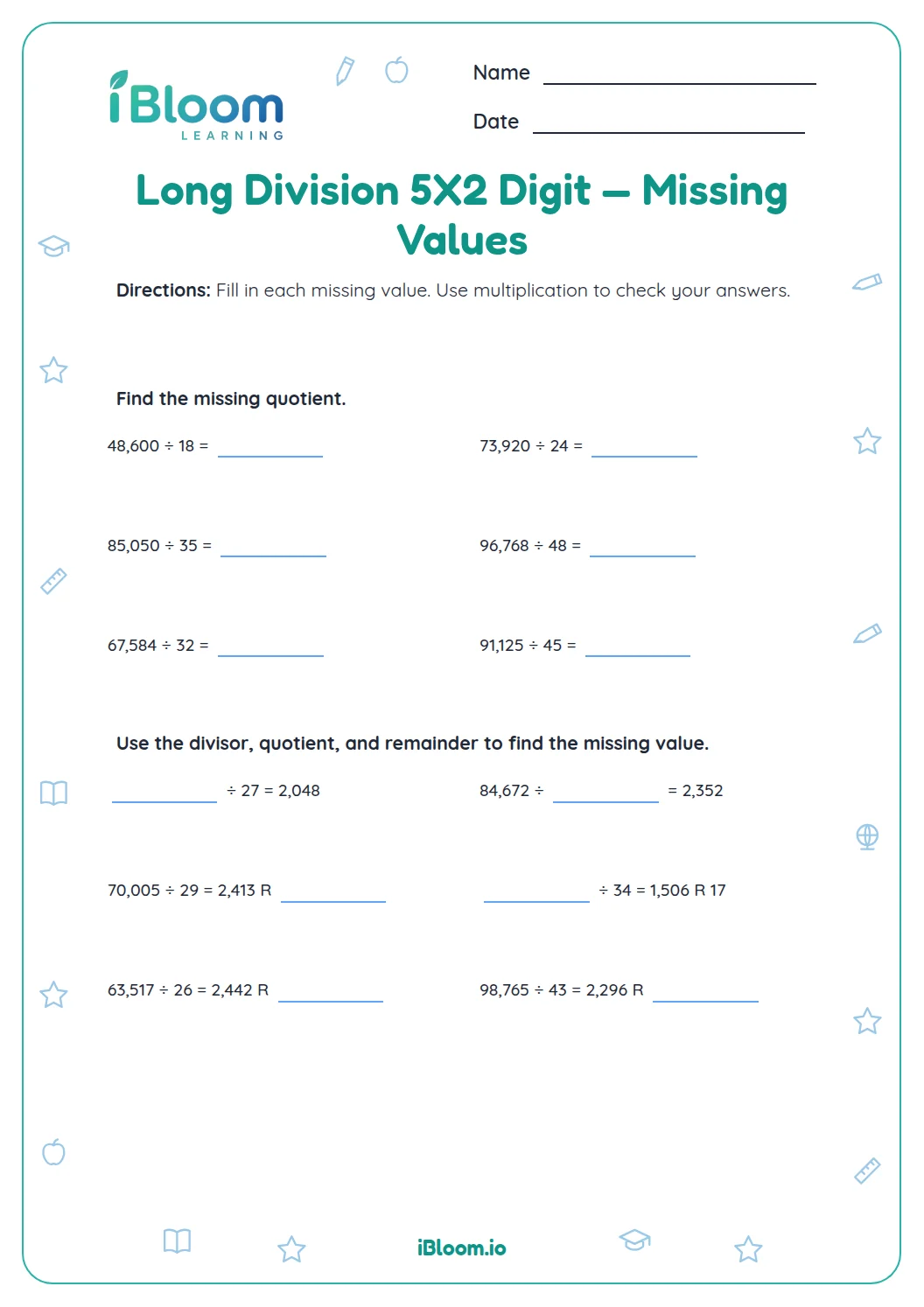
About this worksheet
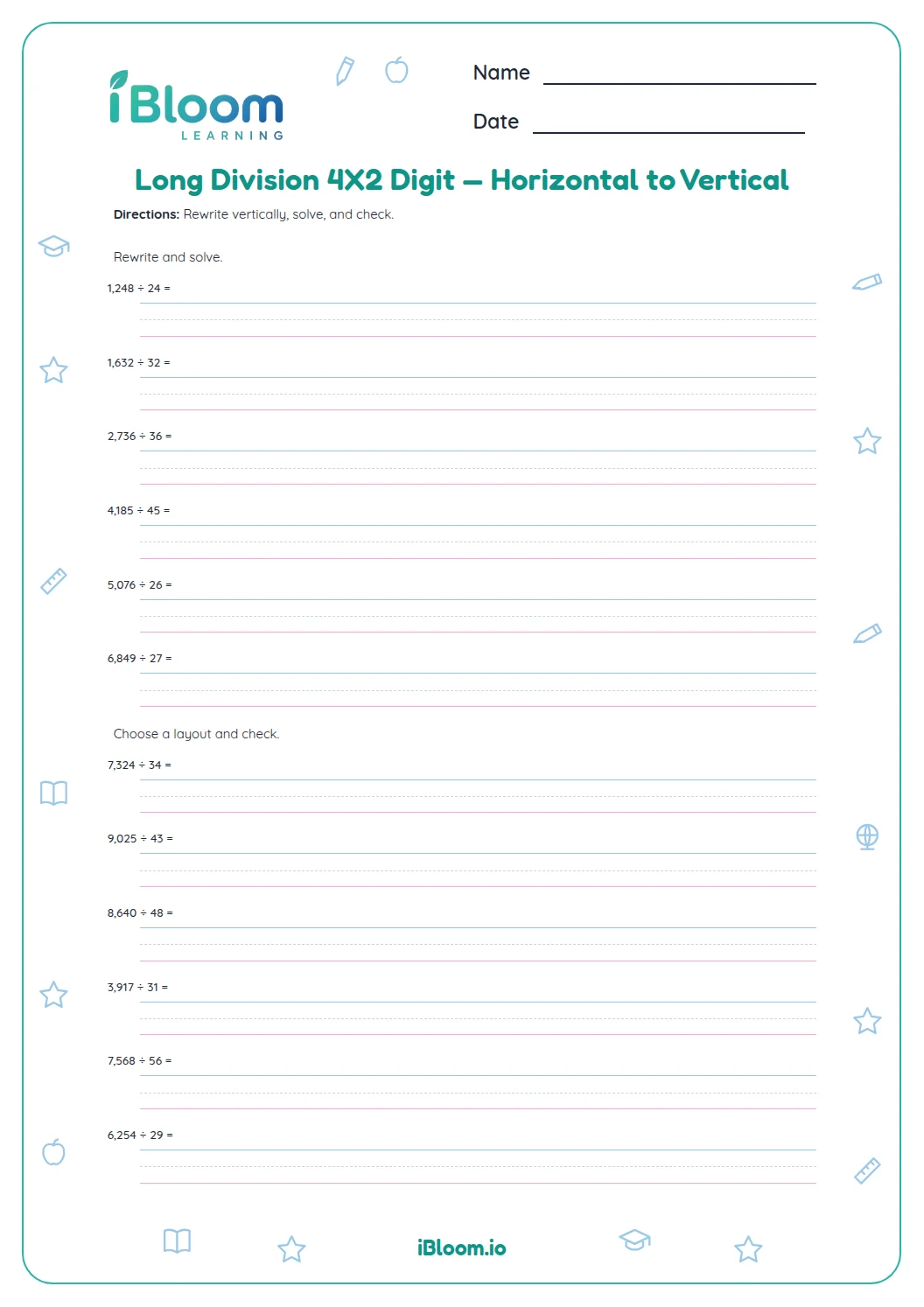
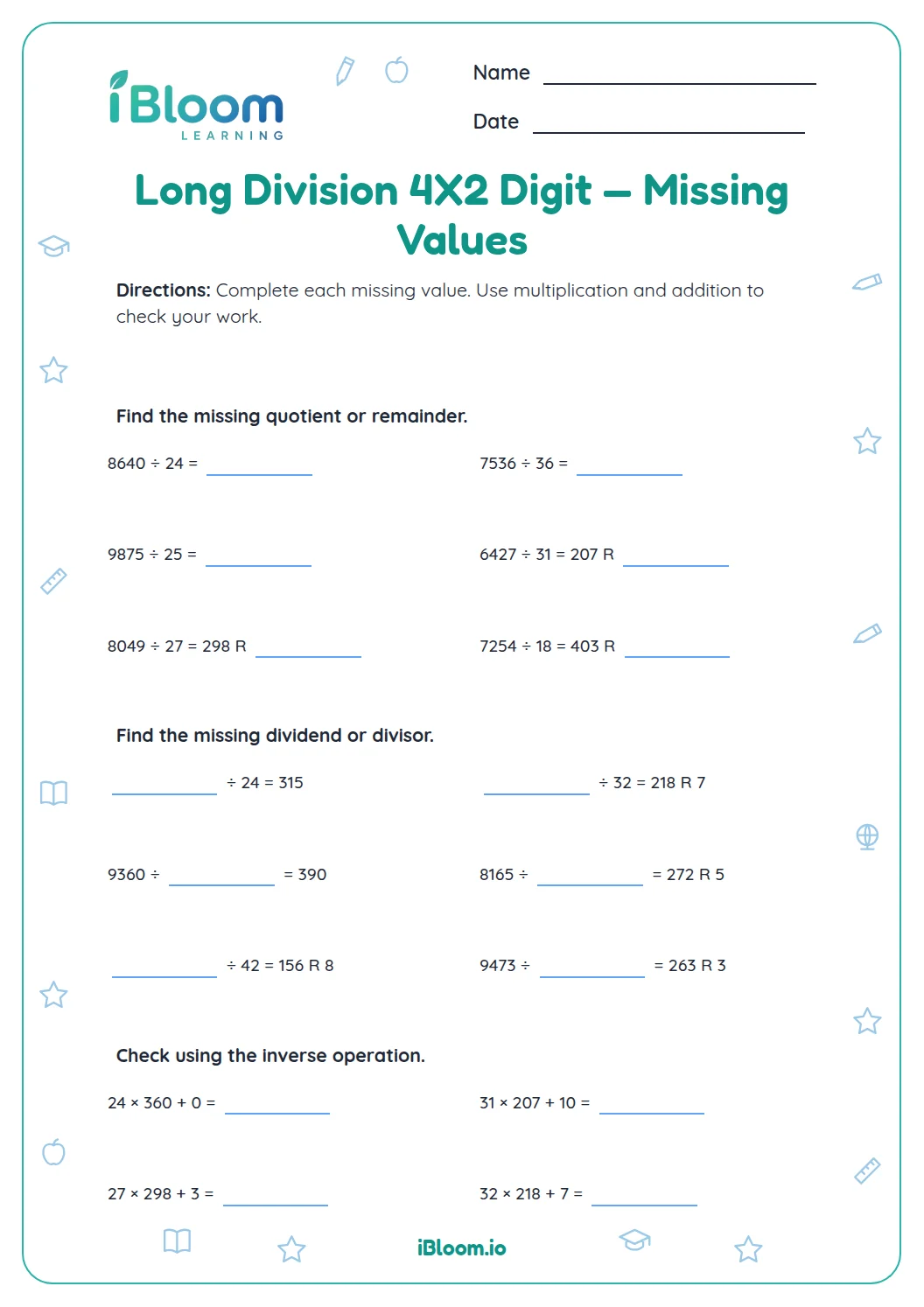
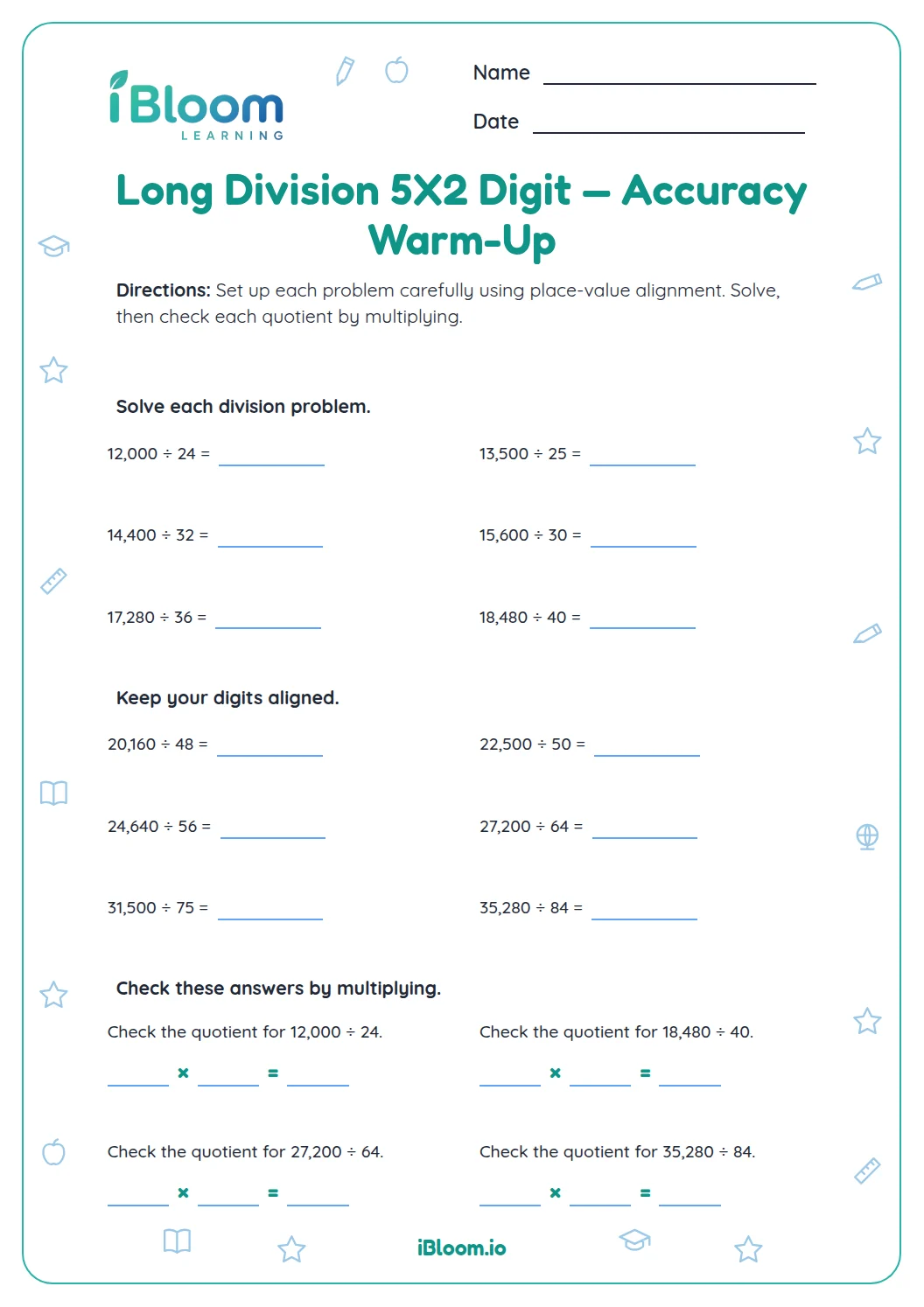
This printable gives students 16 exact-quotient problems with four-digit dividends and two-digit divisors. The four sets move from warm-up quotients to a final accuracy set, with directions to use multiplication as a check. It supports the quotient work described in Common Core 5.NBT.B.6. Students can work on scratch paper and compare each quotient with the separate answer key.
Aligned to 5.NBT.B.6
How does the sheet build division accuracy?
Part A begins with four exact quotients. Parts B and C continue with larger values, and Part D finishes with four more problems. Every dividend has four digits and every divisor has two.
- 11,248 ÷ 24
- 224 × 50 = 1,200, leaving 48.
- 348 ÷ 24 = 2, so 50 + 2 = 52.
- 4Check: 52 × 24 = 1,248.
What is a useful check after division?
Multiply the quotient by the divisor. For an exact quotient, the product should match the dividend. If it does not, review the place value in the quotient and the subtraction steps.
What is included on the worksheet?
There are 16 problems in four short sets. The answer key lists the quotient for each division sentence.
- 16 exact-quotient problems
- Four-digit dividends and two-digit divisors
- A multiplication check reminder
How to use this worksheet
- 1Read the dividend and divisor before starting.
- 2Estimate a quotient so the first digit is reasonable.
- 3Divide one place value at a time and keep digits aligned.
- 4Multiply the quotient by the divisor.
- 5If the product differs, check the division steps.
Common mistakes and quick fixes
The mistake
Putting a quotient digit in the wrong place.
The fix
Estimate the size of the quotient before writing its first digit.
The mistake
Subtracting a product that is larger than the current dividend part.
The fix
Check that each quotient digit times the divisor fits that part.
The mistake
Stopping after writing the quotient.
The fix
Multiply divisor × quotient and compare the product with the dividend.
Common Core alignment
This worksheet practices whole-number quotients using four-digit dividends and two-digit divisors.
Find whole-number quotients with up to four-digit dividends and two-digit divisors.
On this sheet: Every problem has a four-digit dividend and two-digit divisor; multiplication provides a check.
Show the official wordingHide the official wording
Find whole-number quotients of whole numbers with up to four-digit dividends and two-digit divisors, using strategies based on place value, the properties of operations, and/or the relationship between multiplication and division. Illustrate and explain the calculation by using equations, rectangular arrays, and/or area models.
What to practice next
Make more practice
Further reading
Questions parents and teachers ask
How can students check a long-division quotient?
Multiply the quotient by the divisor and compare the product with the dividend. For example, 52 × 24 = 1,248, so 52 is the exact quotient for 1,248 ÷ 24. If the product does not match, revisit the quotient digits and subtraction steps.
What kind of division does this worksheet practice?
Every problem has a four-digit dividend and a two-digit divisor, and each quotient is a whole number with no remainder. Students practice keeping place value organized as they divide and can use multiplication to check each result. The page also reminds students to check with multiplication.
Should students estimate before dividing?
Yes. An estimate helps students predict the size of the quotient and place its digits sensibly. After estimating, divide carefully, then multiply the final quotient by the divisor. The product should return to the original dividend for each exact problem.
What is included with the printable?
The printable contains 16 long-division questions arranged in four sets and a separate answer key. Students can write their calculations in the work area, record each quotient, and compare answers after finishing the worksheet. Students should compare each result with its dividend before moving on.
Why is the multiplication check useful?
Multiplication reverses division, so the divisor times the quotient should equal the dividend. For the first item, 24 × 52 returns 1,248. If the product differs, check the quotient digits and the subtraction steps before recording the answer.