



About this worksheet
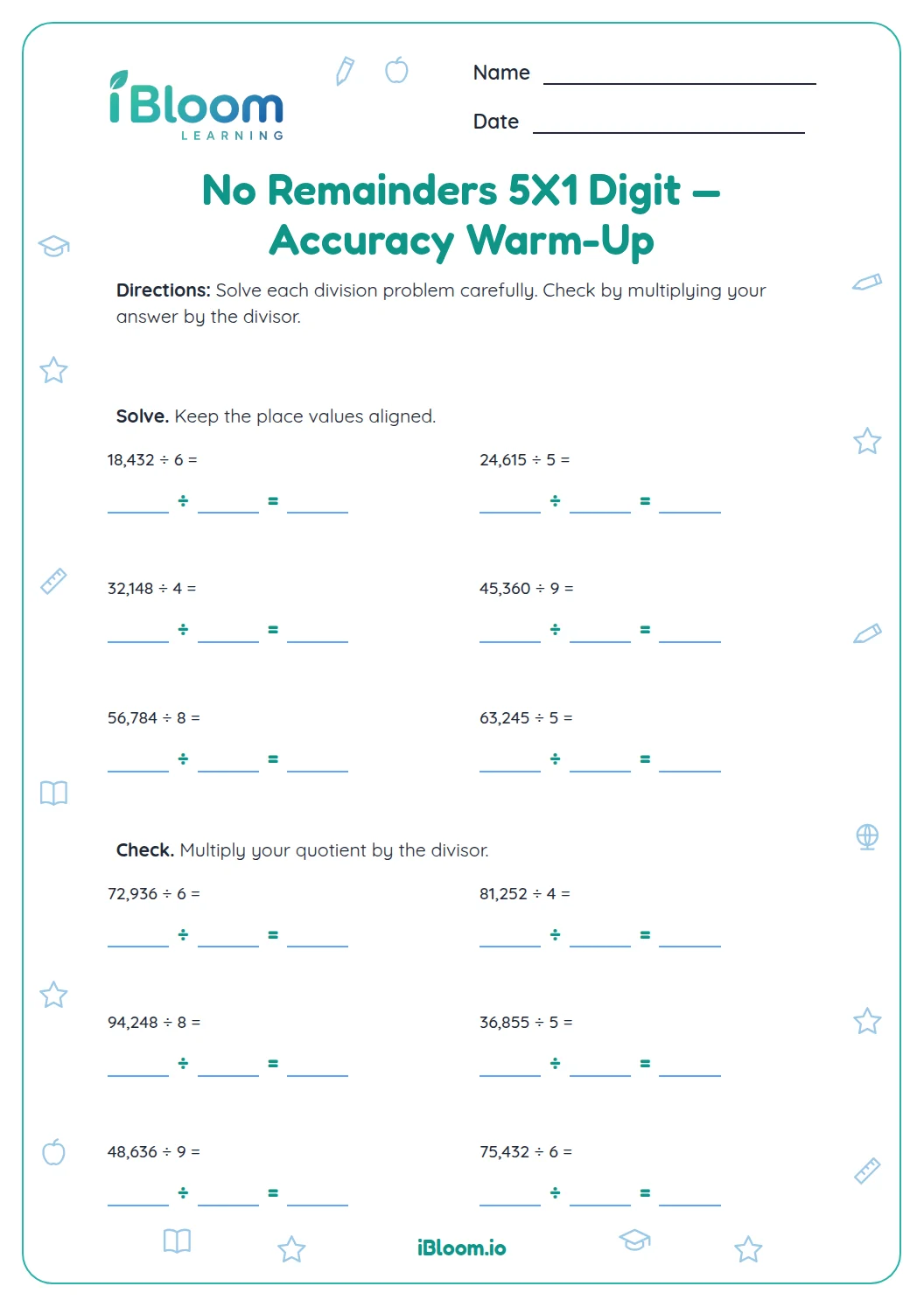
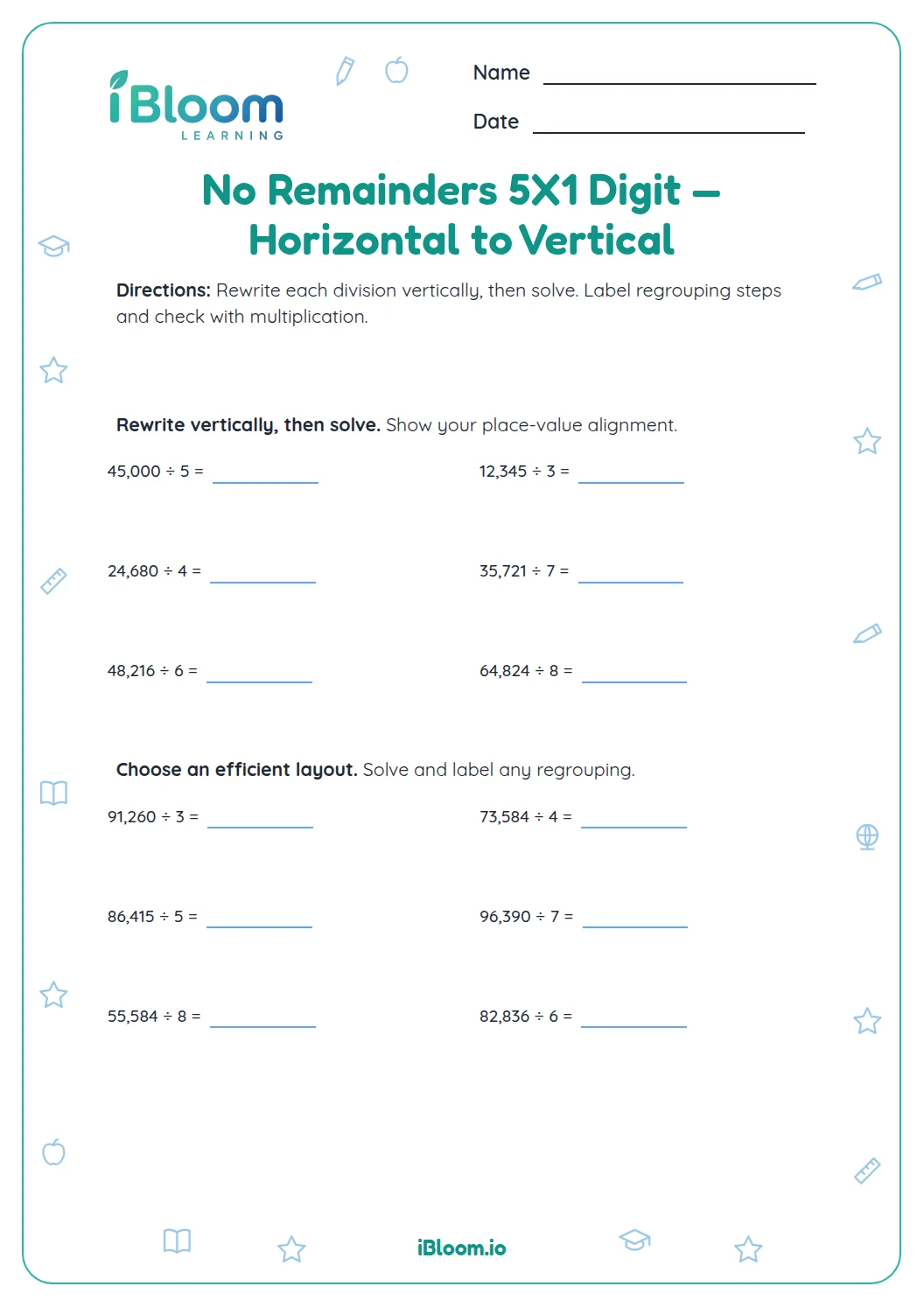
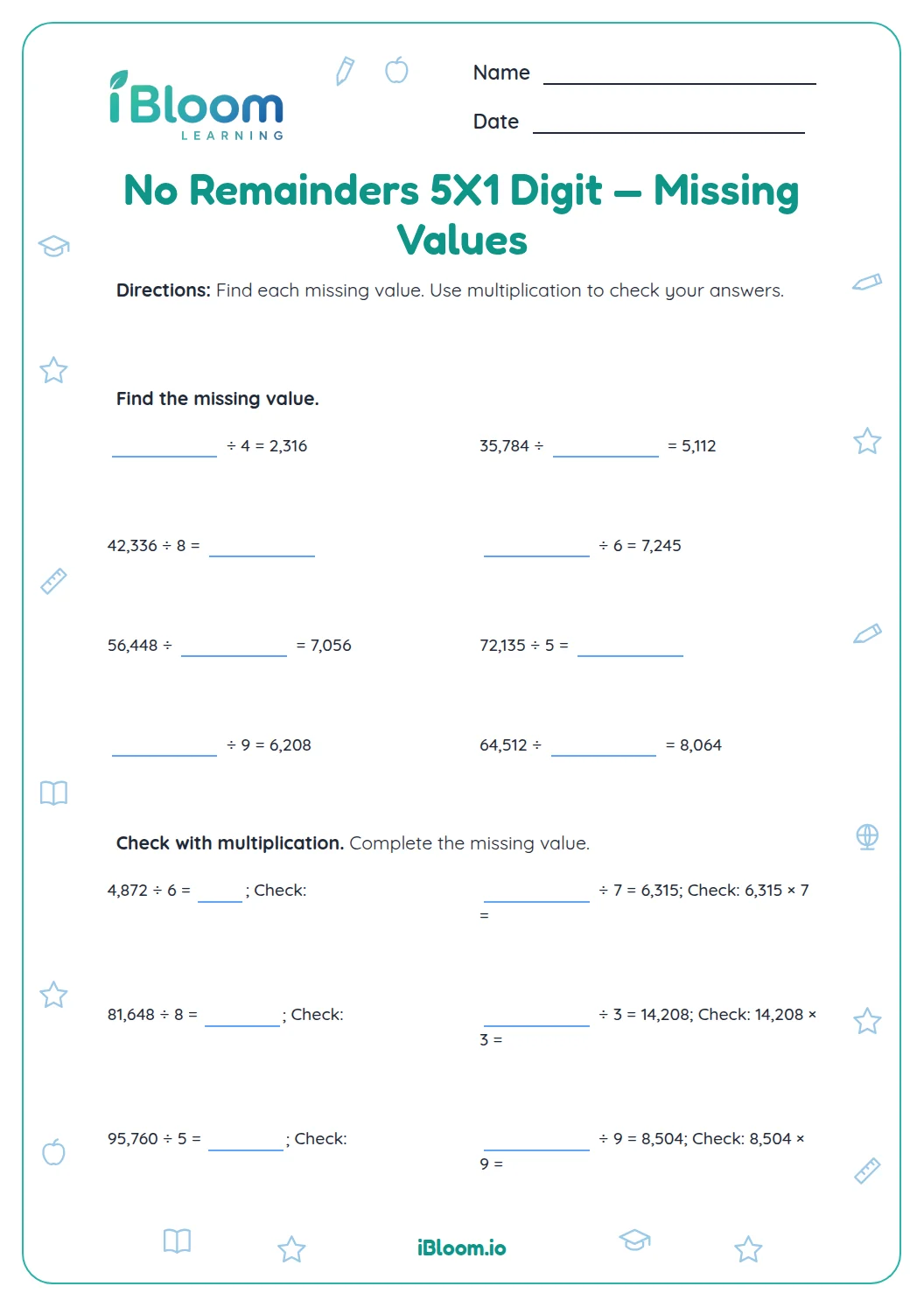
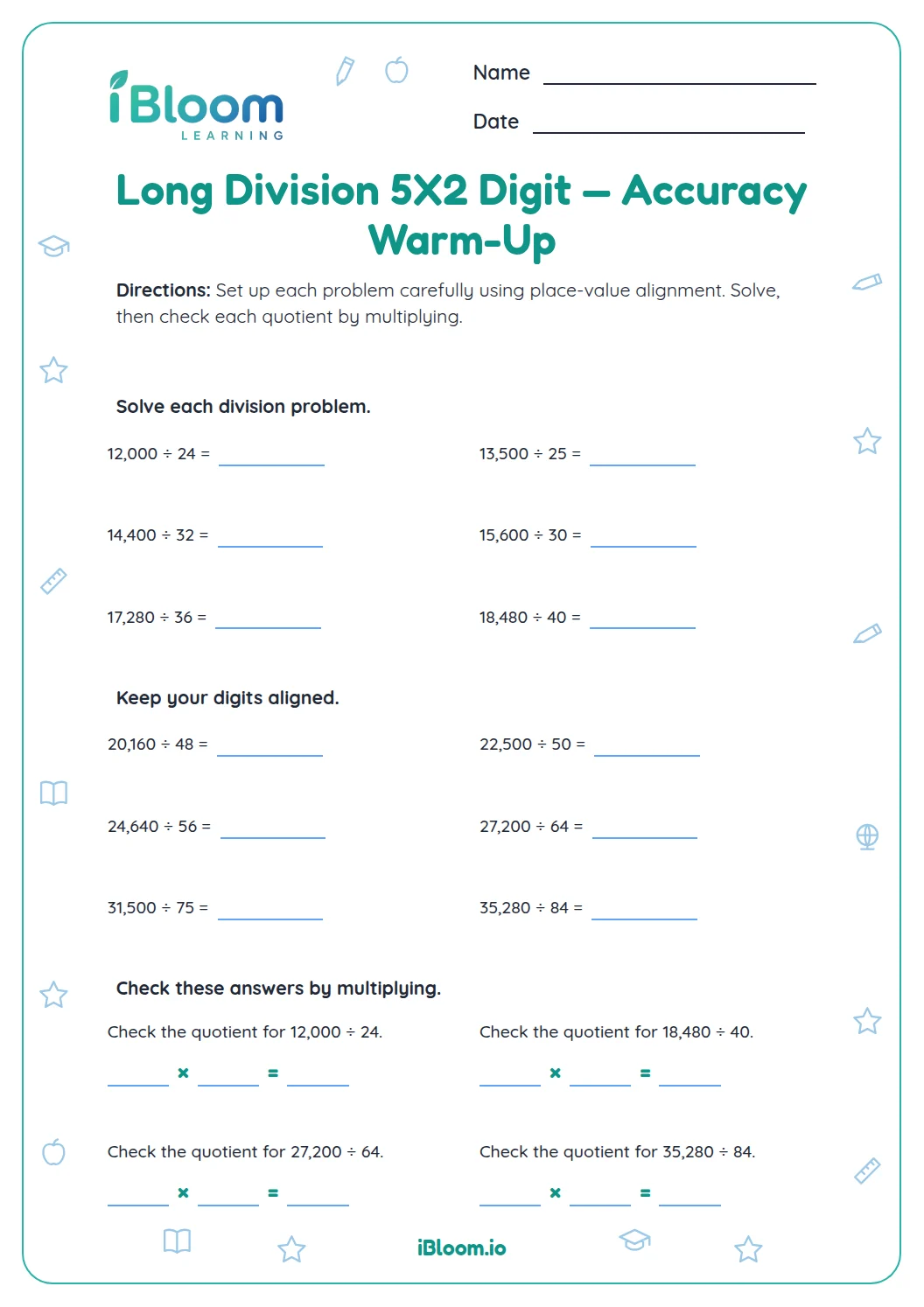
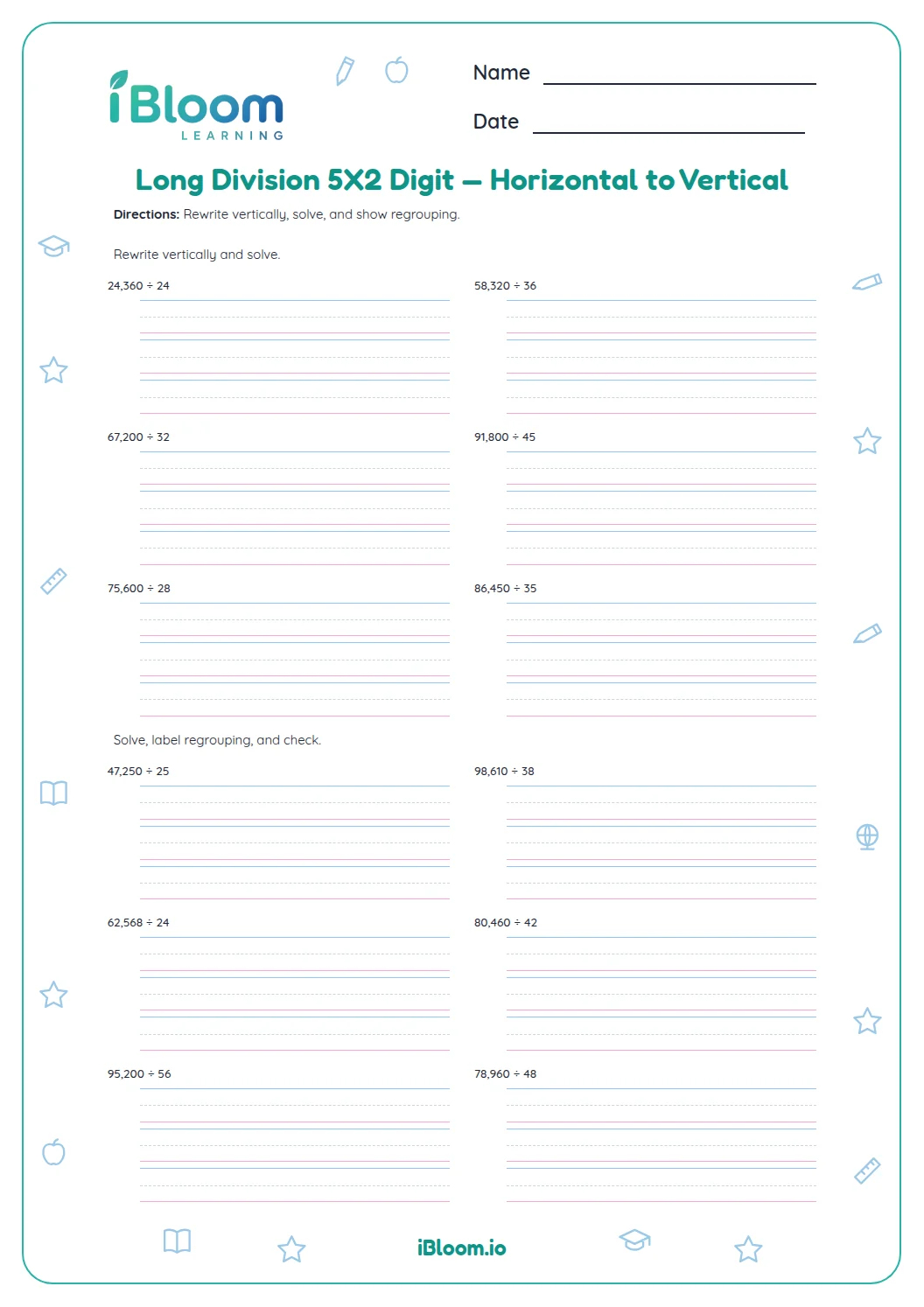
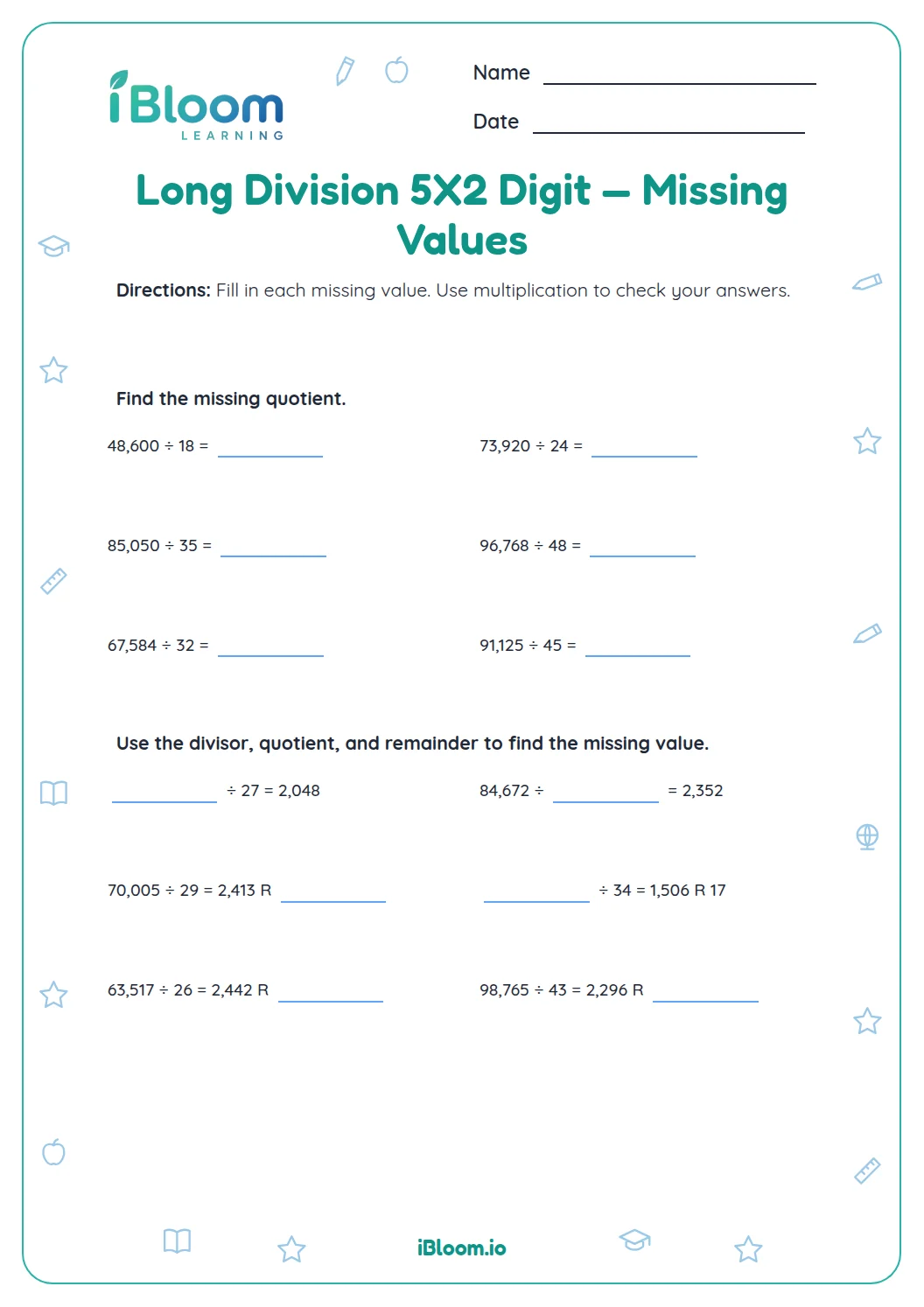
This free printable math warm-up gives students eight five-digit dividends to divide by one-digit divisors, plus two quotient checks. It suits Grades 4–6 students practicing the standard algorithm and aligns with CCSS 6.NS.B.2. Part A has four exact divisions. Part B asks students to check two claimed quotients by multiplication, including one with a missing zero. Part C has four more divisions with zeros in their quotients. Every division has working space. The separate key gives eight quotients and two choices. Accuracy is the focus, with no printed time limit.
Aligned to 6.NS.B.2
What makes this an accuracy warm-up?
Part A uses 12,345 ÷ 5, 21,756 ÷ 4, 27,594 ÷ 3 and 45,675 ÷ 5. Students set up each expression as long division, carry out the steps and multiply to check.
Part B asks students to check two claims: one correct quotient and one with a missing zero. Part C then uses 18,432 ÷ 6, 32,768 ÷ 8, 54,320 ÷ 7 and 60,048 ÷ 6 to practice keeping zeros in different places.
Why must a zero stay in the quotient?
In 18,432 ÷ 6, dividing 18 by 6 gives 3 thousands. After subtracting 18, bring down the 4 hundreds. Six fits into 4 zero times, so write 0 in the hundreds place before bringing down the next digit.
The remaining steps use 43 tens and then 12 ones. Omitting the zero would produce 372, which is much too small: 372 × 6 is only 2,232.
- 118 ÷ 6 = 3; subtract 18.
- 2Bring down 4; write 0 in the hundreds place.
- 3Bring down 3 to make 43; 43 ÷ 6 = 7 remainder 1.
- 4Bring down 2 to make 12; 12 ÷ 6 = 2.
- 5Quotient: 3,072. Check: 3,072 × 6 = 18,432.
How can students check without repeating every step?
Multiplication gives an independent check. For question 1, 2,469 × 5 = 12,345. If the product is different from the dividend, compare the quotient digits with the long-division work and find the first mismatch.
An estimate can flag a missing digit before a full check. Since 60,000 ÷ 6 = 10,000, the answer to 60,048 ÷ 6 should be a little above 10,000. The exact answer is 10,008.
In Part B, 7,541 × 9 = 67,869 confirms Sam’s quotient. Jo’s 300 × 5 = 1,500 is too small for 15,000 ÷ 5. The quotient needs another zero: 3,000 × 5 = 15,000.
A careful long-division routine
- 1Copy the dividend inside a long-division bracket and the divisor outside it.
- 2Start with enough leading digits to divide, and place the first quotient digit above the correct column.
- 3Divide, multiply, subtract and bring down the next digit, repeating until all digits are used.
- 4After starting the quotient, write a zero for any place where the divisor fits zero times.
- 5Multiply each completed quotient by its divisor and compare with the printed dividend.
- 6For Part B, multiply each claimed quotient by its divisor; keep it only if the product matches the dividend.
Errors that a multiplication check catches
The mistake
Writing 372 for 18,432 ÷ 6 after skipping a quotient zero.
The fix
Keep the hundreds place: 3,072 × 6 = 18,432.
The mistake
Writing 4,006 for 32,768 ÷ 8 by adding a second zero instead of dividing 76 by 8.
The fix
After the first zero, bring down 6 to make 76. Eight fits 9 times; continue to get 4,096.
The mistake
Writing 776 for 54,320 ÷ 7 after leaving out the final zero.
The fix
Bring down the final zero and write the ones digit: 7,760. Then verify 7,760 × 7 = 54,320.
Common Core alignment
Divide five-digit whole numbers by one-digit divisors using the standard algorithm.
On this sheet: Eight items practice the standard long-division algorithm; two further items check quotient accuracy by multiplication.
Show the official wordingHide the official wording
Fluently divide multi-digit numbers using the standard algorithm.
What to practice next
Make more practice
Further reading
Questions parents and teachers ask
What does five-digit by one-digit division mean?
It means the dividend has five digits and the divisor has one digit. For example, 12,345 ÷ 5 divides a five-digit number by a one-digit number. The quotient can have a different number of digits; on this sheet, 60,048 ÷ 6 produces the five-digit quotient 10,008.
Do any of these divisions have remainders?
No, all the divisions come out evenly. A temporary remainder during long division still needs to be combined with the next digit you bring down. At the end, the remainder is zero. In Part B, use multiplication to test whether each claimed quotient reproduces its dividend.
How much time should I allow for the warm-up?
Plan about 20 minutes, adjusting for how much support the student needs with multiplication checks. The sheet has no printed time limit. You can complete Parts A and B first and return to Part C later, keeping the emphasis on aligned digits, complete working and accurate answers.
Why does Part C focus on zeros?
Part C uses zeros to test whether students keep every place in the quotient. Its answers are 3,072, 4,096, 7,760 and 10,008. A skipped zero changes the value dramatically. Part B introduces that issue when Jo claims that 15,000 divided by 5 is only 300.
Does the answer key show every long-division step?
The key gives the eight final quotients and marks the two checking choices. Use the worked example on this page to discuss 18,432 ÷ 6. For other items, examine the student’s subtraction and bring-down steps, then verify the answer by multiplying the quotient by its divisor.