



About this worksheet
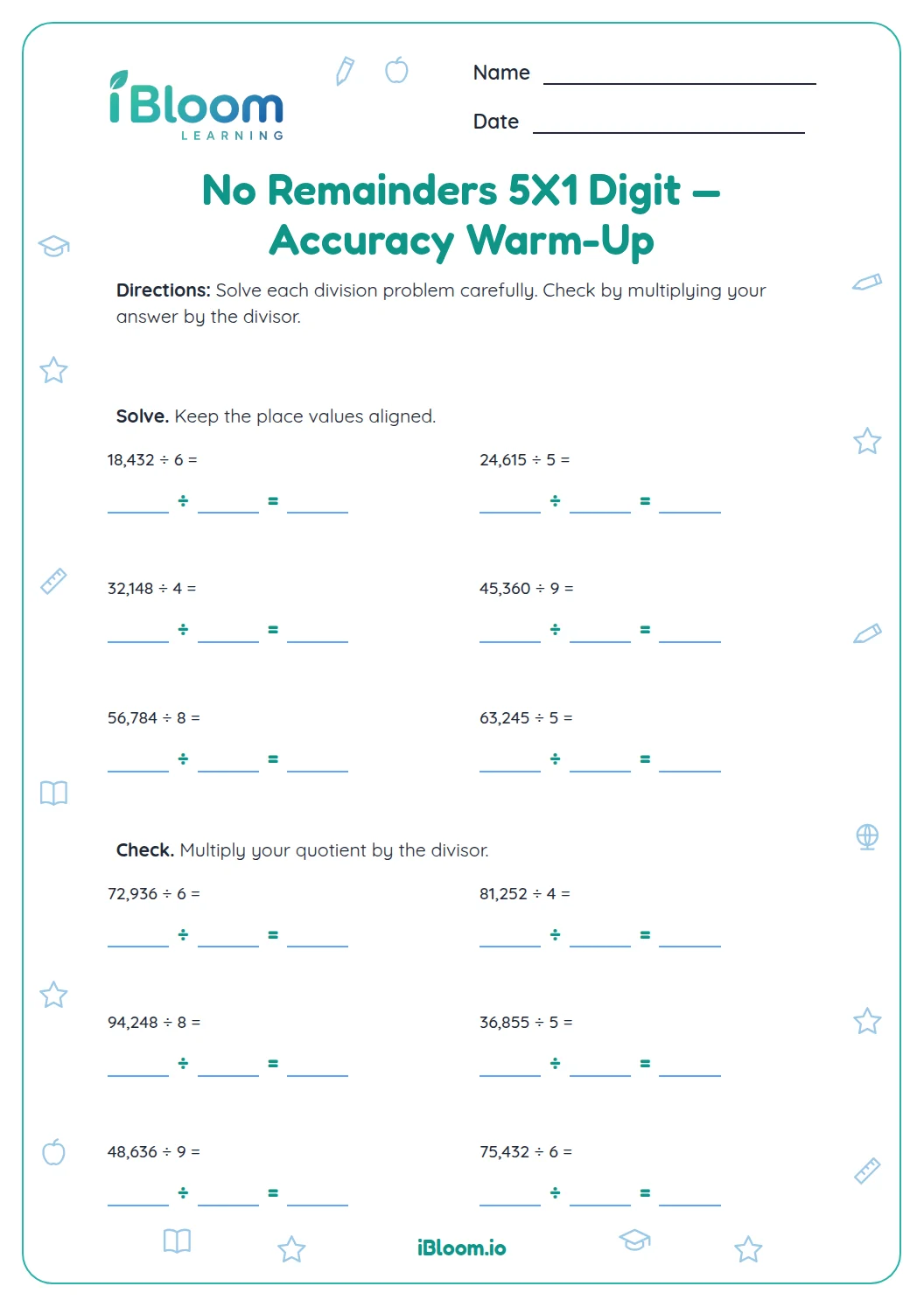
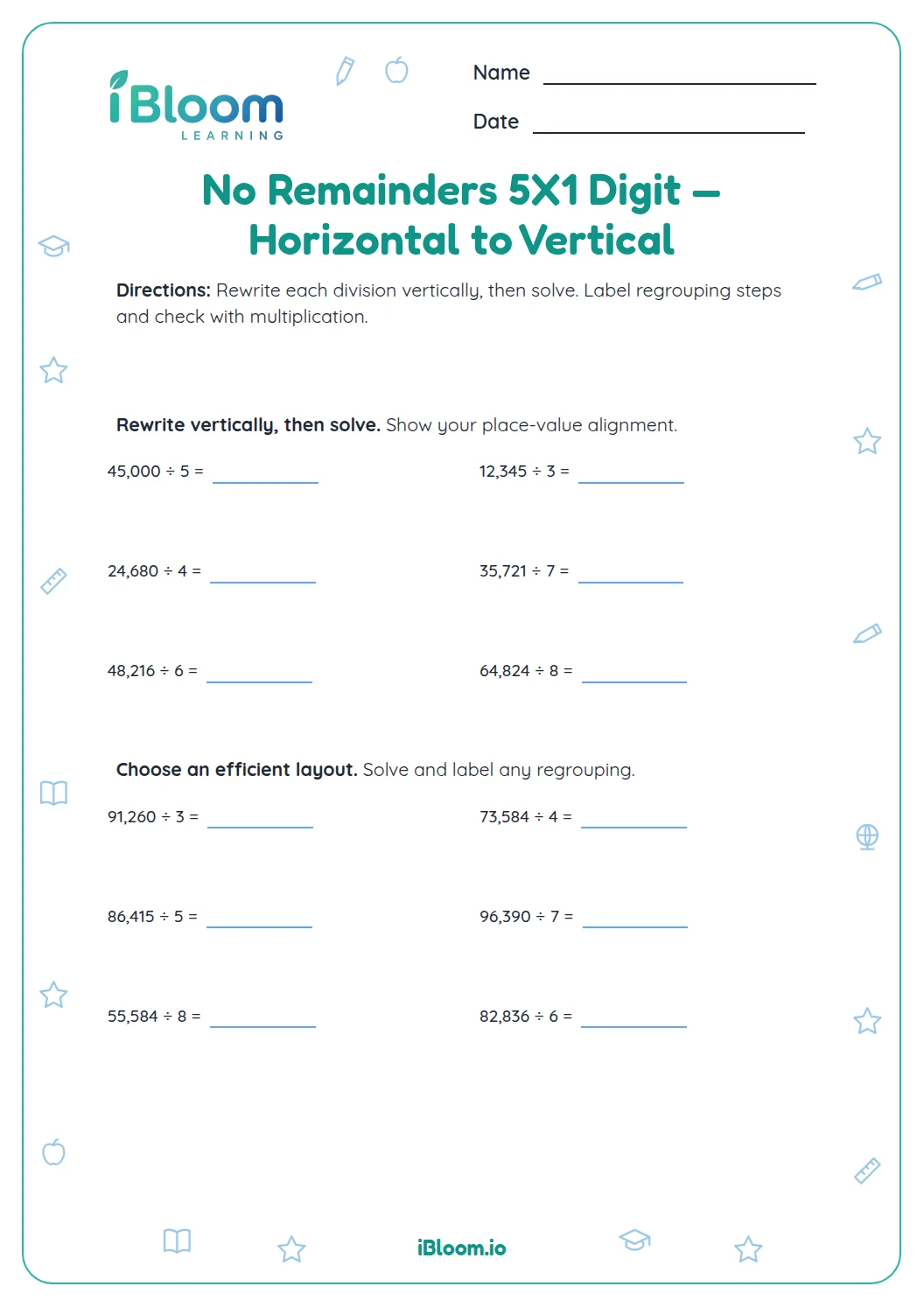
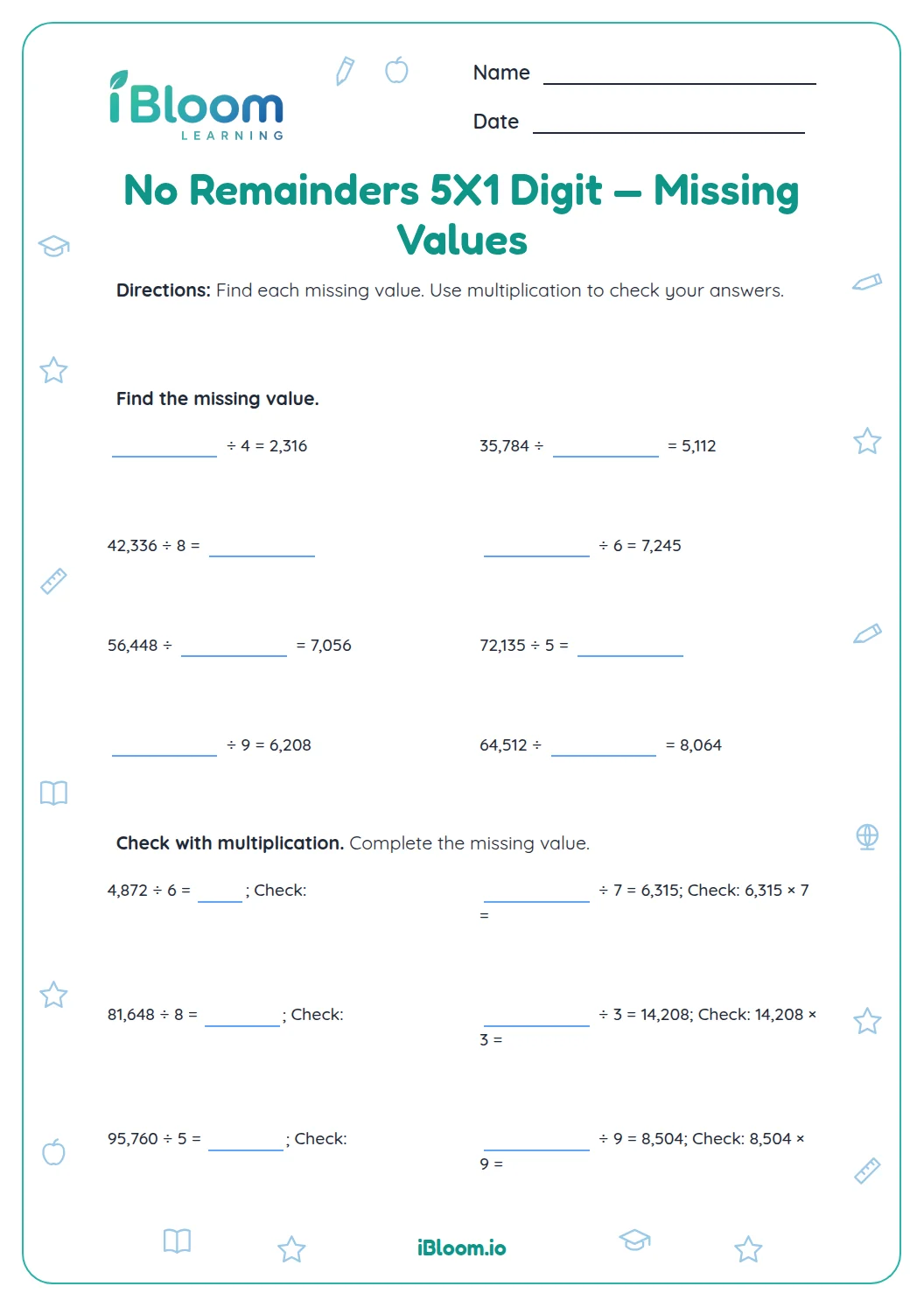
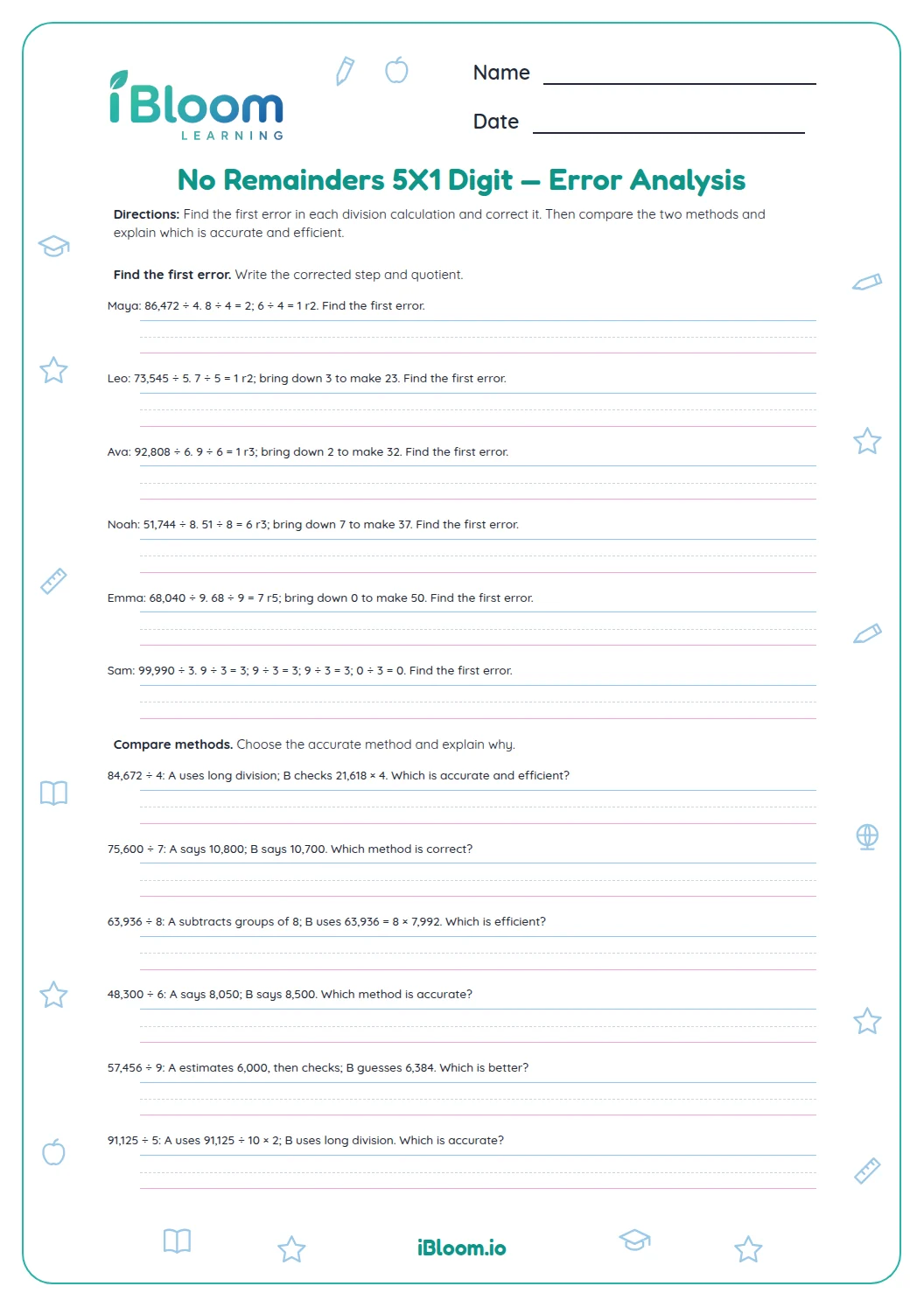
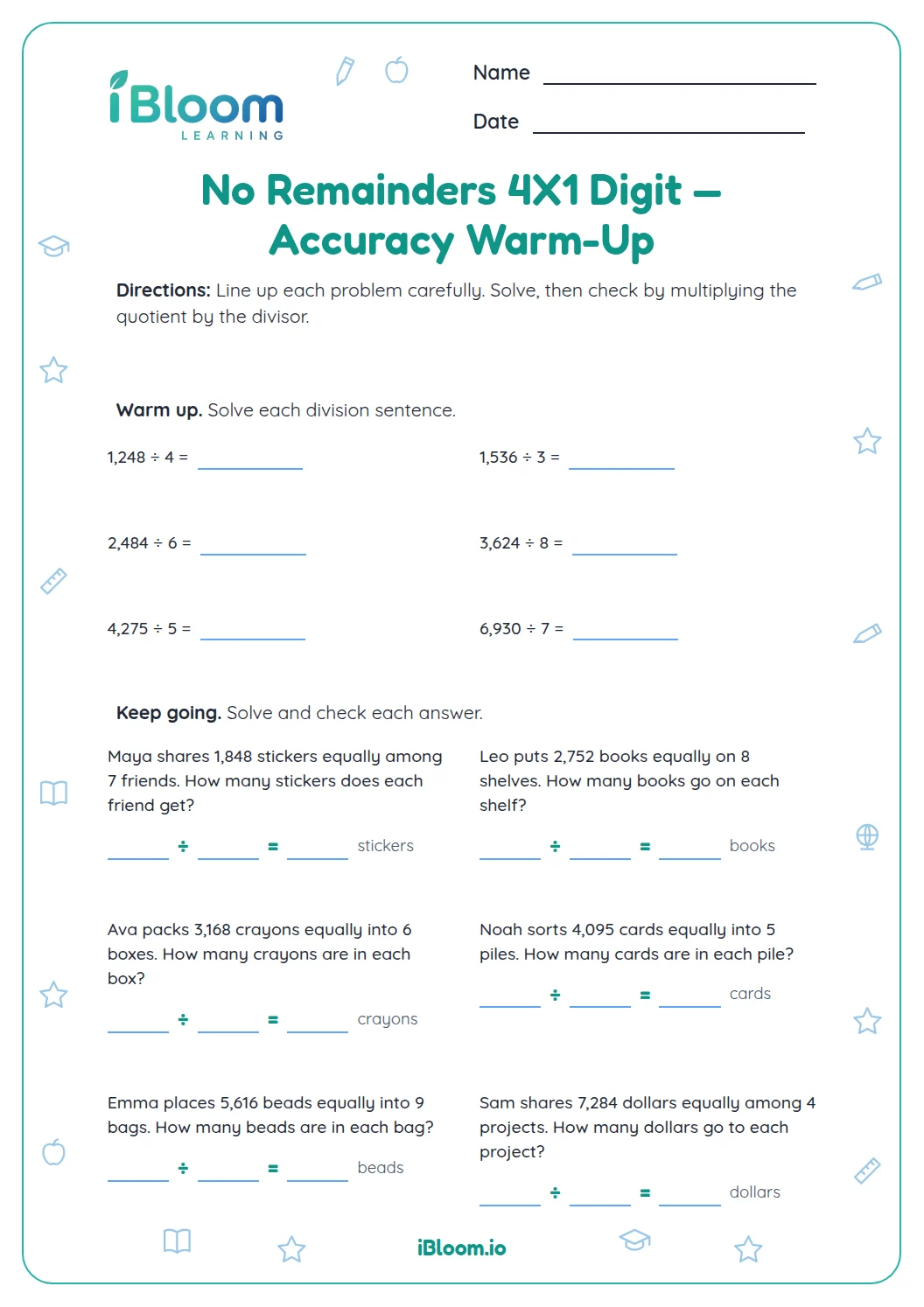
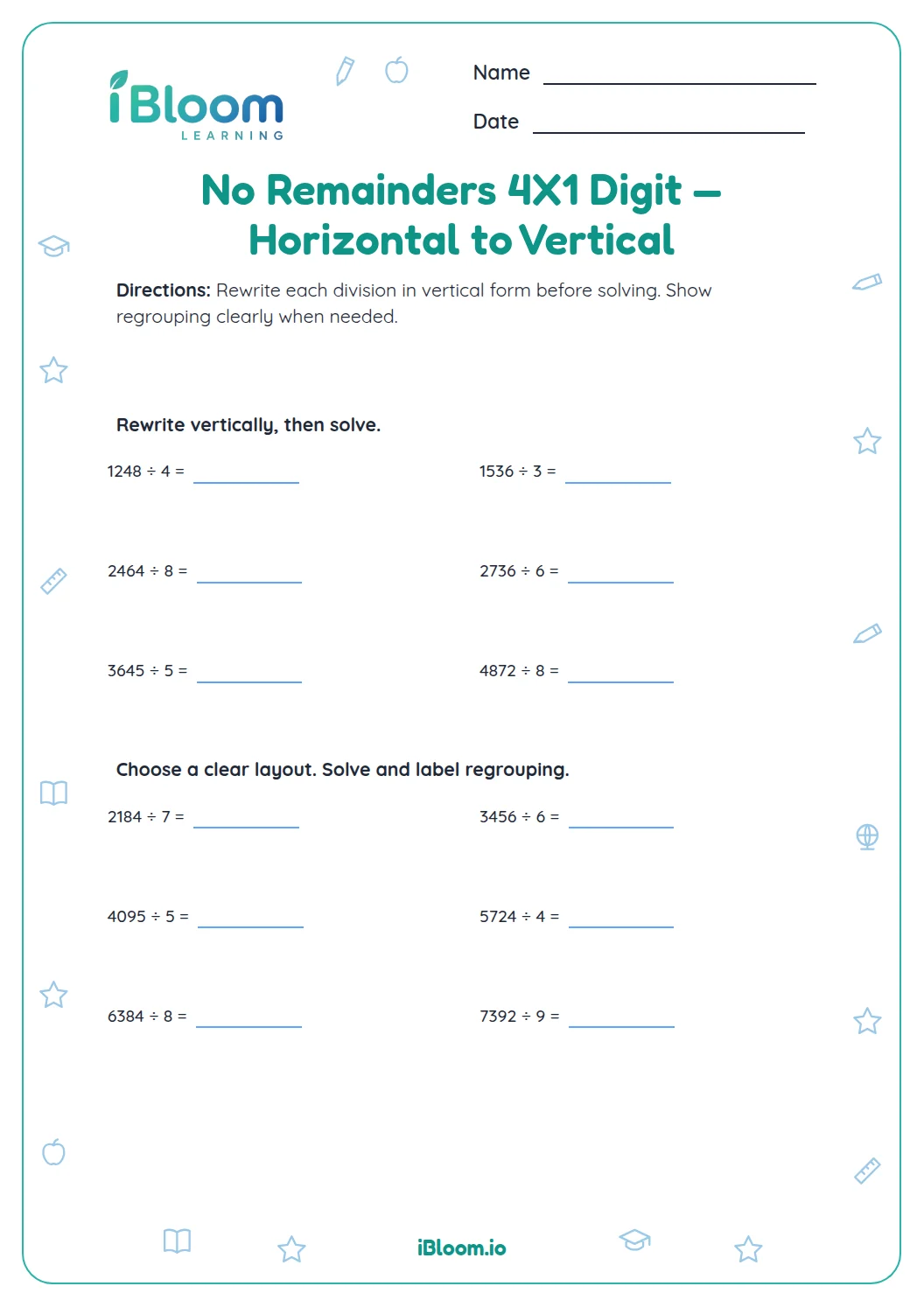
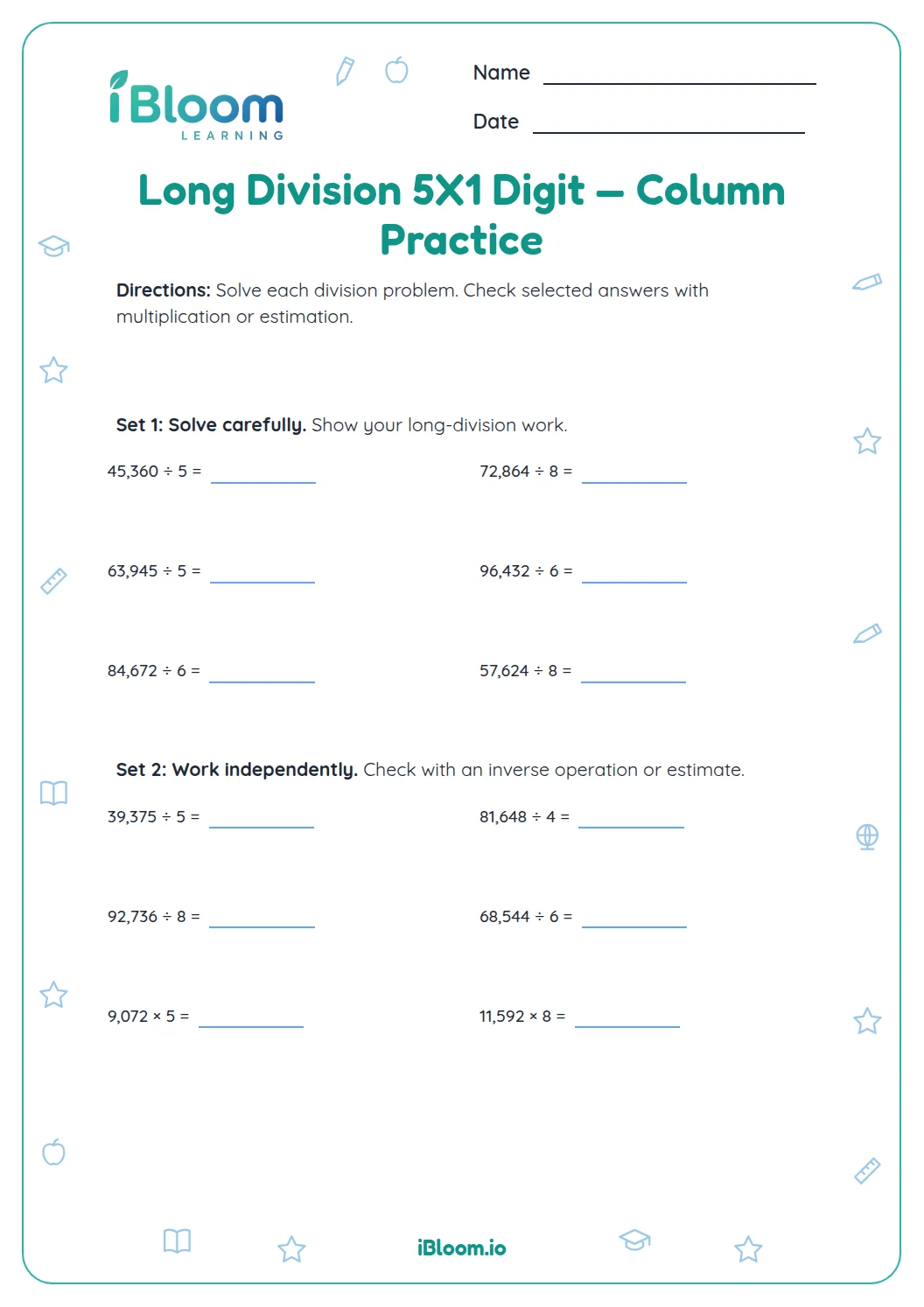
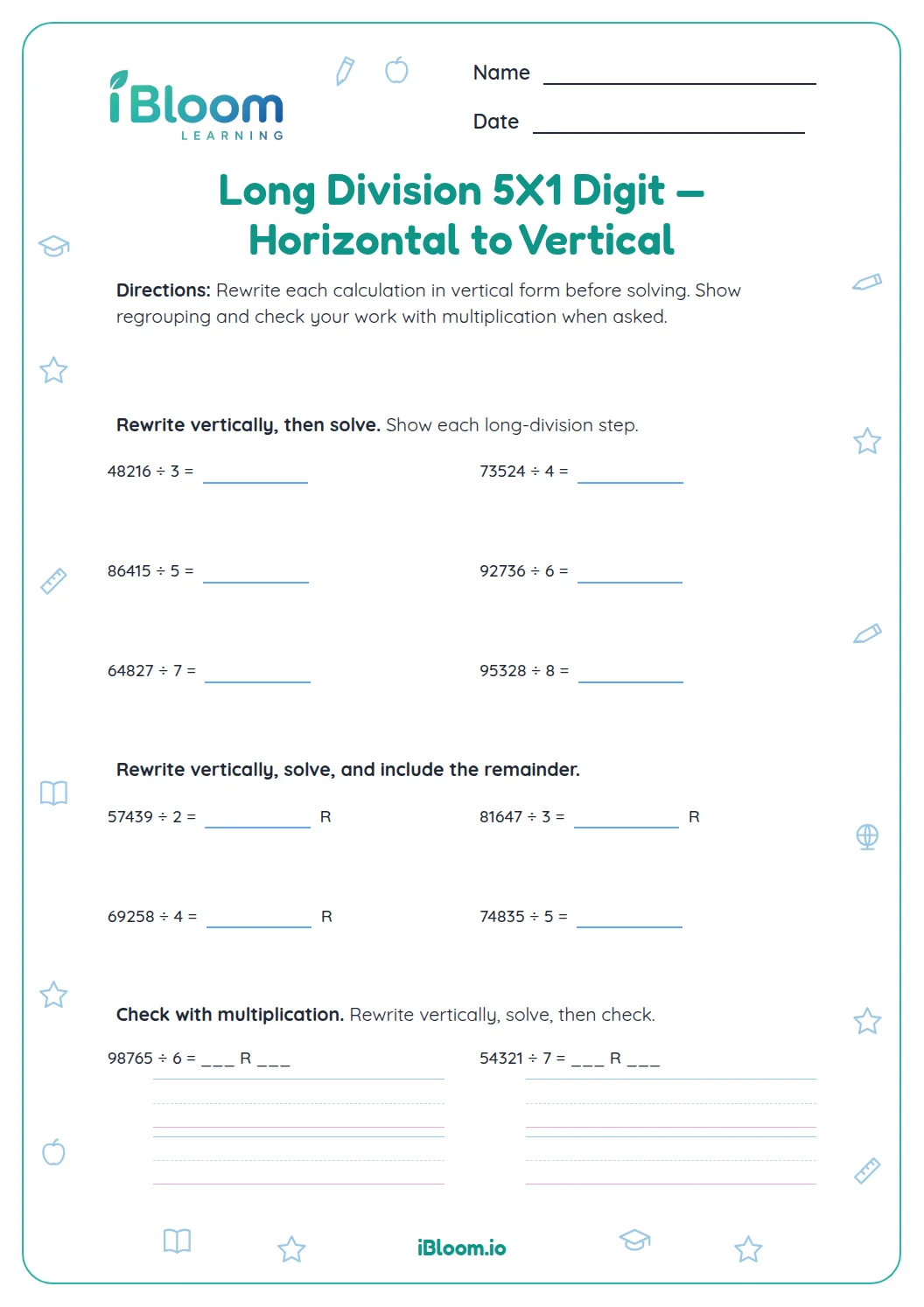
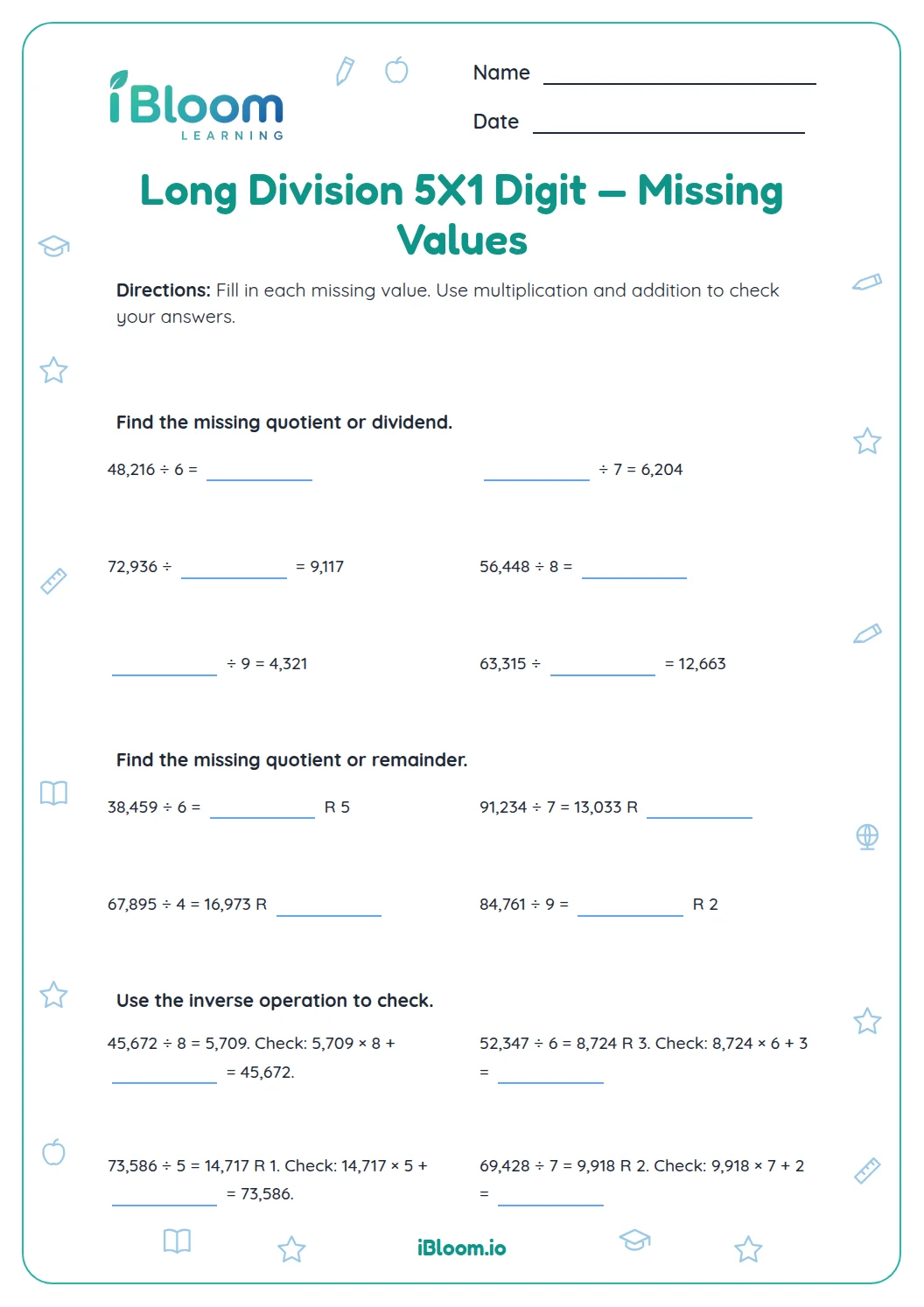
This printable division drill gives Grades 4–6 focused column practice with five-digit dividends and one-digit divisors. Each of the 16 problems divides evenly, with room to record the quotient and intermediate steps. The separate answer key lists every quotient. Multiply each quotient by its divisor to check that the product matches the dividend.
How does column division keep place value clear?
At each step, divide the current part of the dividend, multiply the quotient digit by the divisor, subtract, and bring down the next digit. Keep each quotient digit above the place value it represents.
- 1For 86,424 ÷ 4, begin with 8 thousands ÷ 4 = 2 thousands. Continue through each place to get 21,606.
How can you check a quotient?
Multiply the quotient by the divisor. The product should match the original dividend exactly. A mismatch usually points to a multiplication, subtraction or place-value alignment error.
- 121,606 × 4 = 86,424, so the quotient checks.
What should you do when you bring down a digit?
Write the next digit beside the current remainder and continue the division. Keep the subtraction result smaller than the divisor before bringing down the next digit.
How to use this worksheet
- 1Read the dividend and divisor before starting.
- 2Work from the leftmost digit and write each quotient digit above its place.
- 3Multiply and subtract at each step before bringing down the next digit.
- 4Check the completed quotient by multiplying it by the divisor.
Mistakes to watch for
The mistake
Placing a quotient digit above the wrong place
The fix
Align each quotient digit with the dividend place being divided.
The mistake
Subtracting before multiplying
The fix
Multiply the quotient digit by the divisor, then subtract that product.
The mistake
Skipping a zero in the quotient when needed
The fix
Write a zero in the place whose current value is too small to divide.
What to practice next
Make more practice
Further reading
Questions parents and teachers ask
Do all the problems divide evenly?
Yes. Each dividend is a multiple of its one-digit divisor, so every quotient is a whole number with no remainder. The answer key gives the exact quotient for all 16 questions, and students can check each result by multiplication. Encourage a written check after the final step.
Why show work if I can solve the problems mentally?
Writing the intermediate multiplication and subtraction steps makes place value visible and helps catch errors. It also gives a teacher or caregiver a way to see which step needs attention if the final quotient is incorrect or a digit is out of place.
How do I check a division answer?
Multiply the quotient by the divisor. For example, if a quotient is 21,606 for 86,424 ÷ 4, then 21,606 × 4 should equal 86,424. The original dividend should return exactly, with no remainder left over. Encourage a written check after the final step.
What does “5 by 1 digit” mean?
It means the dividend has five digits and the divisor has one digit. For example, 86,424 ÷ 4 is a five-digit by one-digit problem. The worksheet contains 16 such divisions for column work and quotient checking. Encourage a written check after the final step.
What should students do if the subtraction leaves zero?
Bring down the next digit of the dividend and continue dividing. A zero remainder at one step does not end the problem unless no digits remain to bring down. Keep quotient digits aligned with the place values above the dividend.
Which worksheet follows this one?
Try the four-digit by one-digit no-remainder page for more problems with a shorter dividend, or move to five-digit dividends divided by two-digit divisors for a larger divisor. Both options keep division practice going. Encourage a written check after the final step.