



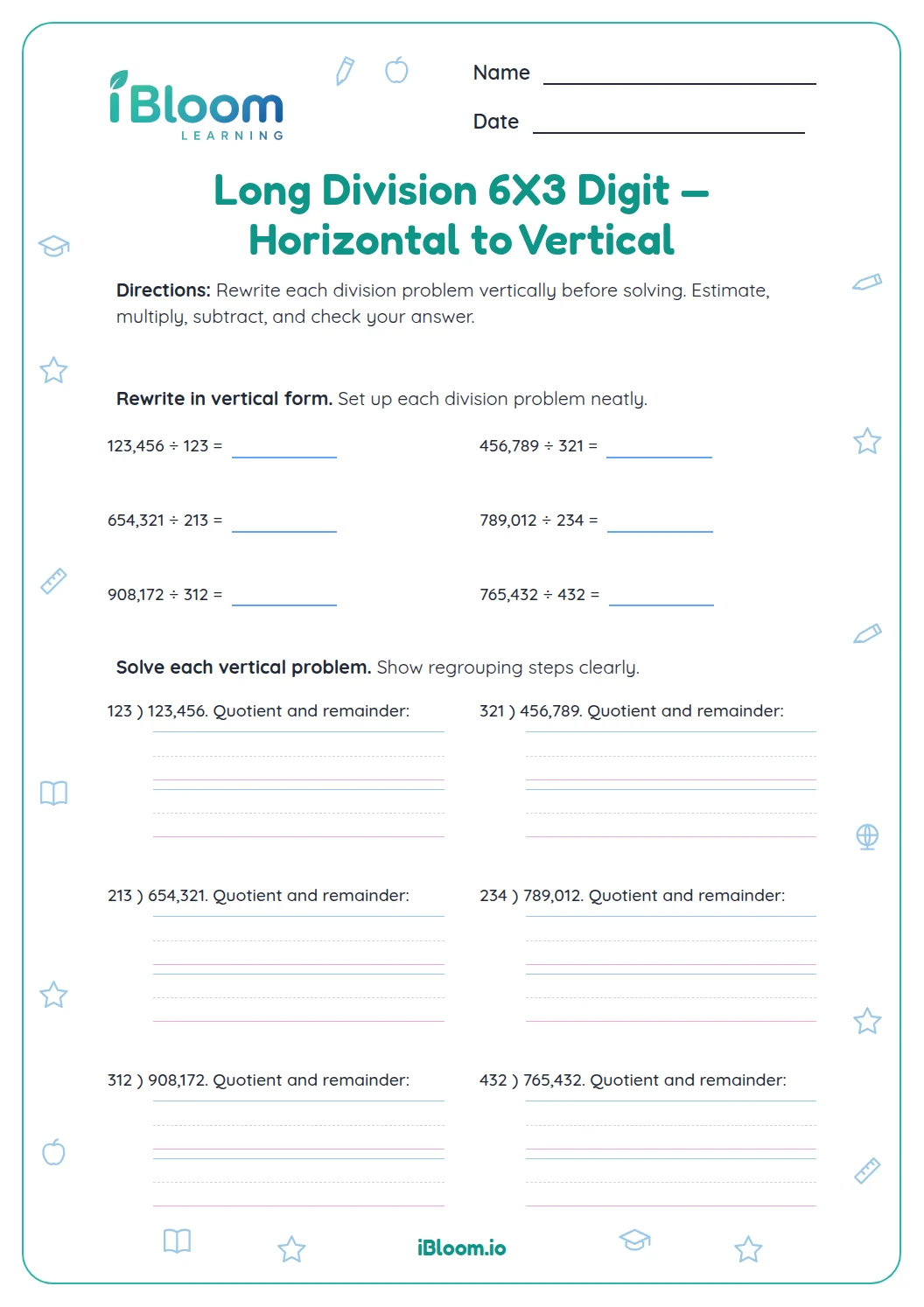

About this worksheet
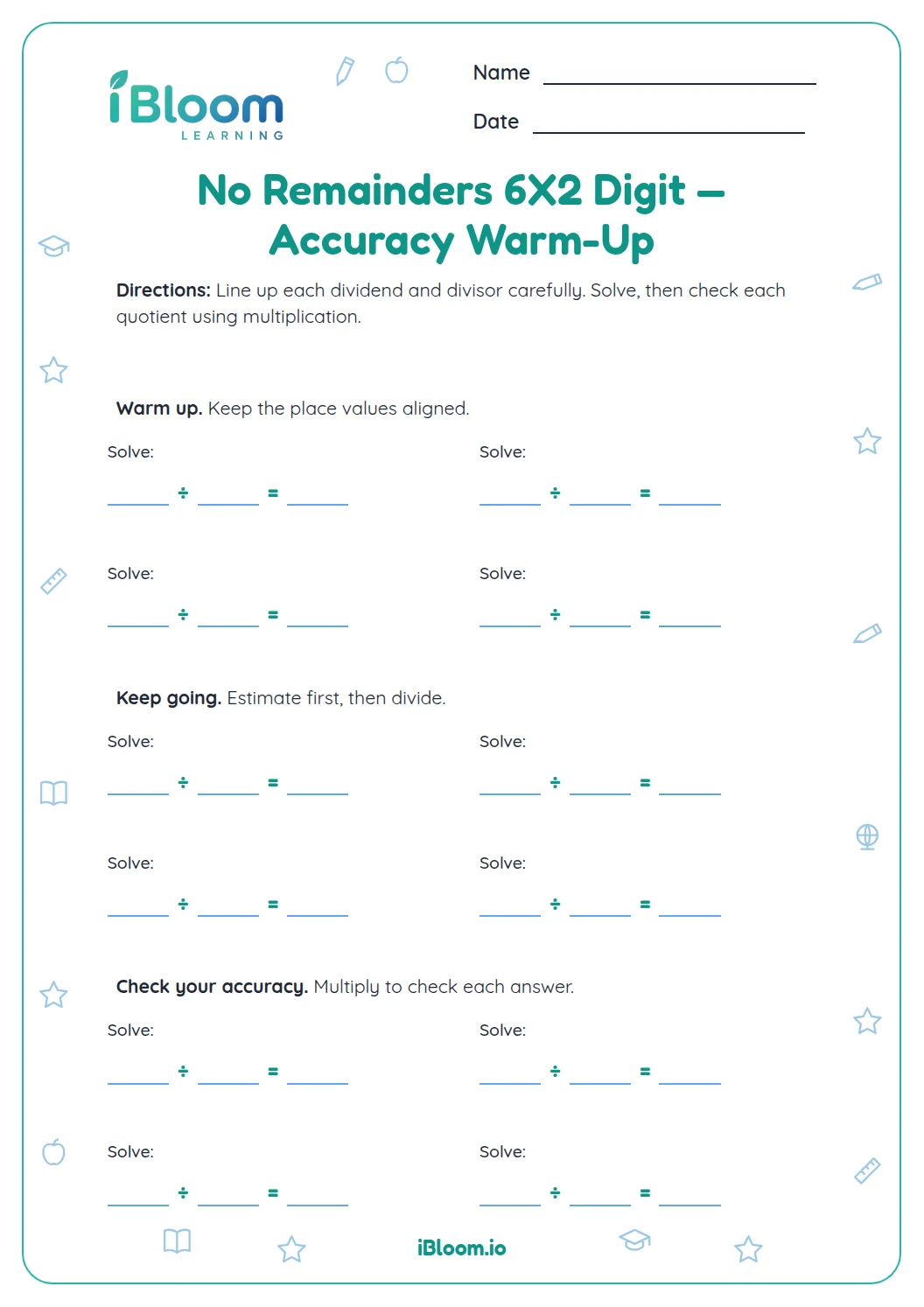
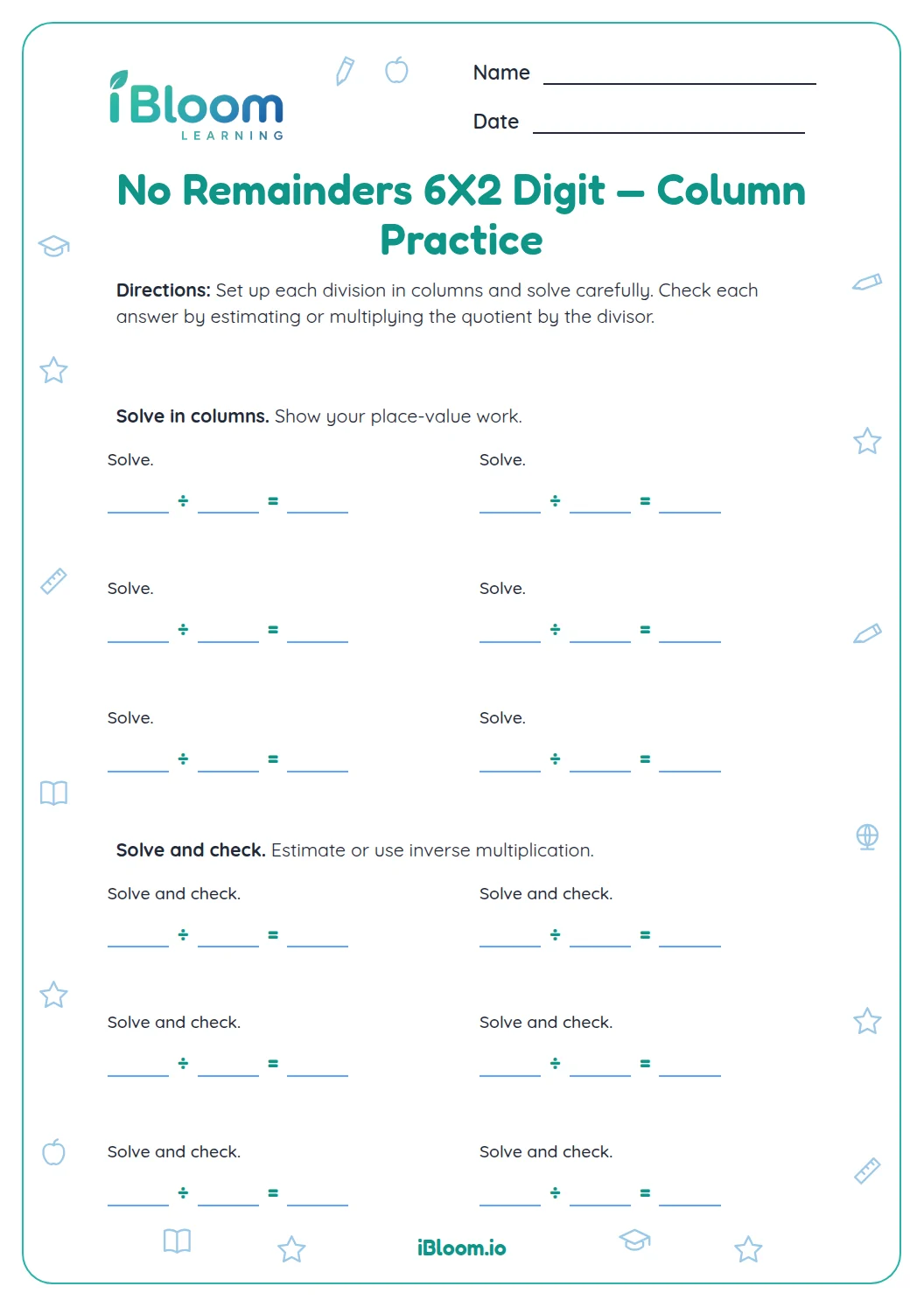
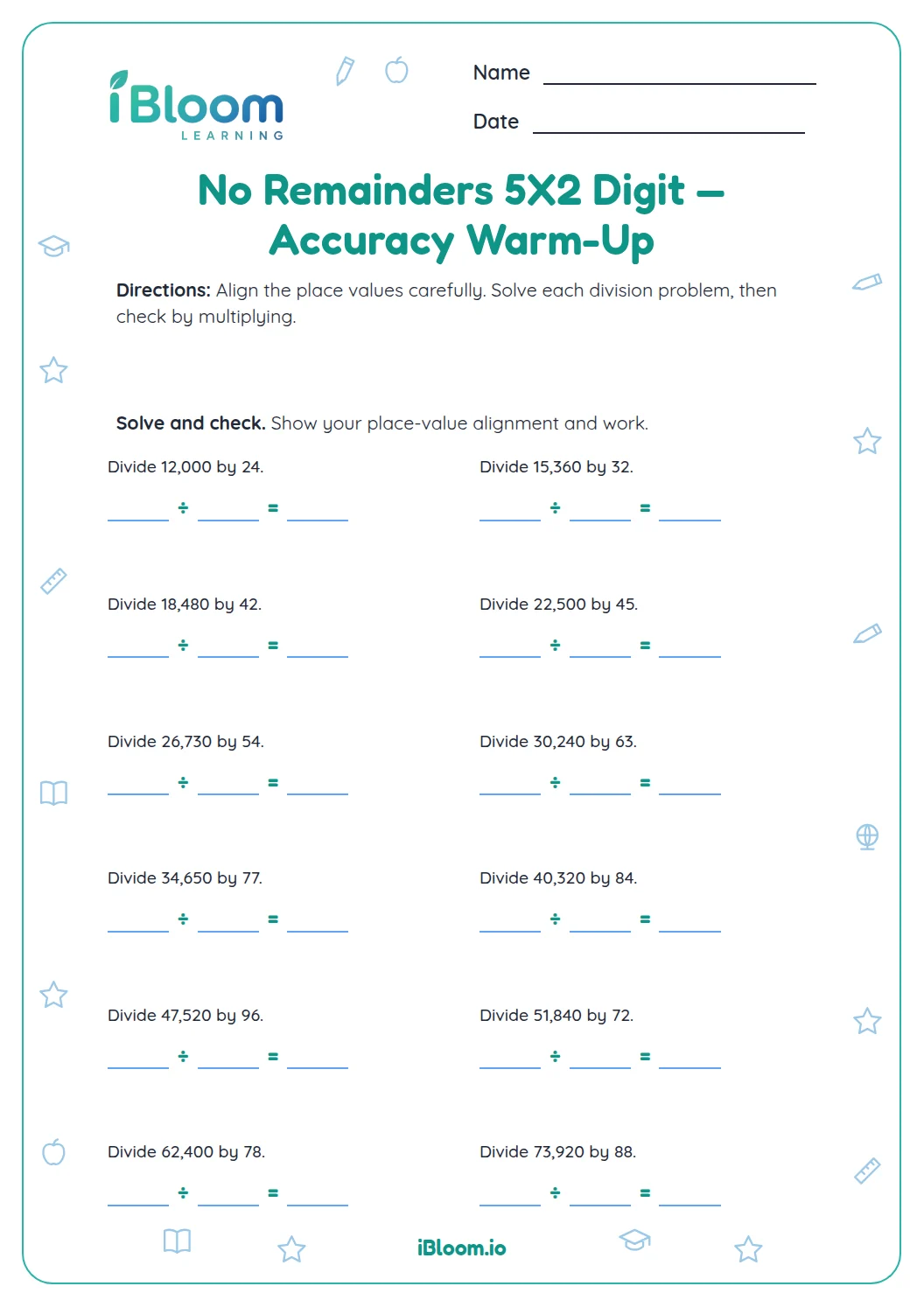
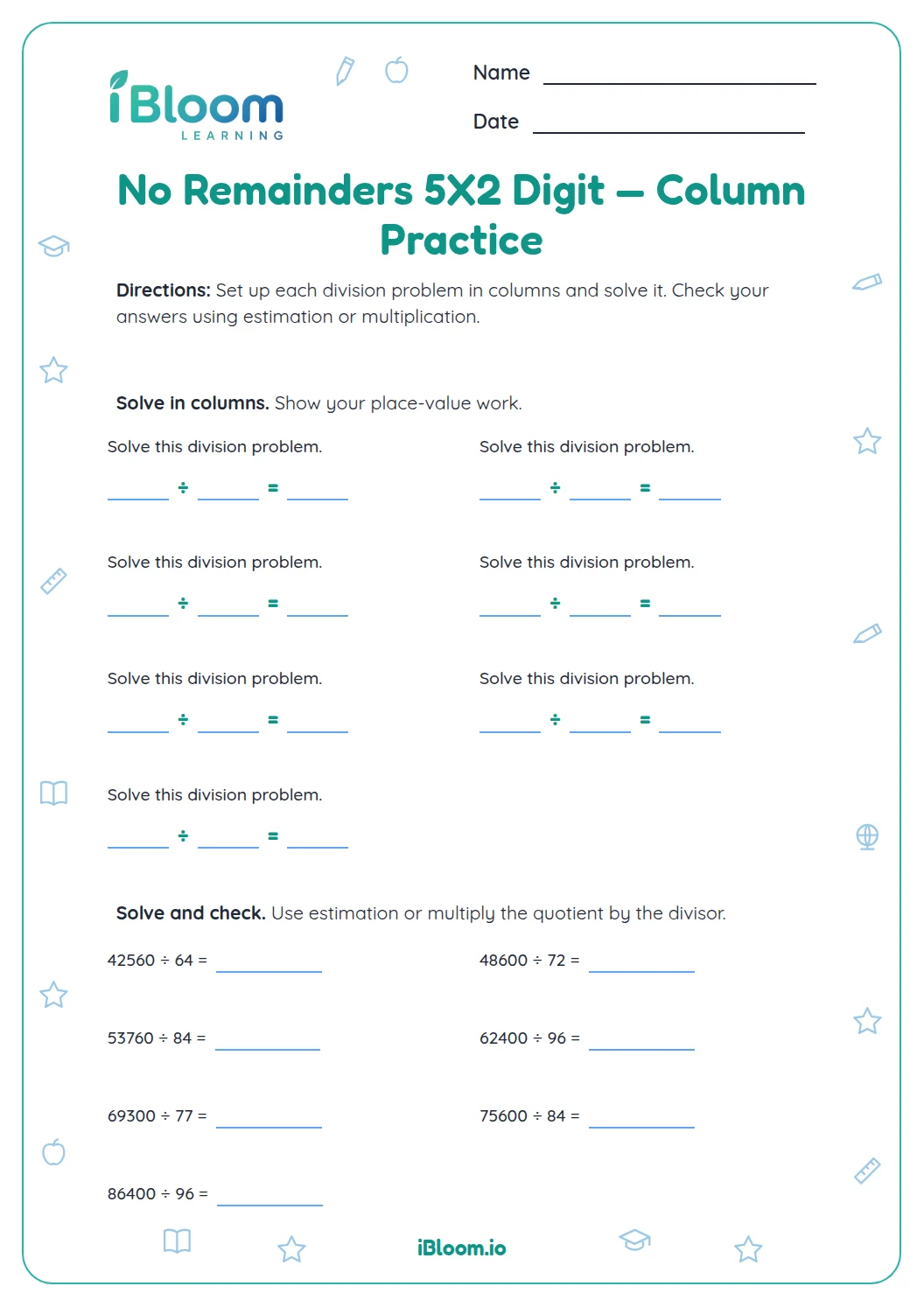
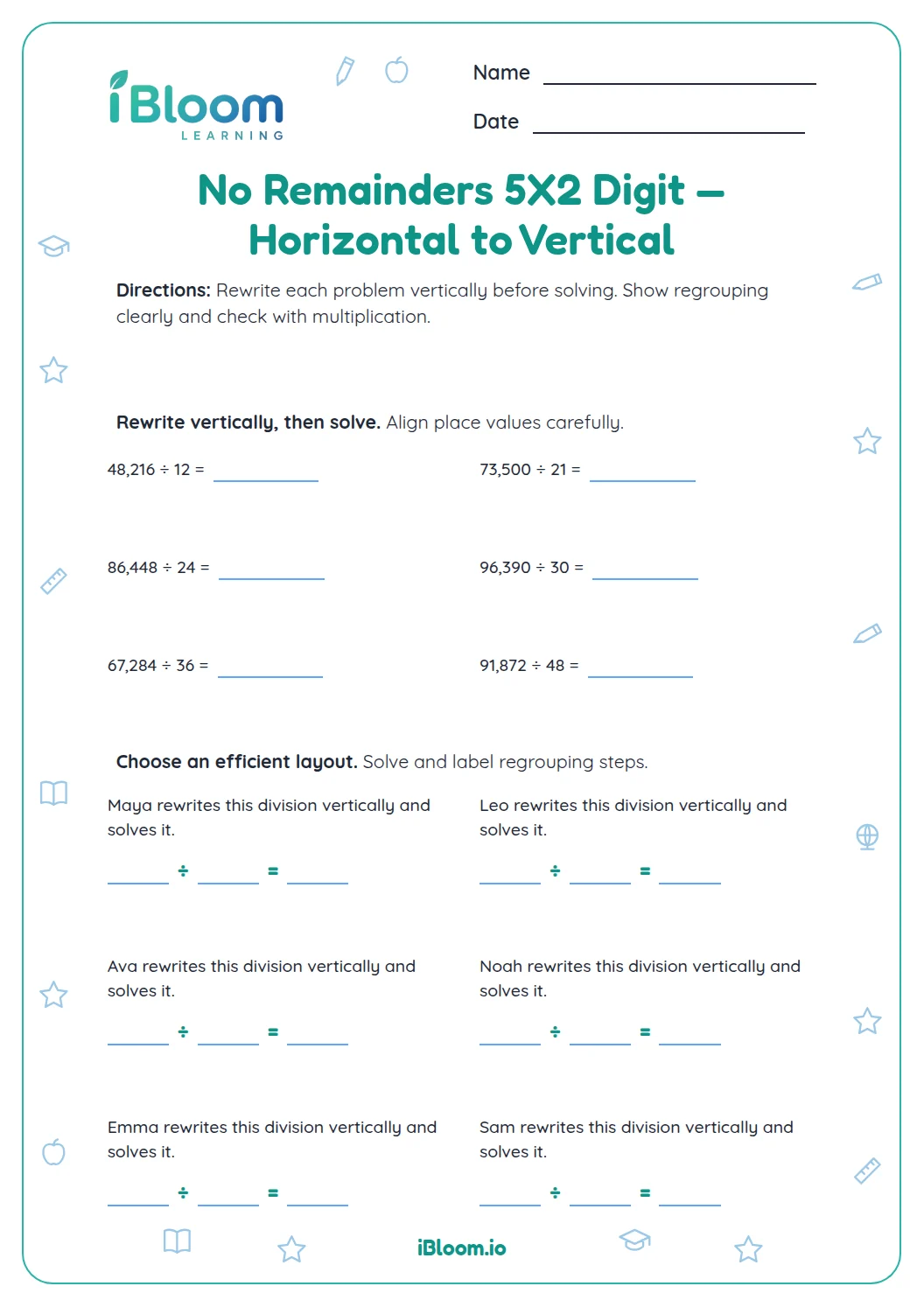
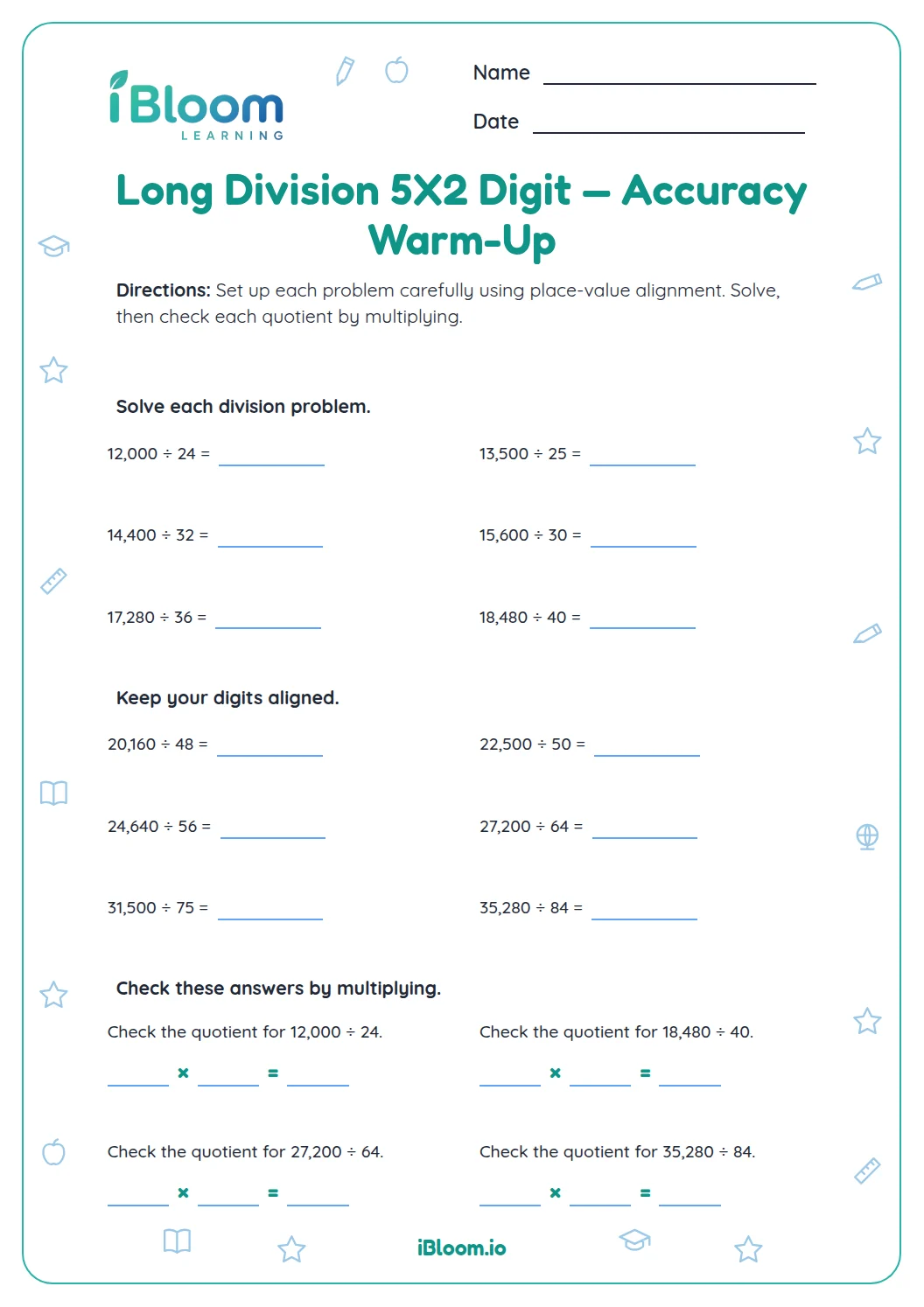
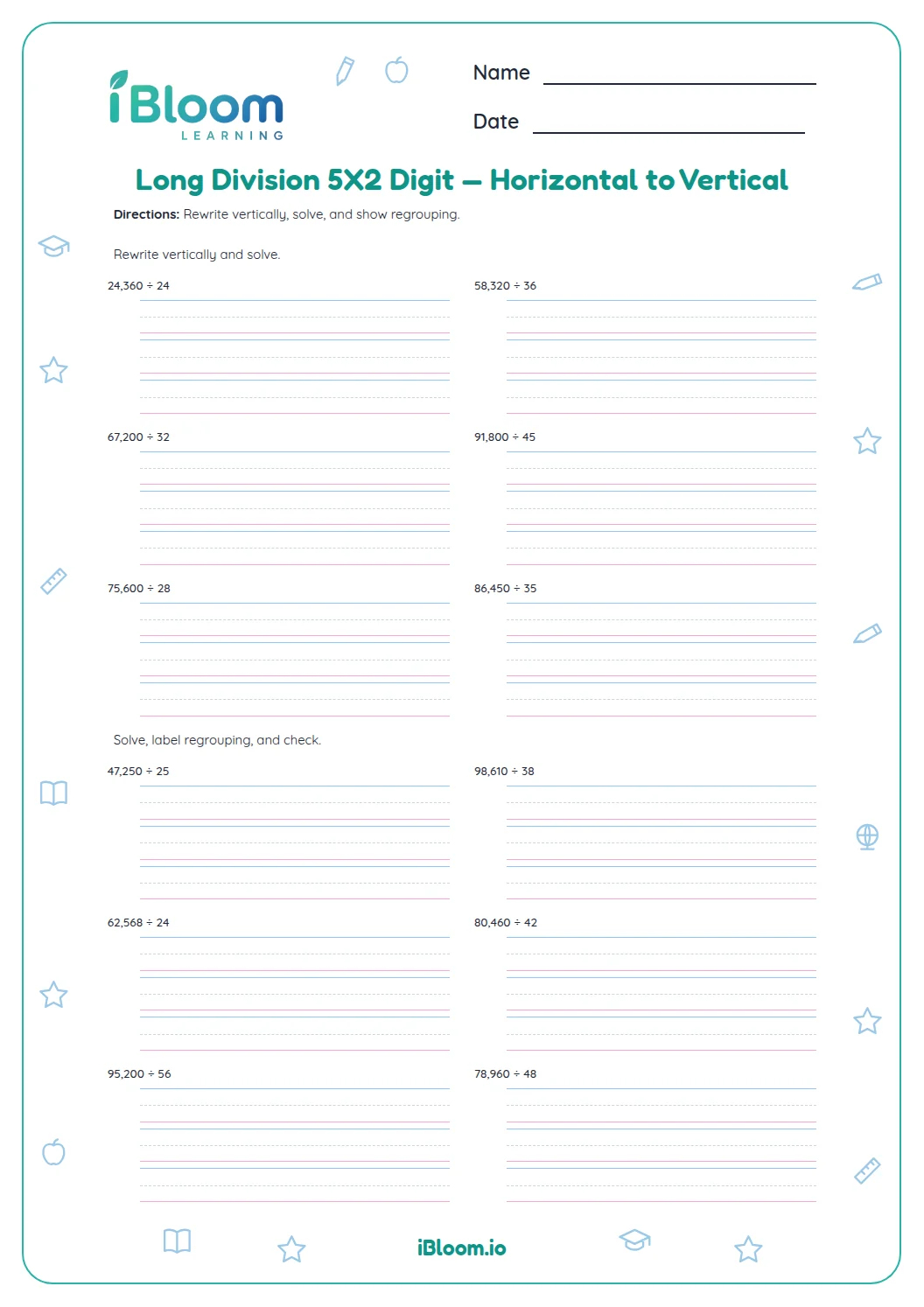
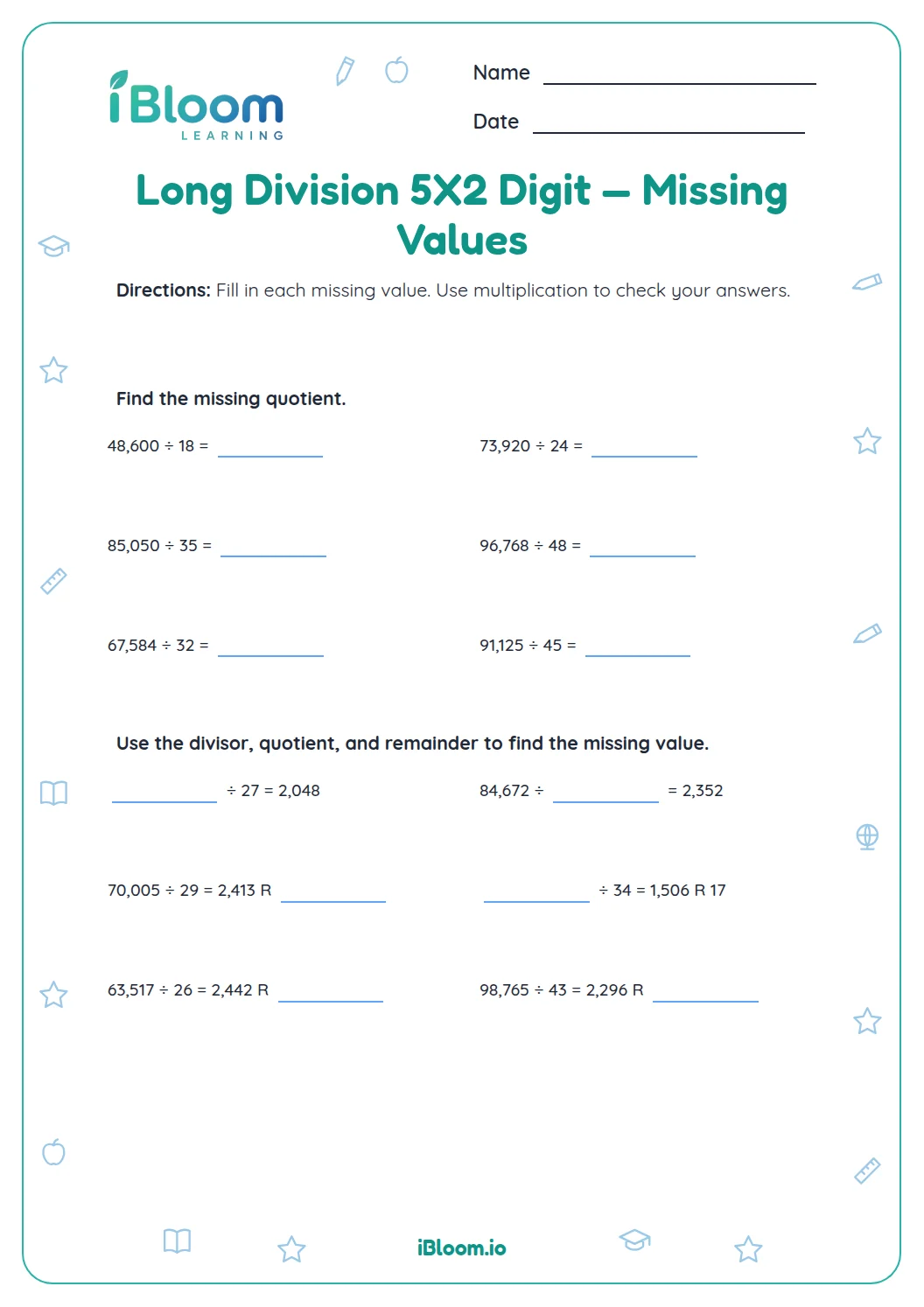
This division worksheet gives learners 24 exact relationships built around six-digit dividends and two-digit divisors. Some items leave a quotient blank; others ask for a missing divisor, dividend, or related factor. Multiply to check that each completed relationship is exact. The answer key lists every missing value. The division practice connects to multi-digit division in CCSS 6.NS.B.2.
Aligned to 6.NS.B.2
How does multiplication check division?
Division and multiplication undo each other. If 864,000 ÷ 24 = 36,000, multiply 36,000 by 24 to see whether the product returns to 864,000.
- 1864,000 ÷ 24 = 36,000
- 236,000 × 24 = 864,000
How do you find a missing value?
Use the numbers that are known. In 540,000 ÷ ___ = 18,000, divide 540,000 by 18,000 to find the missing divisor: 30. If the dividend is missing, multiply the divisor by the quotient.
How can place value help?
Many dividends are multiples of 1,000, so place-value reasoning can simplify the calculation. Keep track of the size of the quotient, then multiply to check that the product matches the dividend.
How to use this worksheet
- 1Identify which value is missing.
- 2Use division or multiplication to find it.
- 3Track the place value in the quotient or product.
- 4Write the missing value.
- 5Multiply divisor by quotient to check.
Common mistakes and quick fixes
The mistake
Dropping a zero from a quotient.
The fix
Estimate the quotient’s size, then multiply to check.
The mistake
Multiplying when the dividend is missing but using the wrong factors.
The fix
Multiply the known divisor by the known quotient.
The mistake
Mixing up divisor and quotient.
The fix
Label the dividend, divisor, and quotient before solving.
Practice multi-digit division and use multiplication to verify exact quotients.
On this sheet:
Show the official wordingHide the official wording
Fluently divide multi-digit numbers using the standard algorithm.
What to practice next
Make more practice
Further reading
Questions parents and teachers ask
What kinds of missing values appear?
The 24 questions leave different parts of an exact division relationship blank: quotients, divisors, dividends, or related factors. The six-digit dividends and two-digit divisors keep practice focused on larger whole-number calculations, and the separate key lists each missing value.
How can I check a quotient?
Multiply the quotient by the divisor. The product should equal the dividend exactly. If it does not, check the multiplication and the place value of the quotient before comparing with the answer key. This check also helps catch a missing zero.
What if the divisor is missing?
Divide the known dividend by the known quotient to find the missing divisor. In 540,000 ÷ ___ = 18,000, calculate 540,000 ÷ 18,000 to get 30. Multiplication then checks that 30 × 18,000 equals 540,000 exactly. Then confirm the product returns to the dividend.
Why do some numbers end in zeros?
The zeros make place-value relationships visible and can simplify some calculations. Learners still need to track the size of the quotient carefully. Multiplying the divisor by the quotient is a useful way to catch a zero that was dropped or added.
Does every problem have a remainder?
No. Each question is designed as an exact relationship with no remainder. The answer key shows the missing number, and multiplying the divisor by the quotient should reproduce the dividend exactly. A mismatch signals that a calculation needs another look.