


About this worksheet
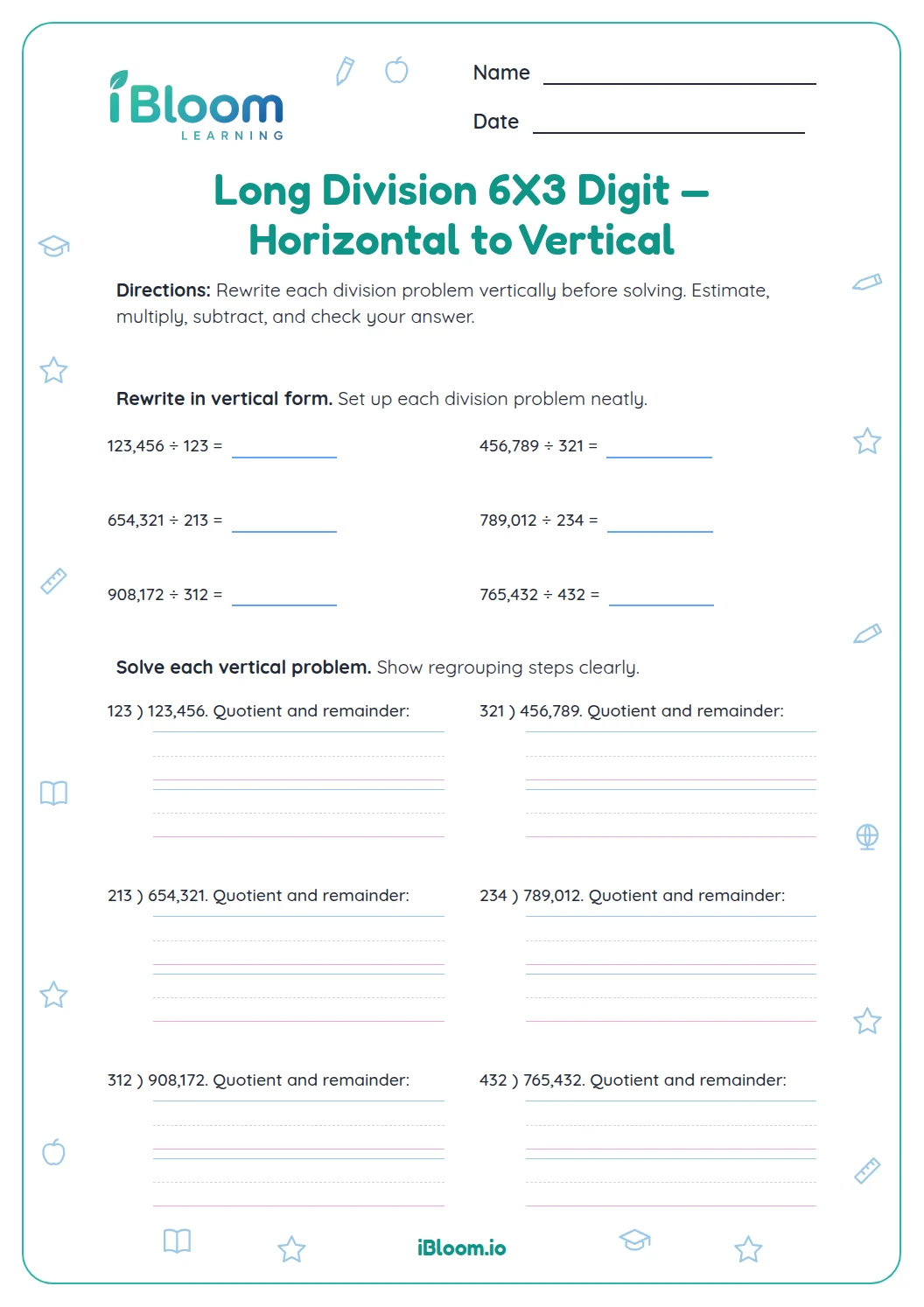
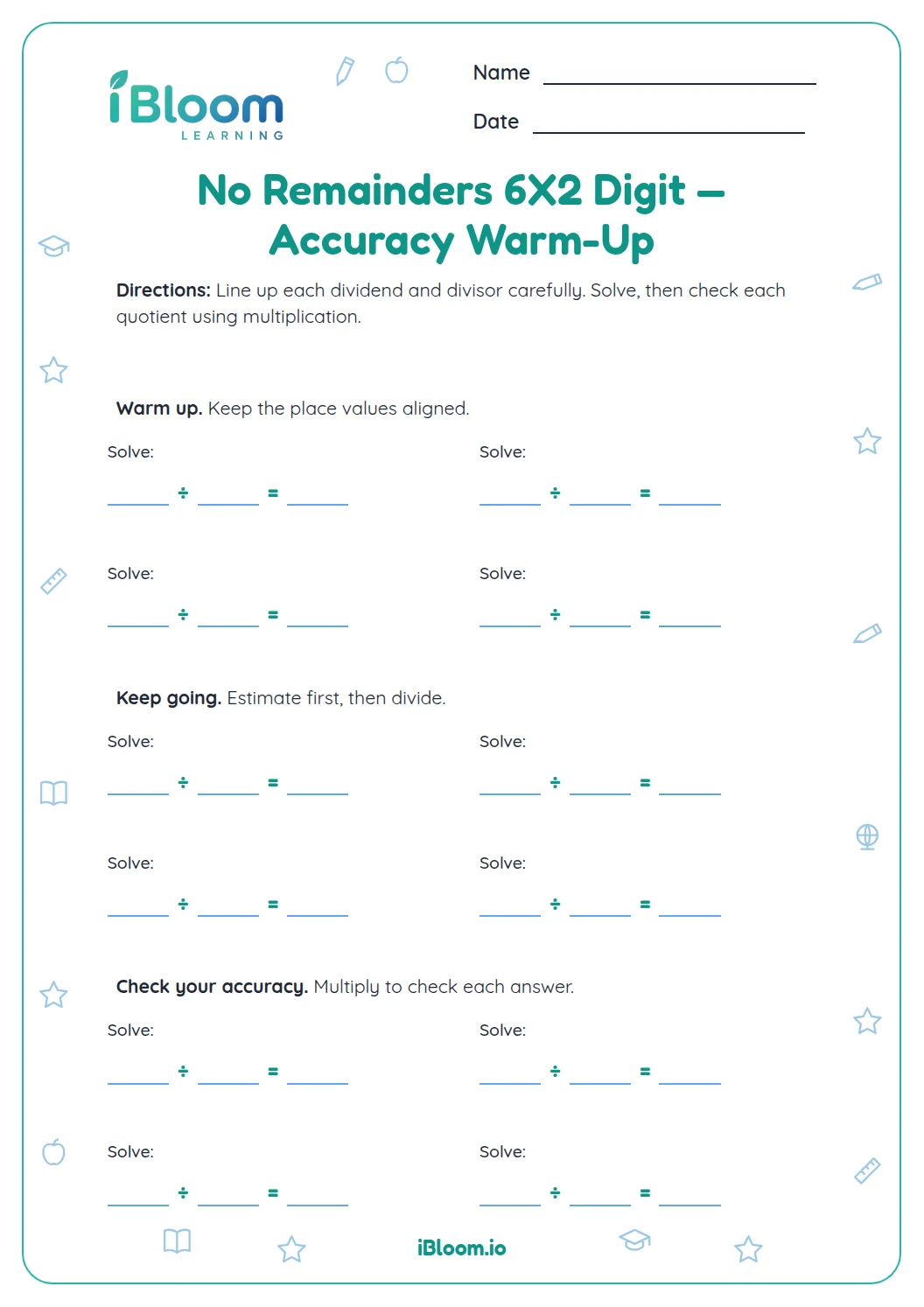
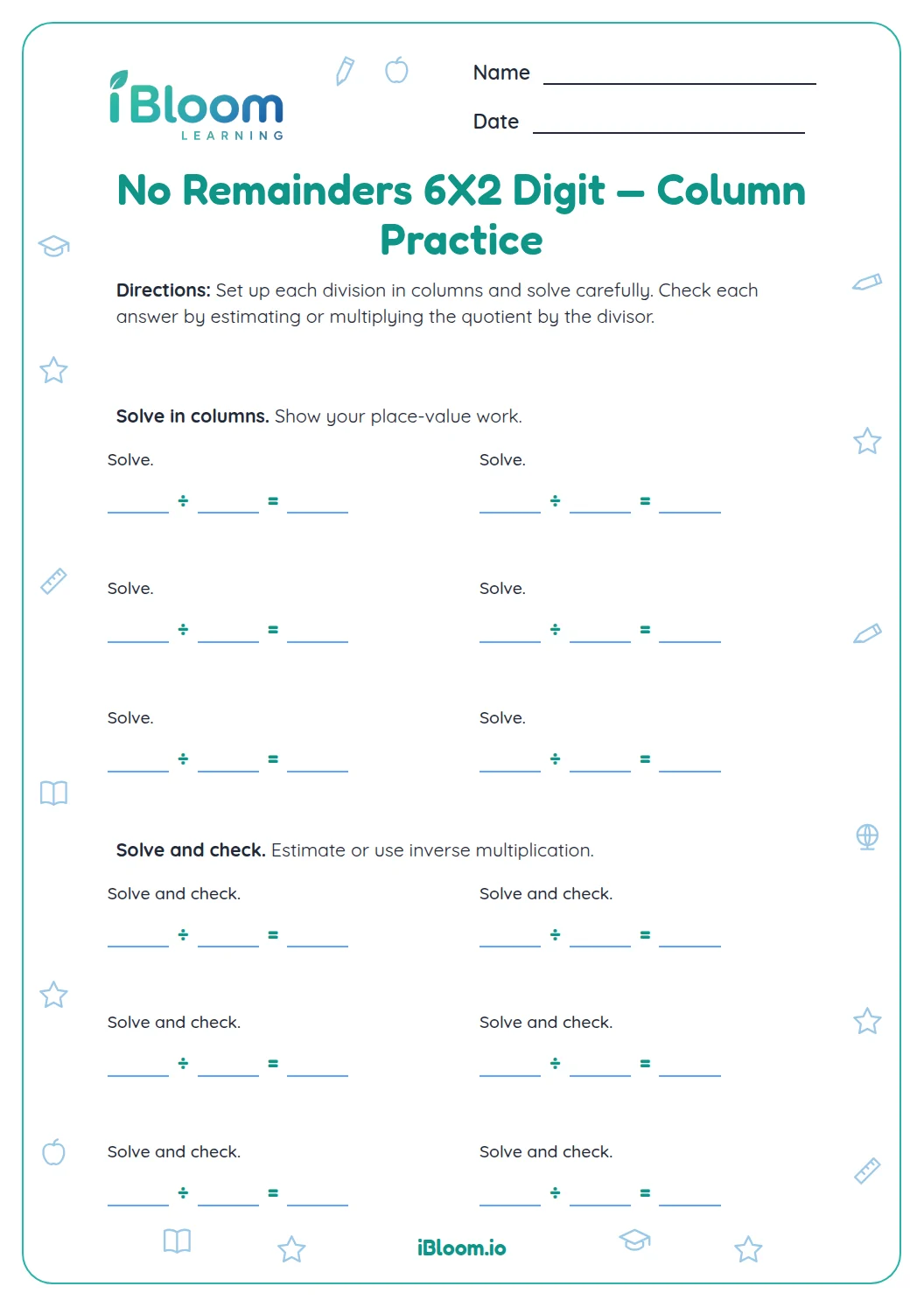
This Grade 6 long-division worksheet gives students 16 six-digit dividends divided by three-digit divisors. The problems have whole-number quotients and are arranged for independent practice with room to set up and work through each calculation. Students can estimate, divide one place at a time, subtract, and bring down digits, then check by multiplication. The separate two-page answer key lists the quotients. The practice aligns with CCSS 6.NS.B.2.
Aligned to 6.NS.B.2
How do students set up each problem?
Write the three-digit divisor outside the division bracket and the six-digit dividend inside. Estimate a quotient digit, multiply, subtract, and bring down the next dividend digit. Repeat until the quotient is complete.
How can a quotient be checked?
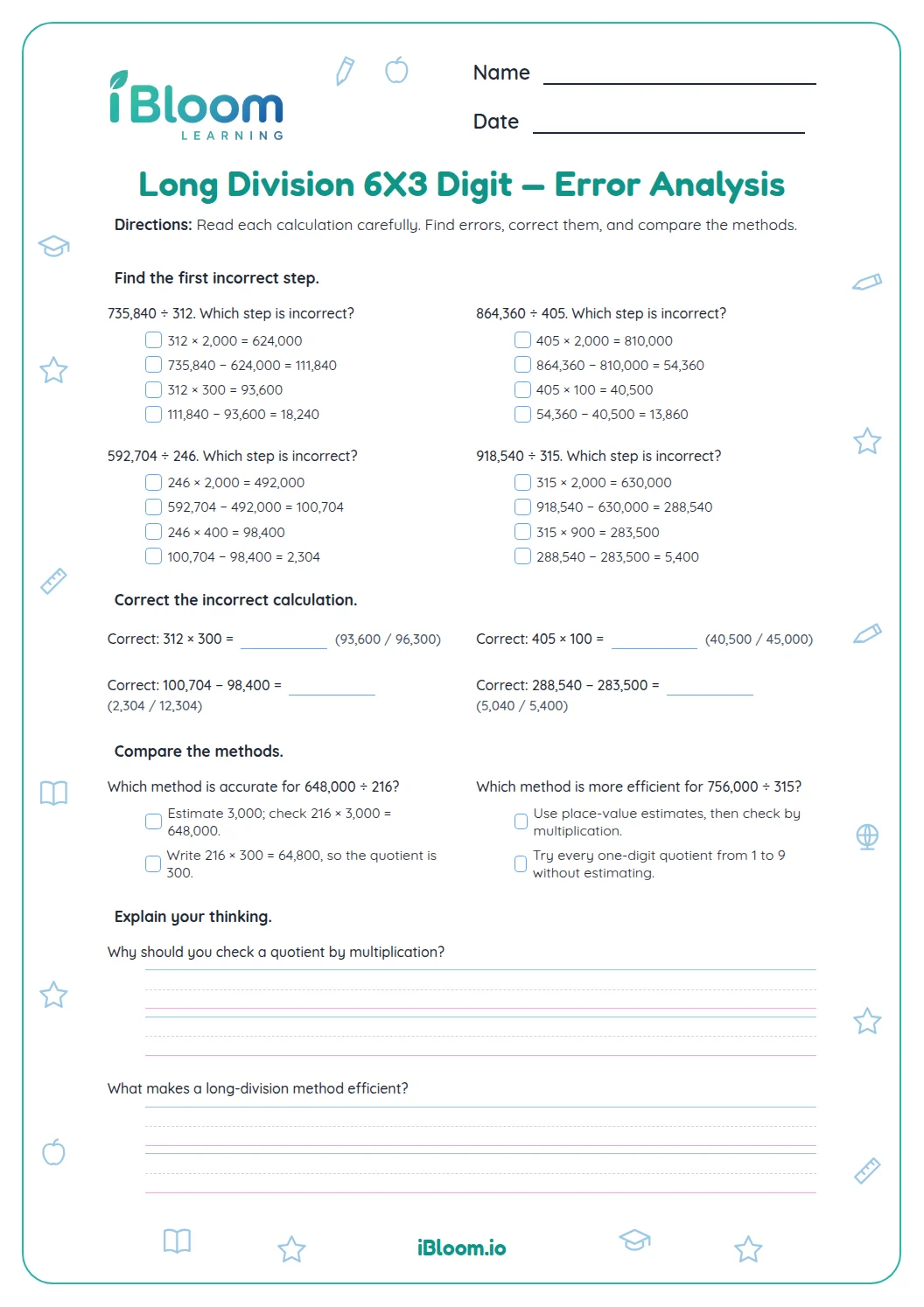
Multiply the quotient by the divisor. For example, 125,216 ÷ 104 = 1,204 because 1,204 × 104 = 125,216. A matching product confirms the quotient.
What kinds of answers are expected?
All 16 problems divide evenly, so each answer is a whole-number quotient with no remainder. The answer key provides the quotients for checking.
How to work through it
- 1Estimate the size of the quotient before dividing.
- 2Divide the leading part and write one quotient digit.
- 3Multiply, subtract, and bring down the next digit.
- 4Repeat until all six dividend digits are used.
- 5Multiply the final quotient by the divisor to check.
Mistakes to watch for
The mistake
Leaving out a zero in the quotient.
The fix
Track each place in the dividend and write a zero quotient digit when needed.
The mistake
Subtracting before multiplying the divisor by the quotient digit.
The fix
Multiply first, subtract that product, then bring down the next digit.
The mistake
Stopping after the first quotient digit.
The fix
Continue the divide-multiply-subtract-bring-down cycle through the full dividend.
Curriculum alignment
This worksheet gives learners practice with the standard below.
Divide multi-digit whole numbers using the standard algorithm.
On this sheet: Students solve six-digit dividends divided by three-digit divisors.
Show the official wordingHide the official wording
Fluently divide multi-digit numbers using the standard algorithm.
What to practice next
Make more practice
Further reading
Questions parents and teachers ask
How many problems are on this long-division sheet?
There are 16 problems across two worksheet pages. Each has a six-digit dividend and a three-digit divisor, and every division problem has a whole-number quotient. Each written response can be compared with its matching entry in the separate key after the child finishes working independently.
Does this sheet include room for long-division work?
Each item provides working space for students to set up the division and show the steps. Encourage students to keep quotient digits aligned with the dividend places as they work. Each written response can be compared with its matching entry in the separate key after the child finishes working independently.
Are there remainders?
No. The 16 dividends are exact multiples of their divisors, so each answer is a whole number with no remainder. The answer key lists each quotient. Each written response can be compared with its matching entry in the separate key after the child finishes working independently.
How can a student check a division answer?
Multiply the quotient by the divisor and compare the product with the original dividend. For instance, 1,204 × 104 equals 125,216, so 1,204 is the quotient of 125,216 divided by 104. Each written response can be compared with its matching entry in the separate key after the child finishes working independently.
What should students do if the quotient seems too large?
Estimate first by rounding the dividend and divisor to convenient values. Then check the completed quotient with multiplication. A product that does not equal the dividend signals a step to review. Each written response can be compared with its matching entry in the separate key after the child finishes working independently.
Is an answer key included?
Yes. The separate two-page answer key lists the quotient for each of the 16 problems. Students can use it after completing their own calculations and recheck any mismatch with multiplication. Each written response can be compared with its matching entry in the separate key after the child finishes working independently.