


About this worksheet
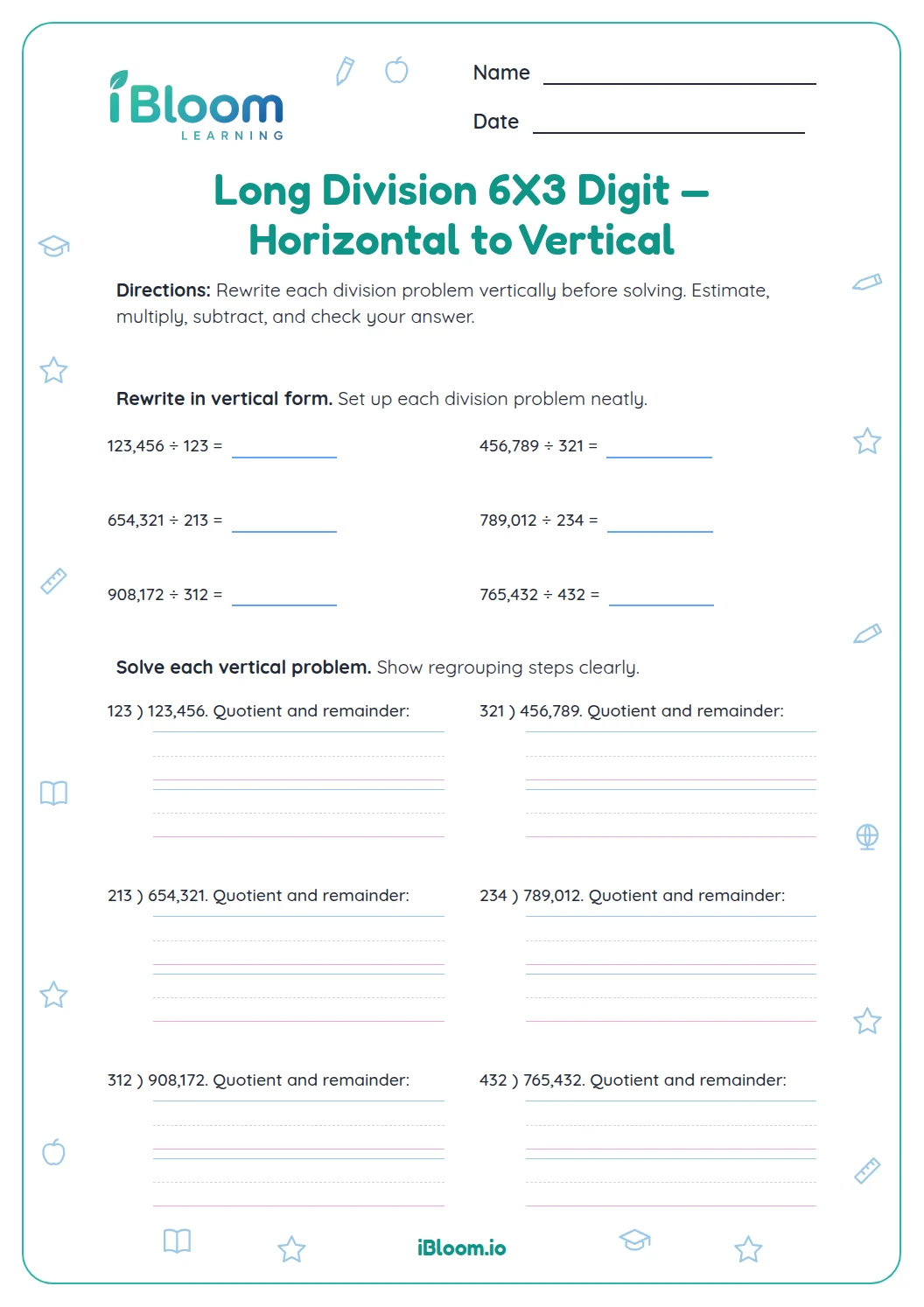
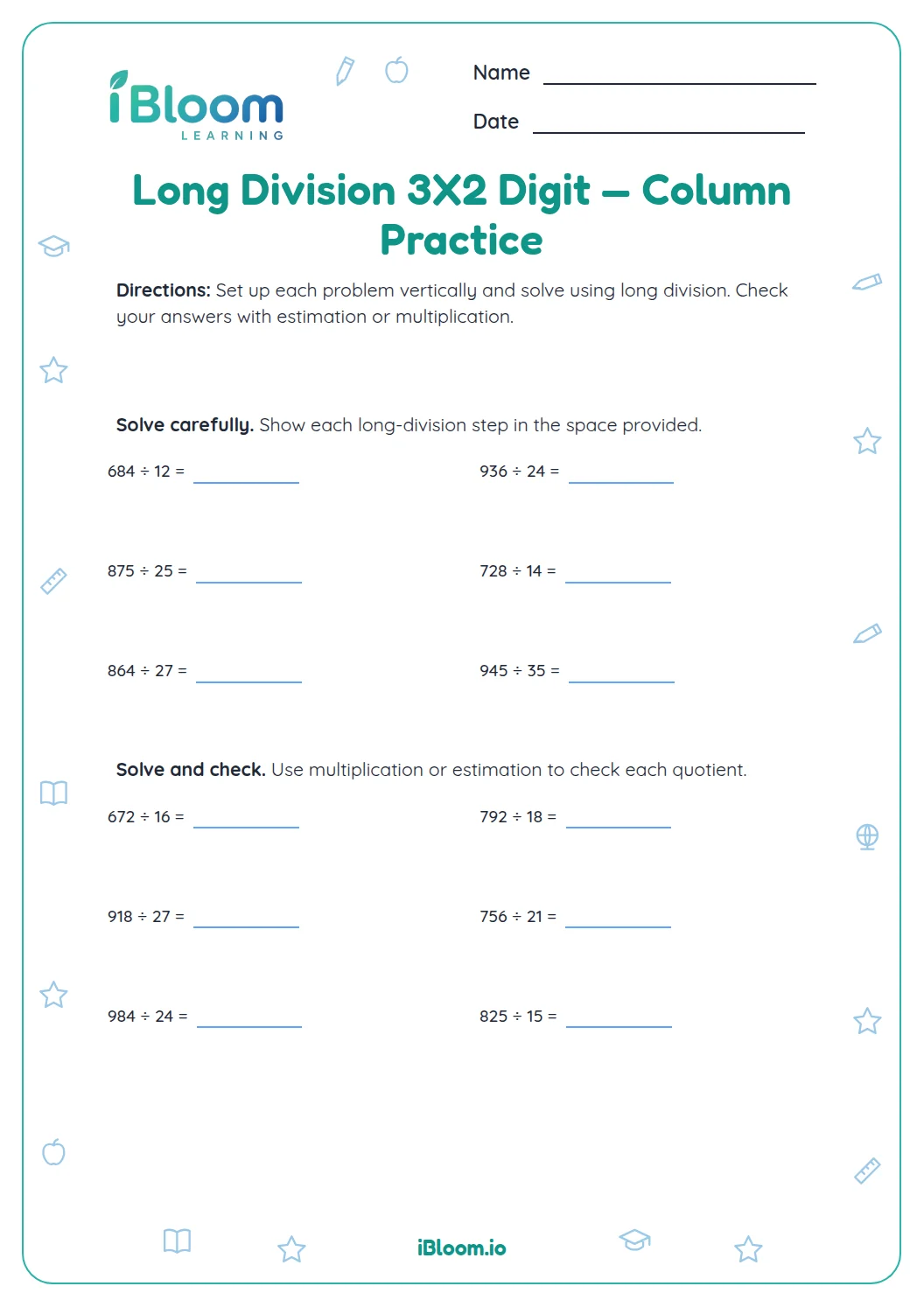
This long-division drill gives students 14 six-digit dividends divided by three-digit divisors. The set mixes exact quotients with quotient-and-remainder answers, so students practice the standard algorithm and check that each remainder is smaller than its divisor. It aligns with Common Core 6.NS.B.2. A separate answer key lists each quotient and remainder.
Aligned to 6.NS.B.2
What is the long-division routine?
Long division works through the dividend from left to right. Estimate how many times the divisor fits, multiply, subtract, and bring down the next digit. Keep the quotient digits over the correct place values.
Some problems divide evenly; others leave a remainder. A remainder must be smaller than the divisor.
How can you check a quotient and remainder?
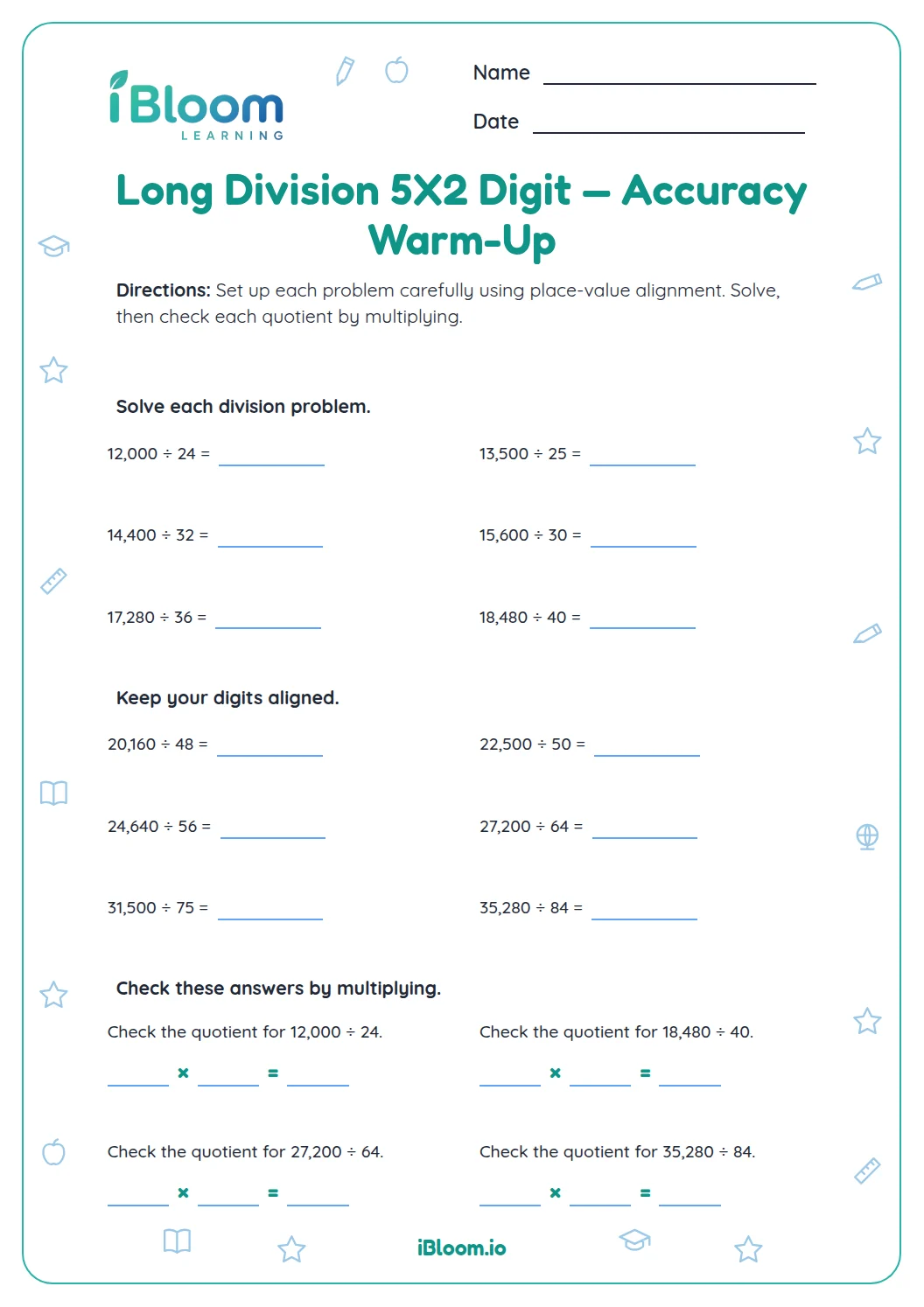
Multiply the divisor by the quotient and add the remainder. The result should equal the original dividend. This check catches place-value and subtraction errors.
- 1246,912 ÷ 123
- 2123 × 2,007 = 246,861
- 3246,912 − 246,861 = 51; 51 is less than 123.
- 4Answer: 2,007 R 51
What is in this drill?
There are 14 long-division equations, all with six-digit dividends and three-digit divisors. The set includes exact quotients and quotient-with-remainder answers. Use the separate key after finishing the calculations.
How to use this worksheet
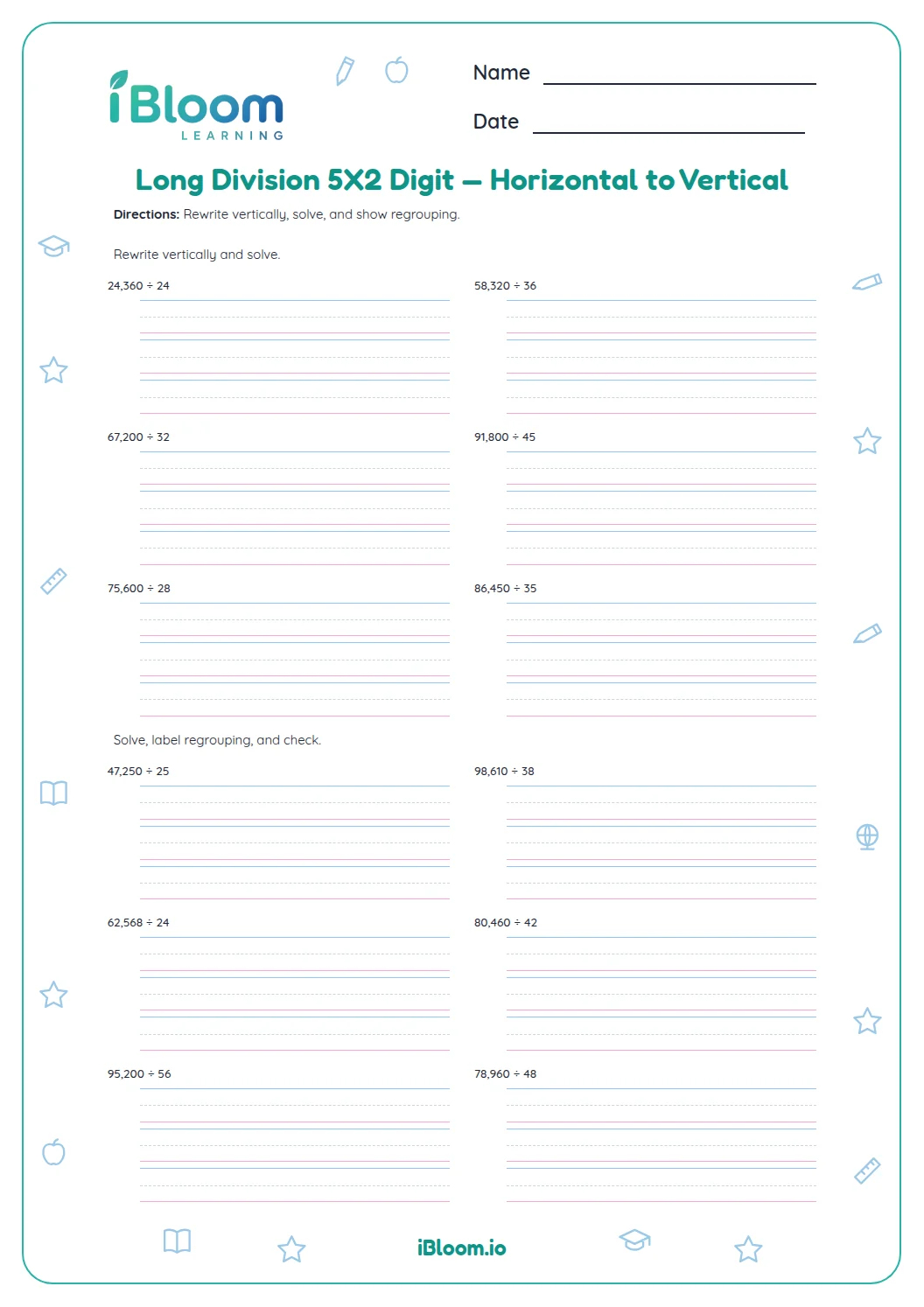
- 1Write the divisor and dividend carefully.
- 2Estimate the first quotient digit and keep it above its place value.
- 3Multiply and subtract before bringing down the next digit.
- 4Continue until every dividend digit has been used.
- 5Check by multiplying the divisor by the quotient and adding any remainder.
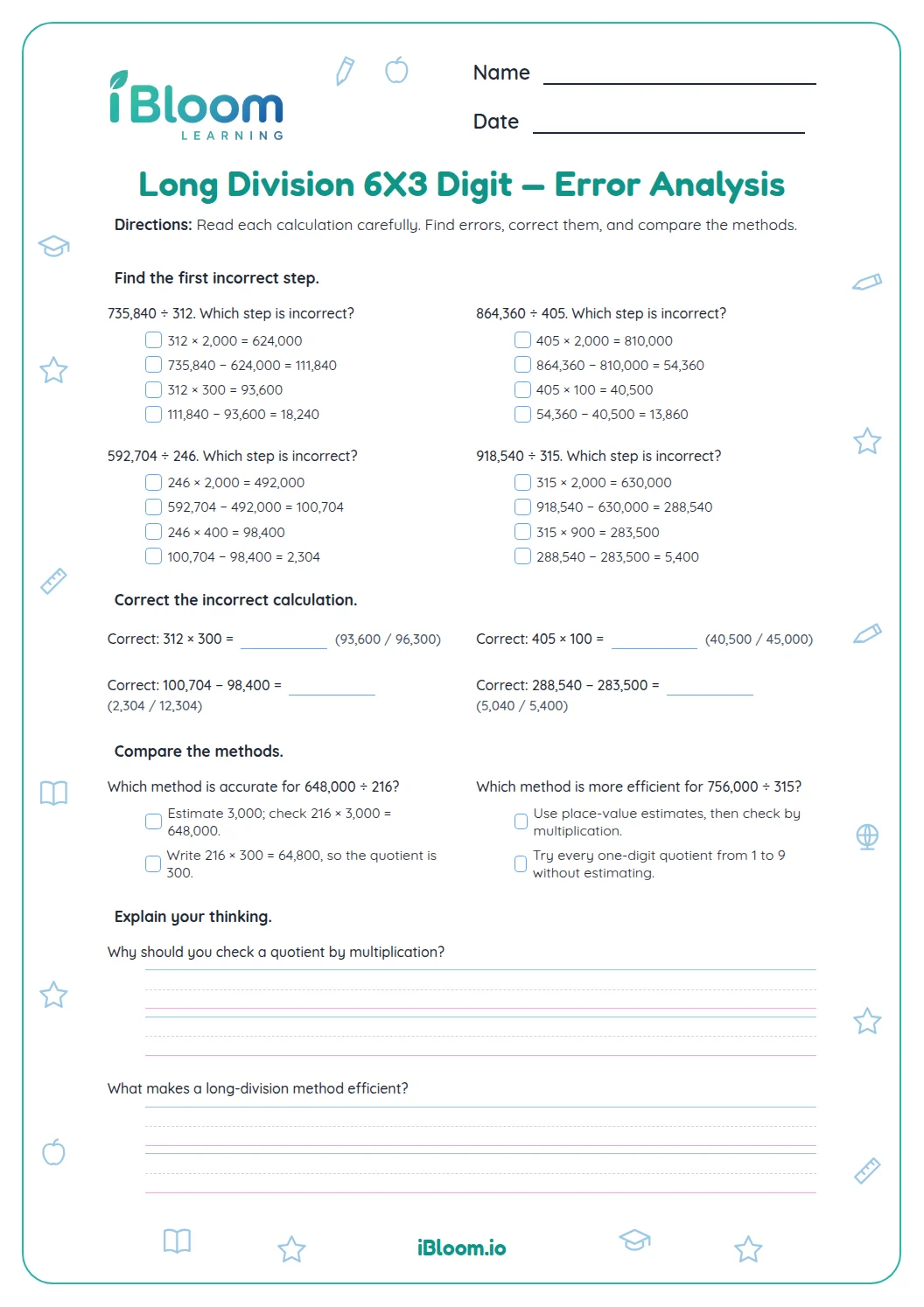
Common mistakes and quick fixes
The mistake
Placing a quotient digit over the wrong column.
The fix
Line up the quotient with the dividend’s place values as you work.
The mistake
Subtracting before multiplying by the divisor.
The fix
Multiply each quotient digit by the divisor, then subtract that product.
The mistake
Writing a remainder as large as the divisor.
The fix
If the remainder is at least the divisor, the quotient needs another group.
Common Core alignment
This drill gives repeated practice dividing multi-digit whole numbers with the standard algorithm.
Fluently divide multi-digit whole numbers using the standard algorithm.
On this sheet: Each item asks students to divide a six-digit whole number by a three-digit whole number and record quotient and remainder.
Show the official wordingHide the official wording
Fluently divide multi-digit numbers using the standard algorithm.
What to practice next
Make more practice
Further reading
Questions parents and teachers ask
How many long-division problems are included?
There are 14 calculations. Each has a six-digit dividend and a three-digit divisor, and the set includes both exact divisions and answers with remainders. The answer key is a separate page. The worksheet gives room to show the long-division steps for each calculation, followed by a separate answer key page.
Should students write remainders?
Yes. When a division is not exact, record the quotient and the remainder. Check that the remainder is smaller than the divisor, then multiply the quotient by the divisor and add the remainder to recover the dividend. For a remainder item, provide the quotient first and the remainder second in the two answer spaces.
How can students keep quotient digits aligned?
Write each quotient digit above the place value it represents in the dividend. Work through the digits from left to right, multiplying and subtracting before bringing down the next digit. This keeps the place-value pattern visible. A remainder is the amount left after making as many complete groups as possible; it must be smaller than the divisor.
What standard does this drill practice?
The calculations practice fluently dividing multi-digit whole numbers with the standard algorithm, aligned with Common Core 6.NS.B.2. Students solve each equation and can check a quotient and remainder by multiplying and adding. The standard algorithm is the repeated estimate, multiply, subtract, and bring-down process used throughout the drill.
How should a student check an answer?
Multiply the divisor by the quotient and add the remainder, if there is one. The result should equal the original six-digit dividend. Also check that any remainder is less than the divisor. For example, 123 × 2,007 + 51 equals 246,912, so 2,007 remainder 51 checks question 1.