



About this worksheet
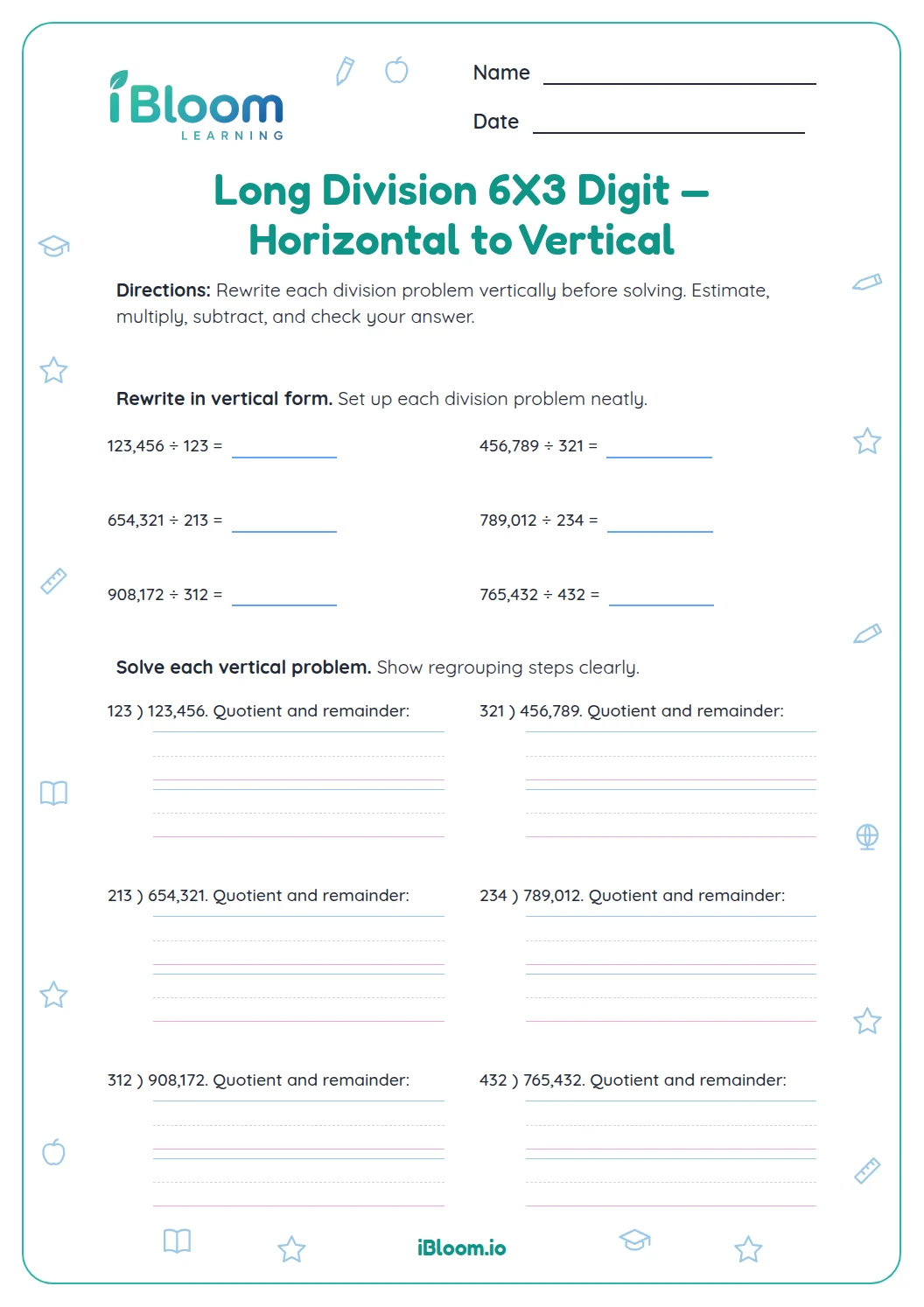
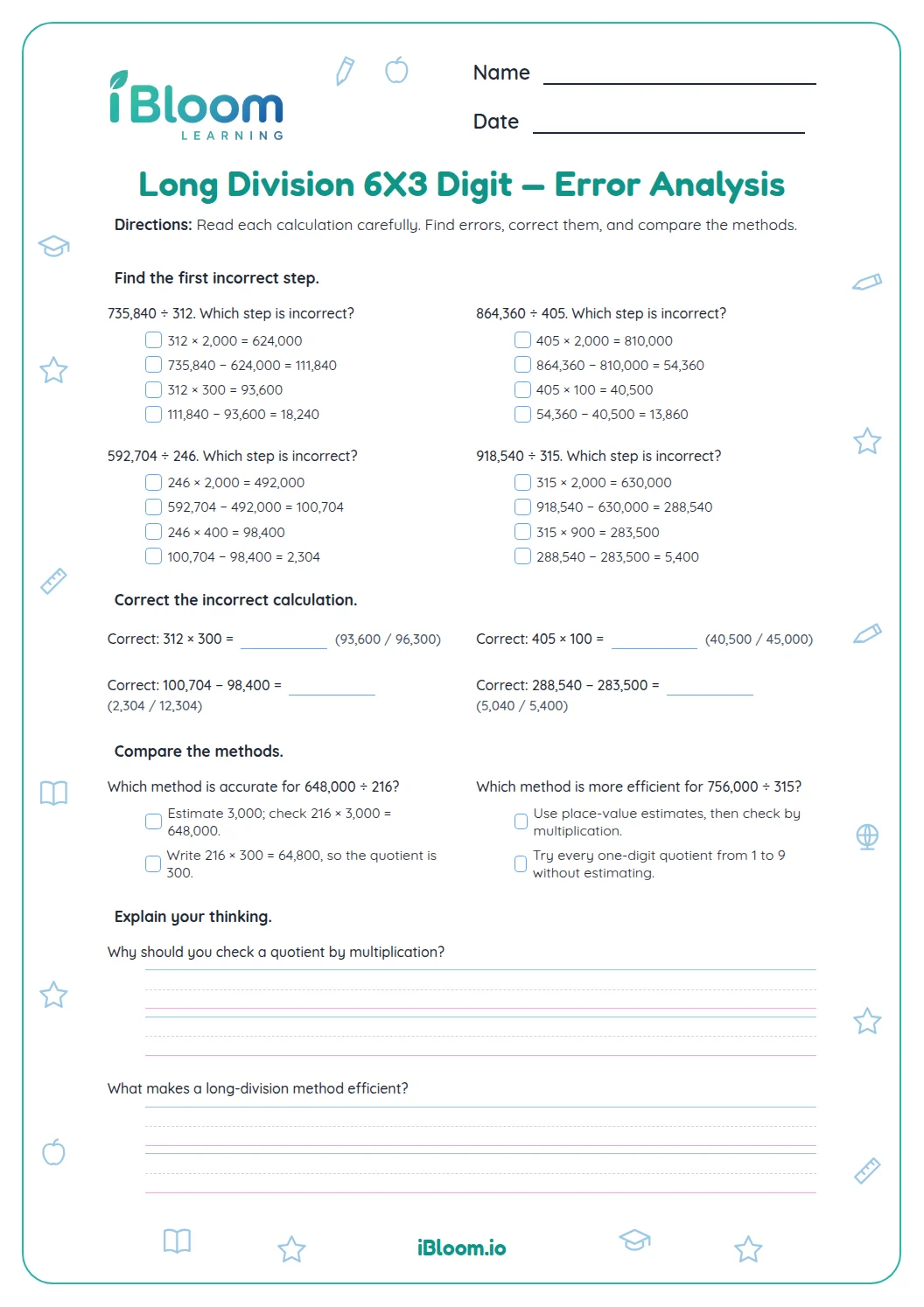
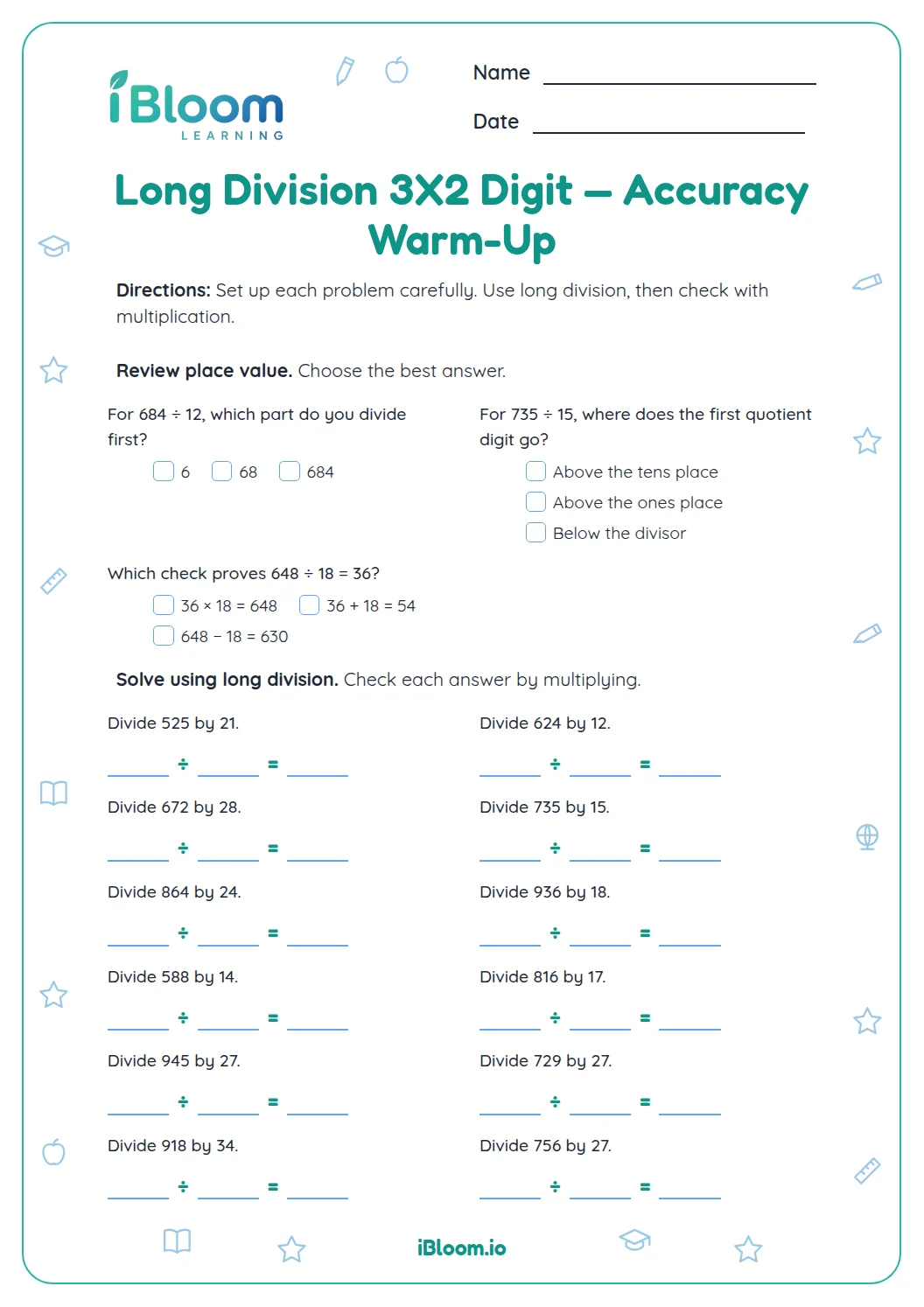
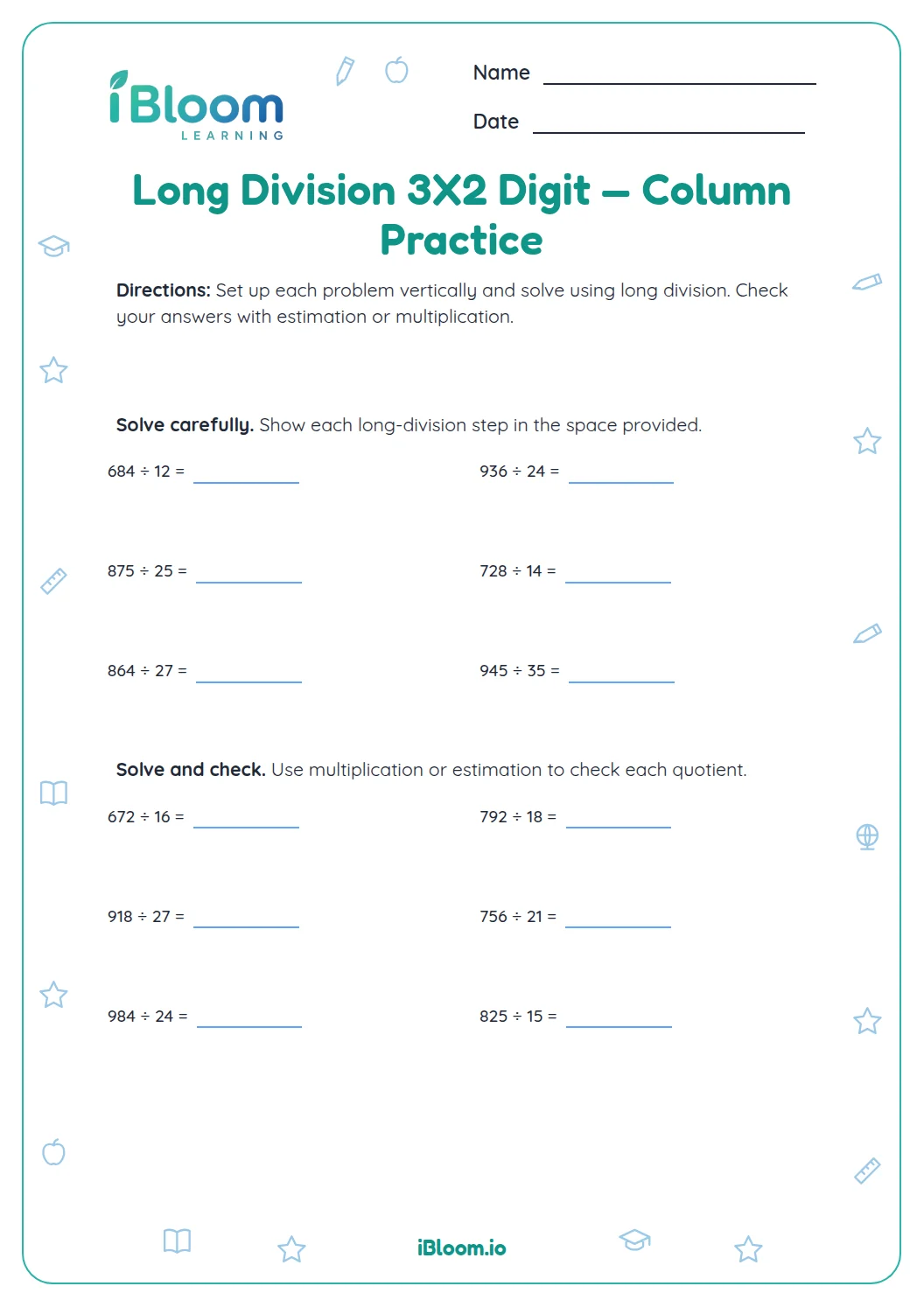
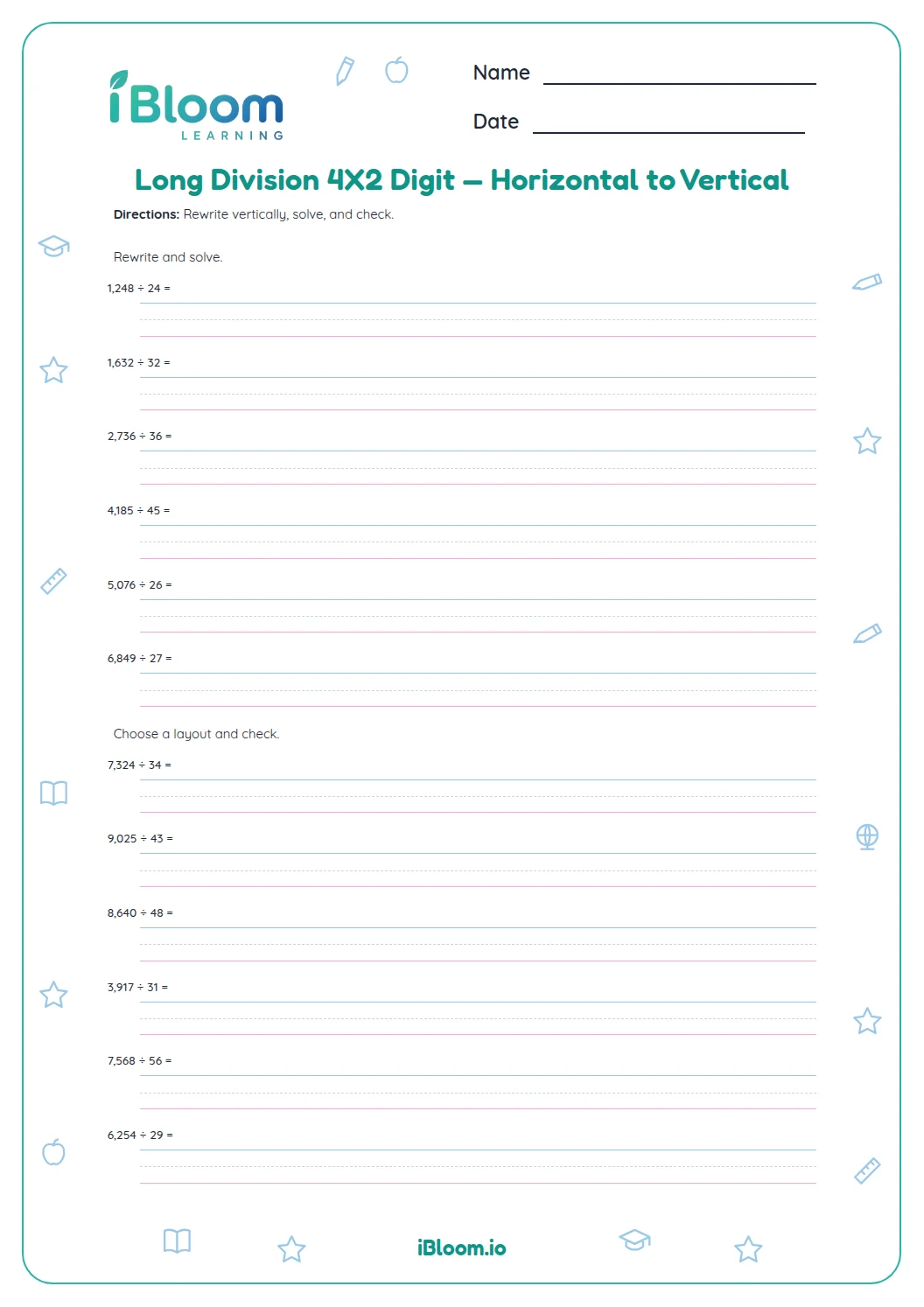
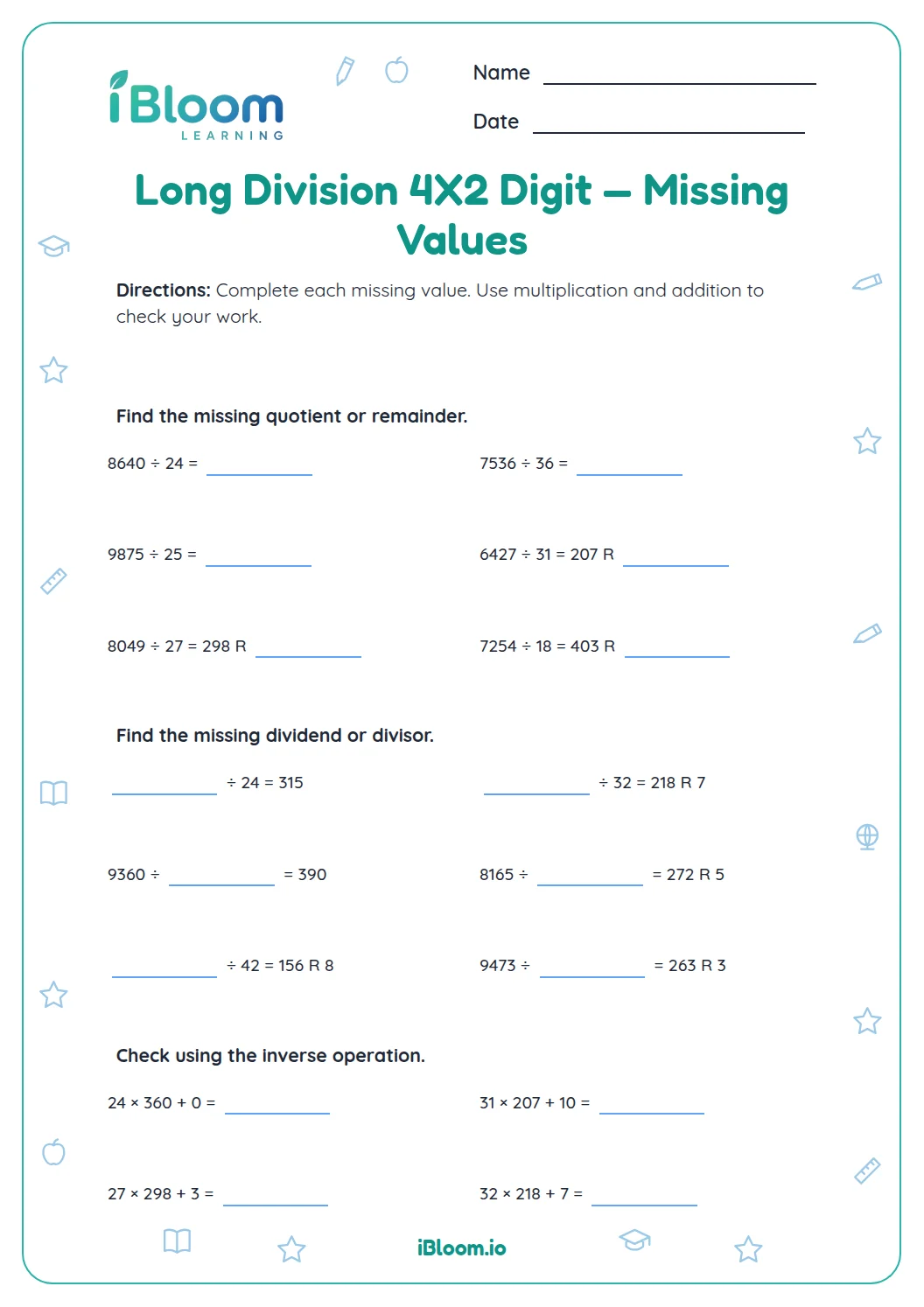
Practice exact long division with six-digit dividends and three-digit divisors. Estimate each quotient, use the standard algorithm, and multiply to check. The 16 problems move through four short sets, and the separate key lists each quotient.
Aligned to 6.NS.B.2
How can students check a long-division answer?
Estimating the quotient gives a useful size check before the written algorithm.
- 1121,401 ÷ 123 = 987 987 × 123 = 121,401 The product matches the dividend.
What will children practice?
All 16 problems have exact quotients. Four parts keep the practice in short groups while students use the same algorithm and check.
- Part A: Estimate, divide, and check
- Parts B–D: Continue the exact-division drill
How can an adult support the practice?
Have the learner multiply the quotient by the divisor. If the product matches the dividend, the exact division is confirmed.
How to use this worksheet
- 1Estimate the quotient using nearby hundreds.
- 2Divide from the greatest place value to the least.
- 3Multiply each quotient digit by the divisor.
- 4Subtract and bring down the next digit.
- 5Multiply the final quotient by the divisor to check.
Common mistakes and quick fixes
The mistake
Leaving out a zero in the quotient.
The fix
Track the place value of every quotient digit, including zero.
The mistake
Subtracting before multiplying the quotient digit.
The fix
Multiply the divisor by the current quotient digit, then subtract.
The mistake
Stopping before using every dividend digit.
The fix
Repeat divide, multiply, subtract, and bring down through the last digit.
Curriculum alignment
This worksheet practices the following standard.
Use the standard algorithm to divide multi-digit whole numbers accurately.
On this sheet: The practice builds accurate standard-algorithm division with multi-digit numbers.
Show the official wordingHide the official wording
Fluently divide multi-digit numbers using the standard algorithm.
What to practice next
Make more practice
Further reading
Questions parents and teachers ask
Are the division problems exact?
There are 16 exact division problems, each with a six-digit dividend and a three-digit divisor. The problems are grouped into four short sets so students can focus on a manageable group at a time. The separate answer key lists all 16 quotients for checking after the work is complete.
What does 6×3 digit mean?
Estimate the quotient before dividing so you have a sense of its size. Then use the standard algorithm one place at a time, keeping each partial quotient aligned with its place value. Multiply the quotient by the divisor to check that the product equals the original dividend.
Why estimate before dividing?
An estimate helps students notice if a quotient is far too large or too small. It provides a quick size check before they work through the place-value steps of the standard algorithm. Ask the learner to point to the equation, picture, or situation that supports the answer.
How can students check a quotient?
Multiply the quotient by the divisor. For these exact-division questions, the product should equal the dividend with no remainder. The answer key can be used to compare the quotient after the multiplication check. Ask the learner to point to the equation, picture, or situation that supports the answer.
How many worksheet and key pages are there?
The printable has two worksheet pages and two answer-key pages. The 16 questions appear in four groups, with four problems in each group. Ask the learner to point to the equation, picture, or situation that supports the answer.