




About this worksheet
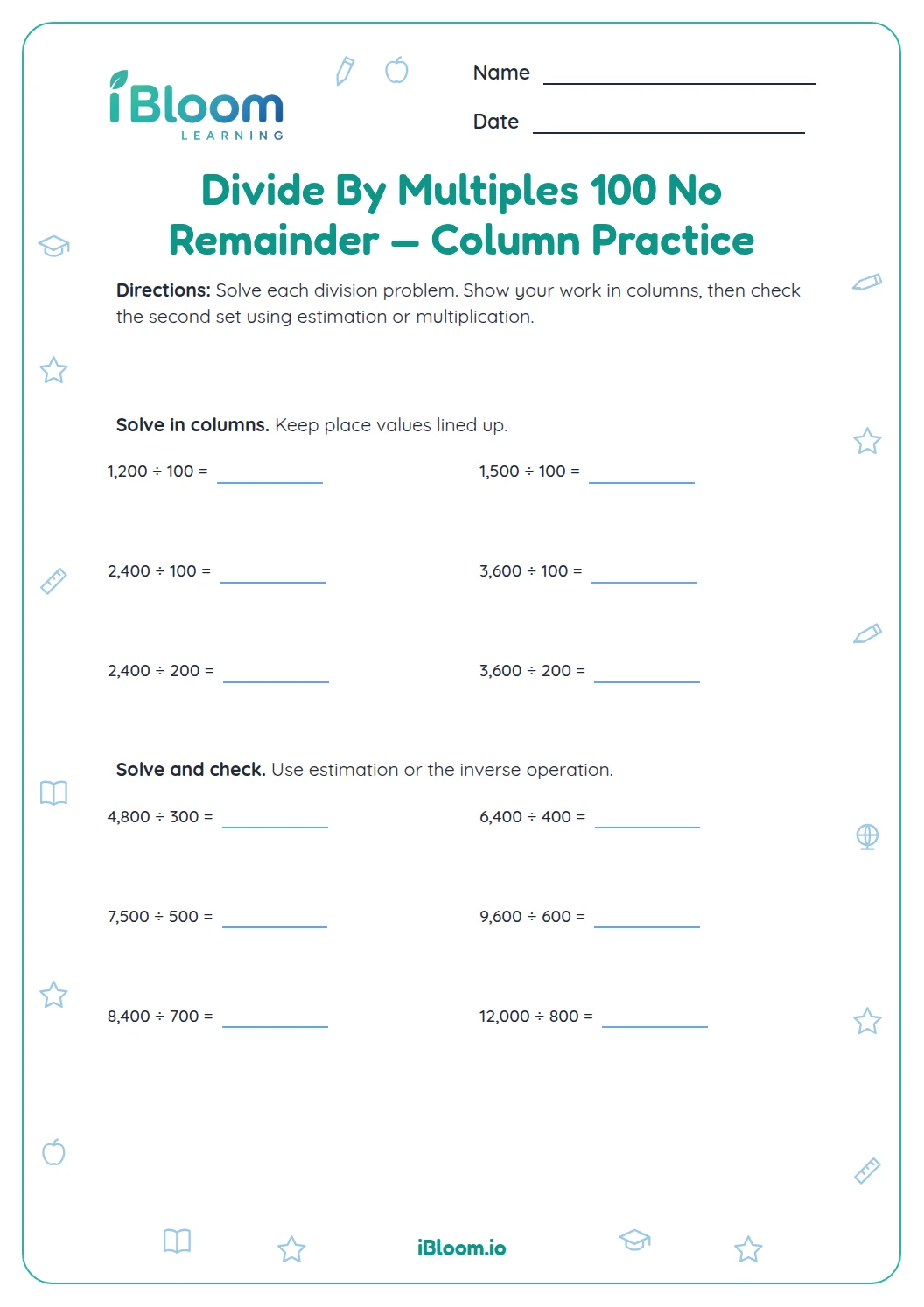
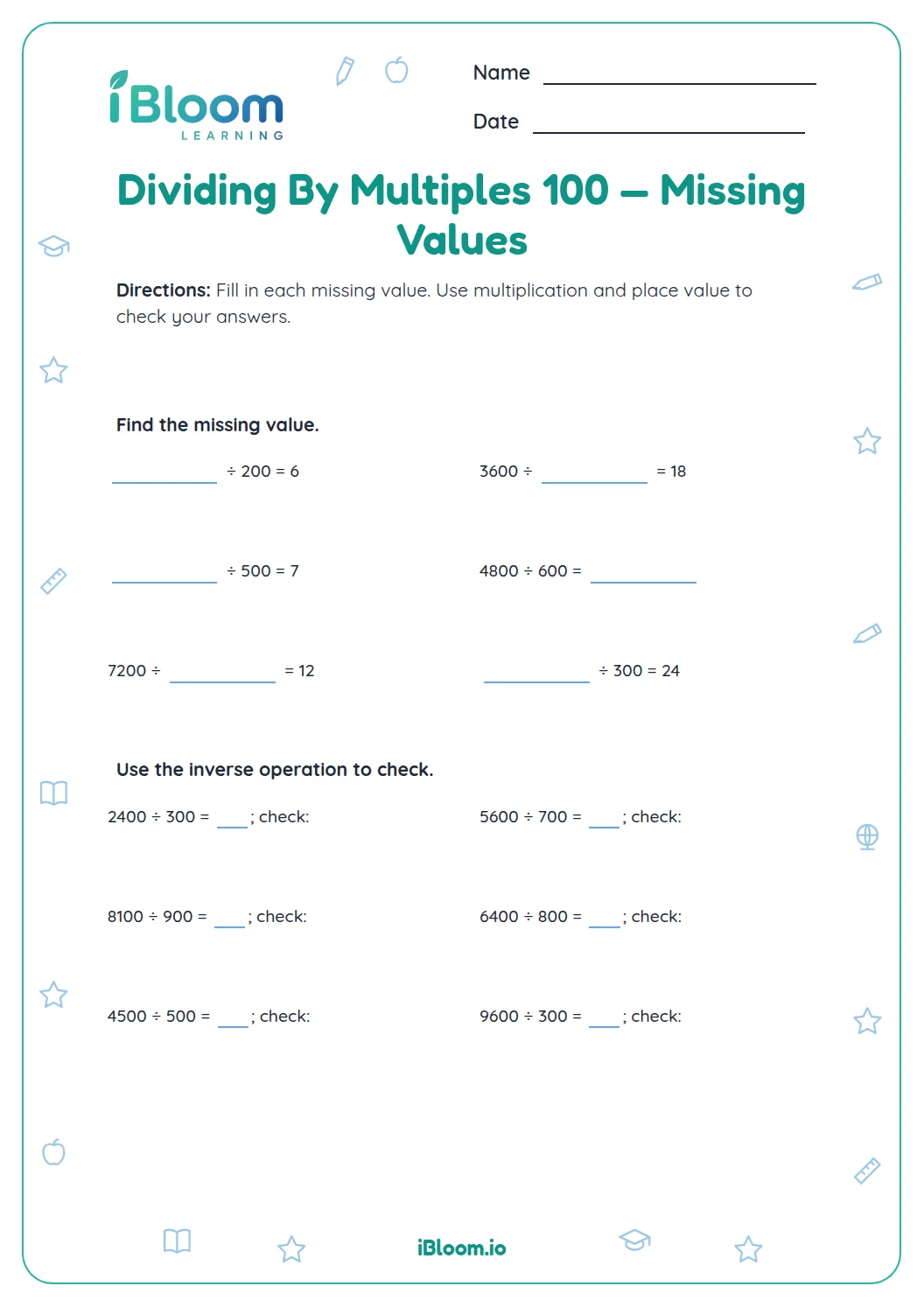
This printable division warm-up gives Grades 4–6 students 16 whole-number problems with no remainders. Each divisor is a multiple of 100, such as 600 or 900, and each dividend is chosen for an exact quotient. Learners can connect the division fact to a smaller basic fact, then check by multiplying. The sheet includes a separate answer key.
How can a basic fact help?
Compare the nonzero digits in the dividend and divisor. In 2,400 ÷ 600, the related fact is 24 ÷ 6. The quotient remains 4 because both numbers have two trailing zeros.
How should the zeros be handled?
Think of both numbers in hundreds: 2,400 is 24 hundreds and 600 is 6 hundreds. Then divide 24 by 6. This keeps the place value visible.
- 12,400 ÷ 600 = ___
- 2Think 24 hundreds ÷ 6 hundreds.
- 324 ÷ 6 = 4, so the quotient is 4.
How can multiplication check the quotient?
Multiply the answer by the divisor. If 4 × 600 = 2,400, the quotient checks.
How to use this worksheet
- 1Identify the multiple of 100 in the divisor.
- 2Rewrite both numbers in hundreds when useful.
- 3Use the related basic division fact.
- 4Write the quotient.
- 5Multiply quotient by divisor to check.
Common mistakes and quick fixes
The mistake
Keeping the trailing zeros in only one number.
The fix
Rename both dividend and divisor in the same unit, such as hundreds.
The mistake
Writing a quotient with extra zeros.
The fix
Use the related fact, then verify by multiplication.
The mistake
Dividing the leading digits but not checking.
The fix
Multiply the quotient by the full divisor and compare with the dividend.
What to practice next
Make more practice
Further reading
Questions parents and teachers ask
What is a multiple of 100?
A multiple of 100 is 100 times a whole number, such as 300, 600, or 900. Every divisor on this sheet is a multiple of 100, and each problem has an exact whole-number quotient. The key lists all 16 answers in order. For example, 700 is 7 hundreds.
How can I solve 2,400 divided by 600?
Think of 2,400 as 24 hundreds and 600 as 6 hundreds. Then compute 24 ÷ 6 = 4. The quotient is 4 because both quantities are measured in the same number of hundreds. Check it by multiplying 4 × 600 to get 2,400.
Do these problems have remainders?
No. Each of the 16 dividends was selected so division by its multiple-of-100 divisor gives an exact whole-number quotient. The separate key lists each quotient. For instance, 5,600 ÷ 700 is 8, because 8 groups of 700 equal 5,600.
How can students check a division answer?
Multiply the quotient by the divisor. The product should equal the original dividend. For example, 4 × 600 = 2,400, which confirms 2,400 ÷ 600 = 4. Students can use the same check on every item after writing the quotient.
What grades can use this worksheet?
The printable is labeled for Grades 4–6. Students can use the related basic-fact connection for support or explain how expressing both numbers in hundreds keeps the quotient unchanged. It contains 16 division equations over two worksheet pages, followed by two answer-key pages.