



About this worksheet
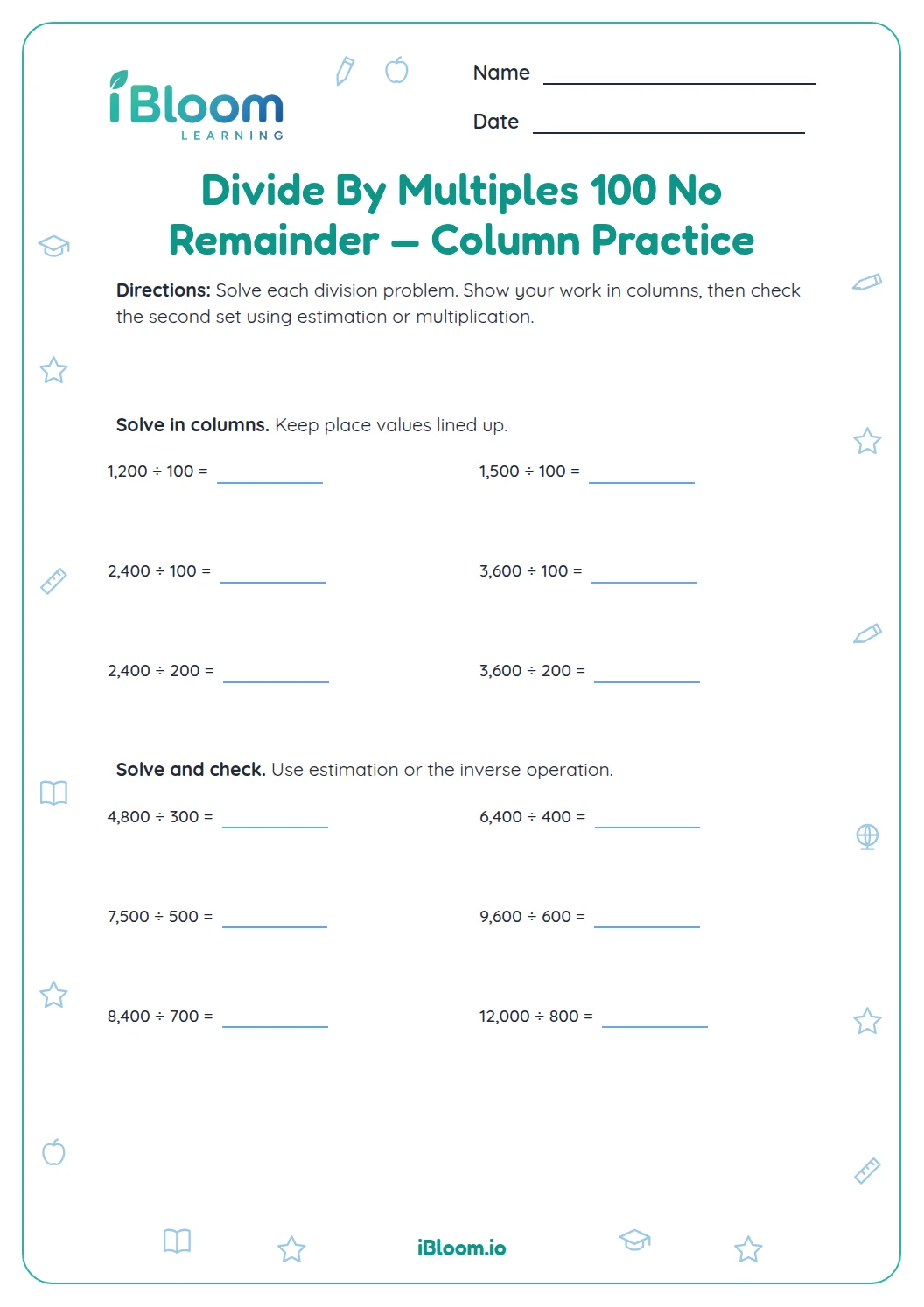
This printable page gives students practice dividing whole numbers by multiples of 100, with an emphasis on place value and error analysis. Students solve quotient problems, spot an incorrect quotient, choose multiplication checks, and apply division to equal groups. The sheet includes 15 questions and a separate answer key. It aligns with CCSS 4.NBT.B.6, which connects whole-number quotients to place value and multiplication.
Aligned to 4.NBT.B.6
How do place values help with these quotients?
When both numbers end in zeroes, divide by the same power of ten to make the numbers easier to compare. For 3,600 ÷ 300, think 36 ÷ 3, which equals 12. The quotient stays the same because both numbers were scaled equally.
- 13,600 ÷ 300
- 236 ÷ 3 = 12
- 3Check: 12 × 300 = 3,600
How can a multiplication check catch an error?
Question 7 presents a common place-value slip: reporting 80 for 6,400 ÷ 800. Multiplying 80 × 800 gives 64,000, ten times too large. Testing the quotient against the original dividend quickly shows that 8 is correct.
What does the worksheet ask students to do?
The 14 questions move from direct quotients to checking, applying, and explaining the reasoning. Equal-group settings make the quotient concrete: the answer counts boxes, bags, or stacks.
How to use this worksheet
- 1For question 1, divide 3,600 and 300 by 100 to get 36 ÷ 3.
- 2Estimate whether the quotient should be a one-digit or two-digit number.
- 3Multiply each quotient by its divisor to check the original dividend.
- 4For the error questions, test the proposed answer instead of guessing the intended mistake.
- 5Use the word problems to name what the quotient counts.
Common division slips
The mistake
Dividing only the dividend by 100.
The fix
Scale the divisor too; 3,600 ÷ 300 becomes 36 ÷ 3.
The mistake
Adding zeroes to the quotient automatically.
The fix
Check by multiplying; the product must equal the dividend.
The mistake
Giving a quotient without its context in a story.
The fix
State what each group represents, such as 8 boxes.
Common Core alignment
This page builds quotient reasoning through place value and multiplication checks.
Use place value and multiplication to find whole-number quotients.
On this sheet: The quotient questions use division and multiplication checks; this standard directly addresses whole-number quotients.
Show the official wordingHide the official wording
Find whole-number quotients and remainders with up to four-digit dividends and one-digit divisors, using strategies based on place value, the properties of operations, and/or the relationship between multiplication and division. Illustrate and explain the calculation by using equations, rectangular arrays, and/or area models.
What to practice next
Make more practice
Further reading
Questions parents and teachers ask
Why divide both numbers by 100?
Dividing both quantities by the same factor keeps the quotient unchanged and makes the calculation easier. For example, 3,600 ÷ 300 becomes 36 ÷ 3. The worksheet starts with this strategy, then asks students to apply it to more quotients and story problems.
How can I check 7,200 ÷ 900?
Multiply the quotient by 900. Since 8 × 900 = 7,200, the quotient is 8. On the sheet, students use this inverse operation both to check their own work and to choose a valid check for a given division equation.
What does an incorrect place-value answer look like?
A student may say 80 for 6,400 ÷ 800 after adding an extra zero. Multiplying 80 by 800 gives 64,000, so the product is ten times too large. The error-analysis questions ask students to test claims in this concrete way.
Does the page include word problems?
Yes. Three questions describe equal groups, including sheets packed into boxes, beads sorted into bags, and cards arranged in stacks. Students divide the total by the group size and name how many groups the quotient represents. The question set also includes two prompts where students explain their approach and share a multiplication check.
What is included in the answer key?
The separate key lists answers for all 15 questions, including concise models for written explanations. Use it to check calculations and to review why a proposed quotient does or does not fit the multiplication check. It also includes a written explanation item, for which the key gives a concise model response students can compare with their work.