




About this worksheet
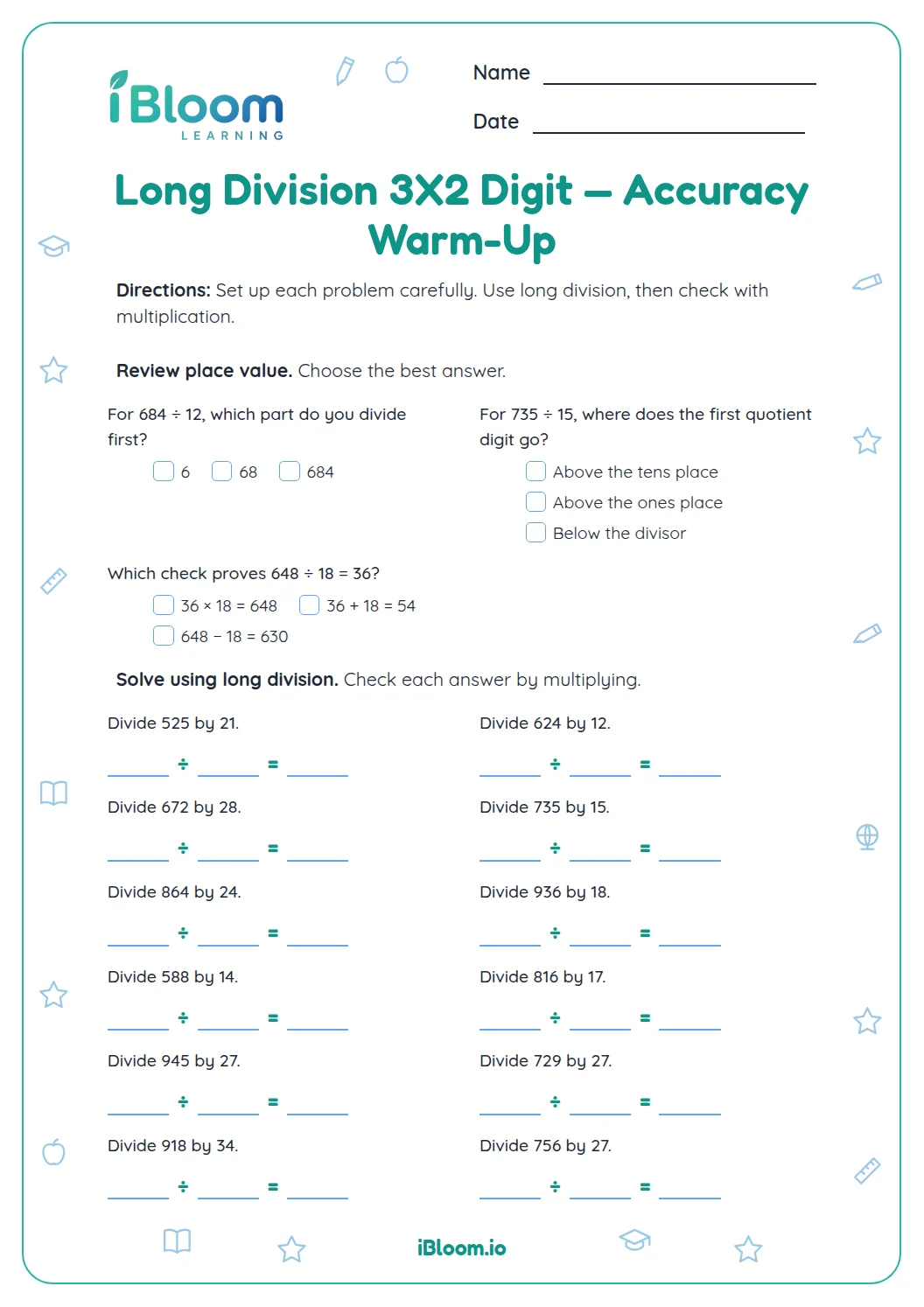
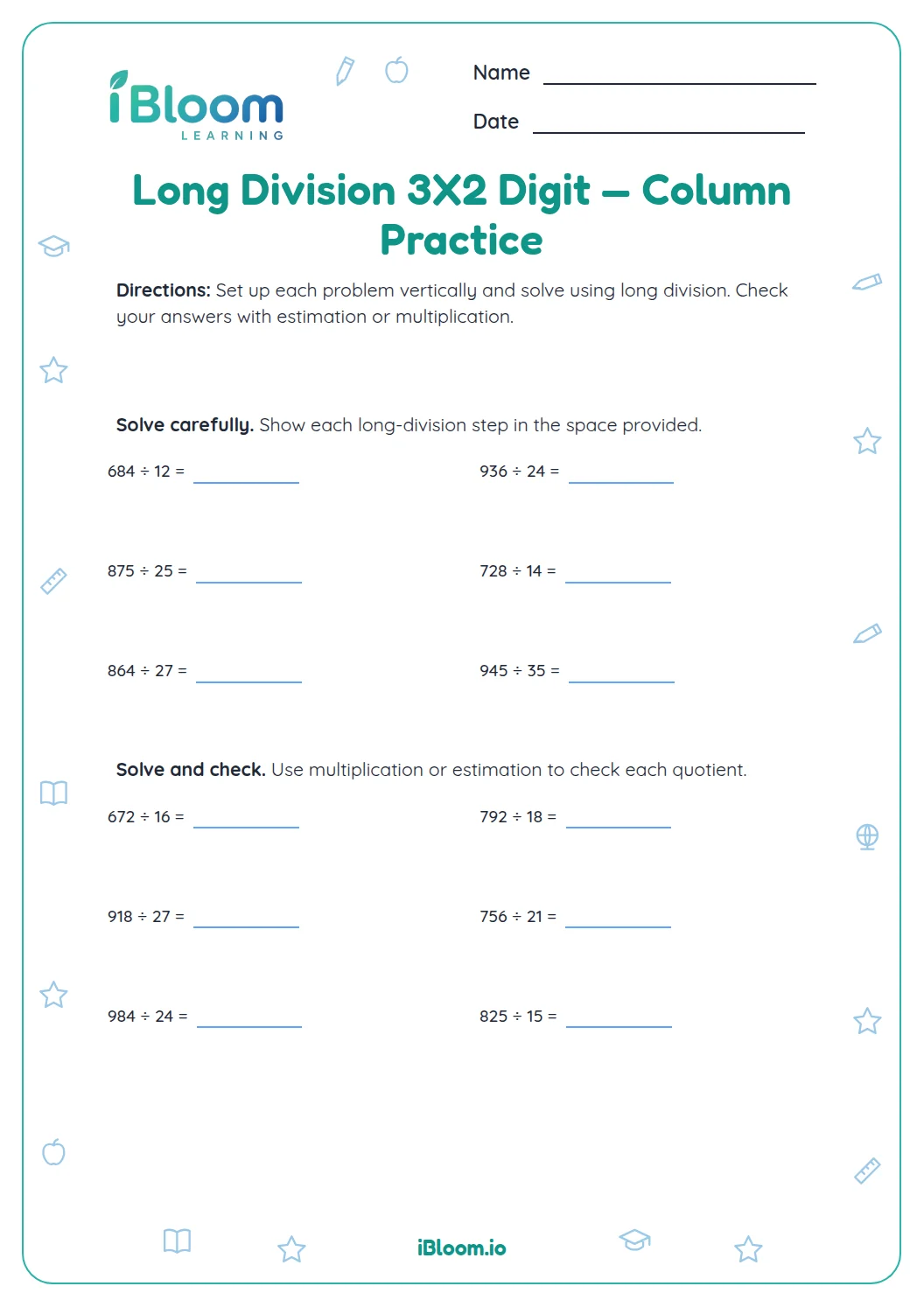
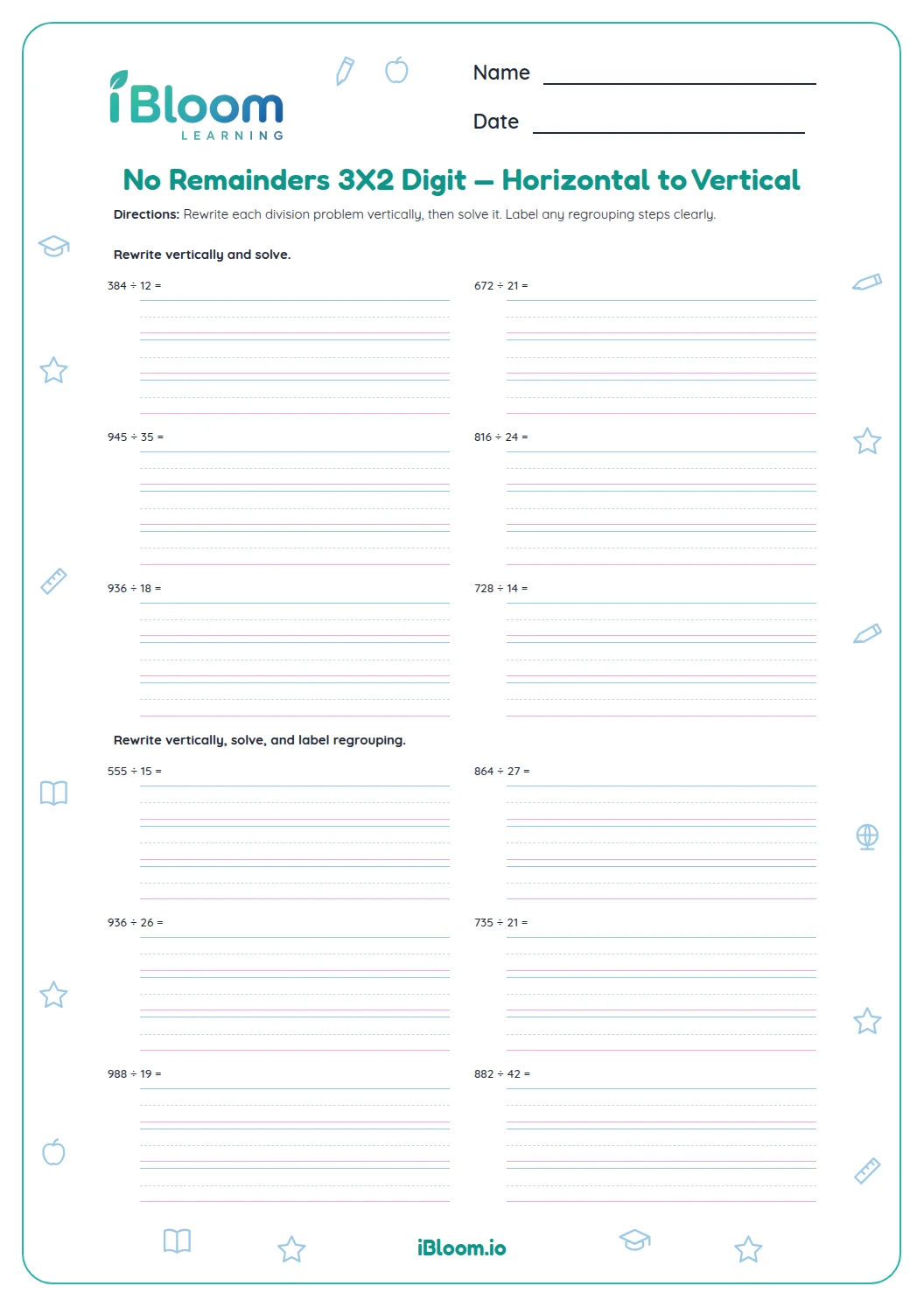
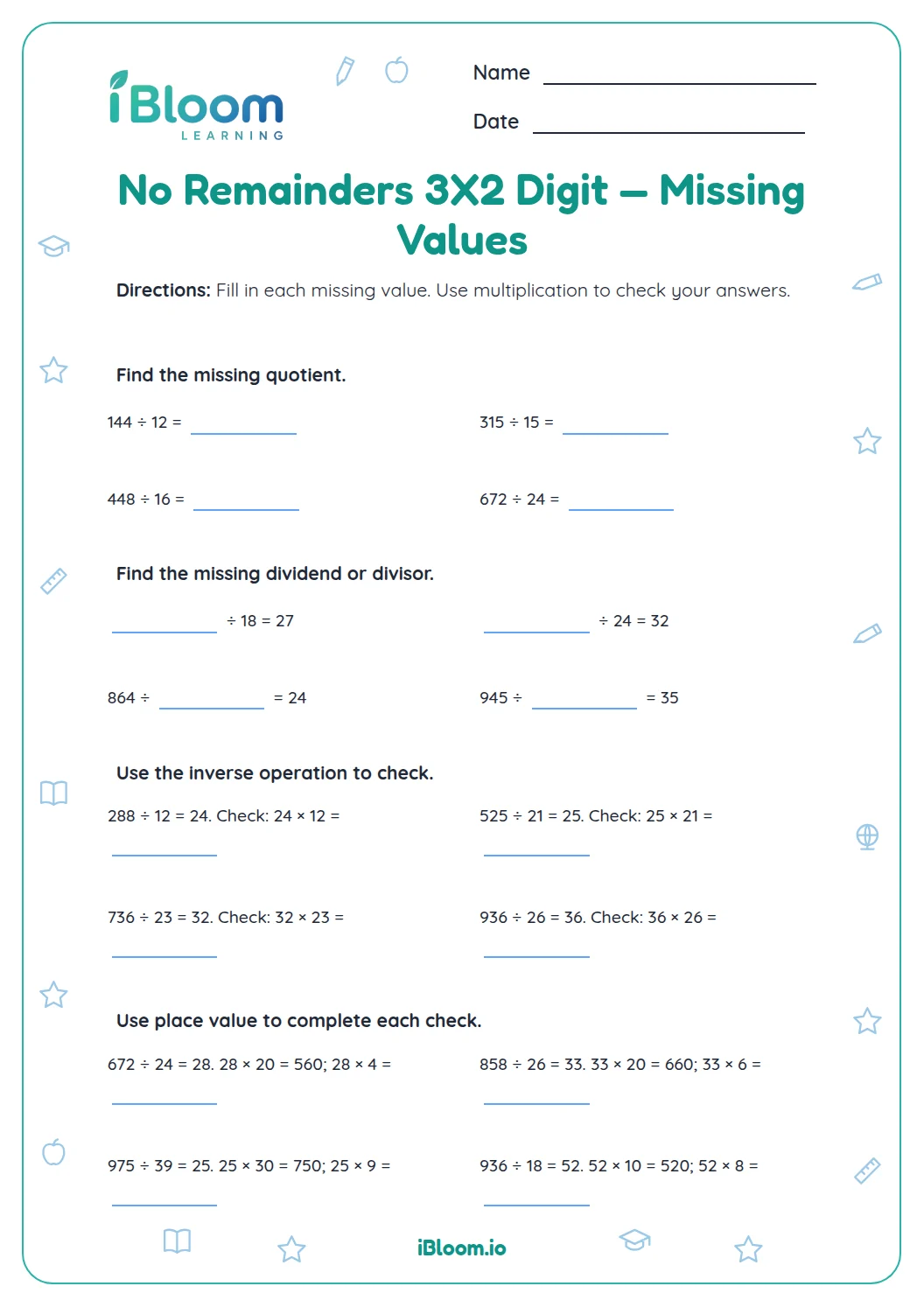
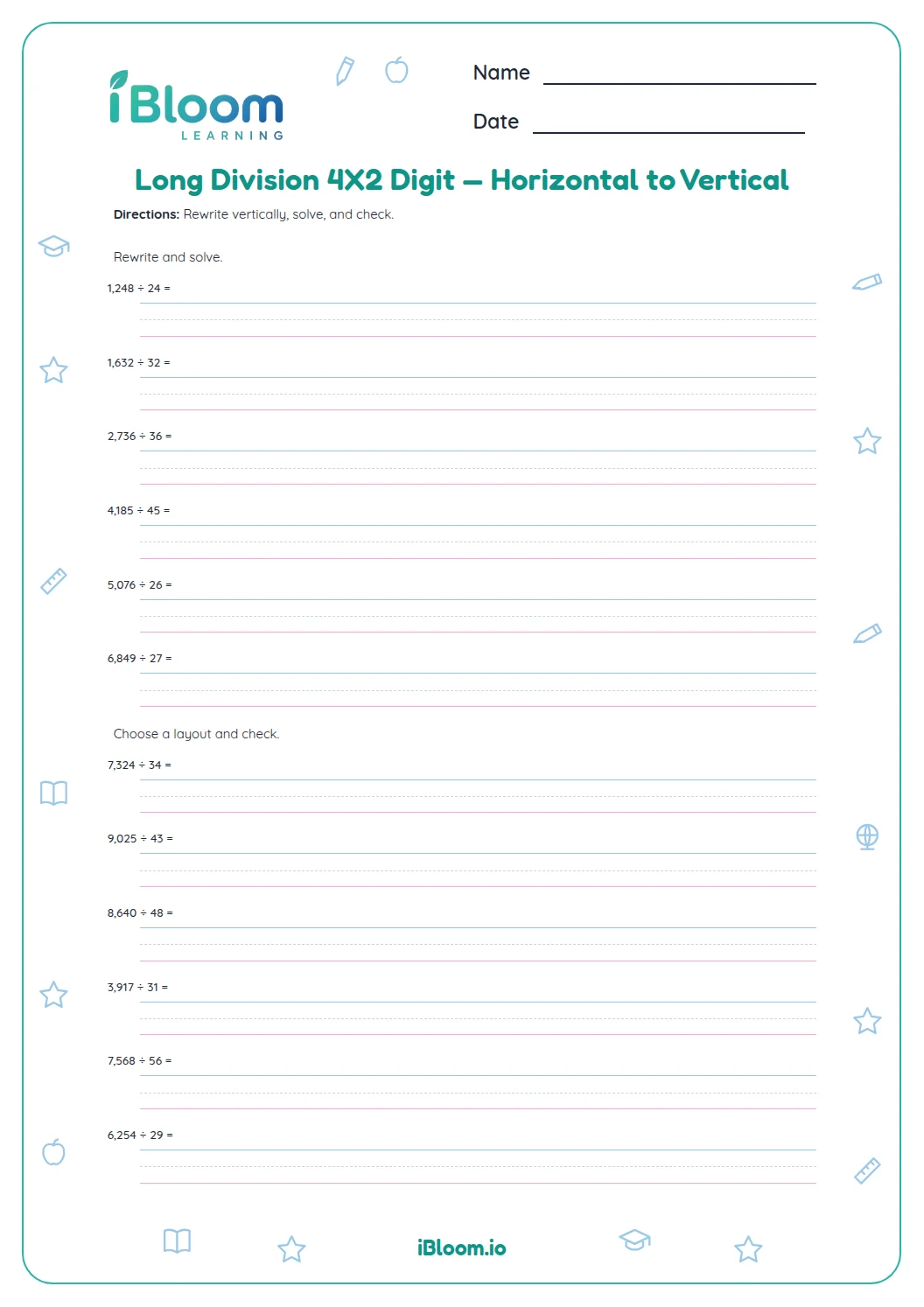
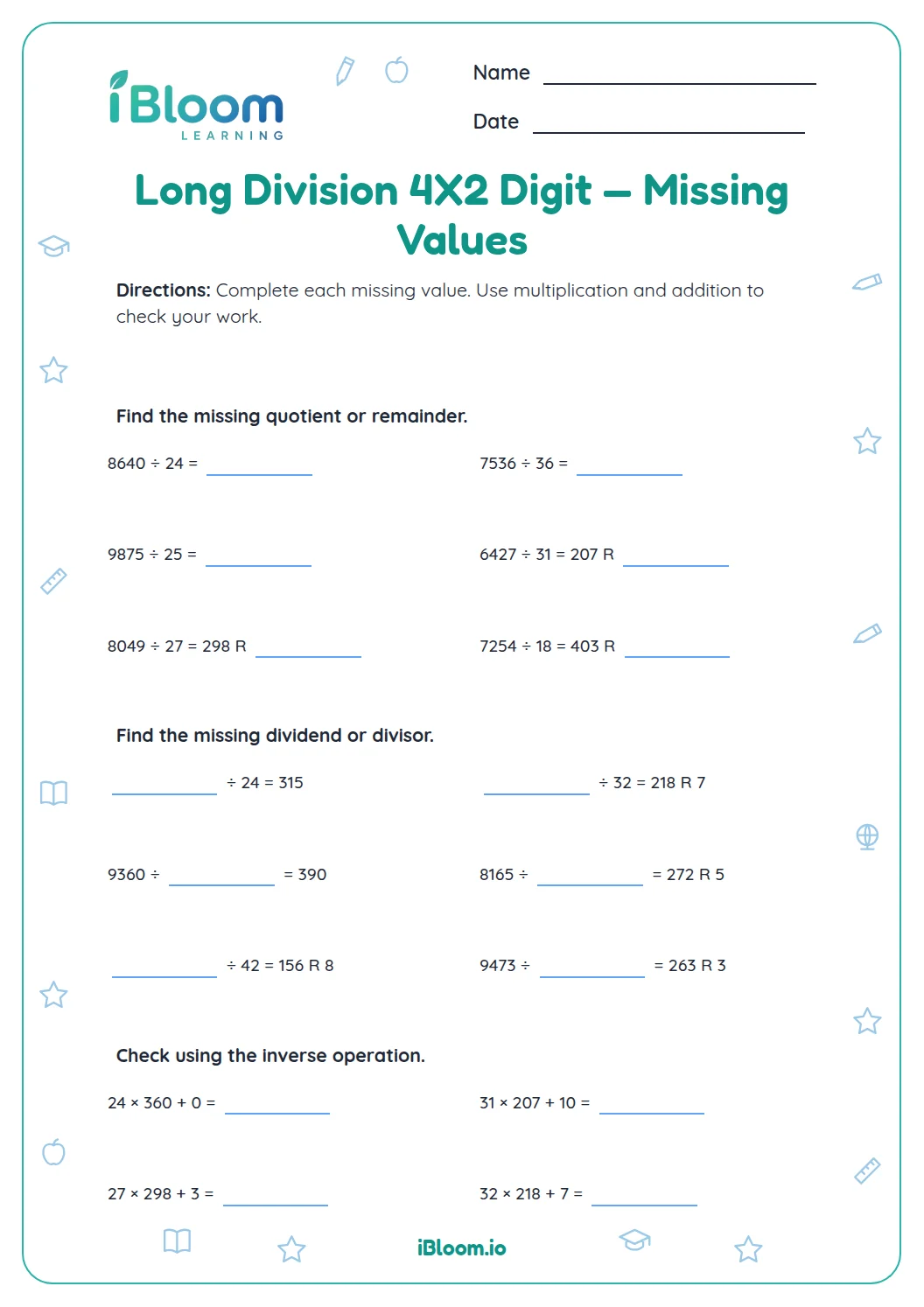
This long-division drill moves from eight exact quotients to eight quotient-and-remainder problems. Every item uses a three-digit dividend and a two-digit divisor, with working space for the division steps. A separate answer key lists each quotient and remainder.
Aligned to 5.NBT.B.6
How is the drill organized?
Part A contains eight three-digit dividends divided by two-digit divisors with exact answers. Part B contains eight similar calculations that leave a remainder. Learners begin with exact quotients, then record both parts of a non-exact answer.
How should a learner check a remainder?
Multiply the divisor by the quotient, then add the remainder. The result should equal the dividend, and the remainder must be smaller than the divisor. For 437 ÷ 12, 12 × 36 + 5 equals 437.
What work belongs in the answer space?
Show each long-division step: determine a quotient digit, multiply, subtract, and bring down the next digit. Keep the quotient above the dividend and record a remainder after the final subtraction when needed.
- 1437 ÷ 12
- 212 × 36 = 432; 437 − 432 = 5.
- 3Answer: 36 R 5.
How to use this worksheet
- 1Estimate how many times the divisor fits into the leading digits.
- 2Write each quotient digit above the correct place.
- 3Multiply and subtract, lining up place values.
- 4Bring down the next dividend digit and continue.
- 5Check that each remainder is less than the divisor.
Common mistakes and quick fixes
The mistake
Starting the quotient over the wrong place.
The fix
Compare the leading dividend digits with the divisor before placing the first quotient digit.
The mistake
Subtracting a product from the wrong digits.
The fix
Line up each product under the digits it represents.
The mistake
Leaving a remainder as large as the divisor.
The fix
If the remainder is at least the divisor, the quotient is too small; divide once more.
Common Core alignment
This worksheet gives practice with the skill named in the standard.
Find whole-number quotients using place value and operation relationships.
On this sheet: All 16 items divide a three-digit dividend by a two-digit divisor; the second part includes remainders.
Show the official wordingHide the official wording
Find whole-number quotients of whole numbers with up to four-digit dividends and two-digit divisors, using strategies based on place value, the properties of operations, and/or the relationship between multiplication and division. Illustrate and explain the calculation by using equations, rectangular arrays, and/or area models.
What to practice next
Make more practice
Further reading
Questions parents and teachers ask
How many problems are included?
The worksheet has 16 problems across two parts. The first eight have exact quotients. The last eight ask for a quotient and a remainder, so learners practice both forms of three-digit divided by two-digit long division. Check by multiplying back to the dividend.
How can I check a quotient and remainder?
Multiply the divisor by the quotient and add the remainder. The total should match the dividend, and the remainder must be smaller than the divisor. For example, 12 times 36 plus 5 equals 437. Check by multiplying back to the dividend.
Does the worksheet include an answer key?
Yes. A separate key lists all 16 answers. For the second part, each key entry gives the quotient followed by the remainder. Learners can also check by multiplying back and comparing with the dividend. Check by multiplying back to the dividend.
What grade is this drill for?
The listing places this drill in Grades 4–6, while its whole-number division method aligns to Grade 5 standard 5.NBT.B.6. The work space supports learners who are practicing calculations with two-digit divisors. Check by multiplying back to the dividend.
How long should the drill take?
Allow about 25 minutes for 16 long-division calculations, especially if the learner writes each step. The exact time depends on fluency with two-digit divisors and whether an adult reviews the first problem together. Check by multiplying back to the dividend.