






About this worksheet
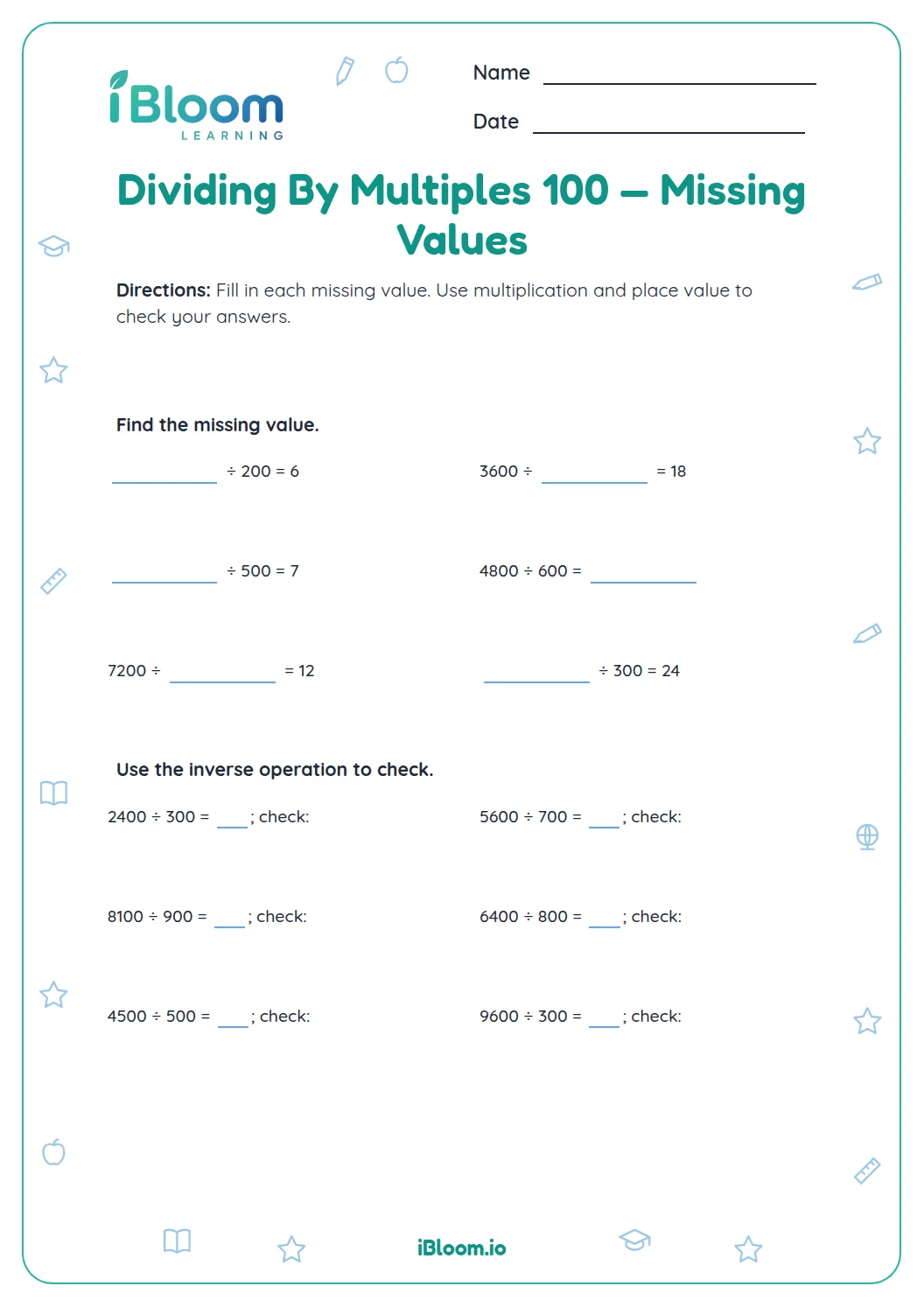
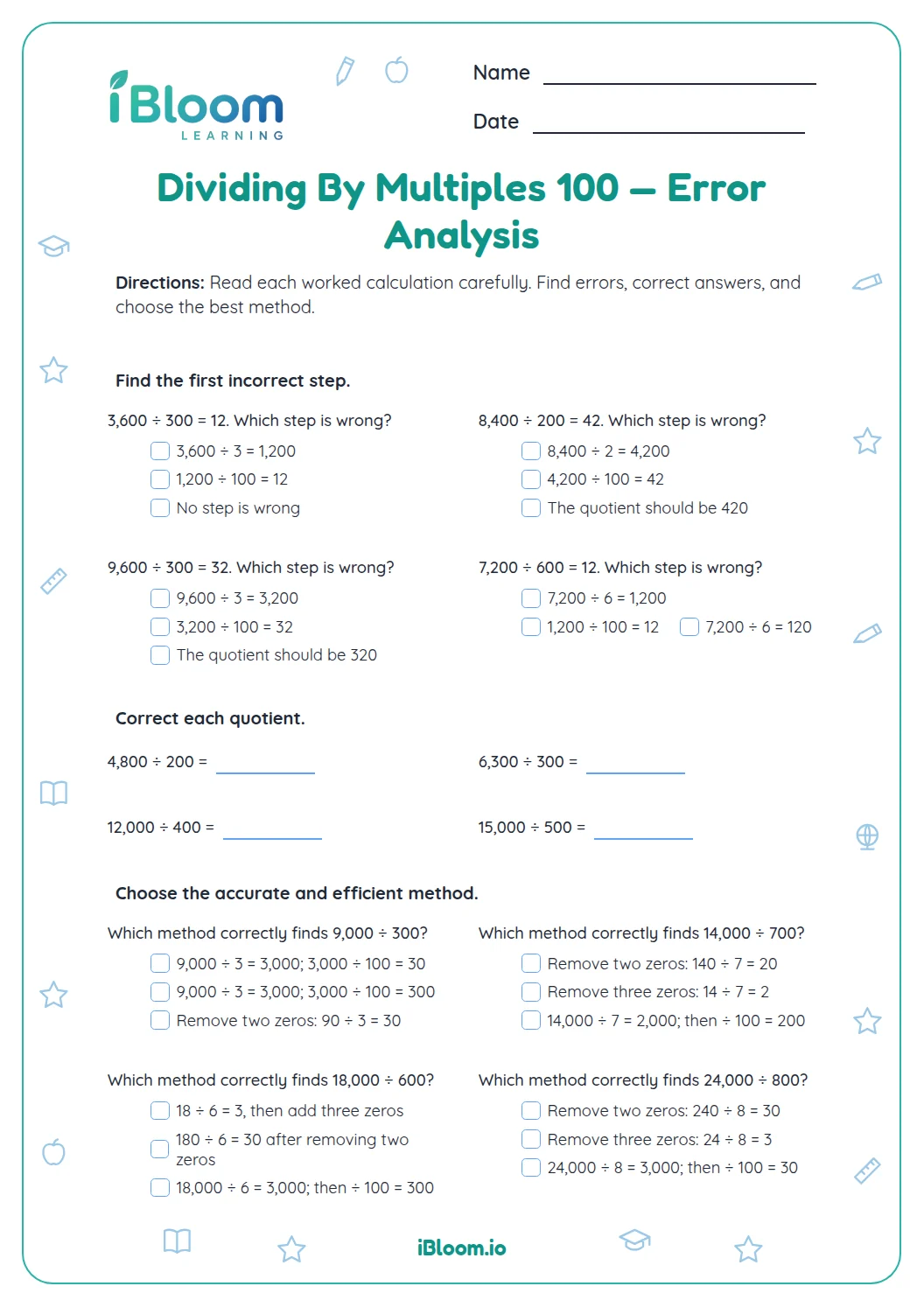
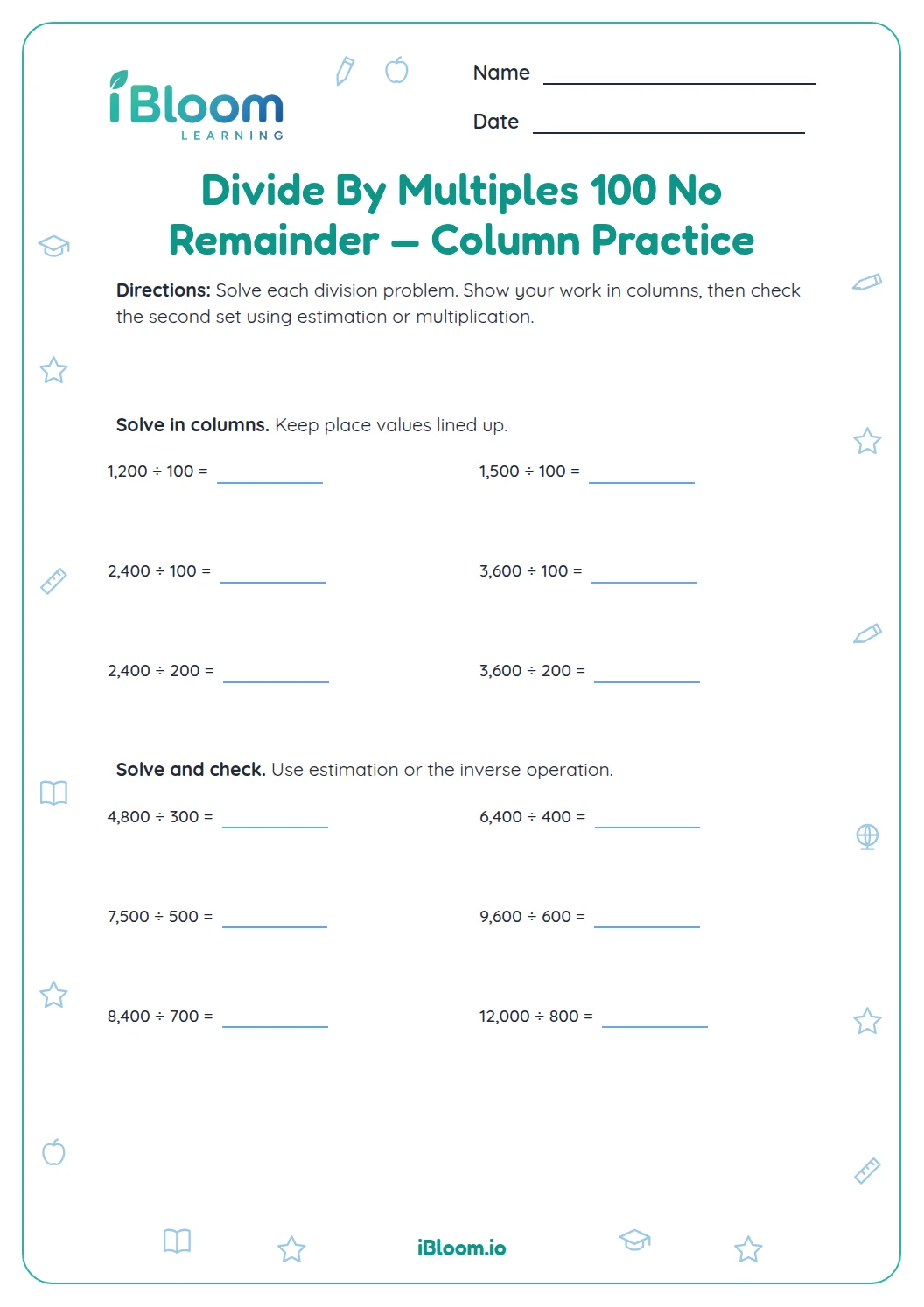
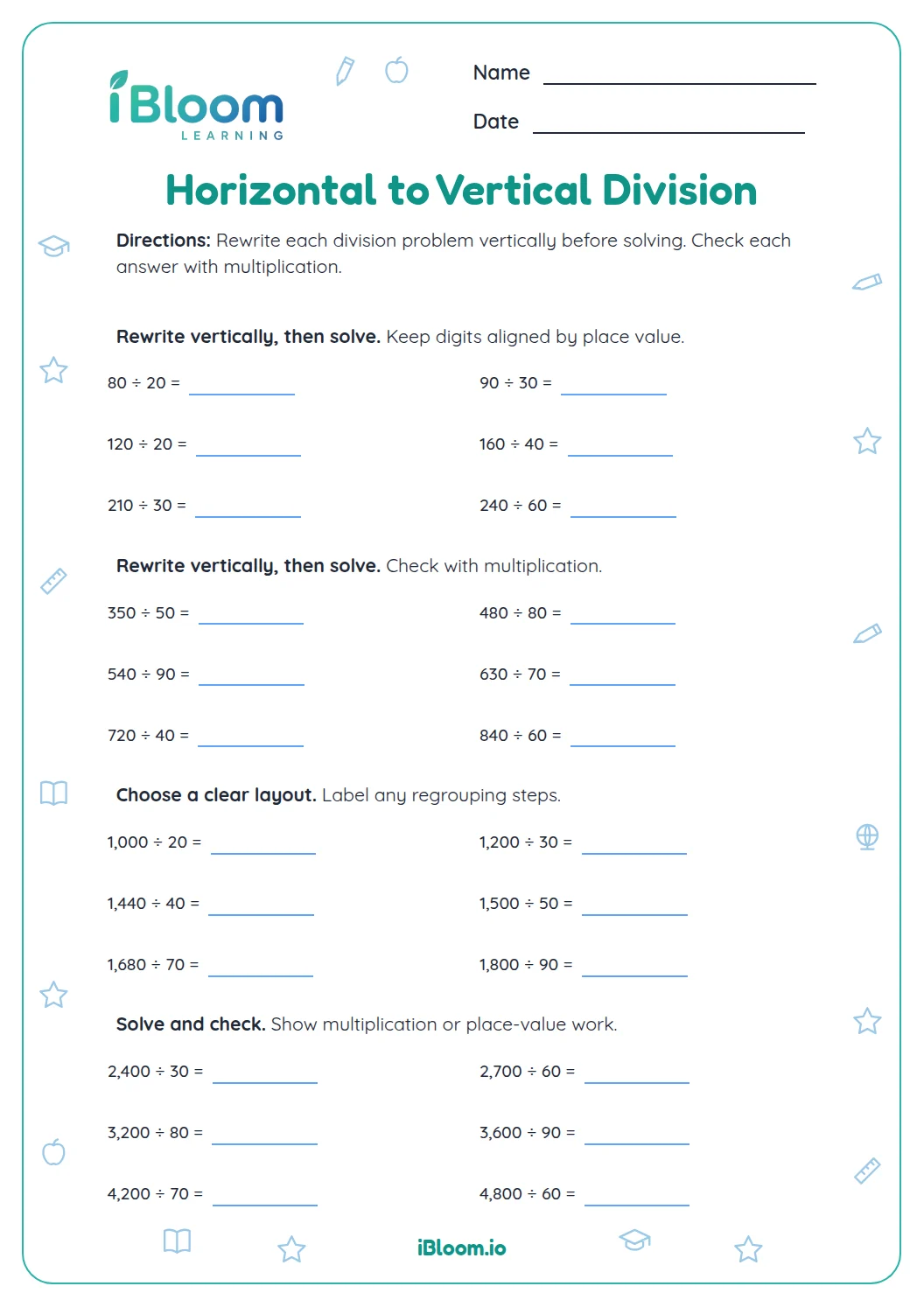
This mixed mastery drill gives students practice dividing multi-digit numbers by multiples of 100. The 16 questions move from direct quotients to missing values, checking a quotient with multiplication, and a short sharing problem. Students can use place value to remove matching zeroes, then multiply the quotient by the divisor to check.
What is on this worksheet?
Part A has six quotient questions using multiples of 100. Part B includes two missing values and three more quotient questions. Part C checks a quotient and a multiplication sentence. Part D solves an equal-sharing problem and finds a missing dividend.
How can you solve one carefully?
For 3,600 ÷ 300, divide both numbers by 100: 36 ÷ 3 = 12. Multiply 12 × 300 to check that the product returns to 3,600.
- 13,600 ÷ 300 = 12
- 236 ÷ 3 = 12
- 312 × 300 = 3,600
How can you check your work?
For 5,400 ÷ ___ = 9, ask what number times 9 equals 5,400. Since 9 × 600 = 5,400, the missing divisor is 600.
- 15,400 ÷ ___ = 9
- 29 × 600 = 5,400
- 3The missing divisor is 600.
How to use this worksheet
- 1Read the dividend and divisor before deciding how to simplify.
- 2Divide both numbers by the same power of ten when possible.
- 3For a missing divisor, use the related multiplication fact.
- 4For equal sharing, divide the total equally among the groups.
- 5Check a quotient by multiplying it by the divisor.
Common mistakes and quick fixes
The mistake
Removing zeroes from only one number and changing the quotient.
The fix
Remove the same number of trailing zeroes from dividend and divisor.
The mistake
Reading 5,400 ÷ ___ = 9 as 5,400 ÷ 9.
The fix
Ask what number times 9 equals 5,400; the blank is the divisor.
The mistake
Writing 70 for 4,200 ÷ 600.
The fix
Divide both numbers by 100 to get 42 ÷ 6 = 7.
What to practice next
Make more practice
Further reading
Questions parents and teachers ask
How do students divide by 300 or 700?
Divide the dividend and divisor by 100 when both have at least two trailing zeroes. For example, 3,600 ÷ 300 becomes 36 ÷ 3, or 12. Multiplying 12 by 300 checks that the product is 3,600 and verifies the quotient.
Why does Part B have missing numbers?
The missing values ask students to use the relationship between multiplication and division. For 5,400 ÷ ___ = 9, ask what number multiplied by 9 equals 5,400. Since 9 × 600 = 5,400, the missing divisor is 600. This is the inverse operation in action.
Does the worksheet include an answer key?
Yes. The separate answer key lists all 16 results. For the two checking questions, the key supplies the corrected quotient or the multiplication sentence that verifies it. Students can compare their work after attempting each part. The equal-sharing question asks for a number of cards per team.
How long should this practice take?
About 15 minutes is a reasonable starting point. Students may want extra time for the missing-value and equal-sharing problems. There is no need to rush: a multiplication check can help confirm whether each quotient makes sense. Students can pause between parts and finish later if needed.
What is the main strategy?
Divide both the dividend and divisor by the same power of ten to make a smaller fact. Then multiply the quotient by the original divisor. For example, 12 × 300 returns to 3,600, confirming the quotient. Keeping the scale factor equal preserves the quotient.
What is the main strategy?
Divide both the dividend and divisor by the same power of ten to make a smaller fact. Then multiply the quotient by the original divisor. For example, 12 × 300 returns to 3,600, confirming the quotient. Keeping the scale factor equal preserves the quotient.