



About this worksheet
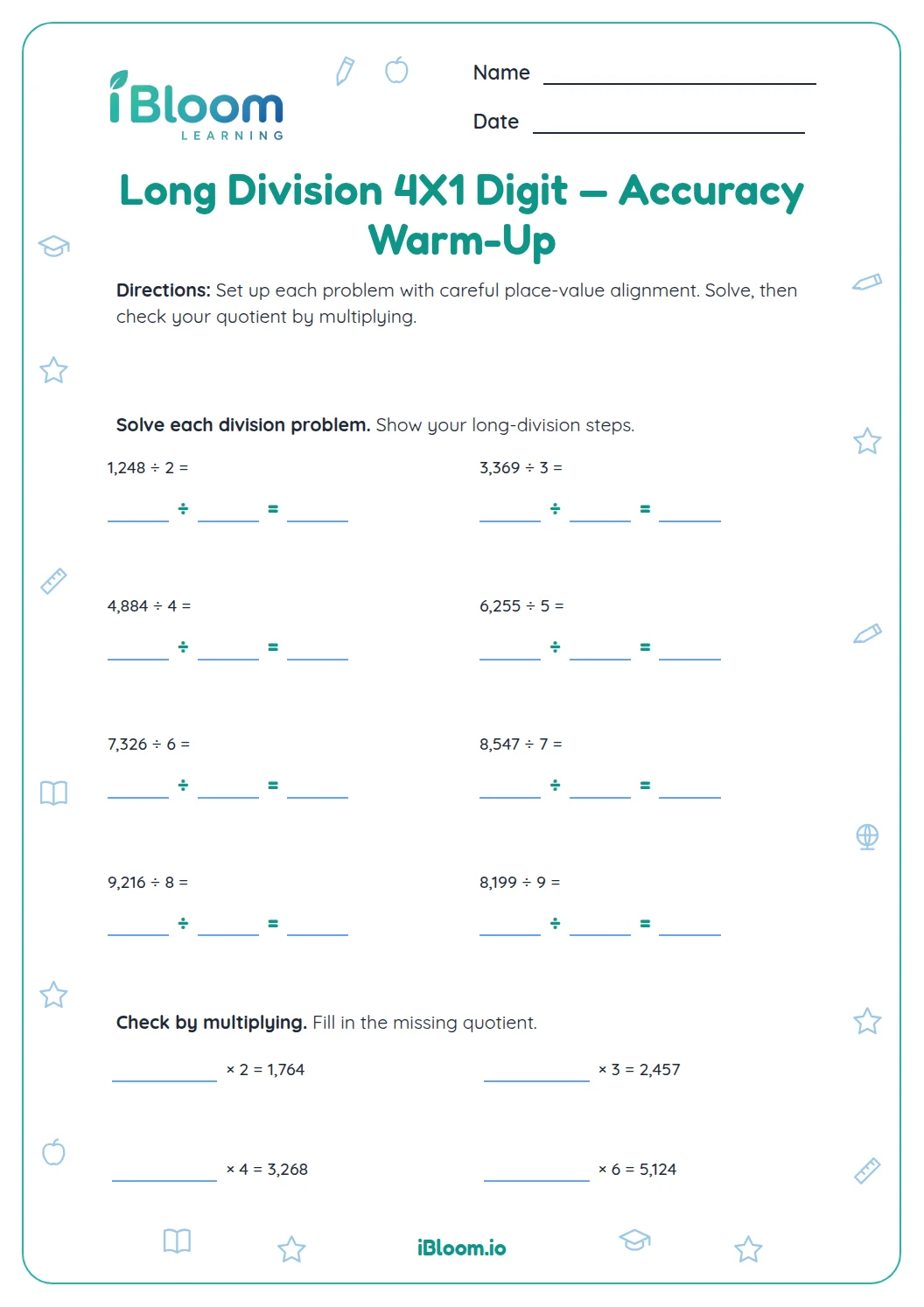
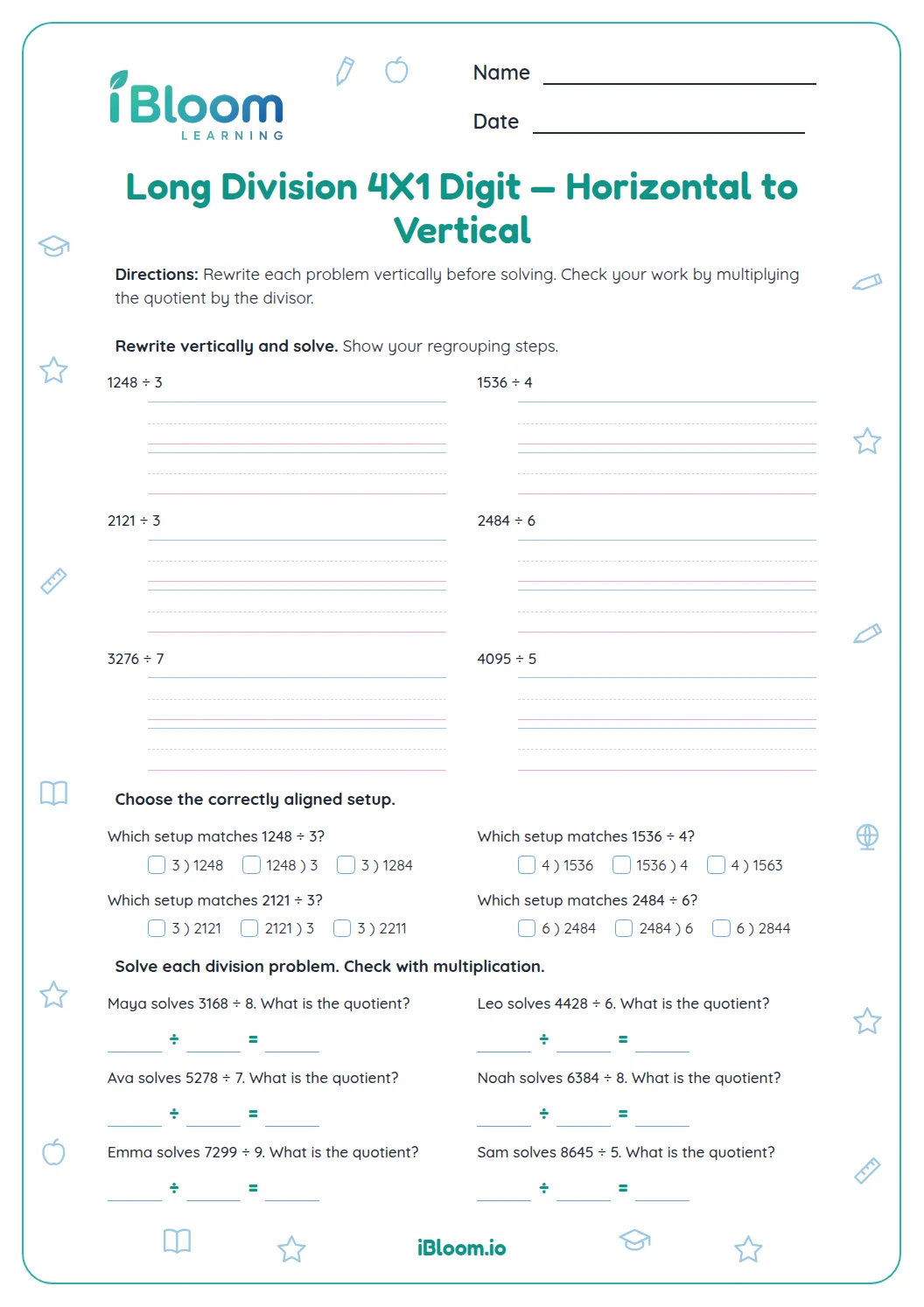
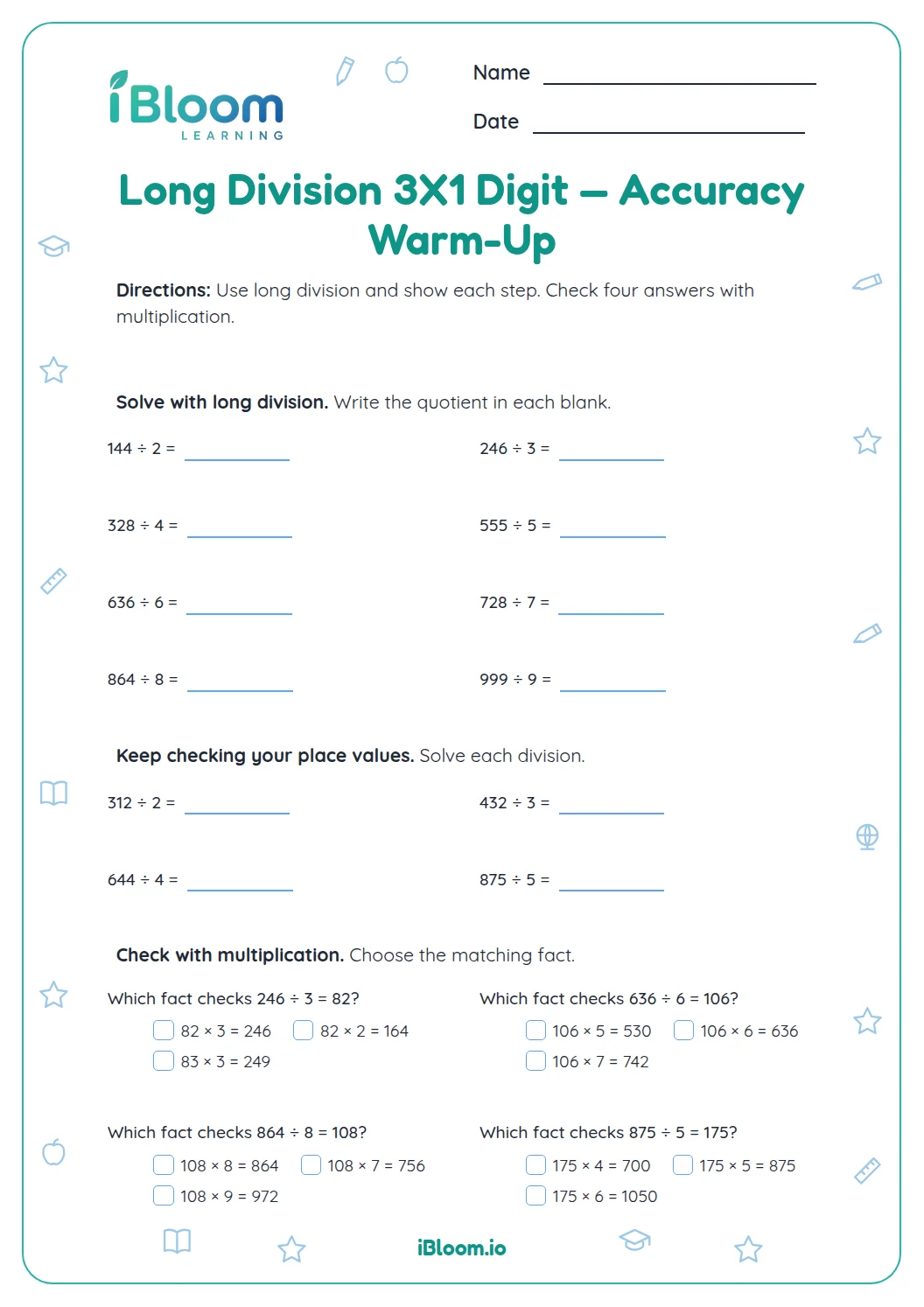
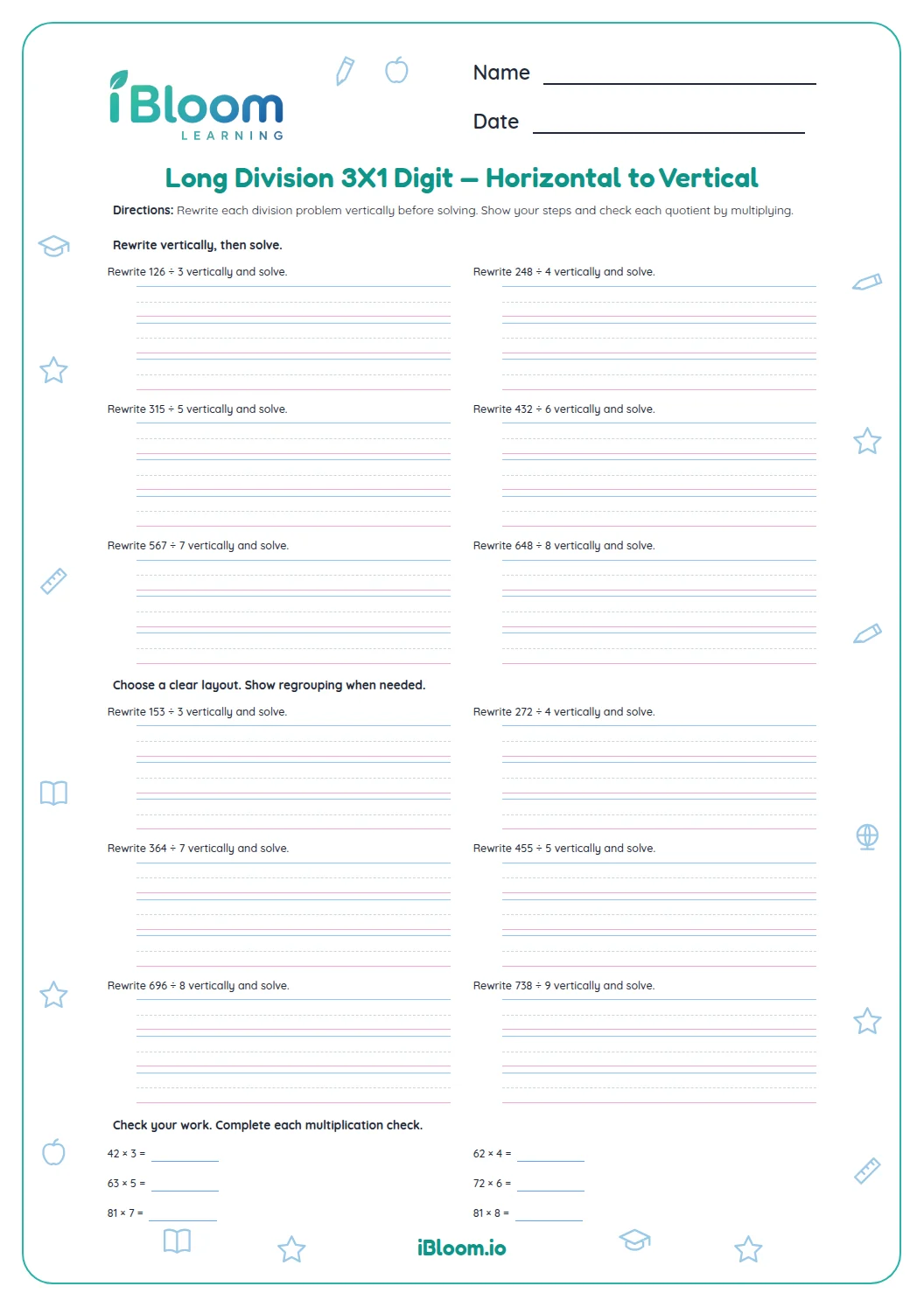
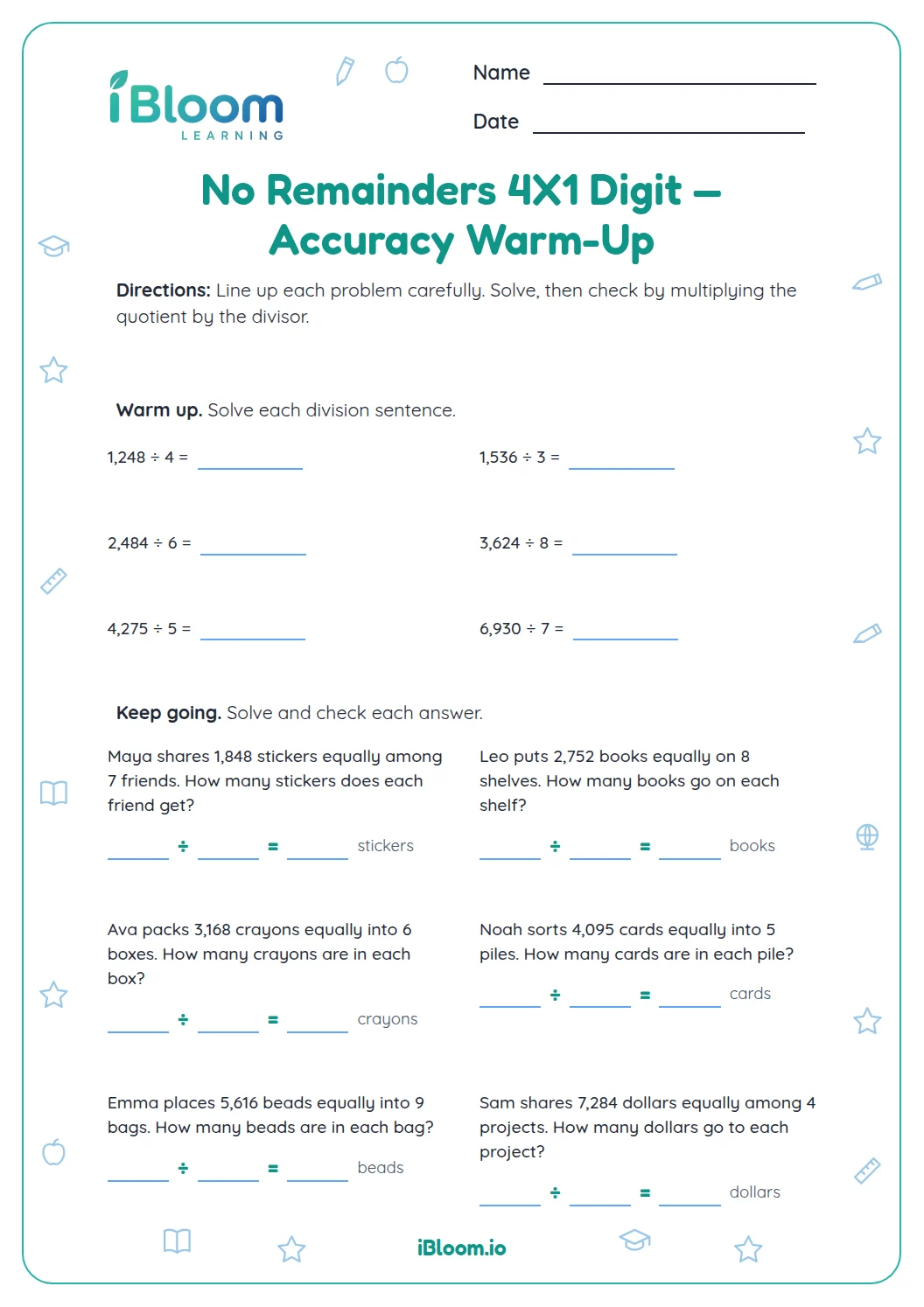
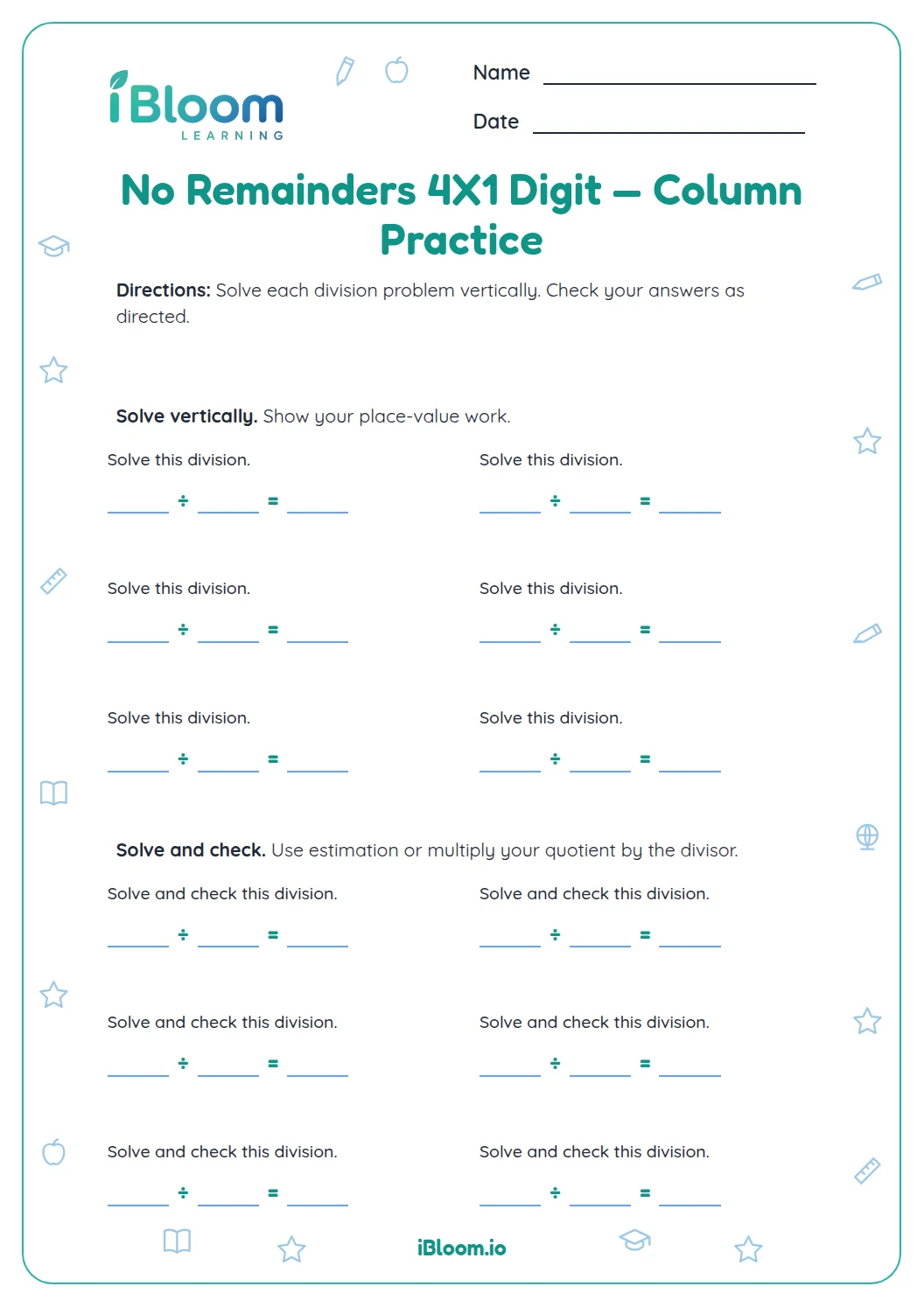
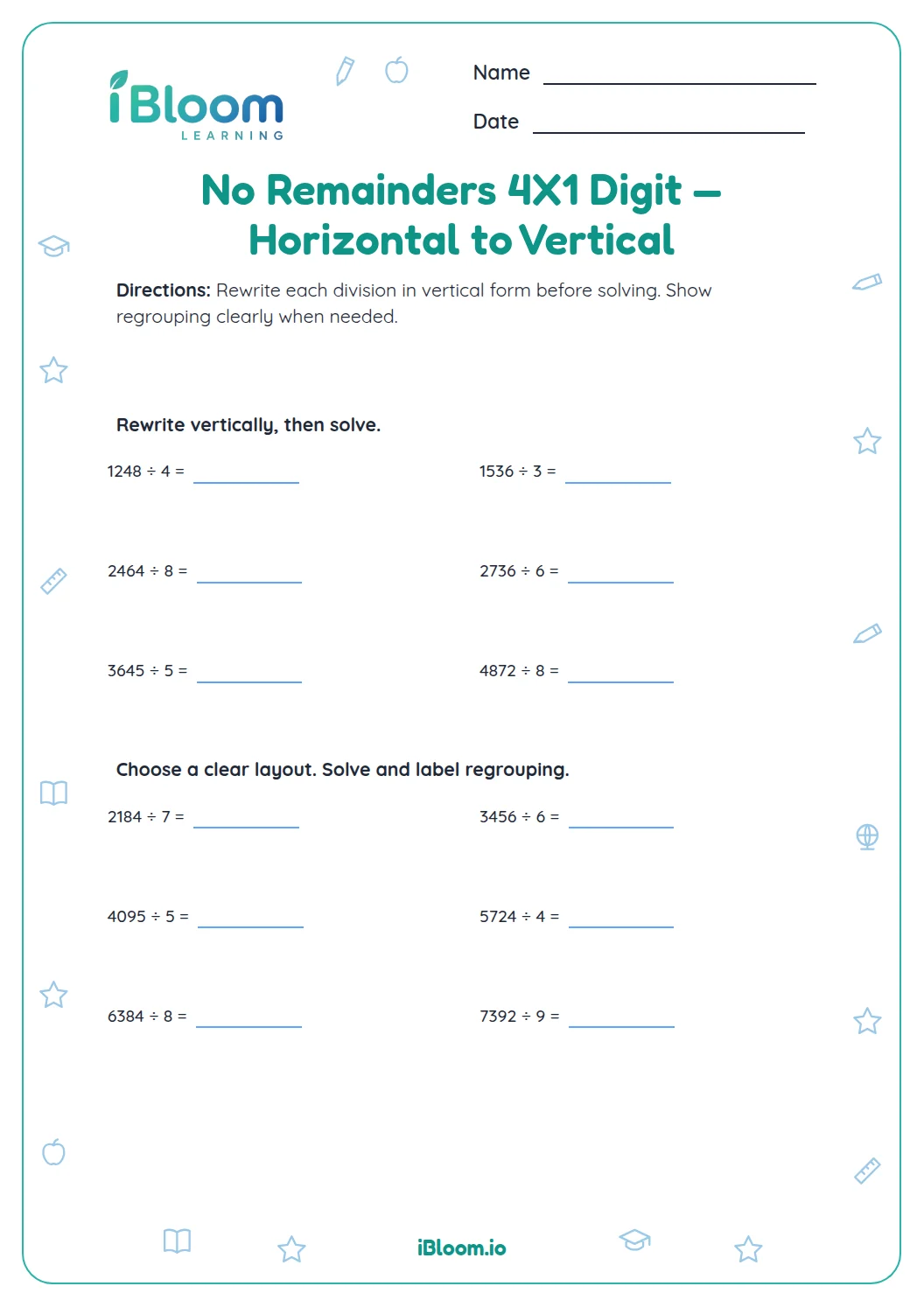
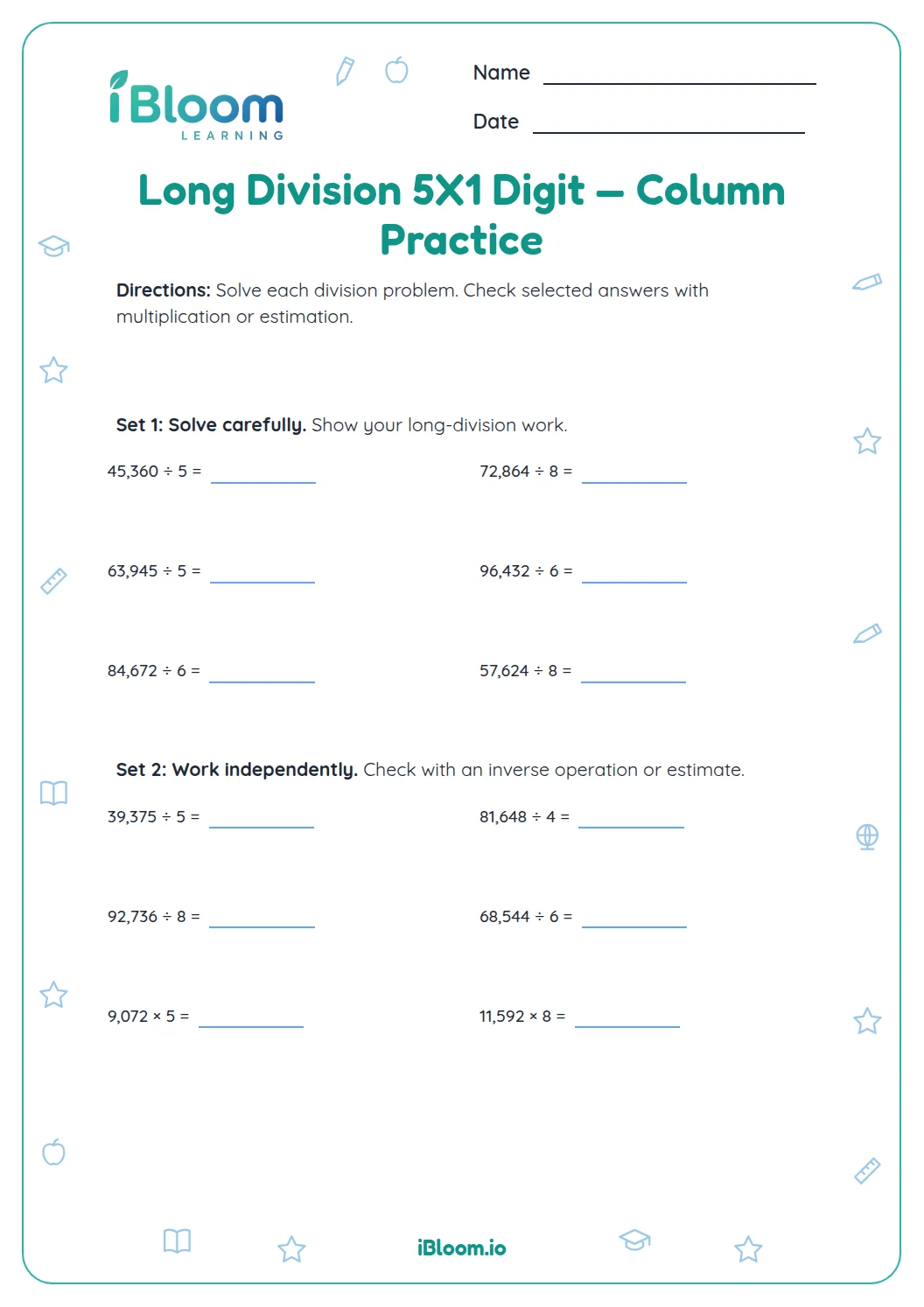
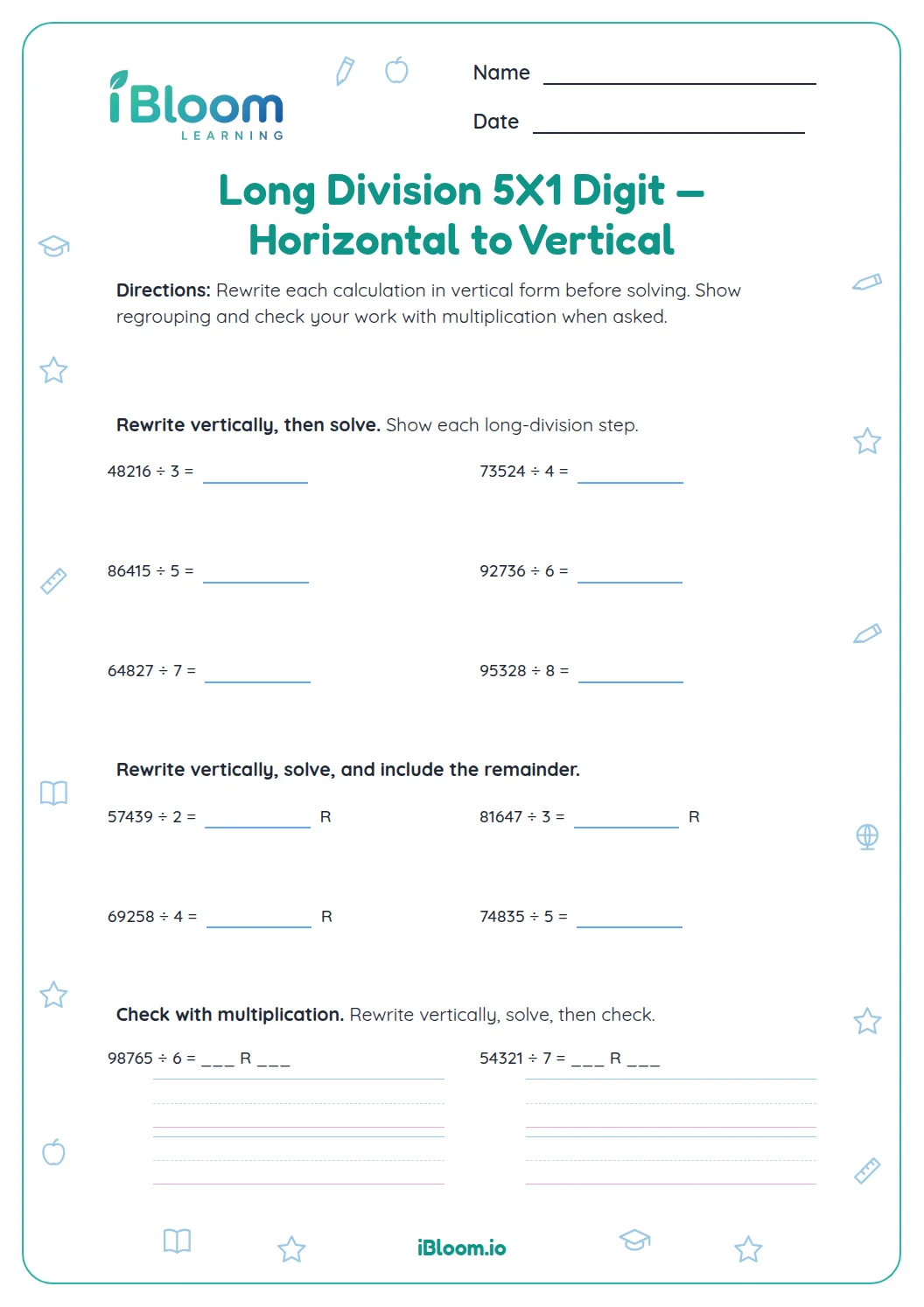
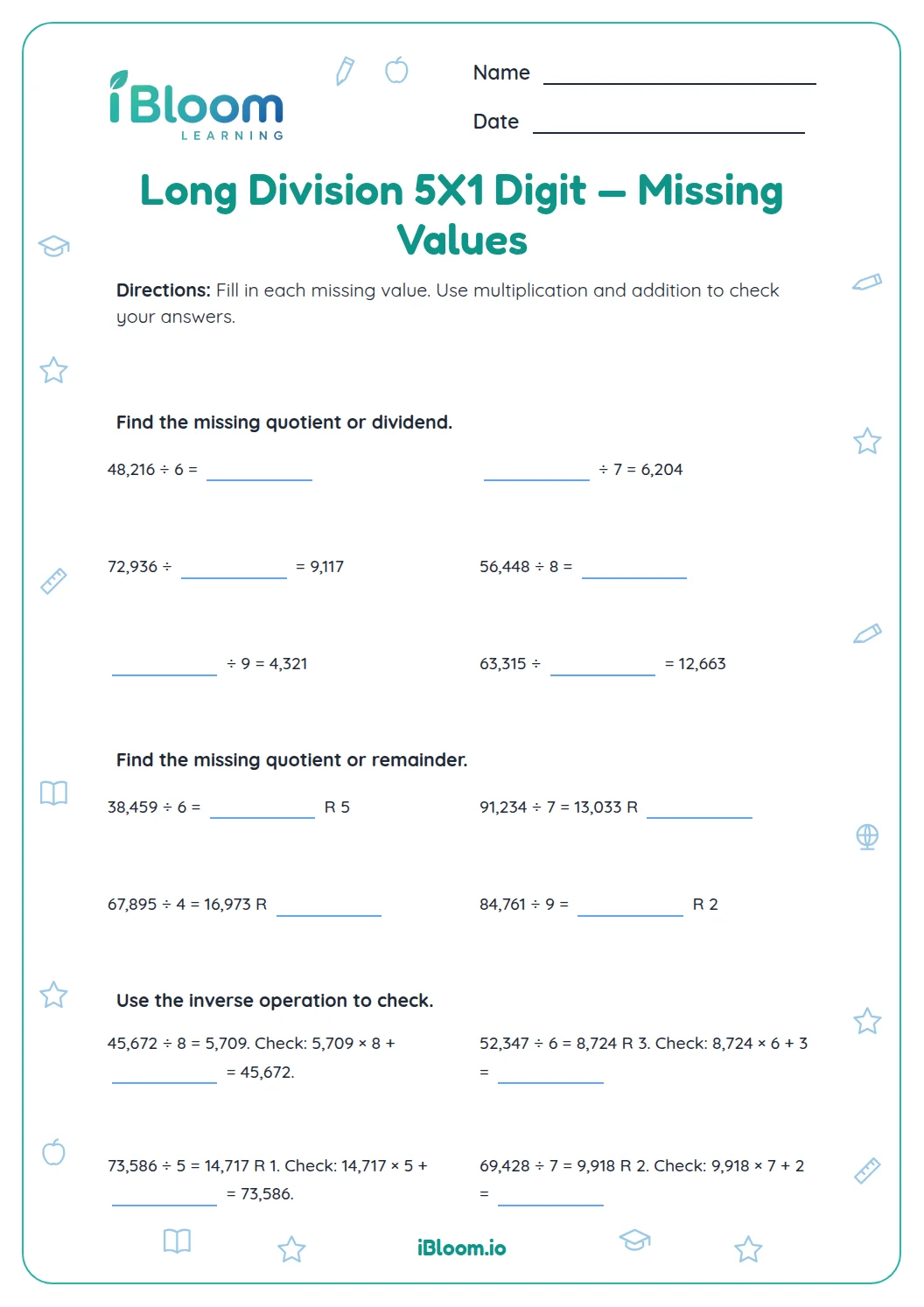
This printable long-division drill has 20 problems with four-digit dividends and one-digit divisors. The first set builds accuracy, the next includes remainders, and the final section mixes both forms. Students can use the multiplication relationship to check each quotient. The practice aligns with CCSS 4.NBT.B.6, and a separate key lists each quotient and remainder.
Aligned to 4.NBT.B.6
What is in this long-division drill?
All 20 questions divide a four-digit number by a one-digit number. Exact divisions and divisions with remainders appear in each section, so students attend to the calculation rather than assume every answer is whole.
How do you check a quotient with a remainder?
For q5, 1,635 ÷ 5 = 327. Multiply 327 × 5 to get 1,635. For a remainder problem, add the remainder after multiplying; for example 2,843 ÷ 4 = 710 R 3 because 710 × 4 + 3 = 2,843.
What does a remainder tell you?
A remainder is what is left after making as many equal groups as possible. It must be less than the divisor. If a remainder is as large as the divisor, one more group can be made, so the quotient needs another step.
How to use this worksheet
- 1Read the divisor and dividend before beginning.
- 2Divide from left to right, keeping each partial remainder.
- 3Bring down the next digit and continue.
- 4Write a remainder only after all dividend digits are used.
- 5Check quotient × divisor + remainder against the dividend.
Mistakes to watch for
The mistake
Stop after dividing the first digits.
The fix
Bring down the next digit each time and continue through the whole dividend.
The mistake
Put a remainder equal to or larger than the divisor.
The fix
If that happens, make another group and increase the quotient.
The mistake
Forget the remainder when checking.
The fix
Multiply the quotient by the divisor and then add the remainder.
Curriculum alignment
Find whole-number quotients and remainders with up to four-digit dividends.
On this sheet: Every problem divides a four-digit dividend by a one-digit divisor; the mixed set includes exact quotients and remainders.
Show the official wordingHide the official wording
Find whole-number quotients and remainders with up to four-digit dividends and one-digit divisors, using strategies based on place value, the properties of operations, and/or the relationship between multiplication and division. Illustrate and explain the calculation by using equations, rectangular arrays, and/or area models.
What to practice next
Make more practice
Further reading
Questions parents and teachers ask
How many problems are on the sheet?
The drill has 20 problems. Each uses a four-digit dividend and a one-digit divisor. Some divide evenly, while others leave a remainder. The worksheet has two pages, followed by a separate two-page key with all quotients and remainders.
How can I check a remainder?
Multiply the quotient by the divisor and add the remainder. For 2,843 ÷ 4, the answer 710 R 3 checks because 710 × 4 + 3 = 2,843. The remainder must also be smaller than 4, the divisor in this problem.
What grade is this worksheet for?
The page is labeled Grades 4–6. It practices the Grade 4 skill of finding quotients and remainders for dividends up to four digits divided by one digit. The questions can also give older students a focused review of that process.
Are all answers whole numbers?
No. The set mixes exact quotients with quotients that have remainders. Finish dividing through the last digit, then write any amount left over as R followed by the remainder. For example, 2,843 ÷ 4 is 710 R 3.
Does the answer key show the work?
The key provides each quotient and any remainder. Students have space to show their own long-division steps on the worksheet, then can check by multiplying the quotient by the divisor and adding the remainder. Students can compare their written steps with the quotient shown in the key.