






About this worksheet
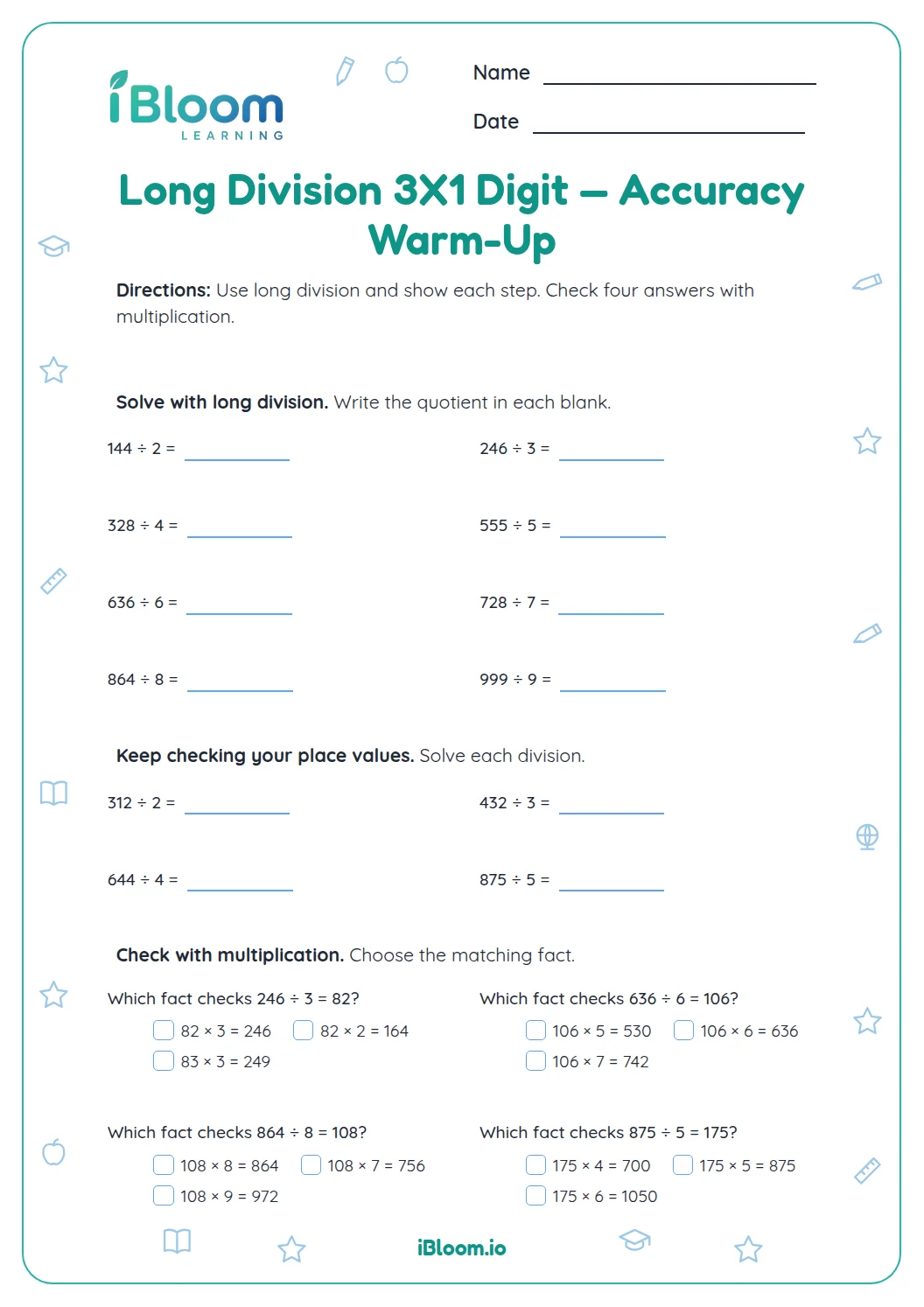
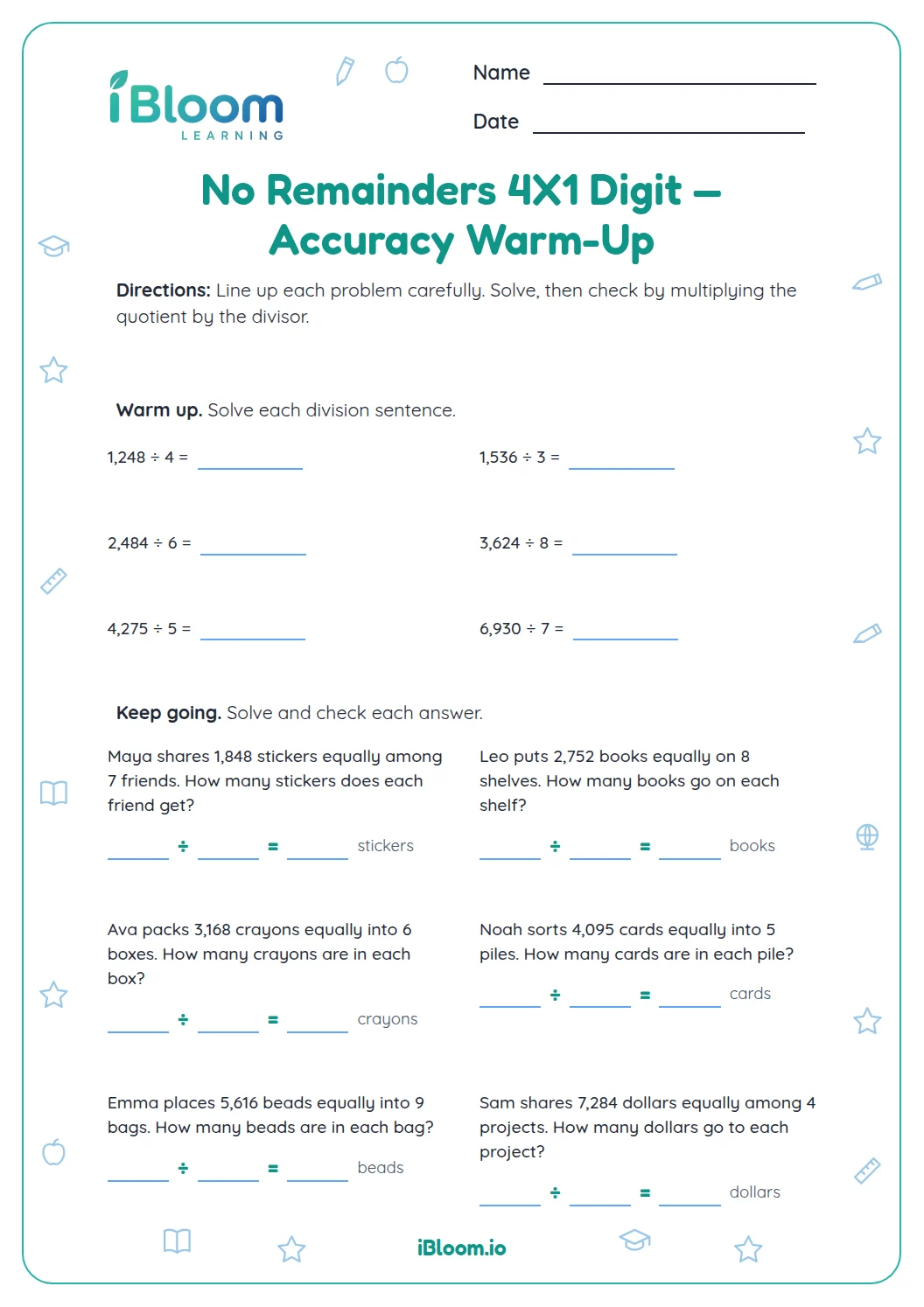
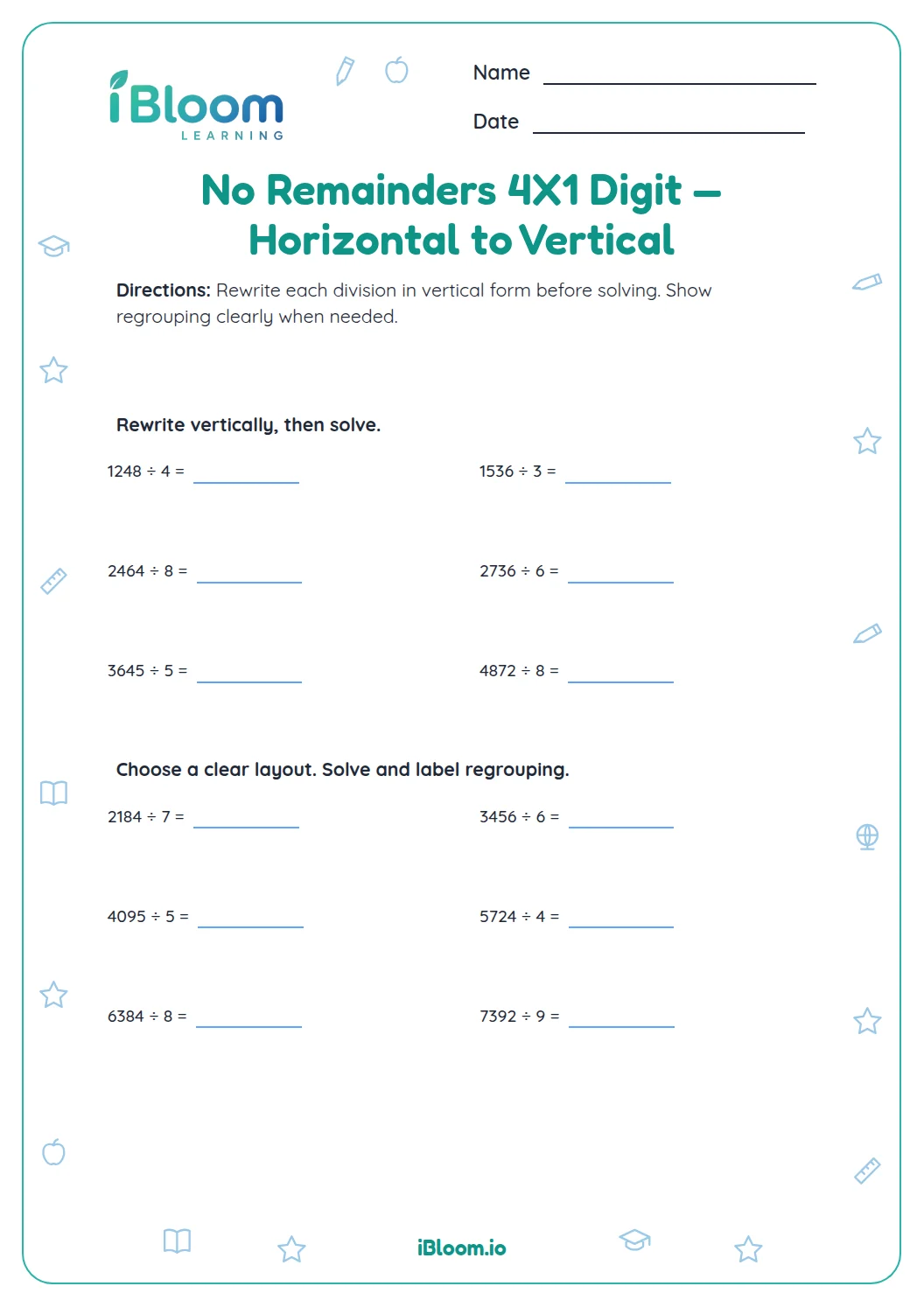
This accuracy warm-up gives students 16 problems with three-digit dividends and one-digit divisors, all chosen for whole-number quotients. The first problems offer a direct start, the next set provides working space, and the final items apply equal sharing in short stories. Students can check each quotient by multiplying it by the divisor. The practice aligns with Common Core 4.NBT.B.6, finding whole-number quotients using place-value strategies and the relationship between multiplication and division.
Aligned to 4.NBT.B.6
How do you divide a three-digit number?
Keep the digits in their place-value columns as you work through hundreds, tens, and ones. At each step, use a multiplication fact to decide how many groups fit. The quotient tells how many are in each equal group.
- 1864 ÷ 4
- 24 goes into 8 hundreds 2 times
- 3Continue through tens and ones
- 4864 ÷ 4 = 216
How can multiplication check the result?
Multiply the quotient by the divisor. If the product returns to the original dividend, the quotient is correct. For a story problem, include the unit named in the question, such as pencils or seedlings.
How to use this worksheet
- 1Read the dividend and divisor carefully.
- 2Work through hundreds, tens, and ones in order.
- 3For a story, write the equal-sharing division equation.
- 4Multiply the quotient by the divisor to check.
Common mistakes and quick fixes
The mistake
Dropping a place-value zero in the quotient.
The fix
Keep the quotient aligned over the dividend and check the final product.
The mistake
Using the dividend as the number of groups in a story.
The fix
Identify how many groups there are first; the quotient tells the amount in each group.
The mistake
Writing a remainder even though the problem divides evenly.
The fix
Check by multiplication; the chosen dividends are multiples of their divisors.
Common Core alignment
This practice uses place-value strategies and multiplication to find whole-number quotients.
Find exact whole-number quotients with a one-digit divisor and check by multiplication.
On this sheet: Every item divides a three-digit dividend by one digit; the story problems use equal groups.
Show the official wordingHide the official wording
Find whole-number quotients and remainders with up to four-digit dividends and one-digit divisors, using strategies based on place value, the properties of operations, and/or the relationship between multiplication and division. Illustrate and explain the calculation by using equations, rectangular arrays, and/or area models.
What to practice next
Make more practice
Further reading
Questions parents and teachers ask
What does 3-digit by 1-digit division mean?
It means a three-digit dividend is divided by a one-digit divisor, such as 864 ÷ 4. This worksheet has 16 exact-division problems, including equal-sharing stories, and its answer key shows the quotients. Each answer can be checked with multiplication.
Do any problems have remainders?
No. Each dividend was selected so it divides evenly by the one-digit divisor. Students can confirm each answer by multiplying the quotient by the divisor and checking that the product matches the dividend. The story problems also share objects into equal groups.
What grade is this worksheet for?
The page is labeled for Grades 4–6 and practices Common Core 4.NBT.B.6. That standard includes finding whole-number quotients with one-digit divisors using place value and the relationship between multiplication and division. These examples use three-digit dividends and divide evenly.
How do the story problems work?
Each story describes an equal share: items are split evenly among boxes, rows, stacks, classes, or trays. Students divide the total by the number of groups and include the matching unit in the answer. The answer key keeps that unit with each model response.
How can students check their work?
Multiply the quotient by the divisor. For example, if 735 ÷ 5 = 147, then 147 × 5 should equal 735. If the product does not match, revisit the place-value steps in the division and check each quotient digit.