







About this worksheet
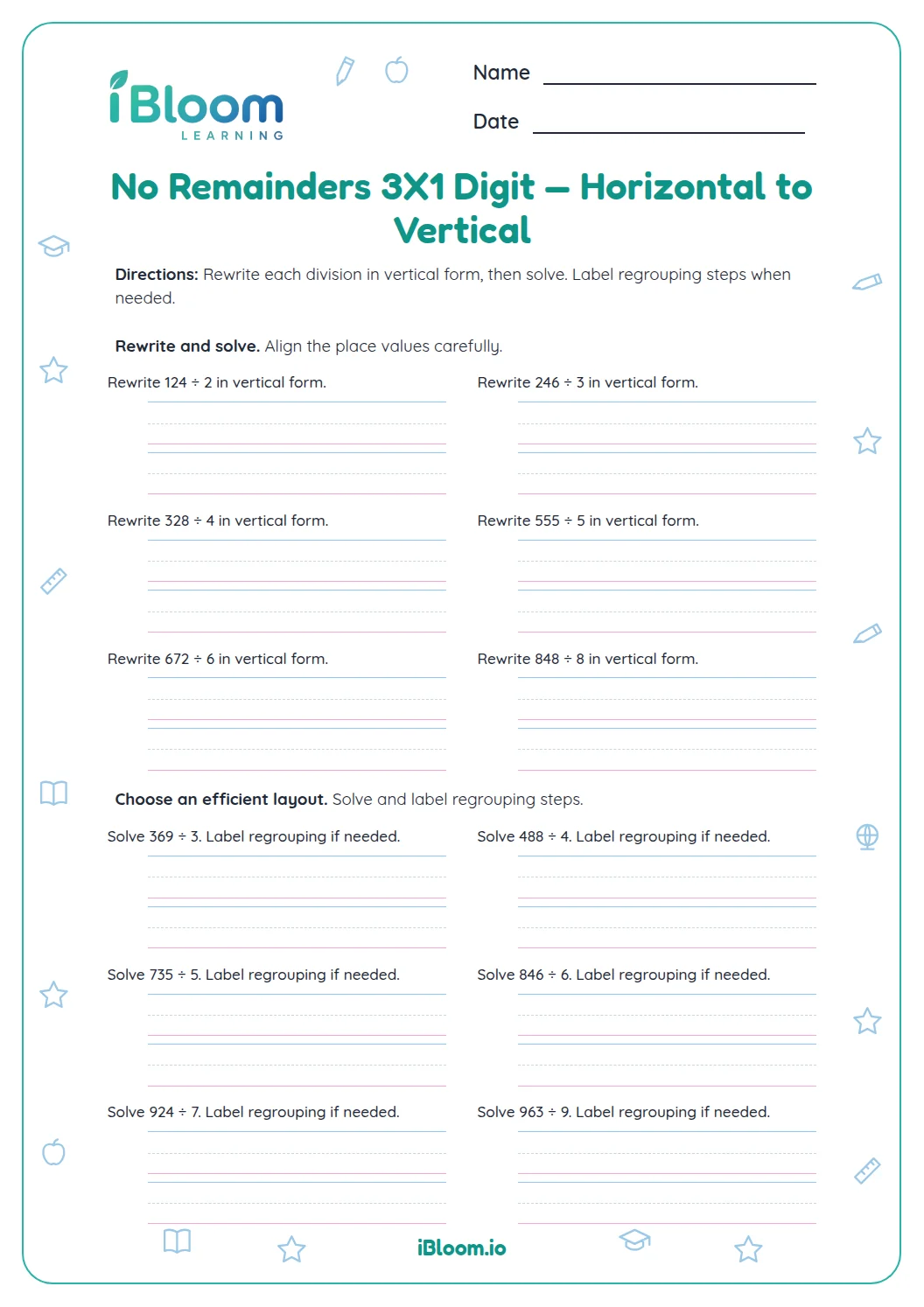
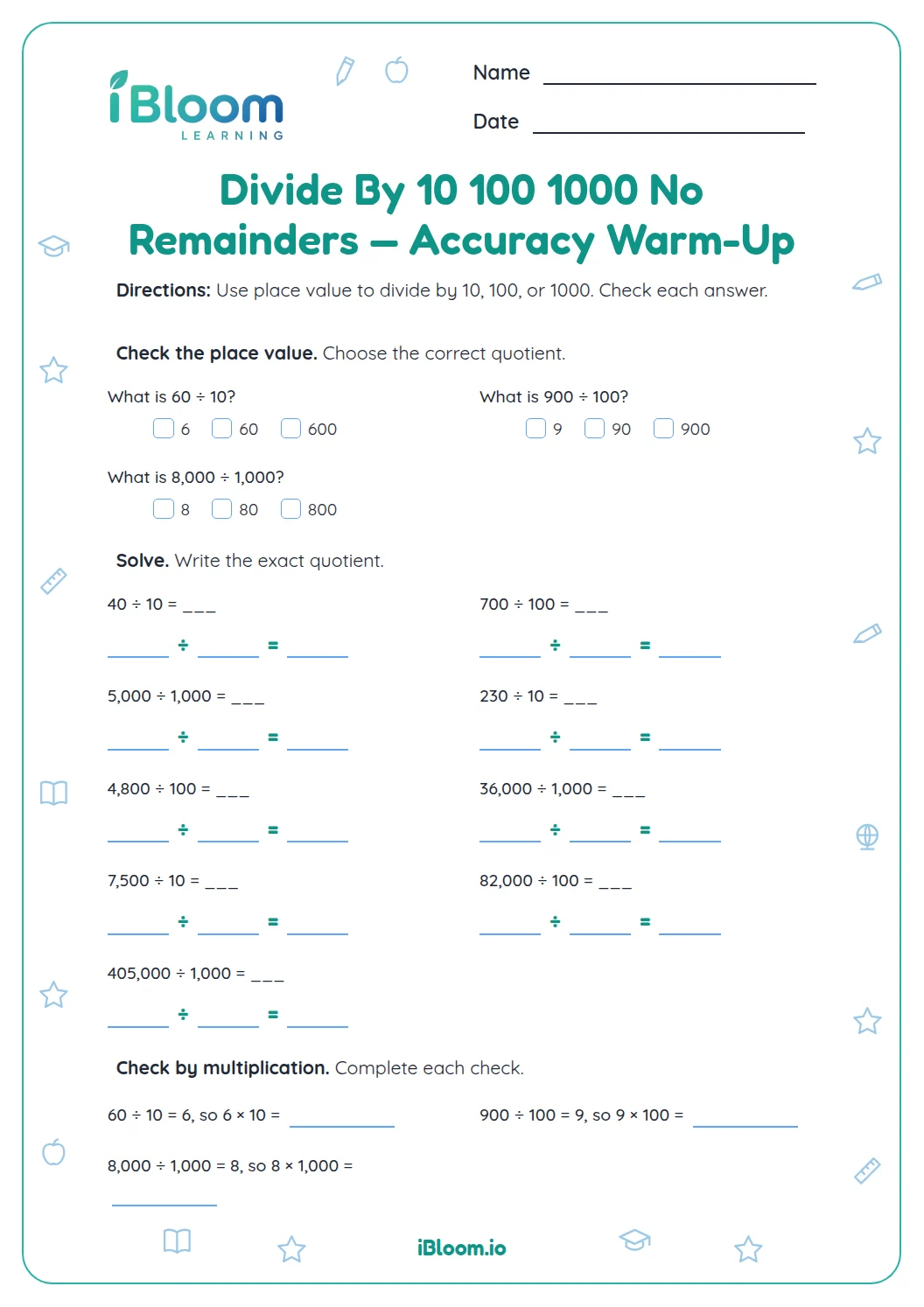
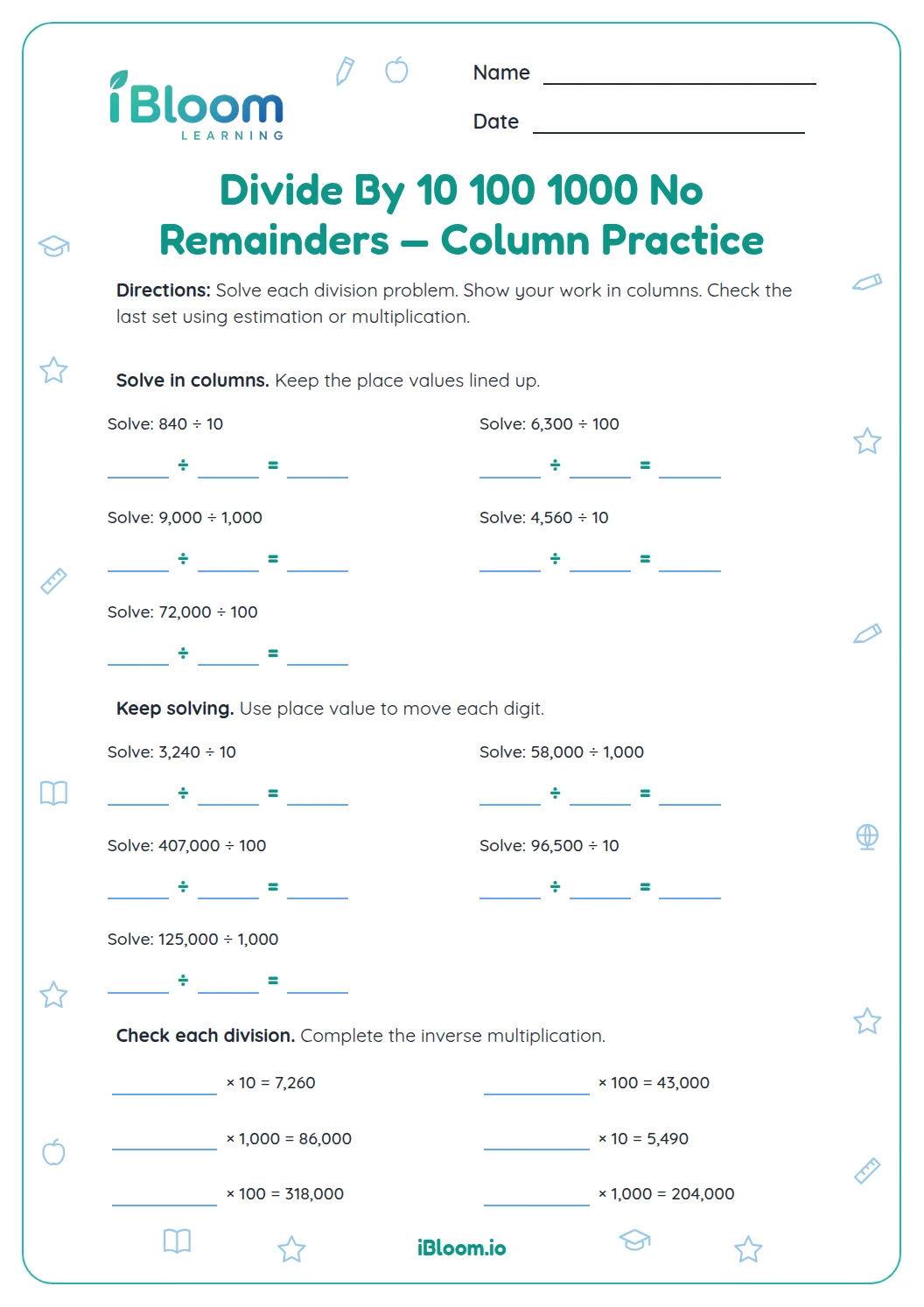
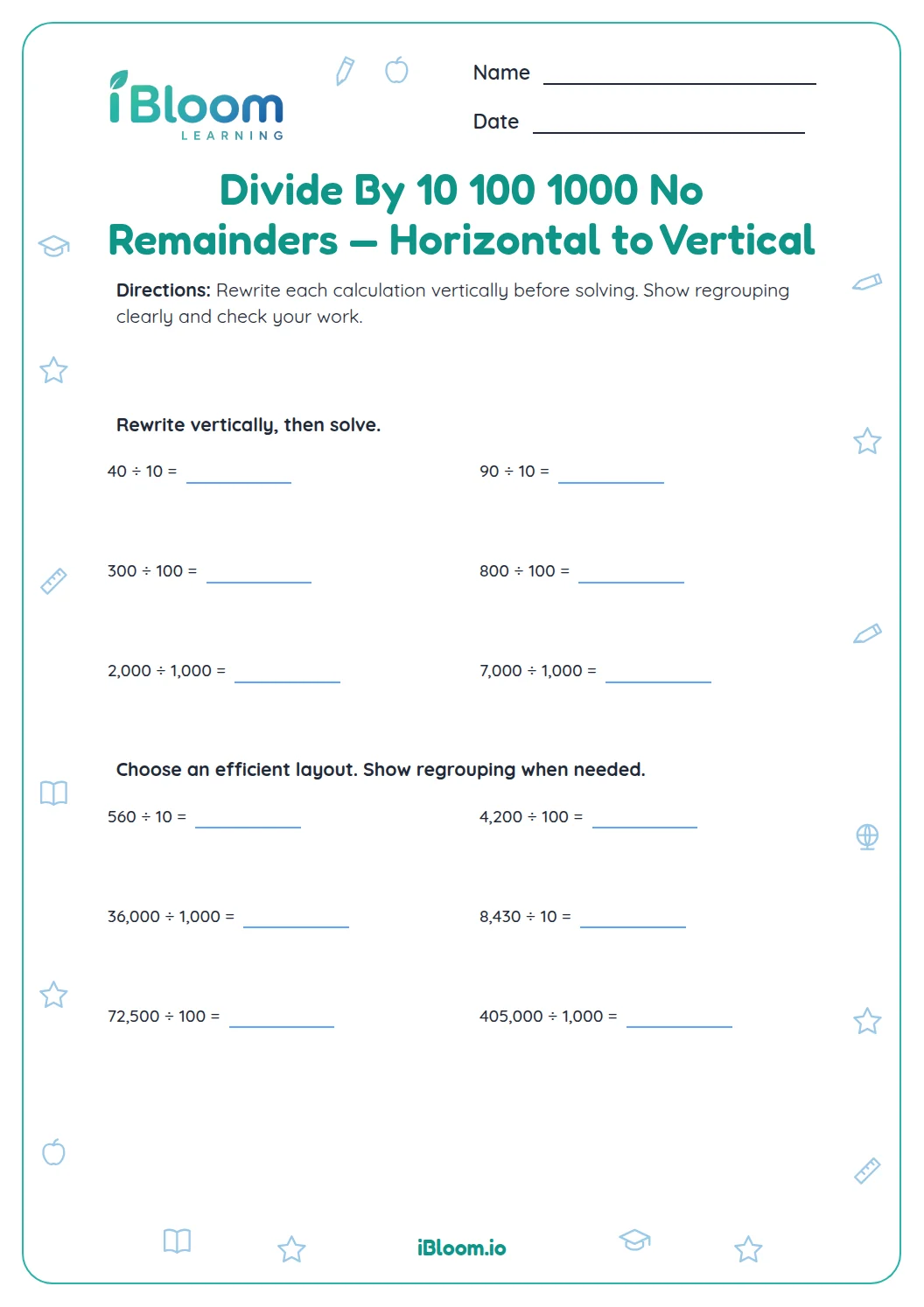
This Grade 4 printable follows the old sheet’s two tasks: students find the first error in six worked examples of three-digit division, then compare methods for eight exact quotients. The divisors are one digit, and every problem has no remainder. Students can verify a quotient by multiplying it by the divisor, as in CCSS 4.NBT.B.6.
Aligned to 4.NBT.B.6
What will students analyze?
Part A shows six partial division solutions. Students find the first incorrect step and give the exact quotient. Part B compares two ways to divide a three-digit dividend by a one-digit divisor.
All quotients are whole numbers. Multiplication can verify each result.
- Part A: locate and correct six division errors
- Part B: compare eight quotient methods
How can a quotient be checked?
Multiply the quotient by the divisor. The product should match the dividend.
- 1648 ÷ 3 = 216
- 2Check: 216 × 3 = 648
What makes a division step incorrect?
At each place, the quotient digit must be no larger than the number of groups that fit. Check each multiplication before subtracting and bringing down the next digit.
How to use the worksheet
- 1Read each shown division step in order.
- 2Check the multiplication and remainder at each step.
- 3Name the first incorrect step and calculate the quotient.
- 4Compare both methods in Part B with the stated quotient.
- 5Multiply the quotient by the divisor to verify.
Division slips and fixes
The mistake
Writing a quotient digit that makes the product too large.
The fix
Choose the greatest digit whose product does not exceed the current number.
The mistake
Dropping a remainder when bringing down the next digit.
The fix
Keep the remainder, then bring down the next dividend digit.
The mistake
Leaving out a zero in a quotient place.
The fix
Write a zero when no group fits in that place before bringing down the next digit.
Common Core alignment
The worksheet practices whole-number quotients with a one-digit divisor and verifies each result.
Find whole-number quotients with a one-digit divisor and verify the relationship.
On this sheet: Students divide three-digit dividends by one-digit divisors and use multiplication to check.
Show the official wordingHide the official wording
Find whole-number quotients and remainders with up to four-digit dividends and one-digit divisors, using strategies based on place value, the properties of operations, and/or the relationship between multiplication and division. Illustrate and explain the calculation by using equations, rectangular arrays, and/or area models.
What to practice next
Make more practice
Further reading
Questions parents and teachers ask
What does Part A ask students to do?
Part A has six division examples with a shown step that contains an error. Students identify the first incorrect step and state the correct quotient. Checking multiplication and remainders helps reveal a slip before it affects later steps. This gives students a clear way to check their work.
Are all the division problems exact?
Yes. Each dividend divides evenly by its one-digit divisor. Every answer is a whole-number quotient, so students do not need a remainder. The answer key lists an exact quotient for each problem on both parts of the worksheet. Each divisor is a single digit, as the title specifies.
How can students check a quotient?
Multiply the quotient by the divisor. The product should equal the dividend. For example, 216 × 3 = 648, so 216 is the exact quotient for 648 ÷ 3. This check works for each no-remainder problem and confirms the result.
What happens in Part B?
Part B gives two methods for each of eight three-digit division problems. Students check whether each method reaches the stated quotient. Some methods are accurate and others contain an error in a place-value chunk or partial quotient. Multiplication provides a quick check for each quotient.
Can students use a different division strategy?
The worksheet asks students to analyze the methods shown in Part B. To check a quotient, multiply it by the divisor and compare the product with the dividend. This check can also confirm a result found with another written strategy.