



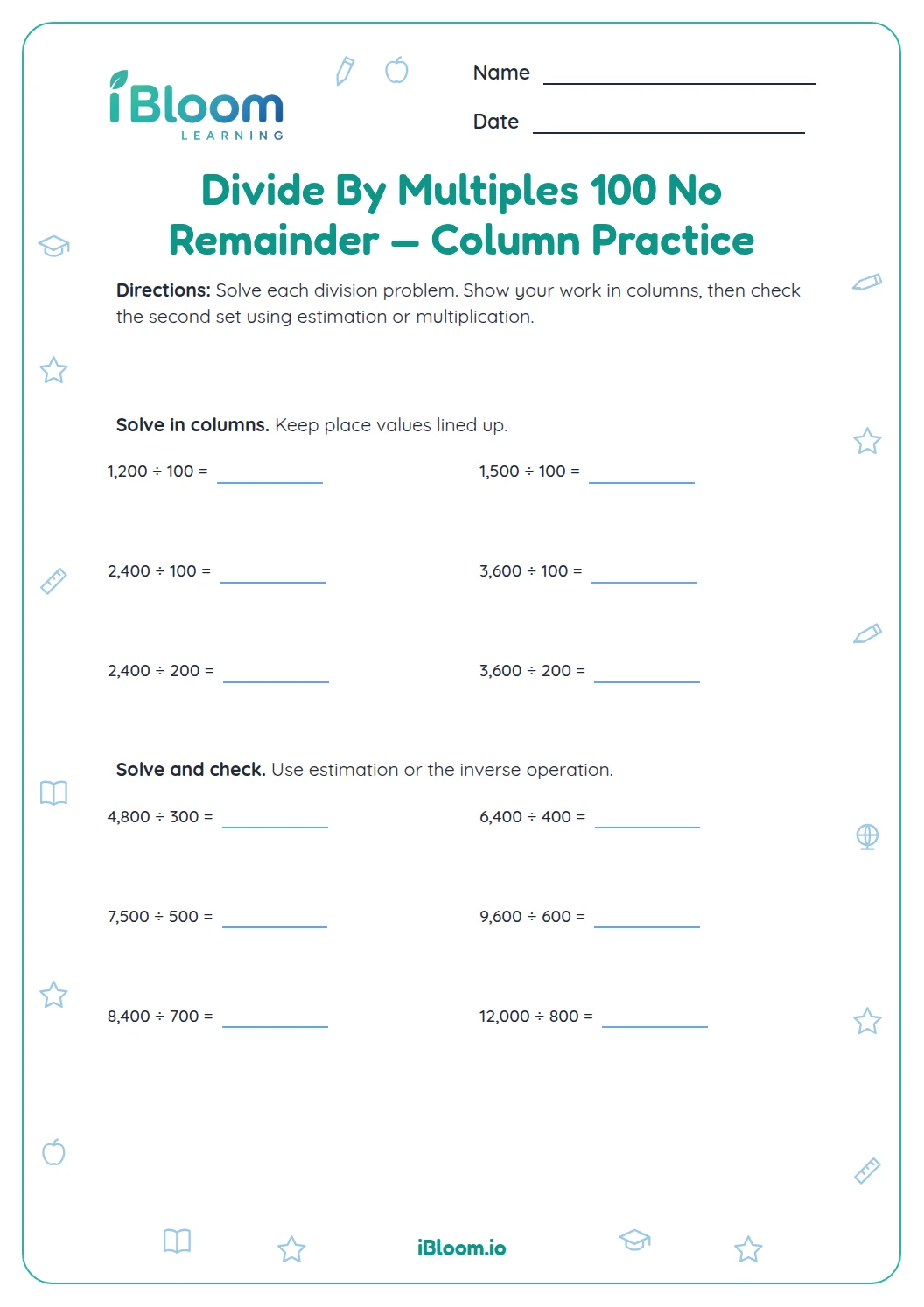


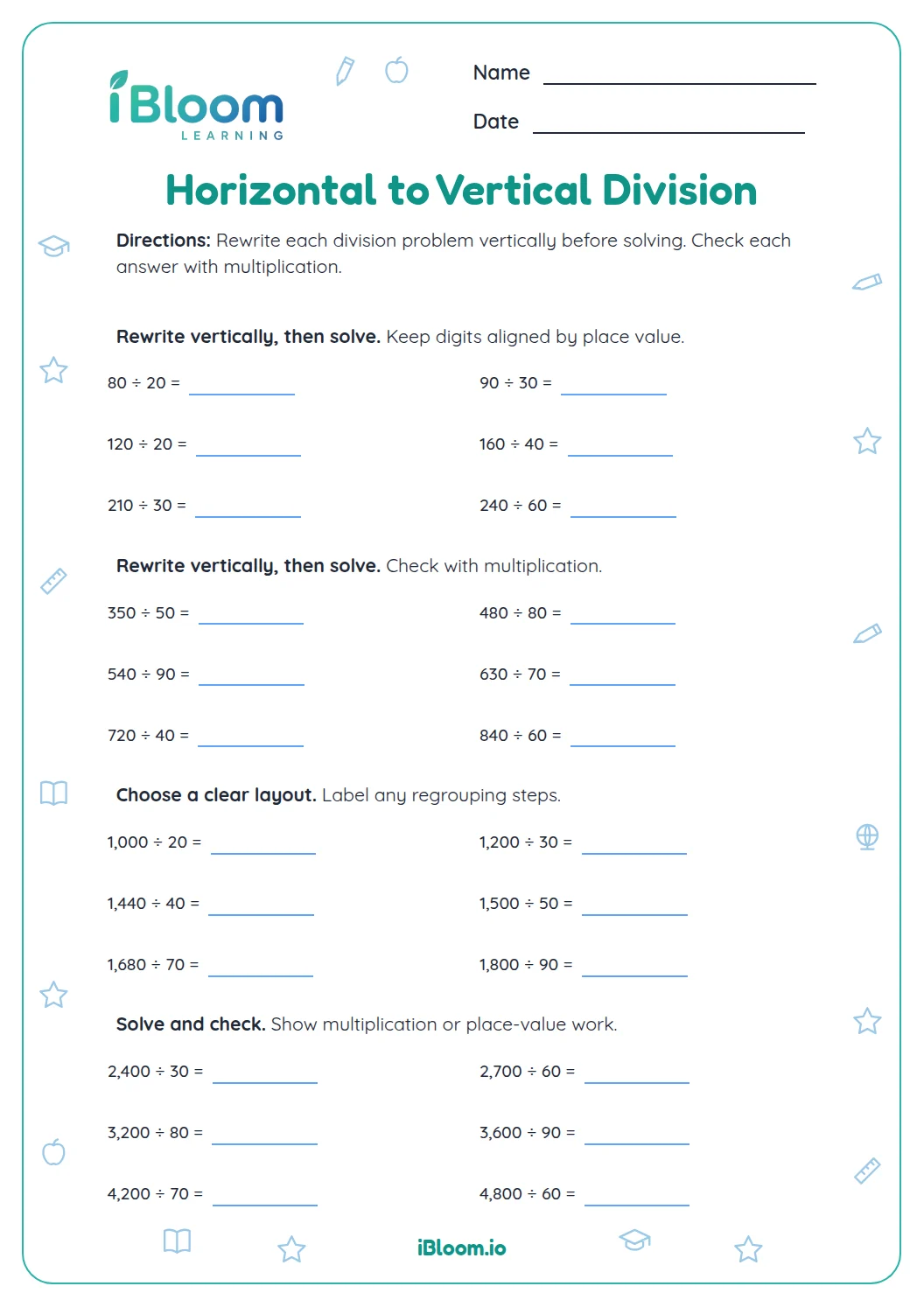

About this worksheet
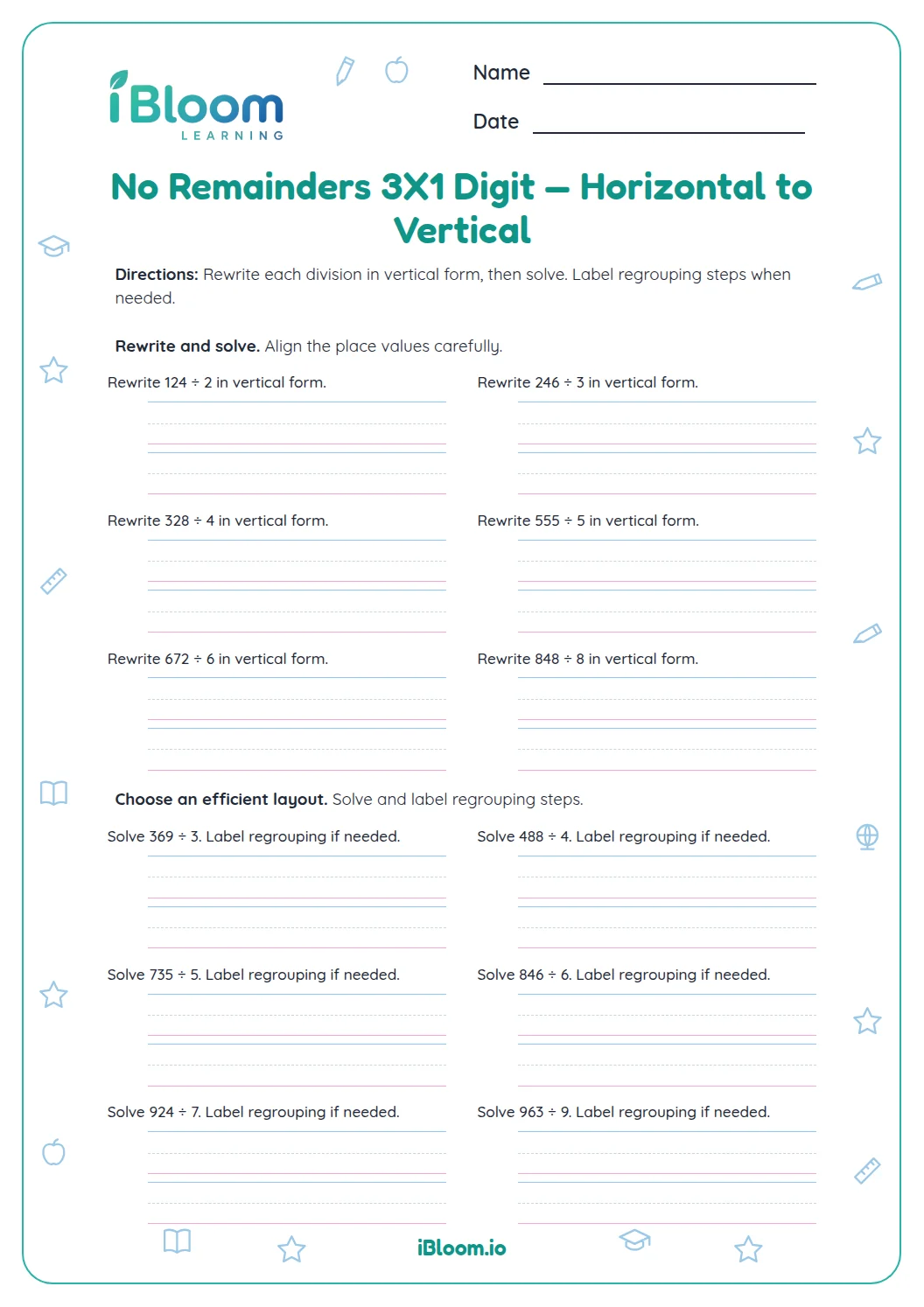
This free printable division drill gives students 16 problems dividing three-digit dividends by one-digit divisors, with no remainders. Students calculate quotients, solve equal-sharing situations, and use multiplication to check a result. A separate answer key is included. The work practices CCSS 4.NBT.B.6, which connects division to place value and multiplication.
Aligned to 4.NBT.B.6
How do you divide a three-digit number by one digit?
Break the dividend into place-value parts or use a written division method, keeping track of the quotient in each place. Check by multiplying the quotient by the divisor.
For question 1, 168 ÷ 4 = 42 because 4 × 42 = 168. The check returns the original dividend.
- 1168 ÷ 4
- 24 × 42 = 168
- 3Quotient: 42
How does division describe equal sharing?
A sharing story gives a total and a number of equal groups. Divide the total by the number of groups to find the amount in each one. In the pencil problem, 264 pencils split among 6 boxes gives 44 per box.
How can multiplication check a quotient?
Multiply the divisor by the quotient. If the product equals the dividend, the division is exact. The final part also asks students to spot quotient errors and complete a missing dividend.
How to use this worksheet
- 1Estimate the size of the quotient before calculating.
- 2Divide using place value, keeping hundreds, tens, and ones in view.
- 3For a story, identify the total and how many equal groups there are.
- 4Multiply divisor × quotient to check the result.
- 5Use the answer key to find a place-value step to review.
Common mistakes and quick fixes
The mistake
Writing the divisor as part of the quotient.
The fix
Keep the divisor outside the division and record the number of groups in the quotient.
The mistake
Dropping a place in the quotient.
The fix
Check each place by multiplying the quotient back by the divisor.
The mistake
Using addition to check division.
The fix
Use multiplication: divisor × quotient should equal the dividend.
Common Core alignment
Divide three-digit numbers by one-digit divisors without remainders.
On this sheet: Divide three-digit numbers by one-digit divisors without remainders
Show the official wordingHide the official wording
Find whole-number quotients and remainders with up to four-digit dividends and one-digit divisors, using strategies based on place value, the properties of operations, and/or the relationship between multiplication and division. Illustrate and explain the calculation by using equations, rectangular arrays, and/or area models.
What to practice next
Make more practice
Further reading
Questions parents and teachers ask
What division skills does this drill practice?
The 16 questions use three-digit dividends and one-digit divisors, with whole-number quotients. Students solve direct division facts, answer equal-sharing stories, and recognize multiplication facts that check division. This mix gives practice with computation and the inverse relationship. Use the separate key to review the reasoning and result.
Are there any remainders in the answers?
No. Each dividend is evenly divisible by its one-digit divisor. For example, 168 ÷ 4 is 42, and multiplying 42 by 4 returns 168. The answer key lists all quotients so students can check their calculations after finishing. Use the separate key to review the reasoning and result.
How can multiplication check a quotient?
Multiply the quotient by the divisor. If the product equals the original dividend, the division is checked. For instance, the check for 426 ÷ 6 is 71 × 6 = 426. The worksheet includes a question that asks students to identify this relationship.
What is included in the printable?
The printable has two worksheet pages and two answer-key pages. Its 16 questions include six direct quotient problems, five equal-sharing situations, and five questions about checking or reasoning with quotients. The separate key provides a quick result check. Use the separate key to review the reasoning and result.
What should a student do when a quotient seems too large?
Estimate the quotient by thinking about a nearby multiple of the divisor, then check with multiplication. A quotient multiplied by the divisor should return the dividend. This estimate can help catch a misplaced digit before checking the exact product. Use the separate key to review the reasoning and result.