
About this worksheet
This printable fact-family worksheet is for students reviewing addition, subtraction, multiplication and division. Part A asks whether each equation is correct; Part B supplies the related numbers and asks learners to write the missing operation sign. Products and quotients stay within 100, and the addition and subtraction practice uses friendly whole-number facts. The multiplication and division relationships align with CCSS 3.OA.C.7. The answer key shows each yes/no decision and operation.
Aligned to 3.OA.C.7 and 2.OA.B.2
How do students spot a wrong operation?
First solve or recall the equation, then compare the result with the number after the equals sign. A true fact earns Yes; a mismatch earns No. Look carefully at the sign as well as the numbers.
The eight checks include all four operations. Some equations are true and some use a believable slip, such as reversing a subtraction result or choosing a nearby quotient.
- Questions 1–2: addition and subtraction
- Questions 3–4: multiplication and division
- Questions 5–8: a second mixed-operation check
How do multiplication and division connect?
Multiplication and division are inverse operations. If 6 × 7 = 42, then 42 ÷ 7 = 6 and 42 ÷ 6 = 7. The same three numbers help check whether a missing operation makes sense.
Addition and subtraction have a similar relationship: 12 + 5 = 17, so 17 − 5 = 12. In Part B, students use the number pair to choose the sign that completes each equation.
- 17 ___ 6 = 42
- 2Ask which operation makes 7 and 6 equal 42.
- 37 × 6 = 42, so the missing sign is ×.
What should students check before writing a sign?
Read the whole equation from left to right. Addition combines amounts, subtraction finds a difference, multiplication counts equal groups and division splits into equal groups.
After writing the sign, solve the equation once to confirm it. A fact is correct only when the operation and result agree.
What is a good next step after this review?
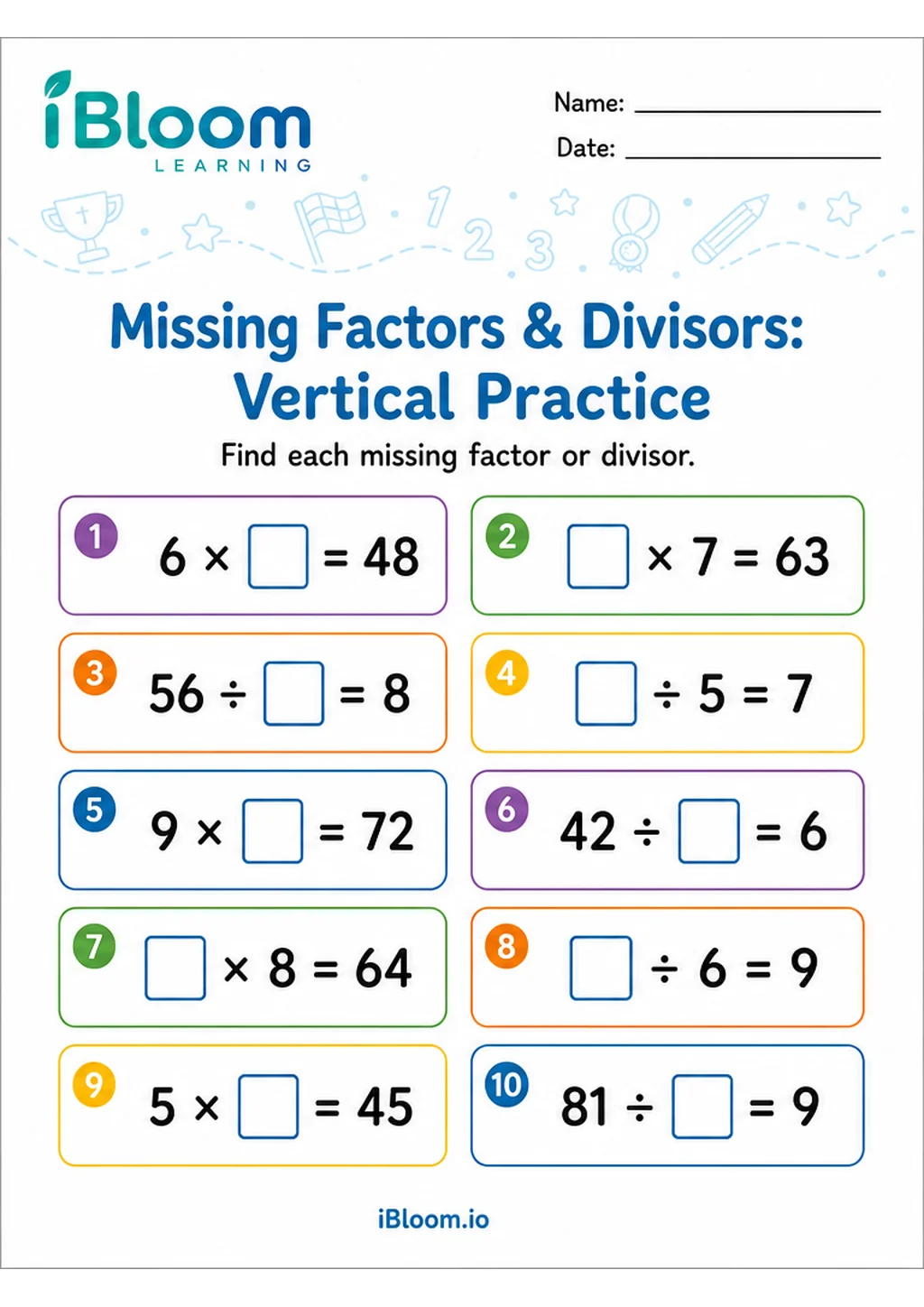
Ask the student to say the related equations aloud for one multiplication and division family. Then use a missing-number practice page to find an unknown factor or divisor.
For more repetition, the fact-families generator can create new number combinations while keeping the same operation relationships.
How to use the worksheet
- 1Read the operation sign before solving each equation.
- 2Decide whether the displayed result matches the calculation.
- 3In Part A, circle Yes or No for all eight statements.
- 4In Part B, replace the incorrect operation and rewrite each fact.
- 5Use the answer key to explain how the three numbers are related.
Operation slips to check
The mistake
Treating 16 − 9 as 9 − 16 and choosing a result from the reversed equation.
The fix
Keep the numbers in the printed order, then subtract: 16 − 9 = 7.
The mistake
Using addition when the equation asks how many equal groups fit.
The fix
For a total split into groups, test division and multiply back to verify.
The mistake
Writing a multiplication sign when a quotient is needed.
The fix
Check whether the result should be smaller than the starting total; division may fit.
Common Core alignment
The multiplication and division questions practice related facts within 100. Addition and subtraction checks reinforce fluency with facts within 20.
Use multiplication and division relationships to check facts within 100.
On this sheet: Parts A and B check multiplication and division facts and their inverse relationship.
Show the official wordingHide the official wording
Fluently multiply and divide within 100, using strategies such as the relationship between multiplication and division (e.g., knowing that 8 × 5 = 40, one knows 40 ÷ 5 = 8) or properties of operations. By the end of Grade 3, know from memory all products of two one-digit numbers.
Check addition and subtraction facts within 20.
On this sheet: The addition and subtraction items use facts within 20.
Show the official wordingHide the official wording
Fluently add and subtract within 20 using mental strategies. By end of Grade 2, know from memory all sums of two one-digit numbers.
What to practice next
Make more practice
Further reading
Questions parents and teachers ask
How does a fact family work?
A fact family uses the same three numbers in related equations. For 6, 7 and 42, multiplication facts connect the factors to the product, while division facts start with 42 and split it into equal groups. Addition and subtraction use the same inverse relationship.
How many items are on the worksheet?
There are 14 items in two parts. The first eight ask whether a mixed-operation equation is correct. The next six ask the student to replace a wrong operation and write the corrected fact. The corrected facts leave room to show a quick check in Part B.
Which operations are included?
Addition, subtraction, multiplication and division all appear. The multiplication and division facts stay within 100, and the addition and subtraction examples use sums and differences within 20. Each item has one answer shown on the key. The equations use familiar whole-number facts.
What is one example of a common error?
In question 2, 16 − 9 is paired with 8, but the difference is 7. A student may have subtracted incorrectly or estimated. Recomputing in the printed order makes it clear that the equation should be marked No. The key confirms the result.
What worksheet could come next?
A focused multiplication-and-division fact-family page is a natural next step. Students can also try missing-factor and divisor questions, where one number is hidden and the relationship between multiplication and division helps reveal it. Those items keep the family connection in view.