
About this worksheet
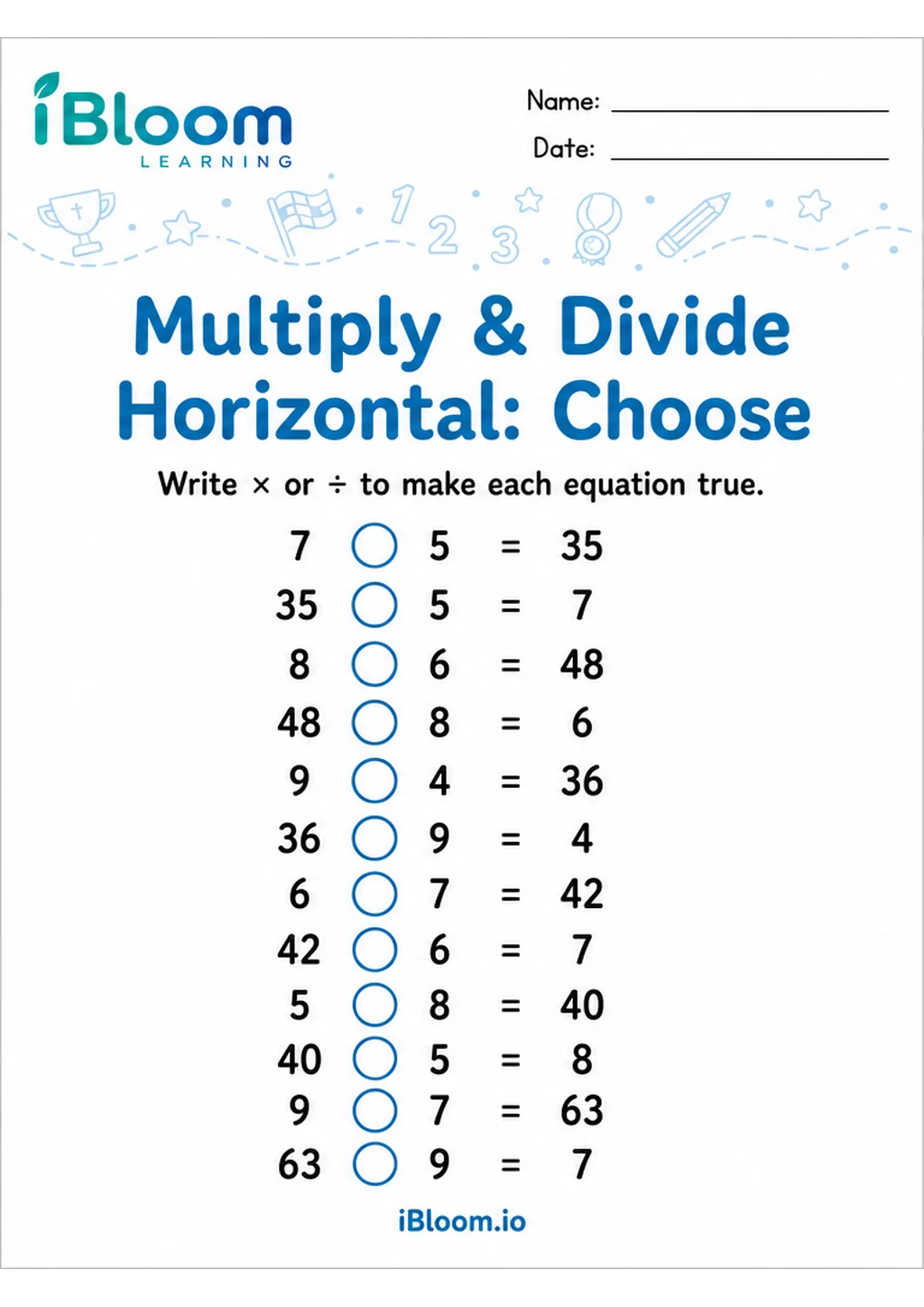
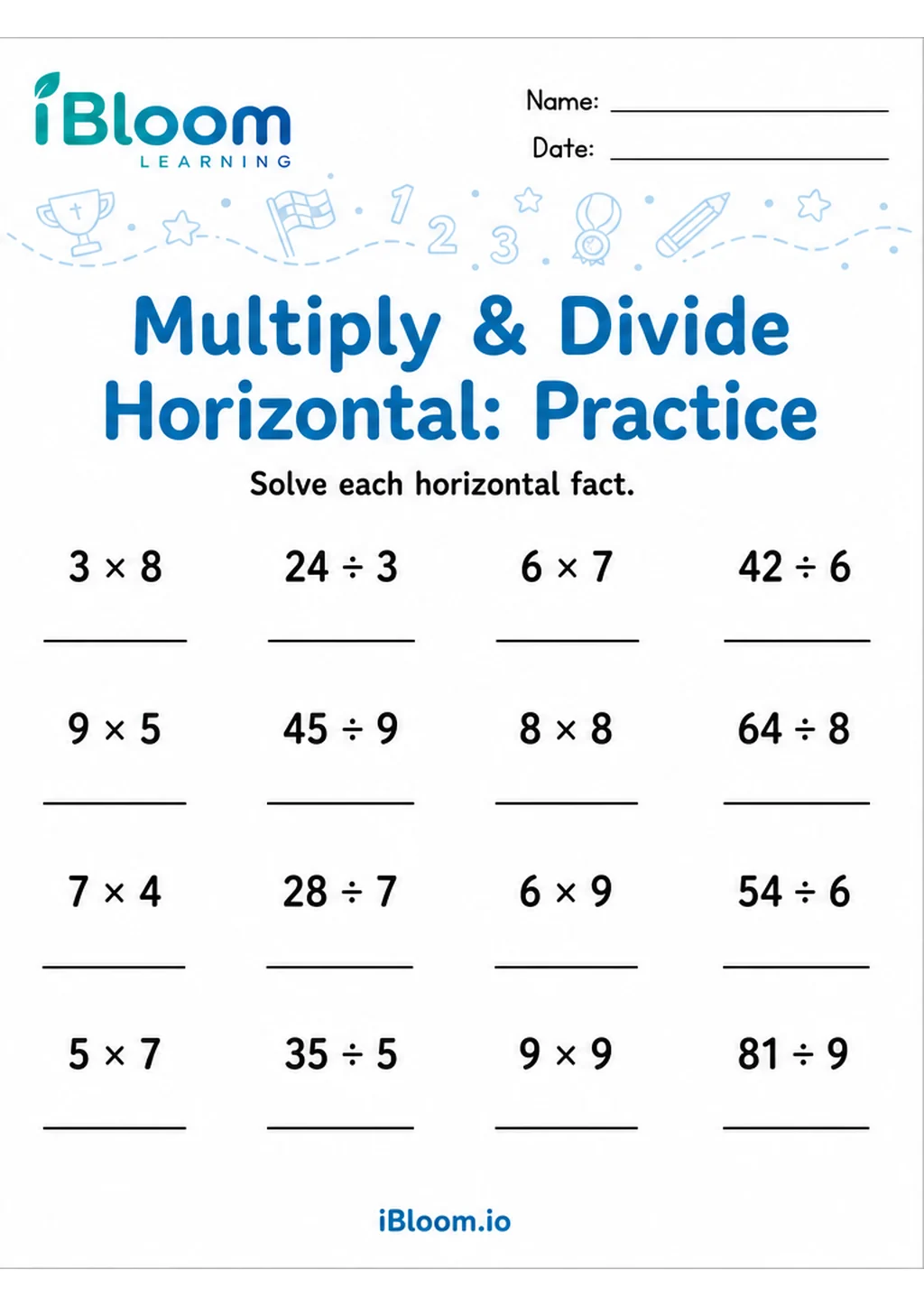
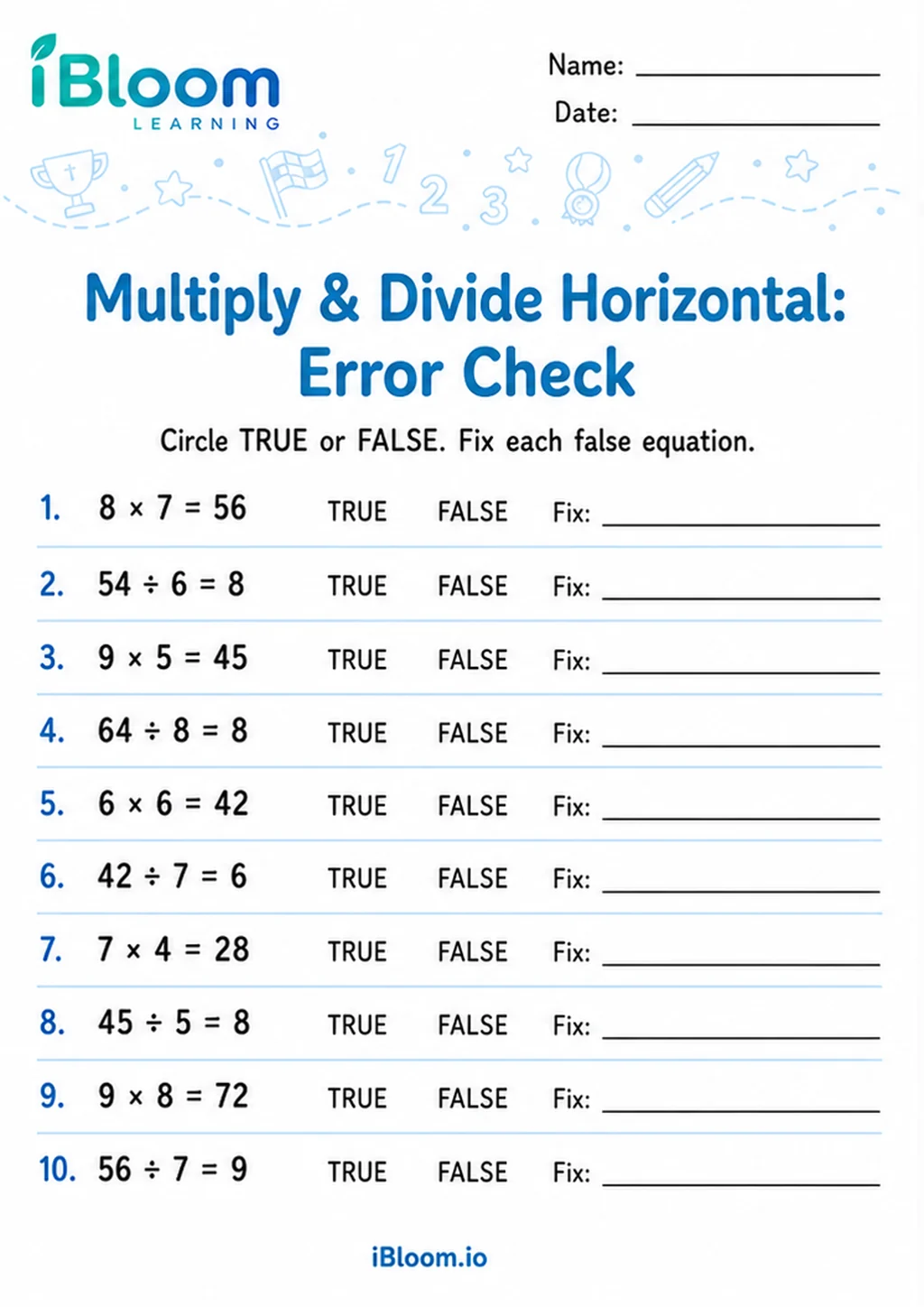
This Grade 3 worksheet mixes one-digit multiplication and related division facts within 100. Students solve 18 horizontal equations in three sets, using scratch paper to rewrite any fact vertically. A separate answer key supports checking.
Aligned to CCSS.Math.Content.3.OA.C.7
How does vertical rewriting help?
The first six questions ask for products, the next six ask for quotients, and the last six mix both operations. All use one-digit facts within 100. Students can rewrite any equation vertically on scratch paper.
- 17 × 8
- 2Answer: 56
- Recall one-digit multiplication facts.
- Use multiplication facts to solve division equations.
- Switch between multiplication and division in the final set.
How can multiplication help with division?
Use the related multiplication fact to check a quotient. For 56 ÷ 7, ask which number multiplied by 7 makes 56; 8 × 7 = 56, so the quotient is 8.
What changes in the mixed section?
The final six questions alternate multiplication and division. Read the operation sign before solving so a familiar fact does not lead to the wrong operation.
How to work each fact
- 1Read the operation sign.
- 2Recall or build the related multiplication fact.
- 3Write the product or quotient in the blank.
- 4Check a division answer by multiplying.
Common fact-practice mistakes
The mistake
Using multiplication when the problem shows division.
The fix
Read the sign before rewriting and solving.
The mistake
Switching the dividend and divisor in a division fact.
The fix
Keep the number before ÷ as the dividend.
The mistake
Writing a related fact’s product as the quotient.
The fix
Check division by multiplying the quotient by the divisor.
Common Core alignment
Build fluency with one-digit multiplication and division facts.
On this sheet: Every fact is a product or related quotient from one-digit multiplication facts.
Show the official wordingHide the official wording
Fluently multiply and divide within 100, using strategies such as the relationship between multiplication and division (e.g., knowing that 8 × 5 = 40, one knows 40 ÷ 5 = 8) or properties of operations. By the end of Grade 3, know from memory all products of two one-digit numbers.
What to practice next
Make more practice
Further reading
Questions parents and teachers ask
Why rewrite a fact vertically?
There are 18 questions: six multiplication facts, six division facts, and six mixed facts. Each has a short answer blank so students can keep a steady practice pace. The first two questions also leave room to set up a vertical calculation, and scratch paper can be used for any other item.
How many multiplication and division questions are there?
The worksheet prints compact horizontal equations. Students can set up the first four questions in a vertical arrangement using the provided work space. For later facts, they may rewrite an equation on scratch paper, then record the product or quotient in the blank.
Can multiplication help check division?
Each question uses a one-digit multiplication fact or a related division fact within 100, the focus of Grade 3 fact fluency. The practice starts with multiplication, moves to division, then mixes both operations so students must read each sign and choose the matching strategy.
Is an answer key included?
Allow about 15 minutes for 18 facts, including time to check division answers with multiplication. Students can pause after the first two sections, then complete the mixed set as a short review. The answer key makes it easy to check facts once all responses are finished.
How long does the worksheet take?
Plan for about 20 minutes to rewrite and solve 18 facts, then check the answer key. Students can complete multiplication and division separately before trying the mixed section, which asks them to attend to each operation sign while solving.