






About this worksheet
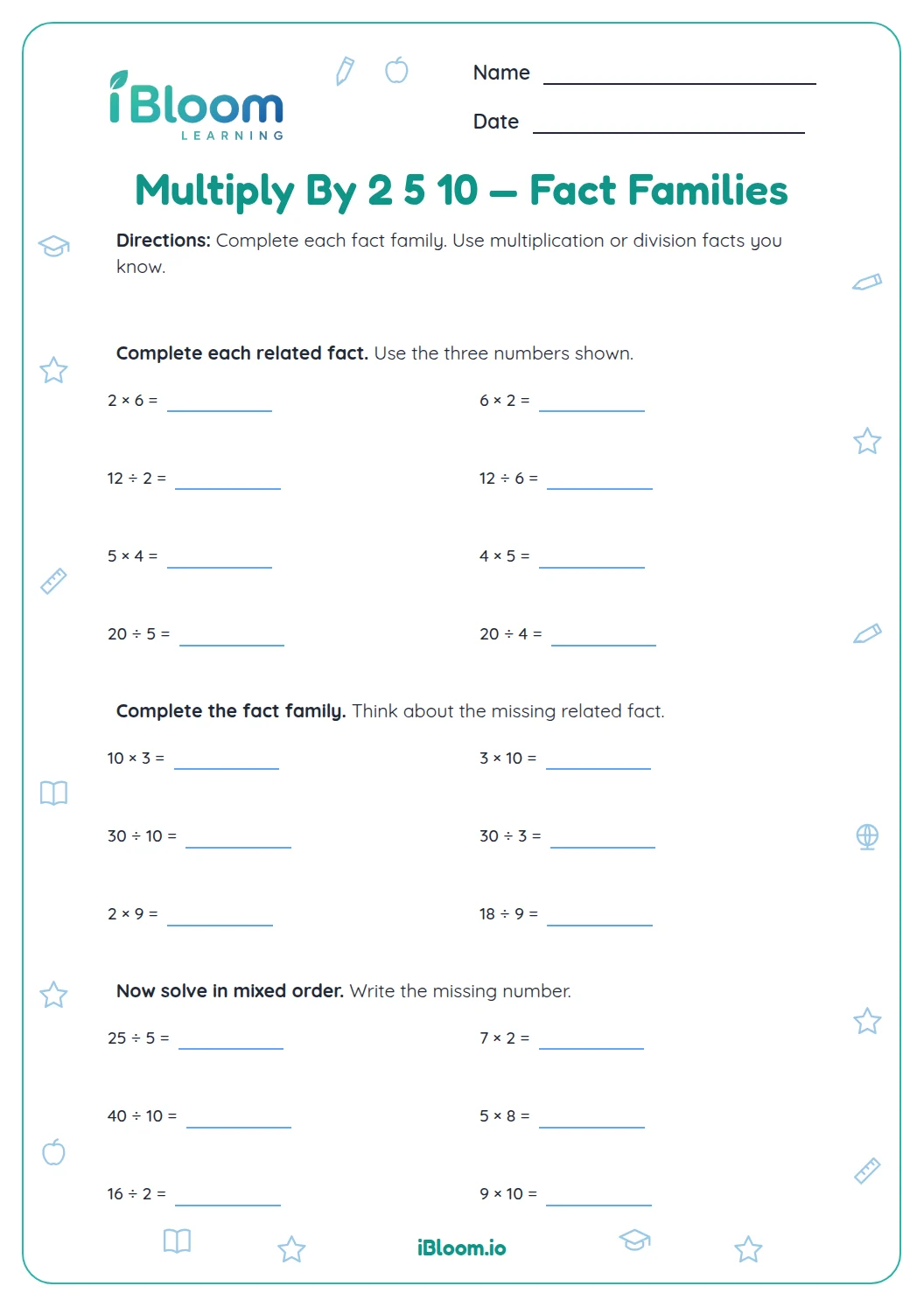
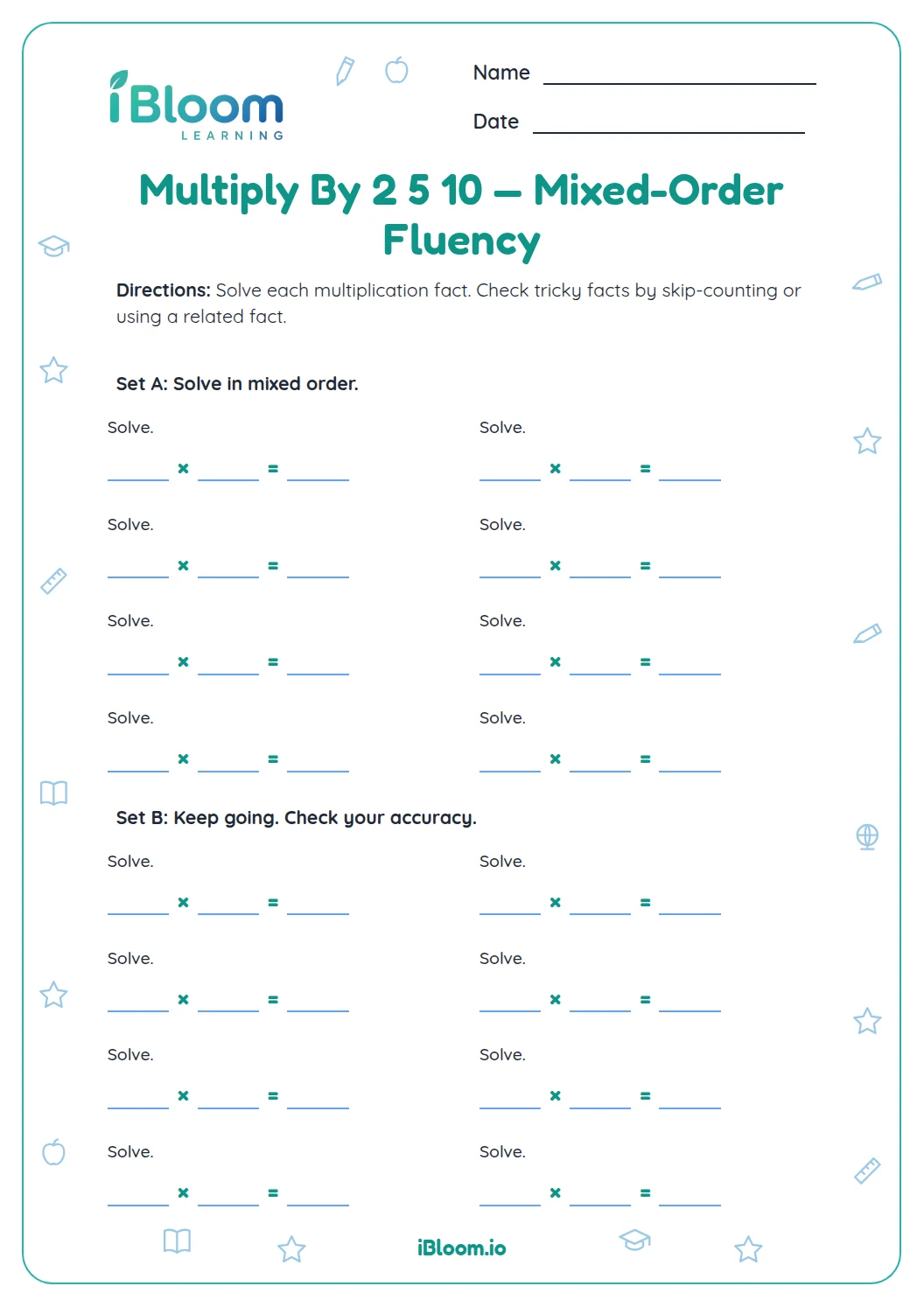
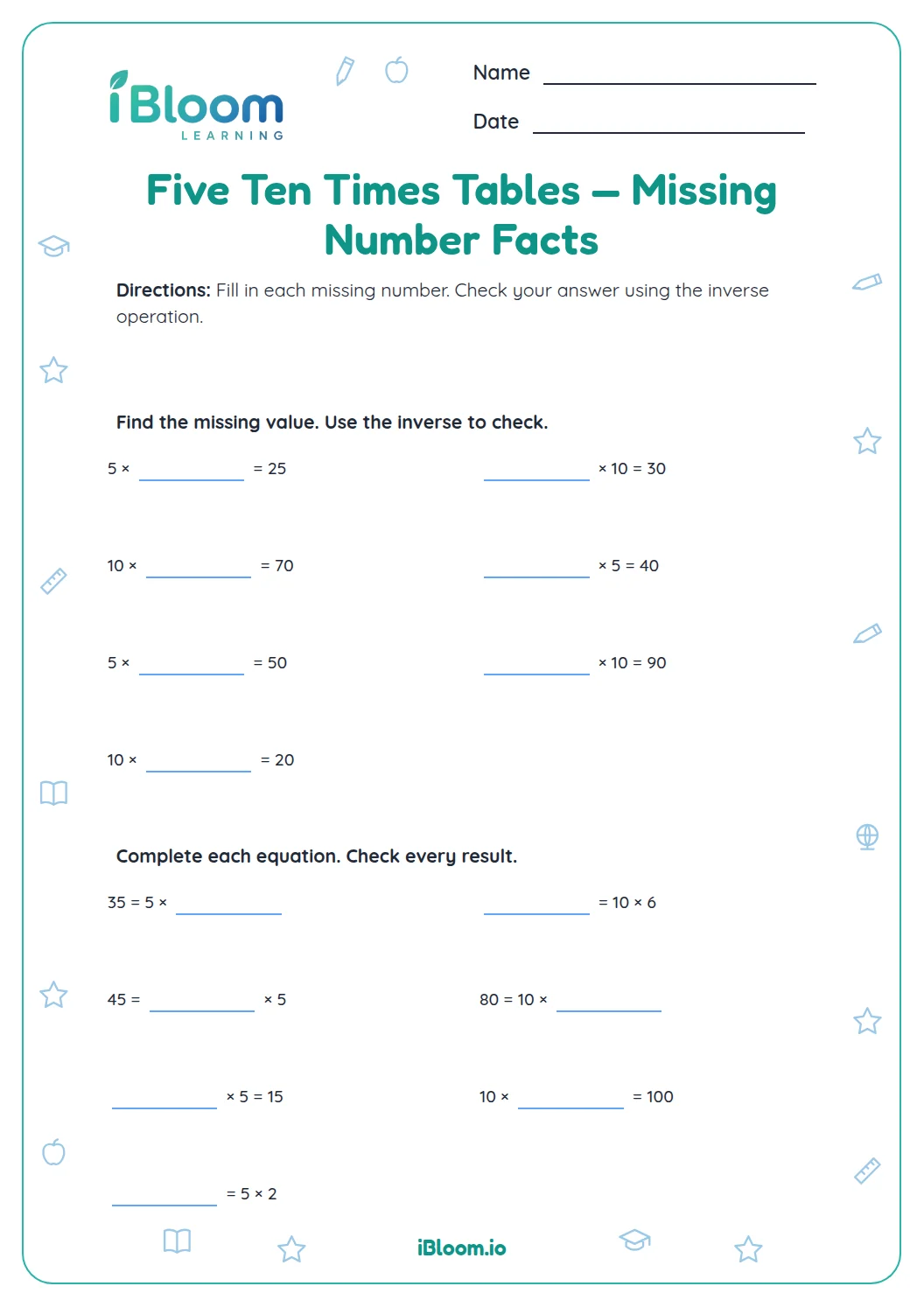
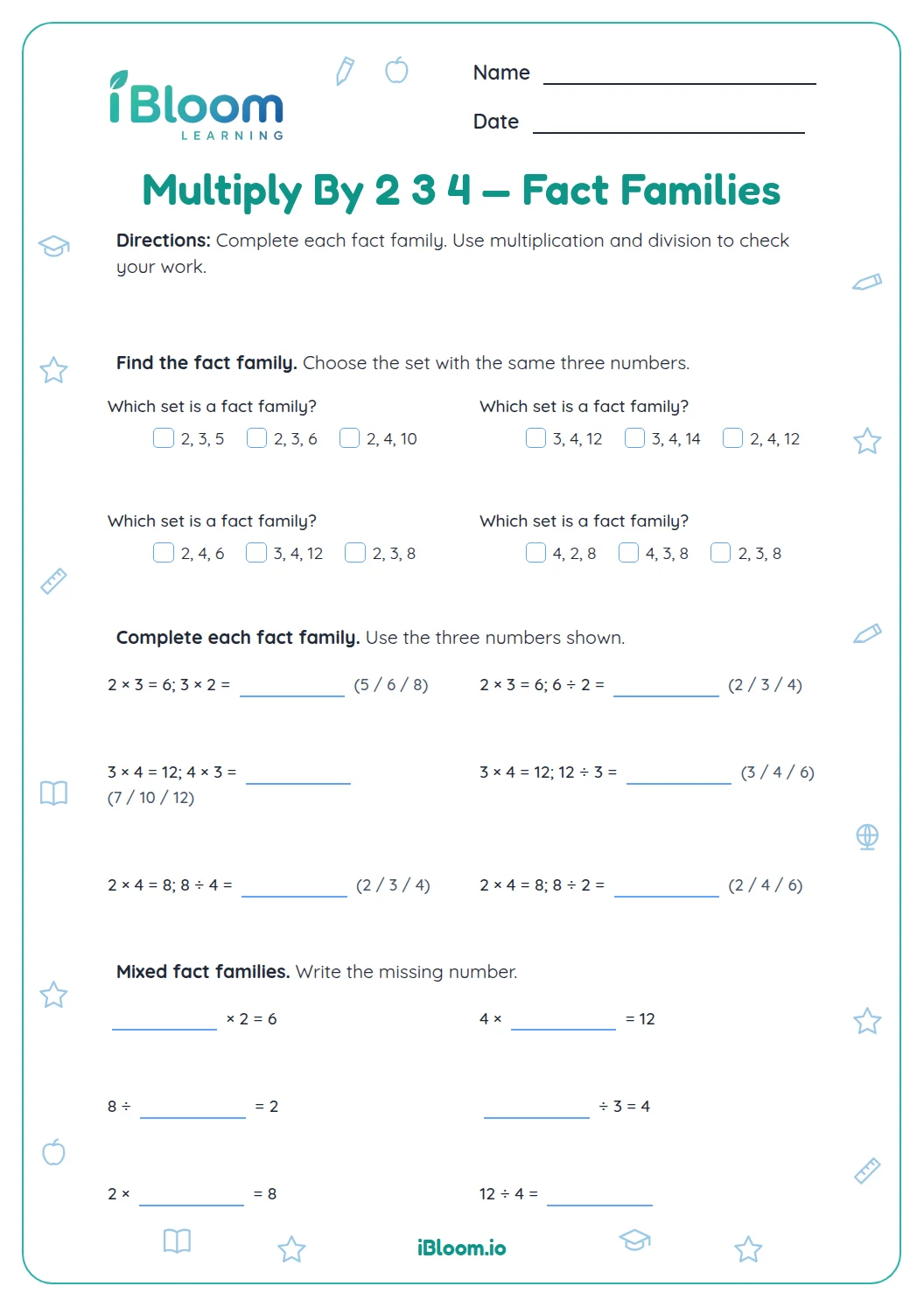
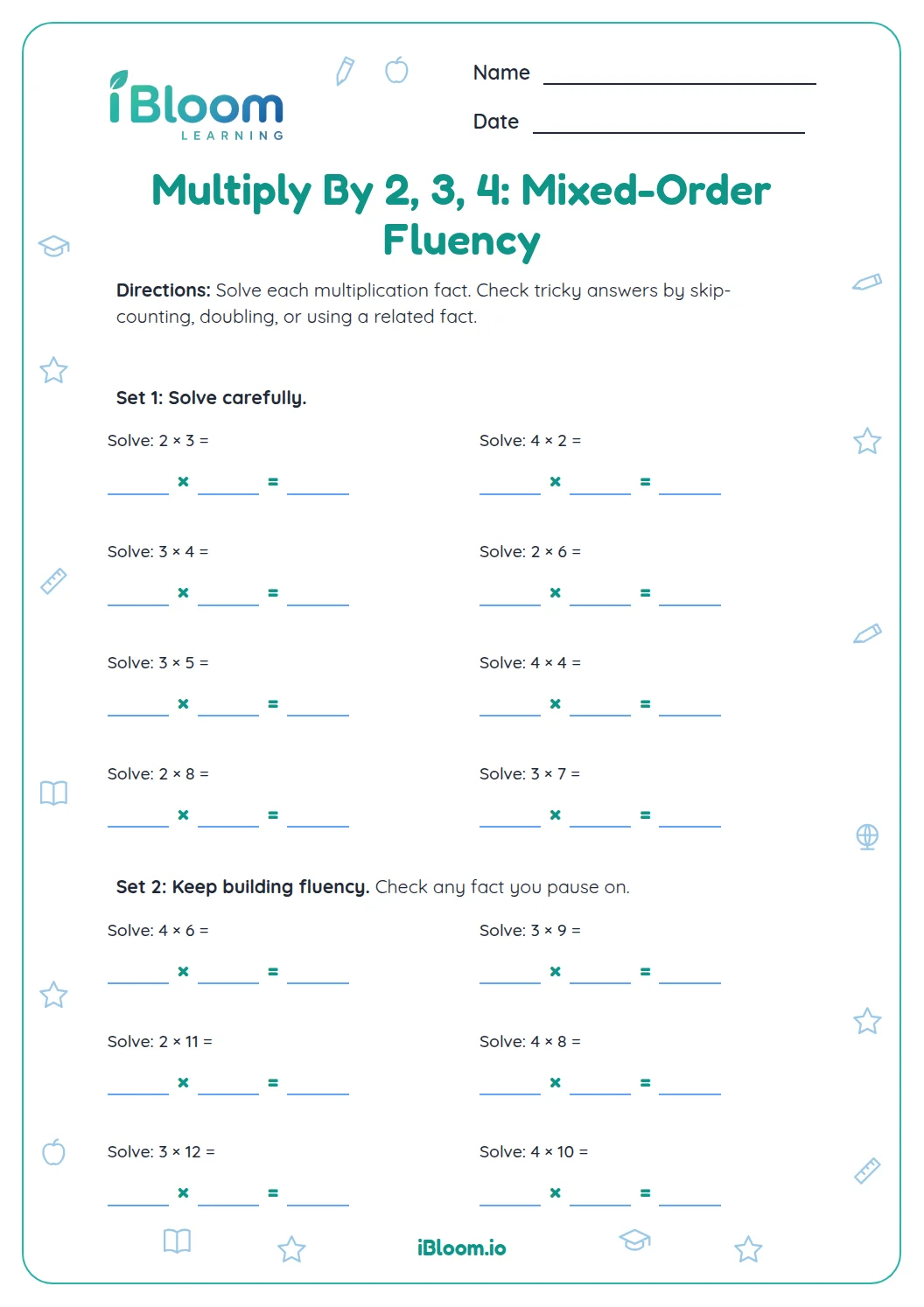
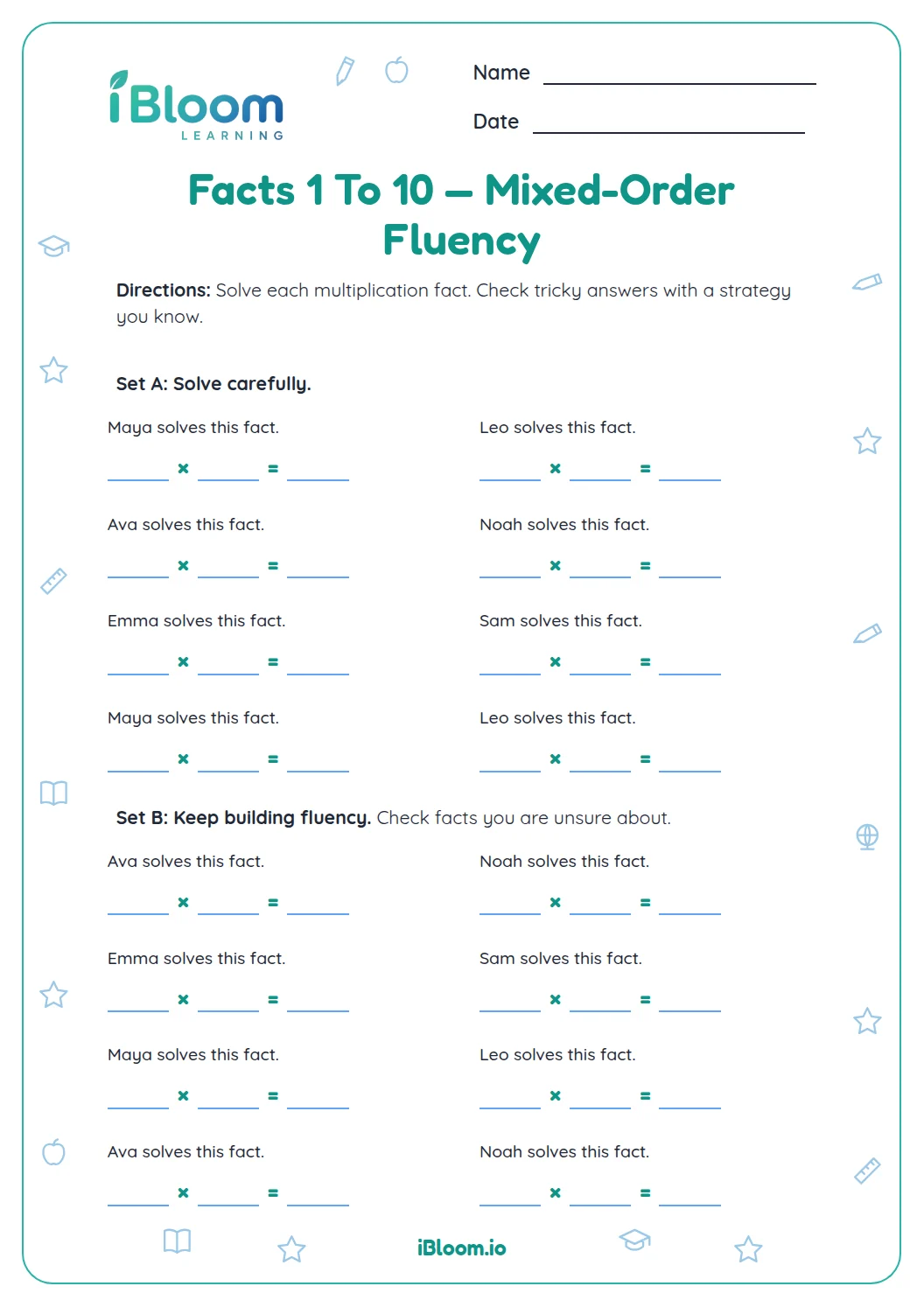
This free multiplication worksheet gives Grades 3–4 students thirty-four facts involving 2, 5 and 10. Part A offers twelve facts grouped by multiplier, and Part B mixes twenty-two more, including reversed factor order. Children can complete both rounds without a timer. If timing is useful, record the time for Part B after students understand the directions. The practice supports Common Core 3.OA.C.7 through multiplication fluency within 100. A separate key supplies every product, so accuracy can be checked before discussing speed.
Aligned to 3.OA.C.7
What is different about the two rounds?
Part A groups four facts with 2, four with 5 and four with 10. This lets students keep one strategy in mind at a time. Part B mixes the three families and sometimes puts 2, 5 or 10 second.
Part A has twelve facts and Part B has twenty-two, all with products from 0 through 100. They contain different items, so use the correct-answer count to guide review instead of treating the two times as directly comparable scores.
Which strategies help with 2, 5 and 10?
For a fact with 2, double the other factor. For a fact with 10, think in tens. For a fact with 5, count by fives or use half of the corresponding tens fact. Keep the meaning of multiplication in view when a product is not yet recalled.
- 15 × 8 = ___
- 210 × 8 = 80
- 3Five groups of 8 are half of ten groups of 8.
- 4Half of 80 is 40, so 5 × 8 = 40.
How can optional timing be used fairly?
Start with an untimed Part A and review mistakes. For Part B, a child may choose to work without timing or use a stopwatch that records elapsed time. Record the result in the page margin after finishing.
For a personal comparison later, reuse the same round under similar conditions and record both time and correct answers. A quicker round with more errors signals a need to slow down and review those facts.
How to use this worksheet
- 1Review one doubling fact, one fives fact and one tens fact aloud.
- 2Complete the twelve Part A facts without timing.
- 3Use the key to check Part A and work through any missed products.
- 4Choose whether to time Part B; start only after the directions are understood.
- 5Record the number correct out of twelve for Part A and twenty-two for Part B, plus any Part B time, in the margin.
Common mistakes and helpful fixes
The mistake
Adding the factors, such as answering 2 × 6 with 8.
The fix
Read it as two groups of six and double six to get twelve.
The mistake
Keeping the other factor when multiplying by zero.
The fix
Zero groups contain no objects, and groups of zero also contain no objects.
The mistake
Changing the answer when factor order reverses.
The fix
Compare 8 × 2 with 2 × 8. Both products are sixteen.
Common Core alignment
Build fluent recall of multiplication products with 2, 5 and 10 within 100.
On this sheet: Both rounds practice accurate multiplication facts and allow checking with known related products.
Show the official wordingHide the official wording
Fluently multiply and divide within 100, using strategies such as the relationship between multiplication and division (e.g., knowing that 8 × 5 = 40, one knows 40 ÷ 5 = 8) or properties of operations. By the end of Grade 3, know from memory all products of two one-digit numbers.
What to practice next
Make more practice
Further reading
Questions parents and teachers ask
How many multiplication facts are on this drill?
There are thirty-four facts, split into twelve grouped facts and twenty-two mixed facts. Part A has four facts in each family: twos, fives and tens. Part B mixes the families and reverses factor order in some items. Every answer is a product within 100, including zero and one facts.
What time limit should I set?
No fixed time limit is required for this sheet. After an accurate untimed round, you can use a stopwatch to record how long Part B takes, or leave timing out entirely. Write the time and number correct in the margin so the result includes accuracy as well as pace.
How can a child work out a forgotten fives fact?
Use a known tens fact and take half, or count by fives. For question 7, ten times eight is eighty, so five times eight is forty. Let your child use that reasoning during practice, then revisit the fact later to see whether the product comes to mind more readily.
Should we compare the times for the two rounds?
Treat the rounds as different sets of practice, since they contain different facts and arrangements. Part A groups the families, while Part B mixes them. For a clearer personal comparison, repeat the same round another day under similar conditions and record both elapsed time and correct answers.
What should we do with incorrect answers?
Choose one missed fact at a time and rebuild it with doubling, fives or tens. Then have your child say the complete multiplication sentence and try it again later. The separate answer key gives all thirty-four products, making it easy to identify the facts that need another look.