



About this worksheet
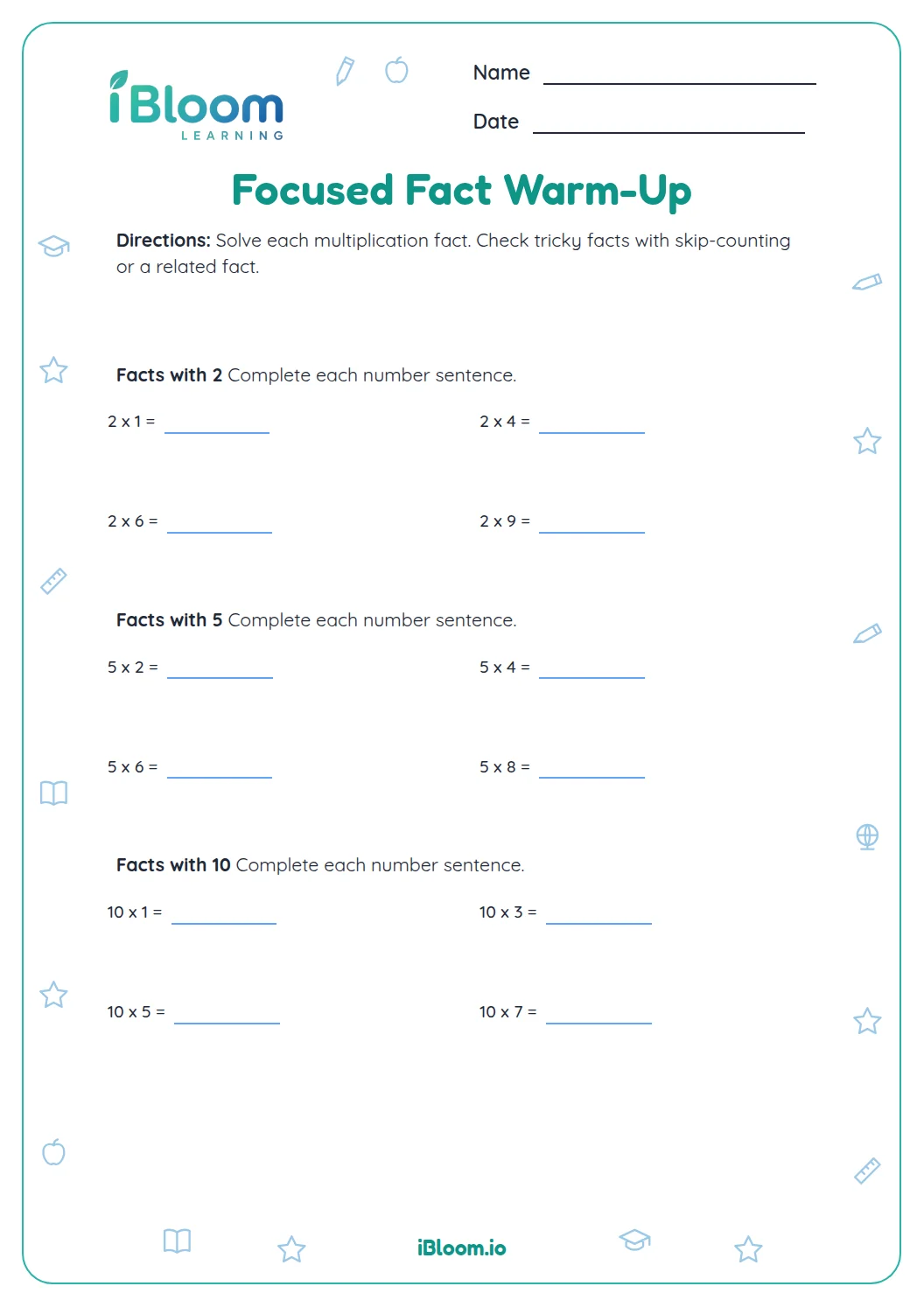
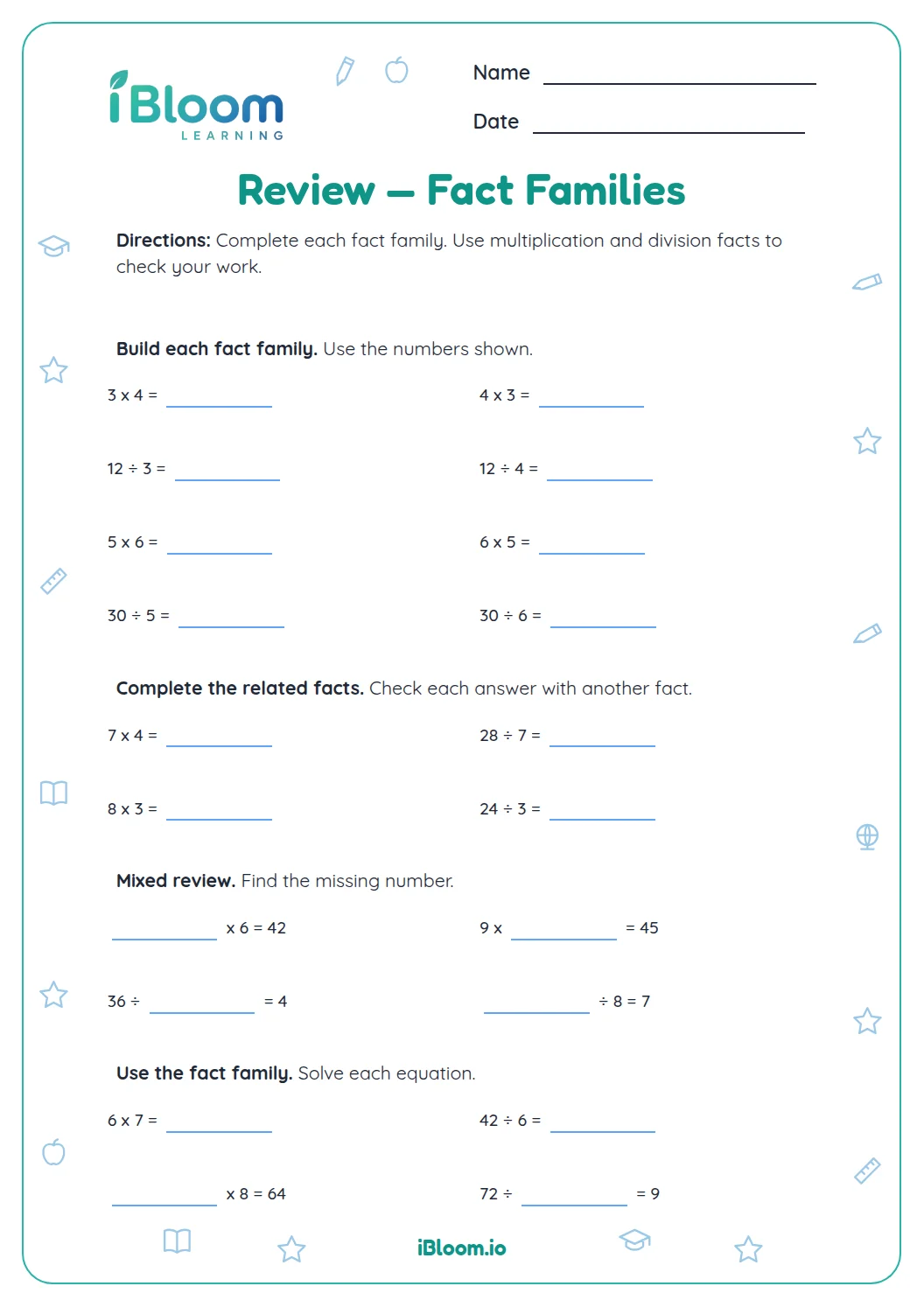
This Grade 3 multiplication review starts with a fact, then uses equal-group situations such as bags of marbles and rows of tiles. Children check incorrect products by choosing a valid strategy and finish with missing factors. The two-page worksheet includes 14 questions and a separate two-page answer key. Its fact fluency work aligns with CCSS.Math.Content.3.OA.C.7.
Aligned to CCSS.Math.Content.3.OA.C.7
How do equal groups show a product?
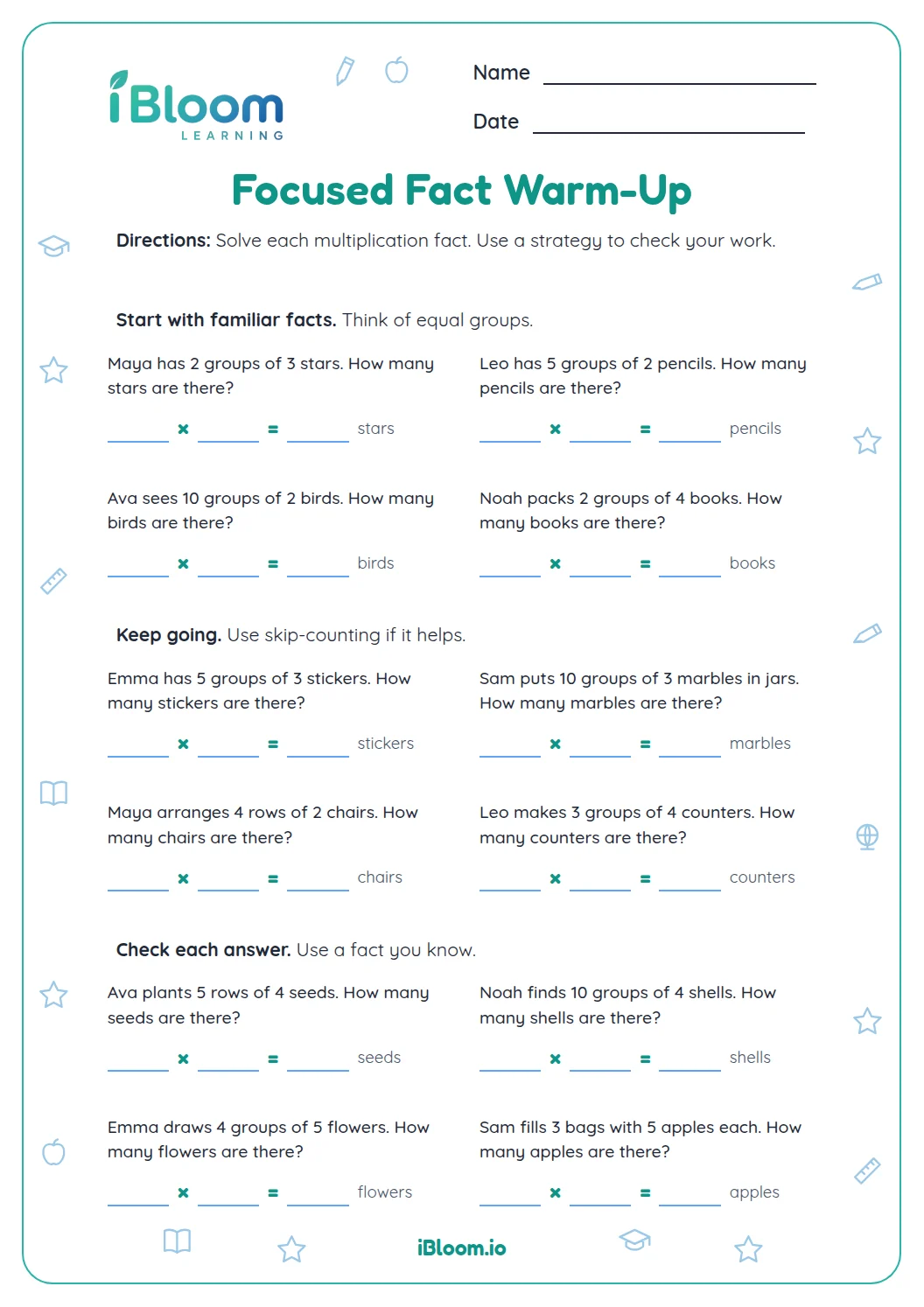
A multiplication fact counts equal groups. In the bags question, 6 bags with 7 marbles each means 6 groups of 7, or 42 marbles. The unit belongs in the answer because the story asks how many marbles.
- 16 bags × 7 marbles in each bag
- 26 × 7 = 42
- 3Answer: 42 marbles
How can a known fact help?
Break a factor into easier parts or use a nearby fact. For 9 × 6, use 9 × 5 = 45 and add one more group of 9 to get 54. The error-check questions ask children to choose both a corrected product and a reason.
What kinds of questions are included?
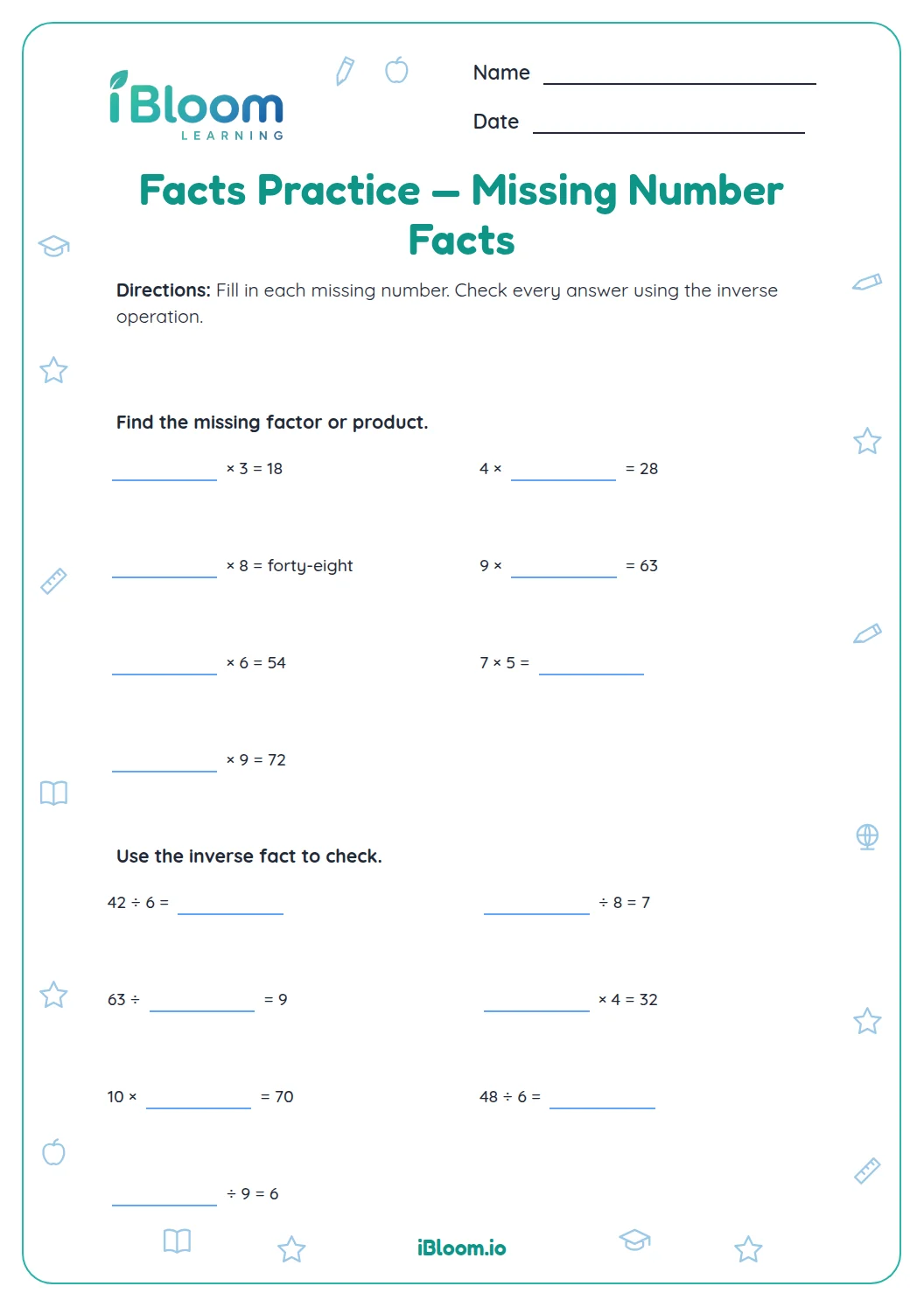
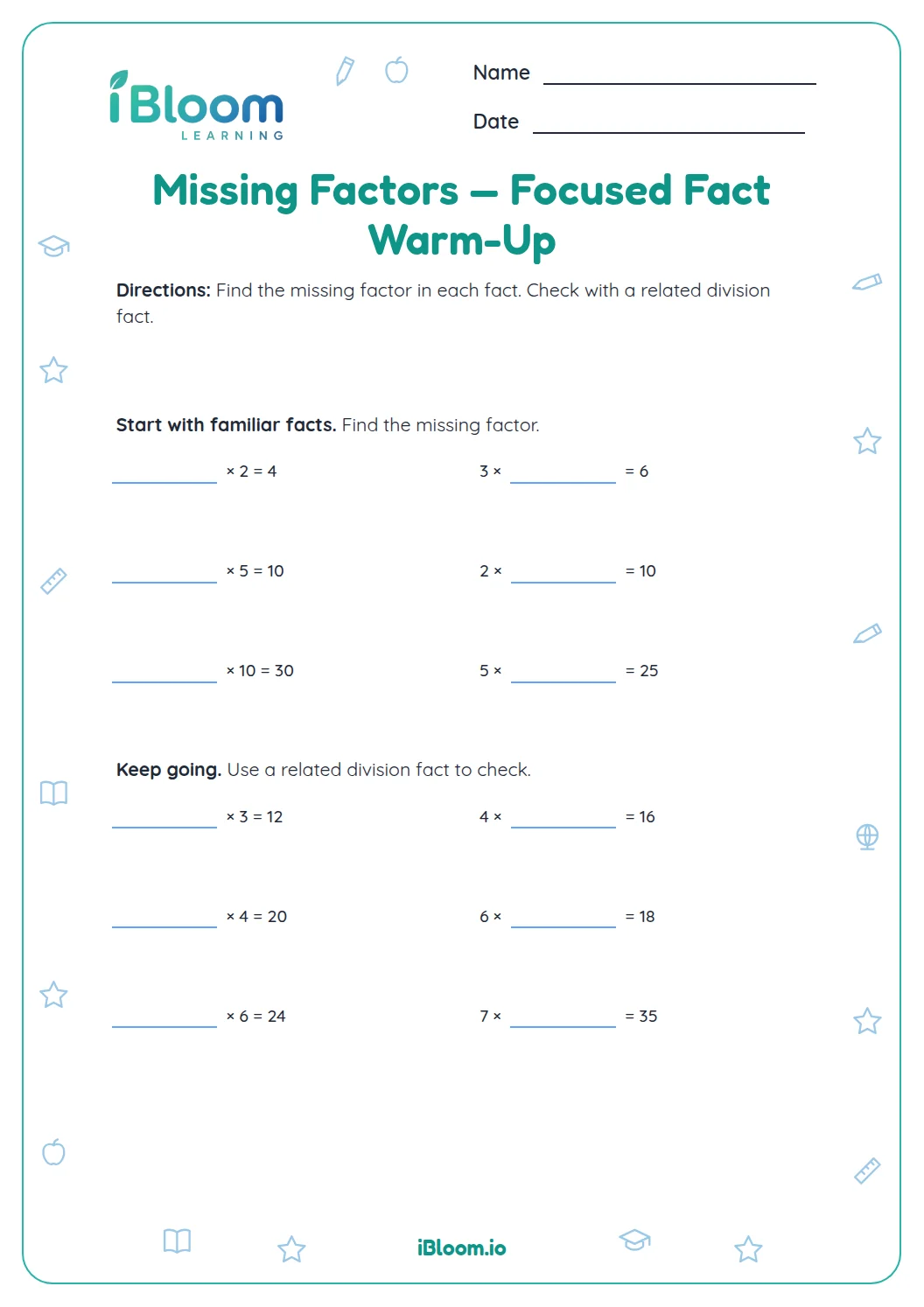
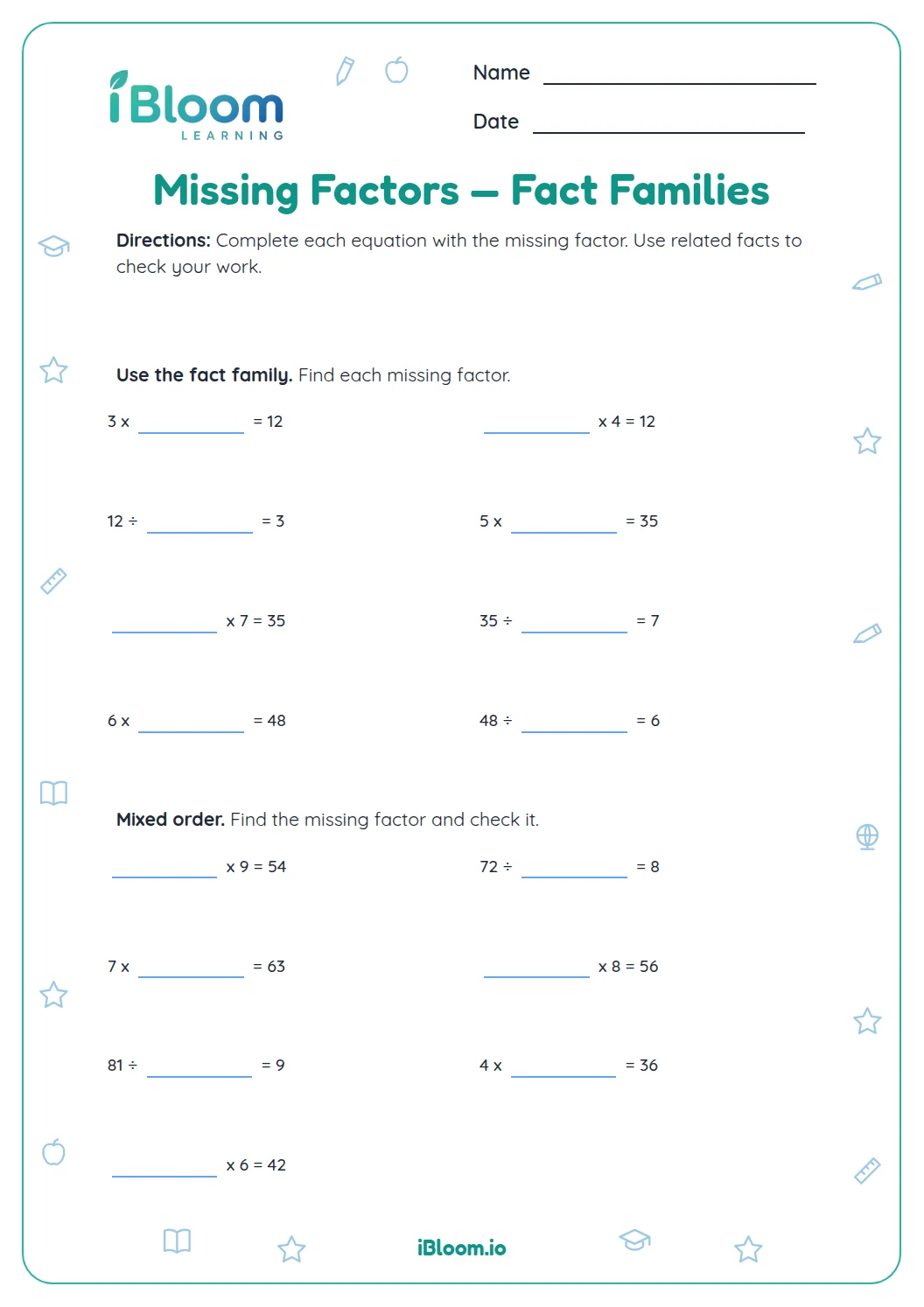
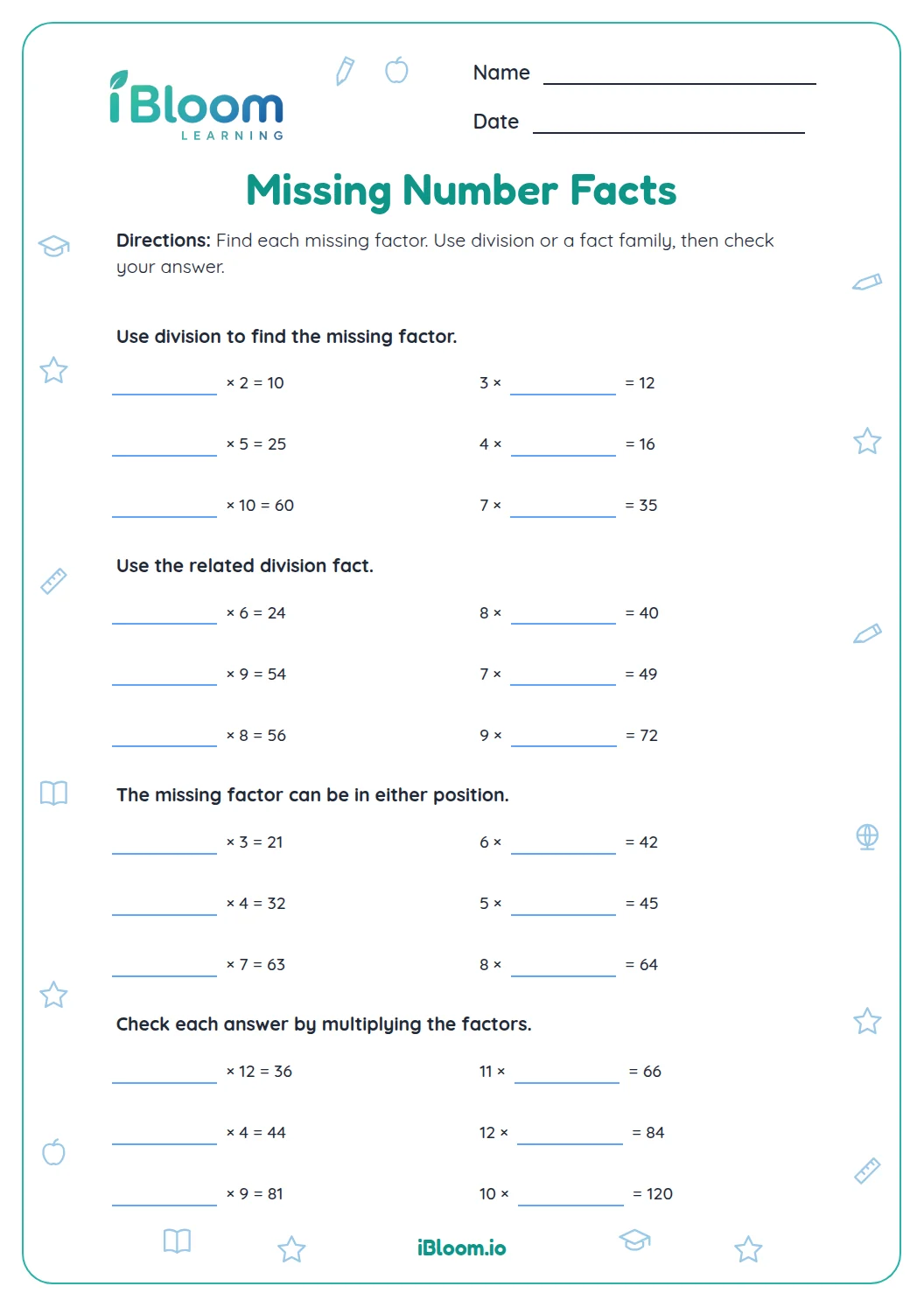
Part A applies multiplication to equal-group stories. Part B checks proposed products and strategies. Part C completes missing-factor equations.
- Four short equal-group situations
- Four choose-the-correction error checks
- Five missing-factor or related-fact items plus a fact recall and garden problem
How can a child check a product?
Count the stated number of groups, use a related fact, or divide the product by one factor. For example, 42 ÷ 6 = 7 confirms 6 × 7 = 42.
How to use this worksheet
- 1Read the directions together and name the skill in your own words.
- 2Complete the first few items slowly, explaining each choice.
- 3Work through the remaining questions independently or in a small group.
- 4Use the answer key to check each response and discuss any mismatch.
- 5Return to missed items and solve them again with the key covered.
Common mistakes and quick fixes
The mistake
Adding the factors instead of counting equal groups.
The fix
Draw or imagine the stated number of groups, then count the same number in each group.
The mistake
Using the right strategy with an incorrect product.
The fix
Recalculate the related fact; for 9 × 6, 9 × 5 is 45, then add 9 to reach 54.
The mistake
Putting the product in a missing-factor blank.
The fix
Divide the product by the known factor to find the missing factor.
Common Core alignment
This page connects the practice activities to the following Common Core standard.
Recall facts and use strategies to check products within 100.
On this sheet:
Show the official wordingHide the official wording
Fluently multiply and divide within 100, using strategies such as the relationship between multiplication and division (e.g., knowing that 8 × 5 = 40, one knows 40 ÷ 5 = 8) or properties of operations. By the end of Grade 3, know from memory all products of two one-digit numbers.
What to practice next
Make more practice
Further reading
Questions parents and teachers ask
What multiplication skills are on this worksheet?
The 14 questions practice one-digit facts, equal-group word problems, checking incorrect products, and finding missing factors. Children use strategies such as doubling a known fact or splitting a factor into tens and ones. The answer key is printed separately on two pages.
How does the worksheet use equal groups?
Several questions describe groups in a real context, such as 6 bags with 7 marbles in each. Multiply the number of groups by the amount in each group: 6 × 7 = 42 marbles. The unit in the story should appear in the answer.
How can a child find a missing factor?
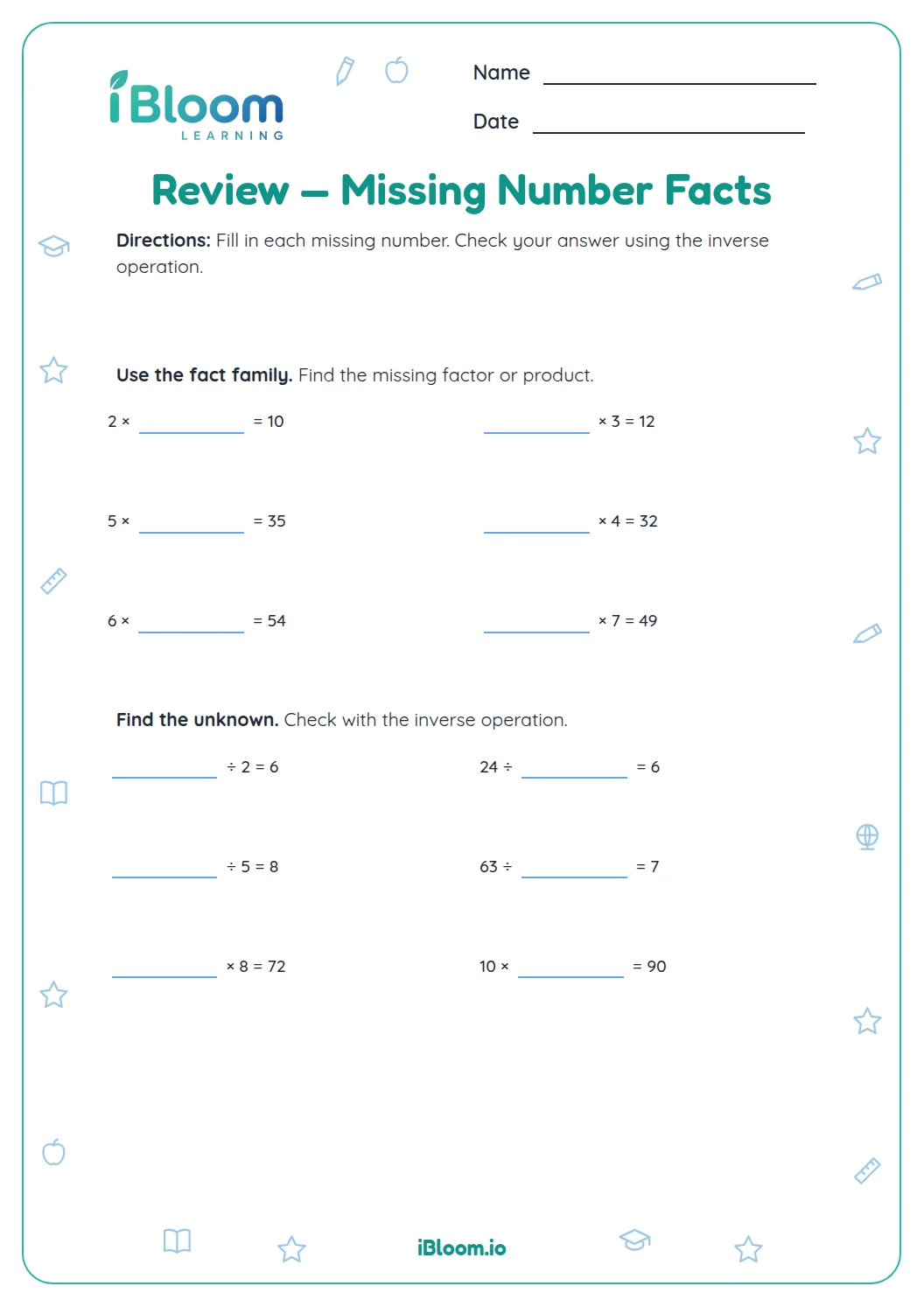
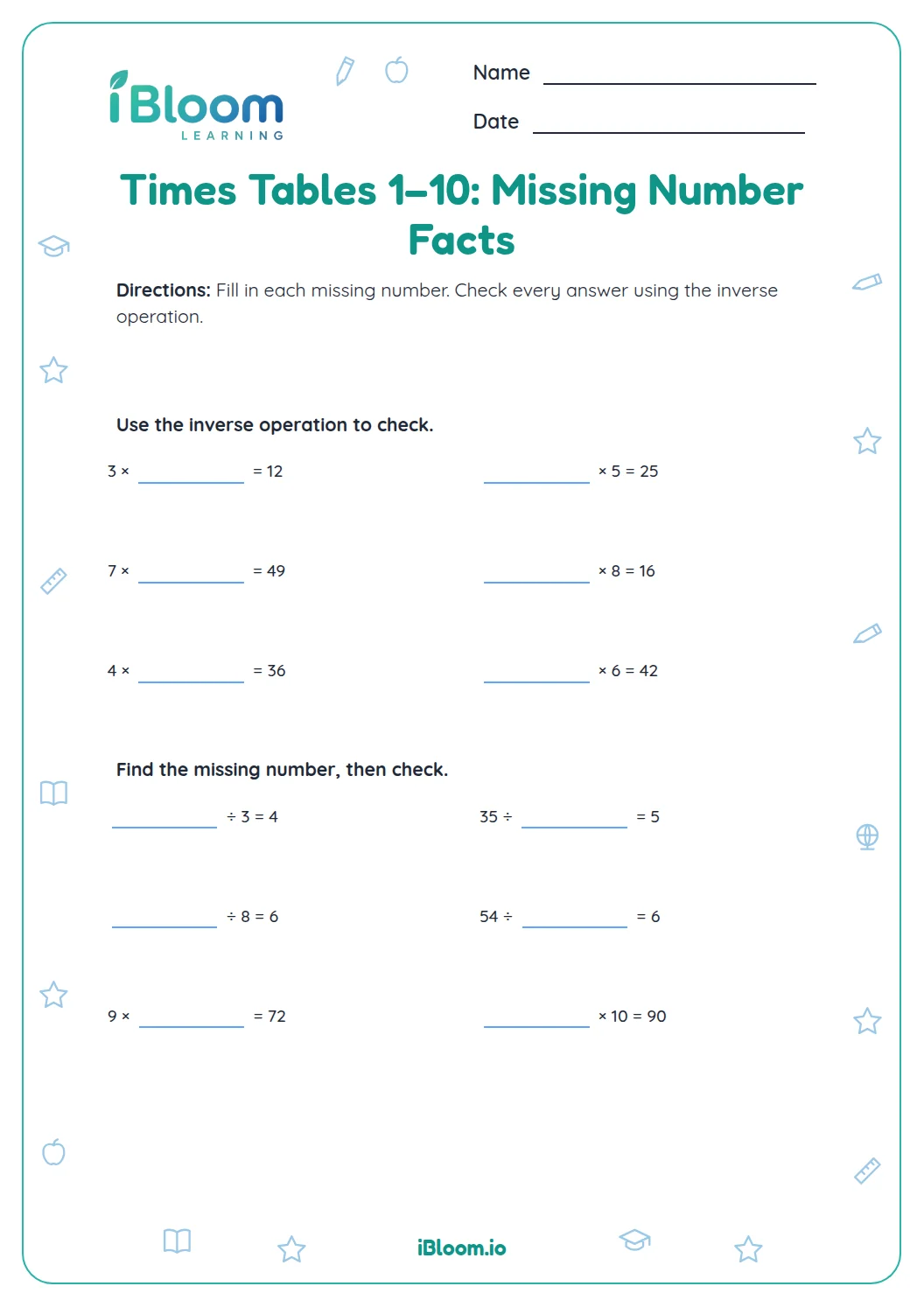
Use division or a known multiplication fact. In 7 × ___ = 56, ask what number multiplied by 7 makes 56, or calculate 56 ÷ 7. The missing factor is 8, and multiplying 7 × 8 checks it. Read the answer aloud with the completed example to check that it fits.
What is one error-check example?
One item says Maya thinks 6 × 7 = 36. Children choose the correct fact and reason: 6 × 7 = 42 because six groups of seven make 42. They practice checking the product as well as naming a useful strategy.
How long does it take, and is there an answer key?
The page suggests about 20 minutes for the 14 questions, though pace varies. A separate two-page answer key shows the products and correct strategy choices. Children can complete one section at a time and use the key after finishing. Read the answer aloud with the completed example to check that it fits.