





About this worksheet
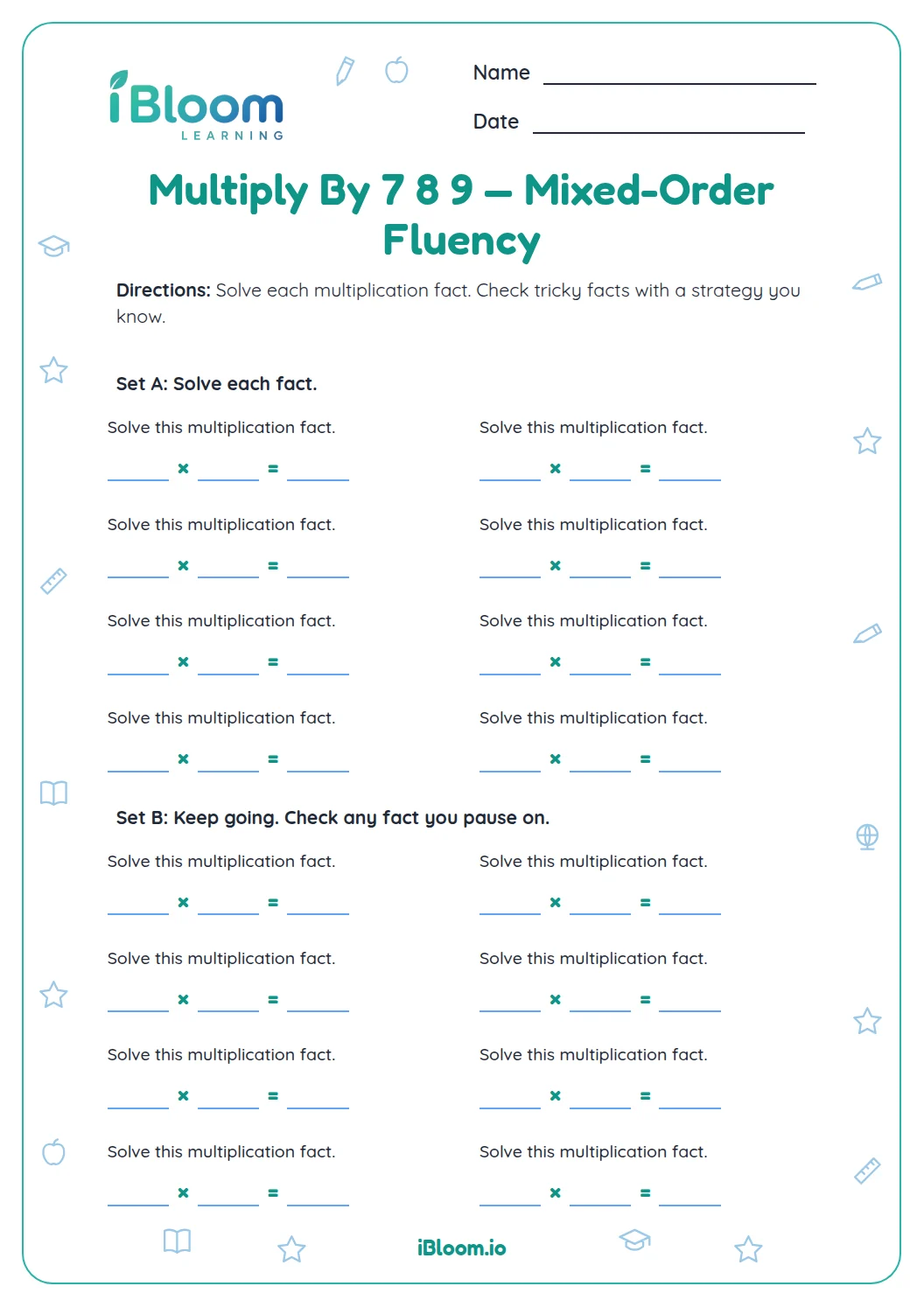
This free printable multiplication review is for Grades 3–4. Children solve fifteen facts without a timer, then try fifteen more with timing only if they choose. The facts include factors from 0 through 12, with products of one-digit numbers practicing Common Core 3.OA.C.7. Two final prompts record accuracy and a useful checking strategy. The 30 calculations and two reflections provide practice followed by a chance to discuss errors. A separate answer key gives every product and sample reflection responses. Timing is optional, and the suggested routine checks correct answers before discussing speed.
Aligned to 3.OA.C.7
How should the two rounds be used?
Start with Round 1 without a timer so the child can focus on accurate products. Check its fifteen answers before beginning Round 2. A fact that takes thought can be solved with a known related fact.
For Round 2, the child may work untimed or measure elapsed time. Let the timer count up while the child completes all fifteen facts, then record that time with the accuracy score. The rounds contain different facts, so their times are not equivalent measures of progress.
How can a known fact help with 6 × 8?
Break six groups of eight into five groups and one more group. Five eights make 40, and one more eight makes 48. This gives a check on a recalled product and a way forward when the answer is not yet quick.
- 16 × 8 = (5 × 8) + 8
- 240 + 8 = 48
- 3Write 48, then use the same reasoning in the reflection.
What should children record after solving?
Question 31 asks for the number correct out of fifteen in each round and the Round 2 time if one was measured. An untimed attempt can simply be labeled “not timed.” Question 32 asks children to choose a fact and explain a checking strategy.
Use the errors to choose the next practice set. An error on 0 × 8 needs a different discussion from an error on 7 × 9, so keep the corrected fact beside its explanation.
How to use this worksheet
- 1Explain that only Round 2 has an optional timing choice.
- 2Complete and check the fifteen Round 1 facts without timing.
- 3Choose whether to measure elapsed time for Round 2; let a timer count up if timing is wanted.
- 4Complete Round 2 and check each product with the key.
- 5Record both accuracy scores and any measured time in question 31.
- 6Explain one strategy in question 32 and revisit any incorrect facts.
Mistakes to notice and repair
The mistake
Answering 0 × 8 with 8.
The fix
Zero groups of eight contain zero objects; distinguish this from 1 × 8.
The mistake
Adding the factors, such as answering 6 × 8 with 14.
The fix
Read the expression as six groups of eight and use 5 × 8 plus one more eight.
The mistake
Treating a faster round with more errors as automatic improvement.
The fix
Compare accuracy first and discuss missed facts before considering time.
Common Core alignment
Recall multiplication facts and use known products to check uncertain answers.
On this sheet: Children recall products of one-digit numbers in both rounds and explain how a known product checks another fact.
Show the official wordingHide the official wording
Fluently multiply and divide within 100, using strategies such as the relationship between multiplication and division (e.g., knowing that 8 × 5 = 40, one knows 40 ÷ 5 = 8) or properties of operations. By the end of Grade 3, know from memory all products of two one-digit numbers.
What to practice next
Make more practice
Further reading
Questions parents and teachers ask
Is there a required time limit?
No, the worksheet does not set a required time limit. Round 1 is untimed, and timing Round 2 is a choice. If timing is useful for the child, let a timer count up until all fifteen facts are finished. Record correct answers separately from the elapsed time.
Which multiplication facts are included?
The sheet includes thirty facts using factors from 0 through 12. Round 1 mixes familiar products with zero, one, ten, eleven, and twelve. Round 2 includes 7 × 7, 8 × 9, 6 × 11, and 12 × 8. Every product is at most 100.
Can both rounds be completed without timing?
Yes, both rounds can be completed without a timer. The child still gets the full multiplication practice and can record both scores out of fifteen. Write “not timed” for the time entry, then use the final reflection to explain a strategy for checking one of the products.
Should I compare the times for the two rounds?
The rounds contain different facts, so their times do not provide a like-for-like comparison. Round 1 is designed for untimed accuracy practice. If tracking speed later, use comparable practice sets and record correct answers as well as time, while discussing any facts that still need a strategy.
What should the final strategy answer include?
The final answer should name a fact from the sheet and explain how another known fact checks it. For example, 6 × 8 can be checked with 5 × 8 = 40 plus another 8. Accept another accurate strategy if the explanation clearly reaches the correct product.