




About this worksheet
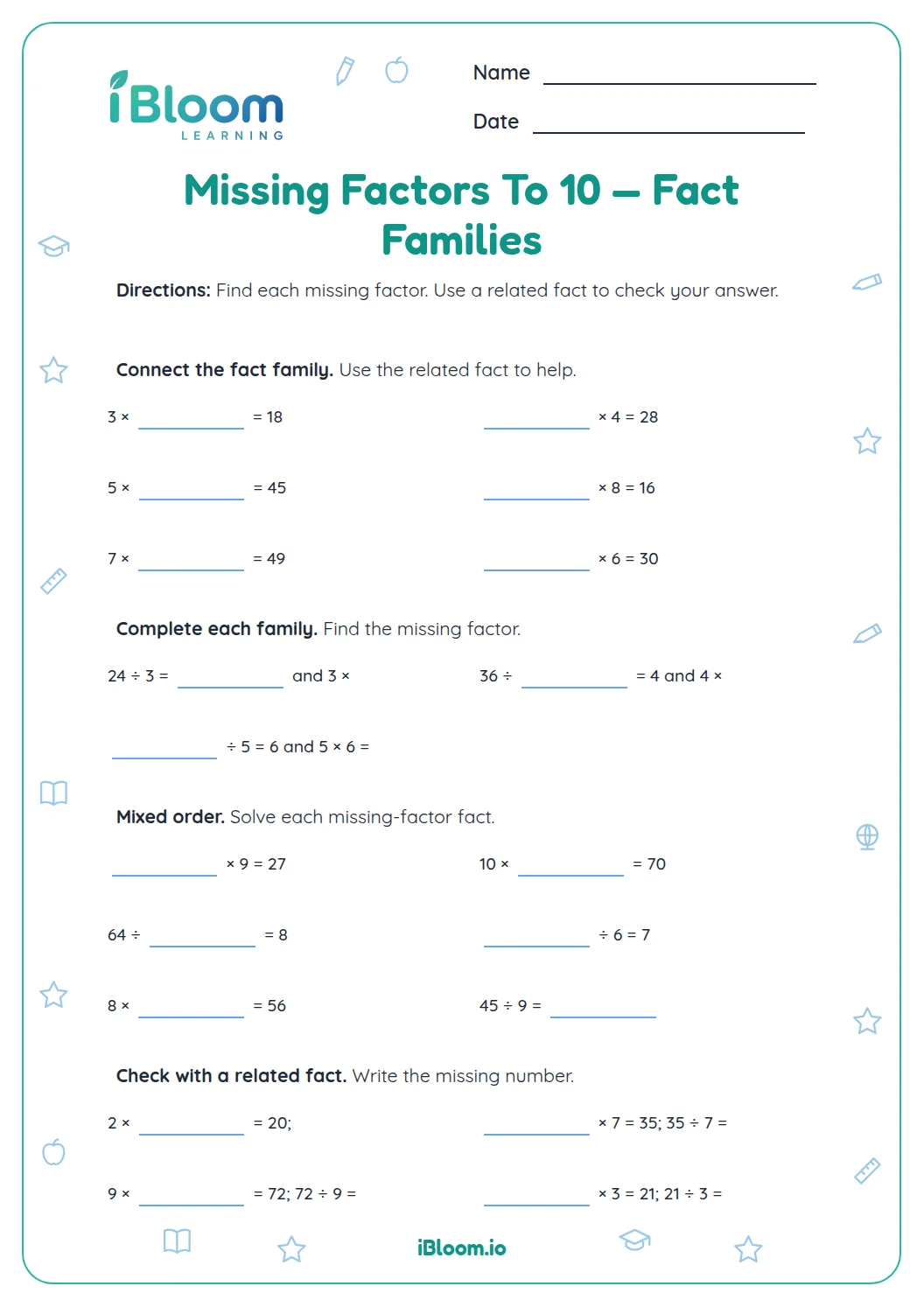
This free multiplication warm-up gives Grades 3–4 students a way into every times table from 1 through 10. The first five questions use keeping a number, doubling, counting by fives, making tens, and adding equal groups. The next five build harder facts from products students may already know. Six mixed facts finish the 16-question sheet. The practice supports Common Core 3.OA.C.7 by using properties of operations to multiply within 100. A separate answer key lists the products so an adult can check accuracy and discuss which hints helped.
Aligned to 3.OA.C.7
Which tables are included in the warm-up?
Questions 1–10 use each multiplier from 1 through 10 once. They are ordered by strategy: 1, 2, 5, 10, and 3 in Part A, followed by 4, 6, 7, 8, and 9 in Part B. This lets students start with direct patterns before trying a fact built from another product.
How does the hint for 6 × 4 work?
Question 7 says to use 5 × 4 and one more 4. Five groups of four make 20. Six groups have one extra group of four, so add 4 to get 24. The extra group has four objects; adding just one would give 21.
- 16 × 4 = ___
- 25 × 4 = 20
- 3One more group of 4: 20 + 4 = 24
- 46 × 4 = 24
What should students do in the final six questions?
Part C removes the printed hints and mixes the facts. Students can still use a strategy mentally. The saved 6 × 4 fact appears again here as question 12, giving students a chance to recall the product they built in Part B.
Check the six answers, then choose one slow or missed fact for discussion. Ask the student to name a nearby fact, such as a five-times or ten-times fact, and explain how it could help. Keep the explanation oral so the warm-up stays brief.
How to use this worksheet
- 1Read the first hint together and solve 1 × 8.
- 2Let students use each Part A hint before writing the product.
- 3In Part B, ask students to say the known product before adjusting it.
- 4Complete Part C with the hints available above if needed.
- 5Check the products and revisit one fact using the student’s preferred strategy.
Mistakes to check together
The mistake
Adding one instead of one whole group in 6 × 4.
The fix
Add 4 to 5 × 4 because each group has four.
The mistake
Subtracting 1 from 10 × 7 to find 9 × 7.
The fix
Subtract one group of 7: 70 − 7 = 63.
The mistake
Doubling only once to find 4 × 6.
The fix
Double 6 to get 12, then double 12 to get 24.
Common Core alignment
Use known facts and related multiplication or division facts to build fluency.
On this sheet: Use known facts and related multiplication or division facts to build fluency.
Show the official wordingHide the official wording
Fluently multiply and divide within 100, using strategies such as the relationship between multiplication and division (e.g., knowing that 8 × 5 = 40, one knows 40 ÷ 5 = 8) or properties of operations. By the end of Grade 3, know from memory all products of two one-digit numbers.
What to practice next
Make more practice
Further reading
Questions parents and teachers ask
Does the worksheet include every table from 1 to 10?
Yes, the ten hinted questions include each table from 1 through 10. They begin with easier patterns and then use known products to build harder ones. Six mixed questions follow, giving students another chance to use or recall several of the products they have practiced.
Are the answers supplied in the hints?
The hints give a strategy for finding each product. Some suggest doubling or counting, while others name a nearby fact to use. Students still calculate the answer. Encourage them to say how the hint works, especially when adding or subtracting a whole group of objects.
Can students use the hints during Part C?
Yes, students can look back at a hint if it helps them solve a mixed fact accurately. Part C gives six opportunities to try recall first. If a product is not yet familiar, using a known fact to rebuild it is a useful next step.
How should I explain the hint for 8 × 3?
Start with 4 × 3, which is 12, and double that product to get 24. Eight groups of three are twice as many groups as four groups of three. If needed, make two rows of four groups with counters and count the total together.
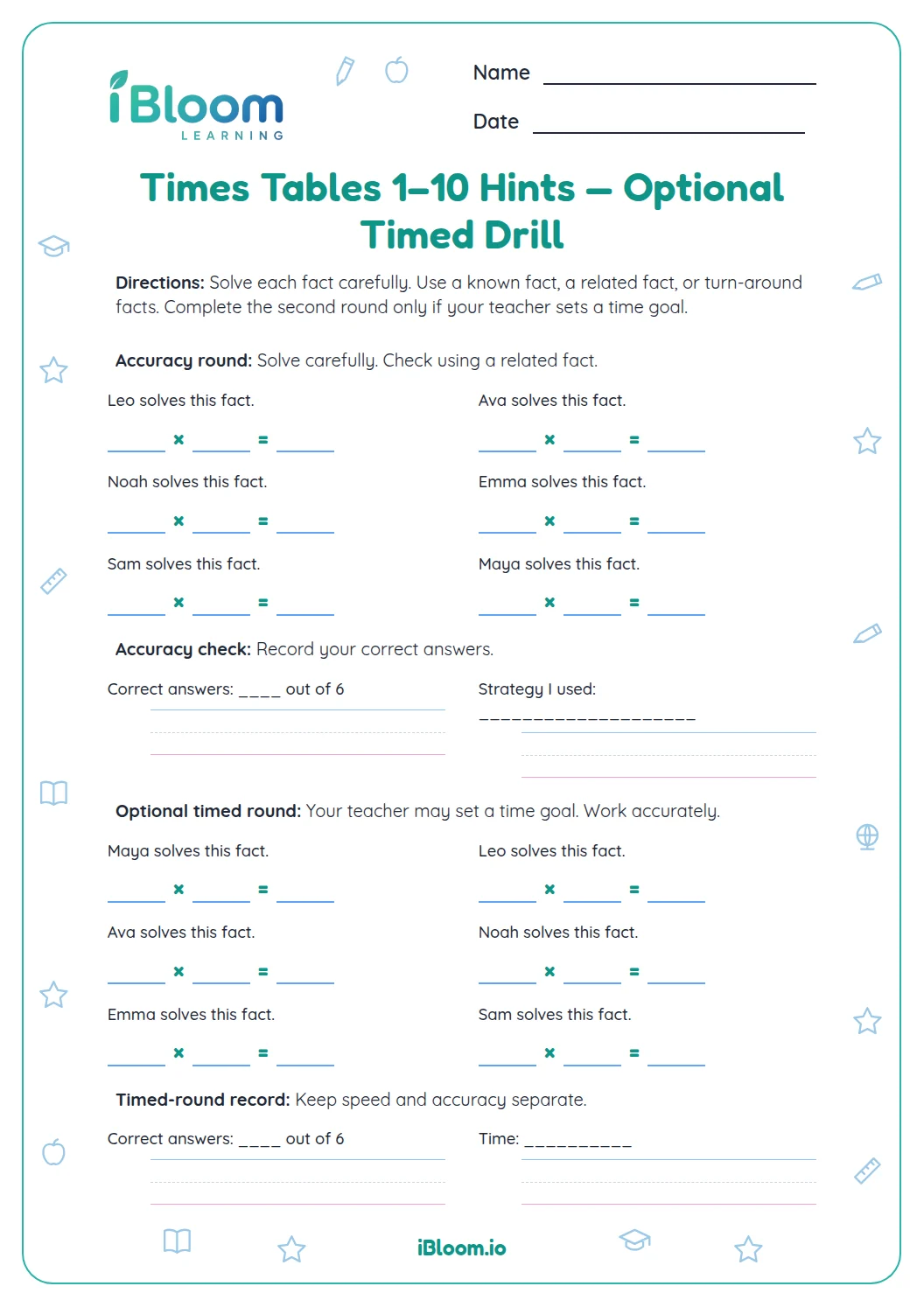
Should this warm-up be timed?
A timer is optional and is not needed for this warm-up. The printed hints invite students to work through strategies, which may take different amounts of time. Use the answer key to check accuracy first, then discuss one product that became easier because of a hint.