




About this worksheet
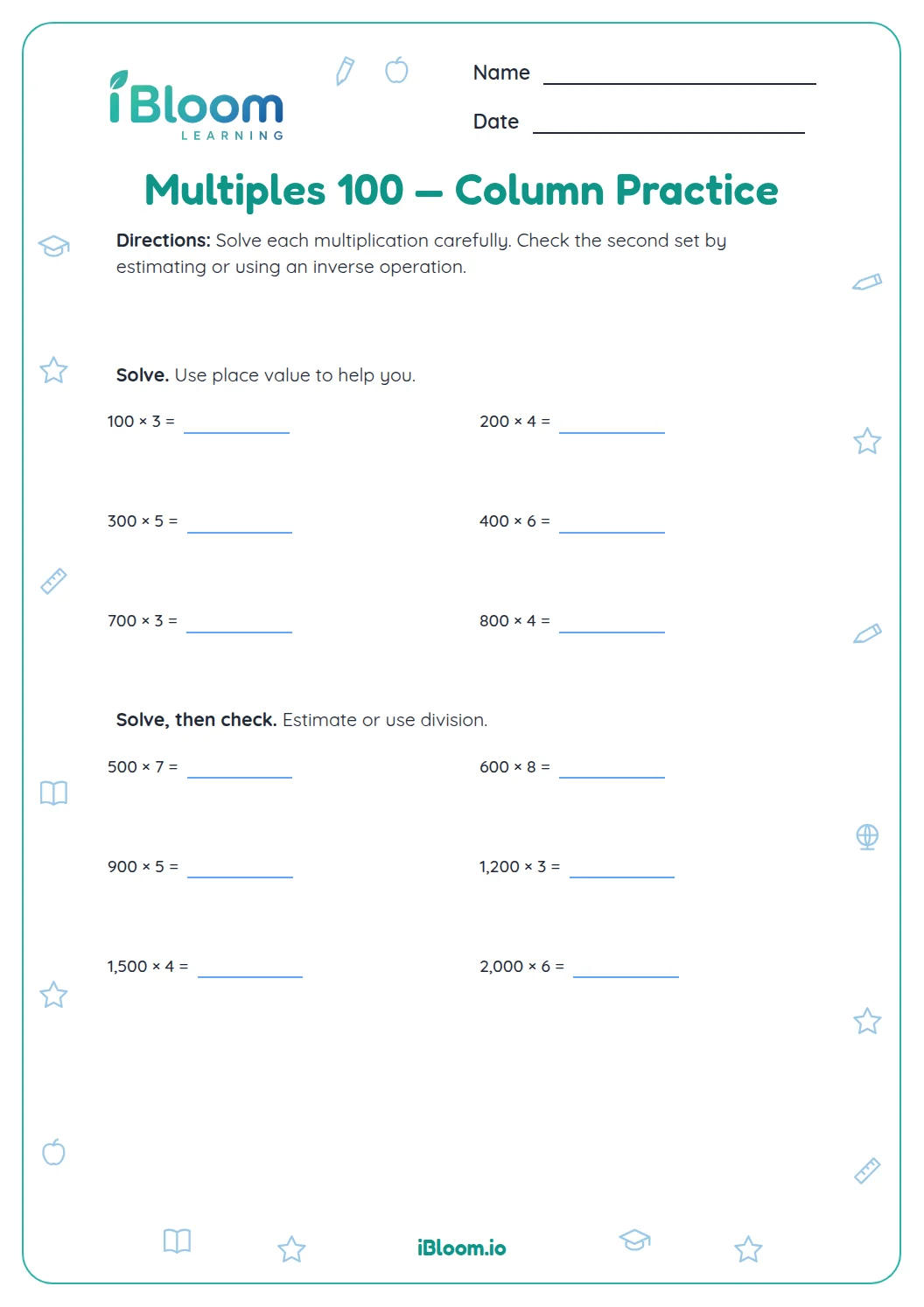
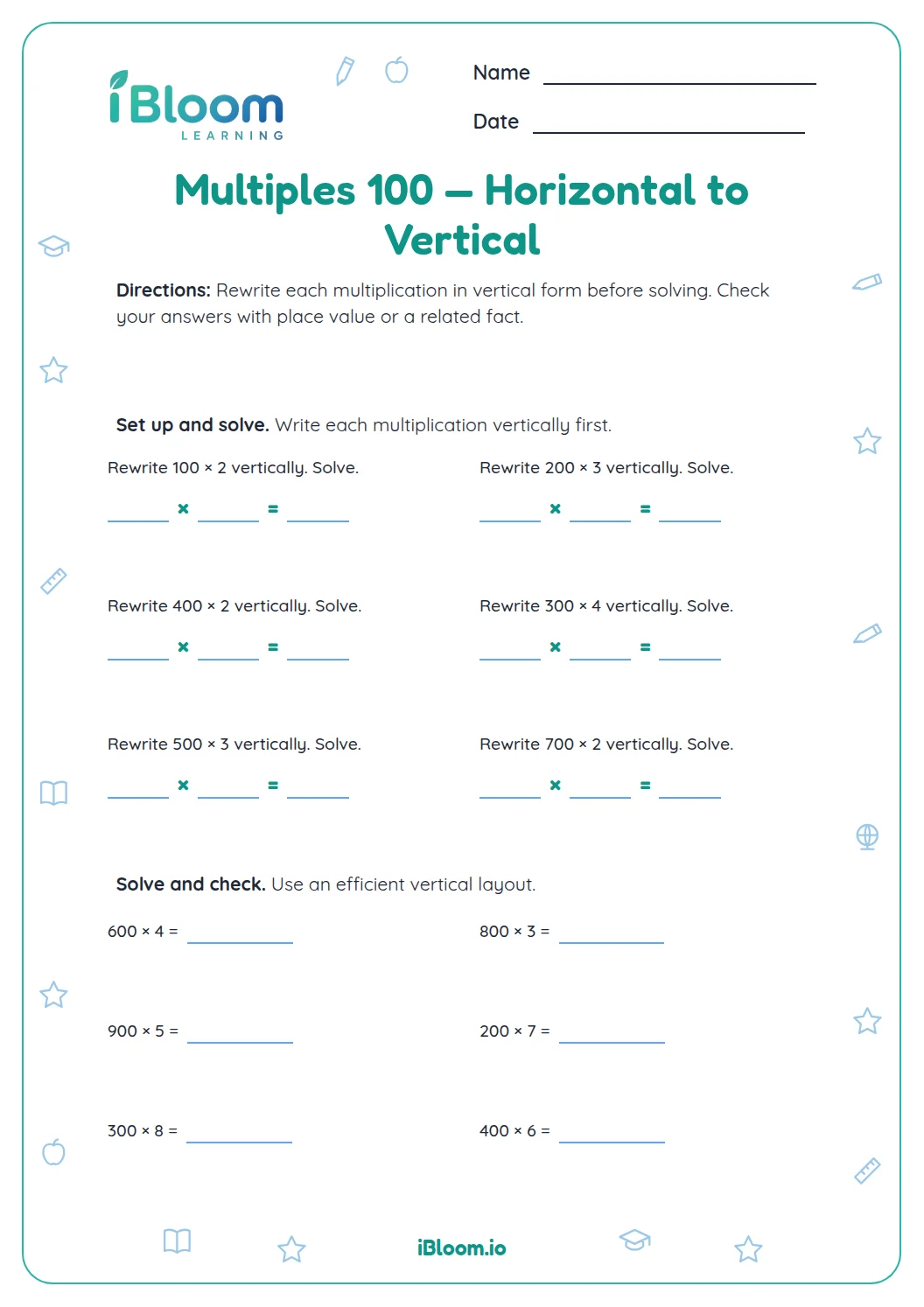
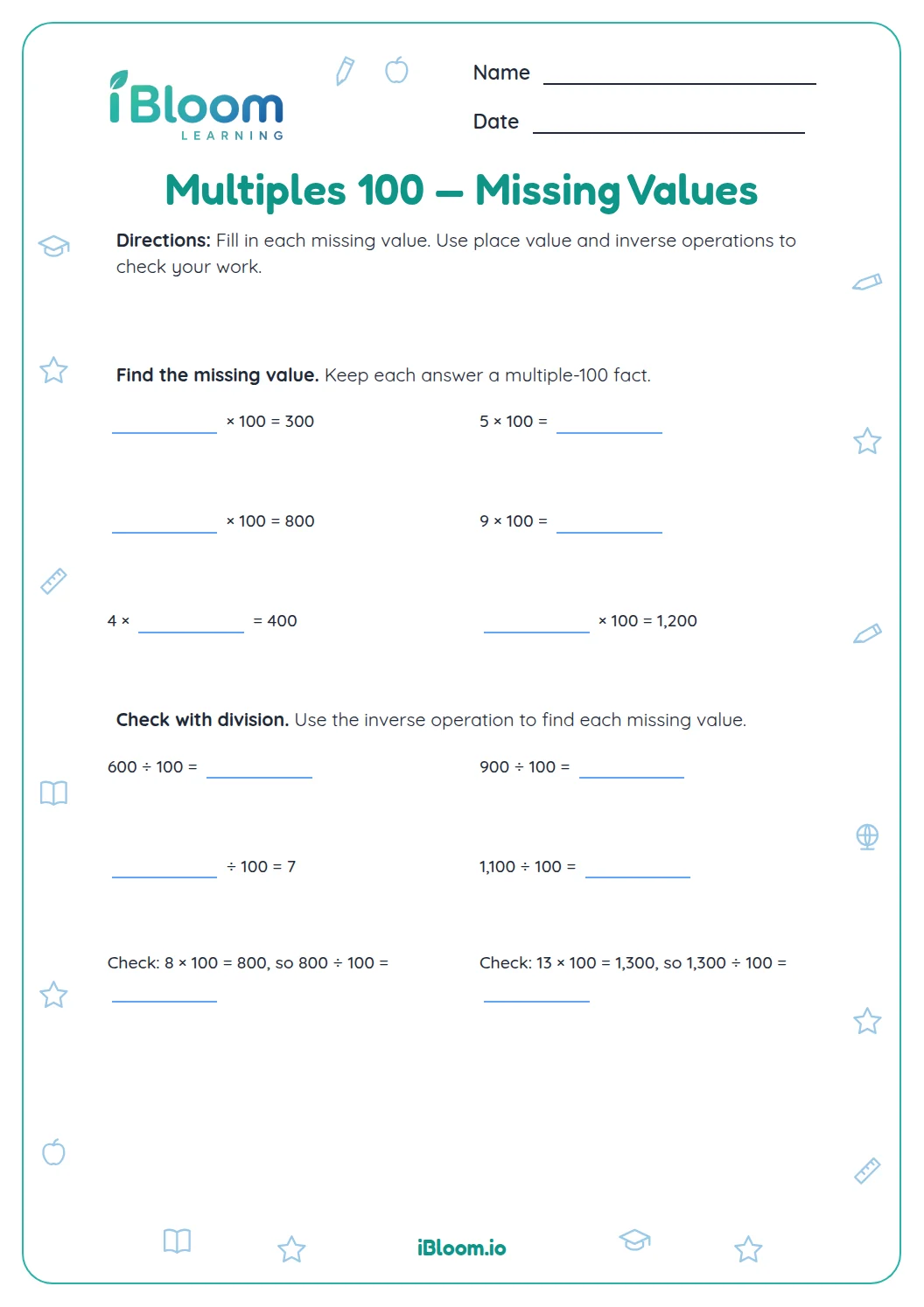
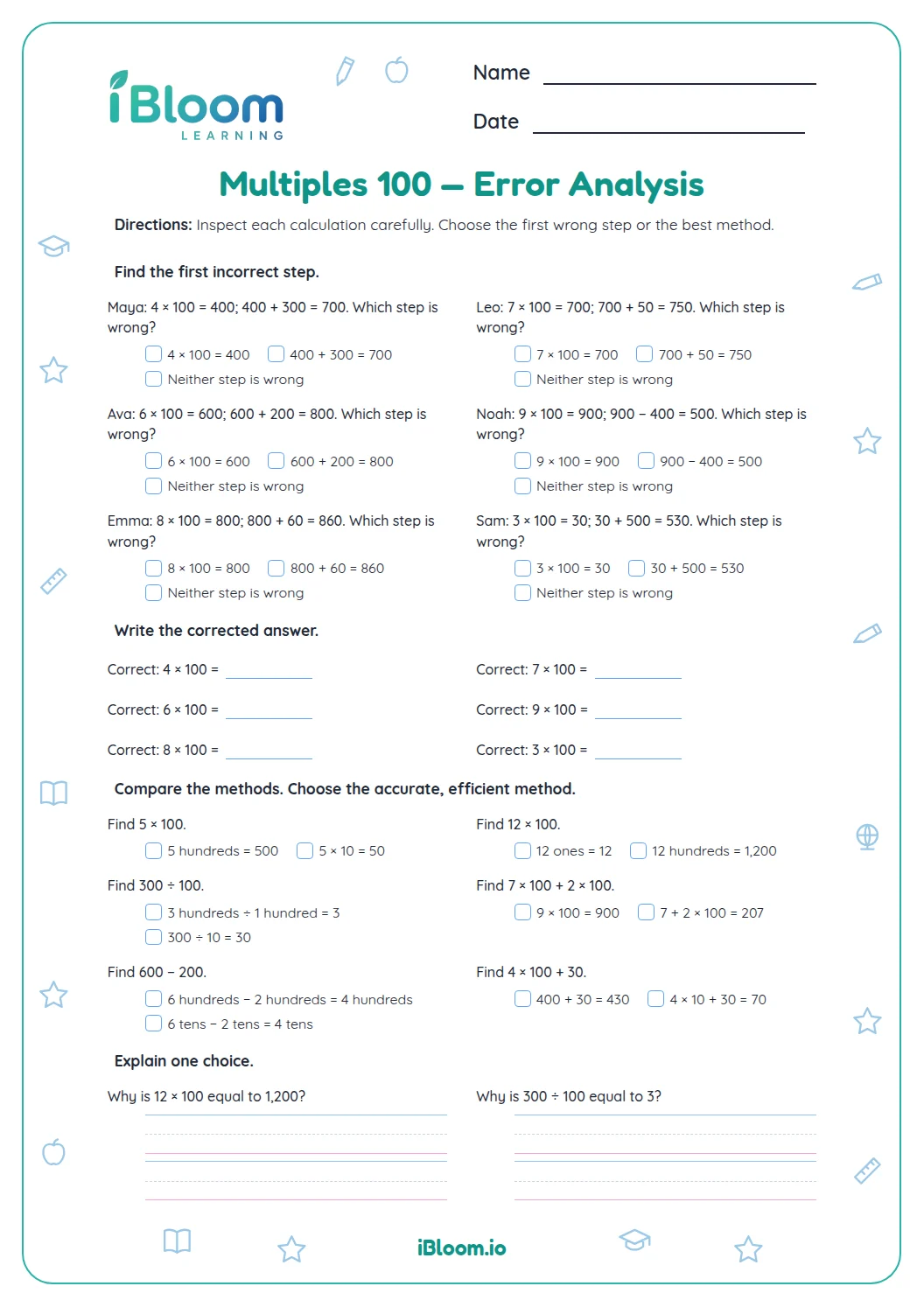
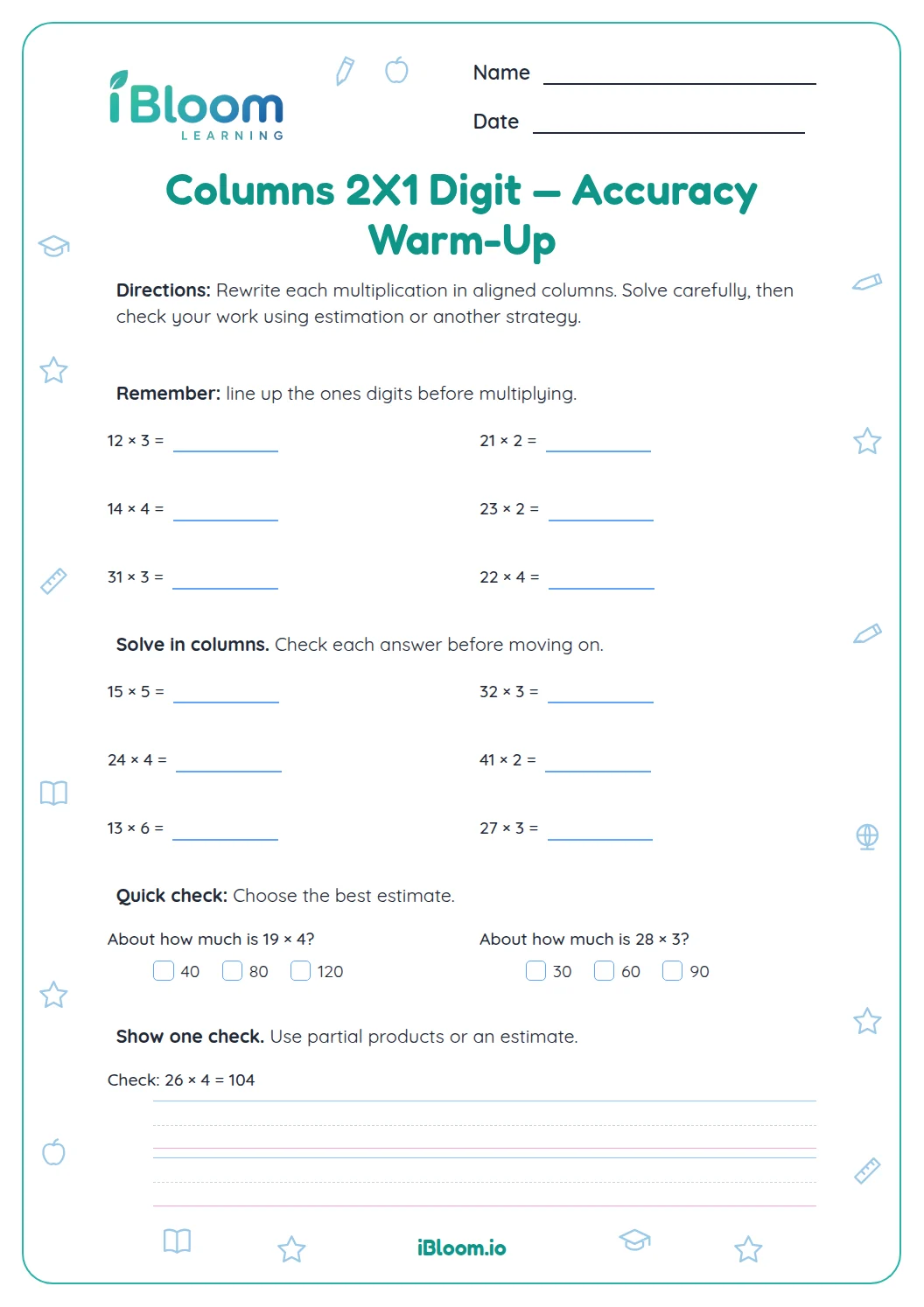
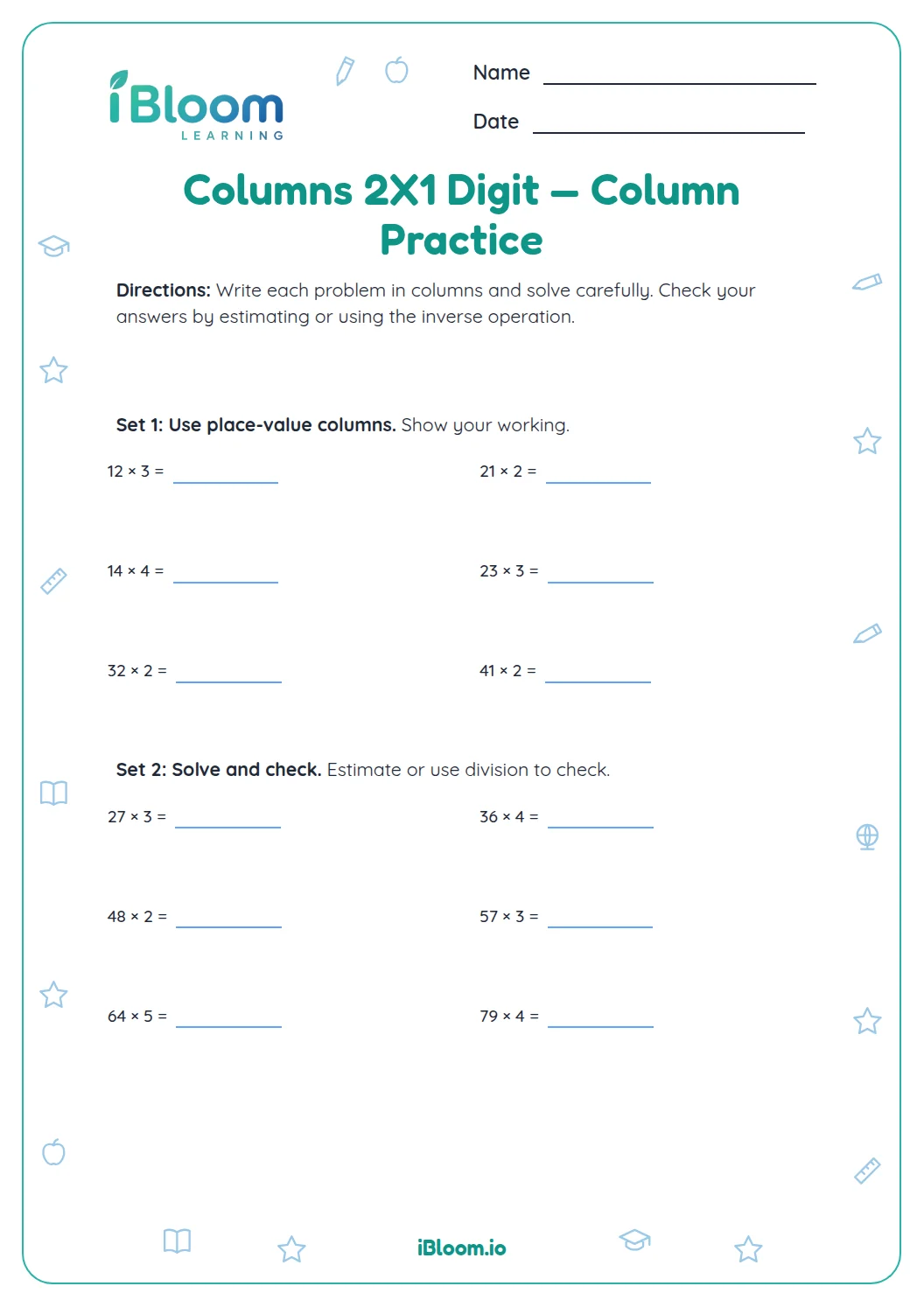
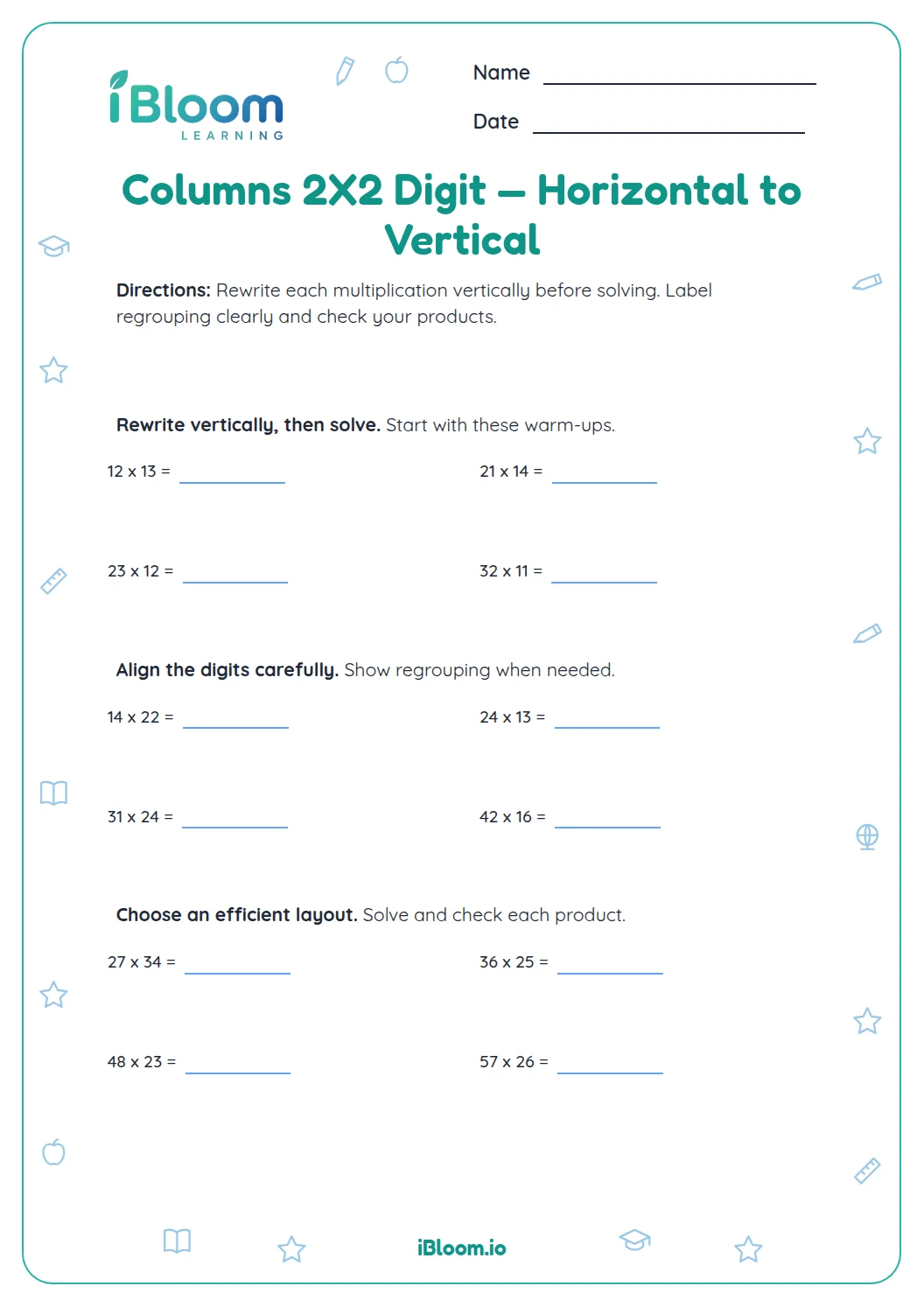
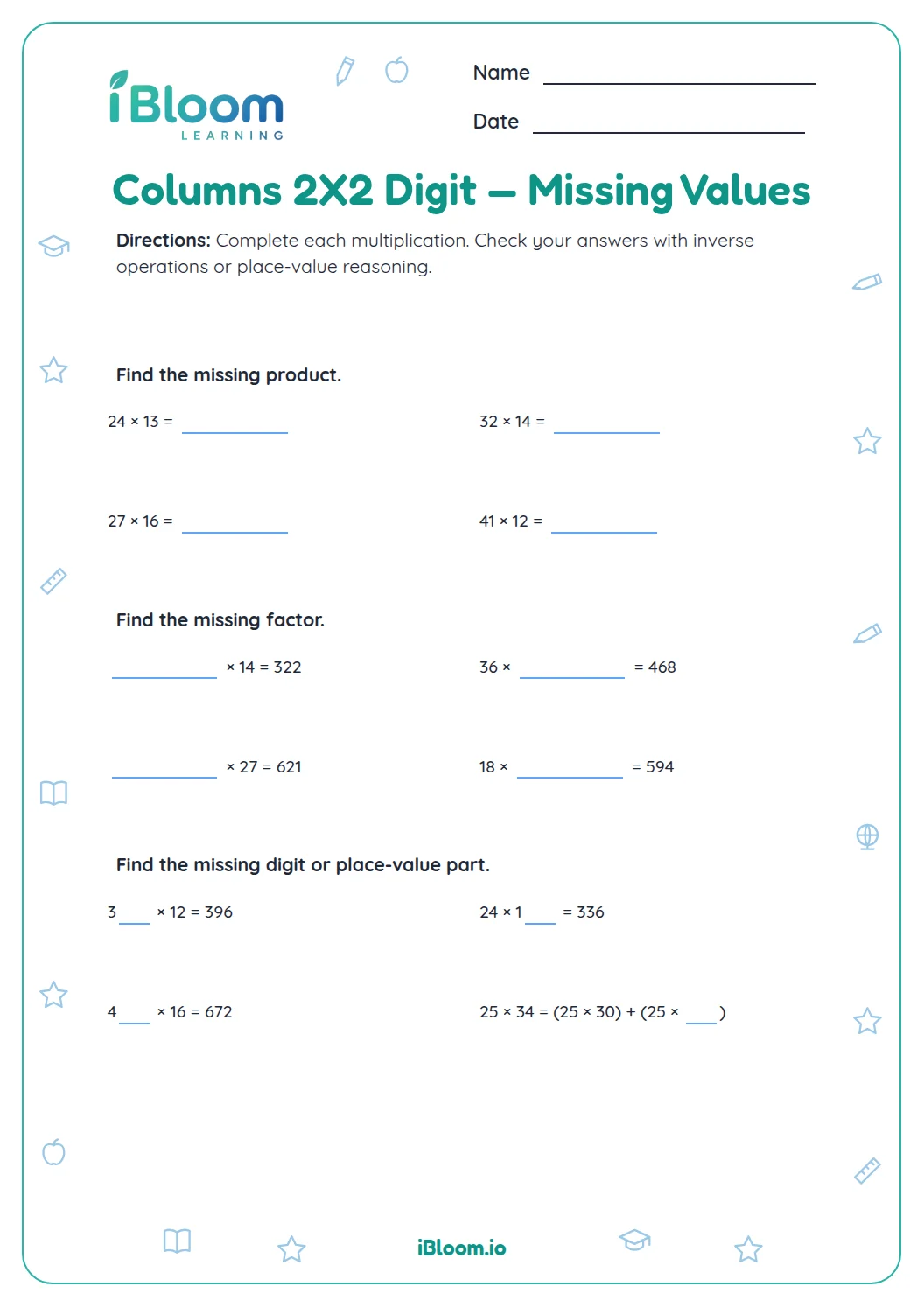
This printable mixed mastery drill practices multiplying whole numbers by 100 and using multiplication facts to reason about products. Children complete direct products, interpret nearby multiples, divide by 100 and select equations that check their thinking. It includes 15 questions across three parts and a separate answer key. The multiplication facts connect to Common Core 3.OA.A.1.
Aligned to 3.OA.A.1
How does multiplying by 100 change a number?
Multiplying by 100 makes 100 equal groups of a number. For example, 12 × 100 is 1,200. In Part A, use familiar facts and keep the hundreds in view.
Question 9 reverses a known product: 900 × 7 = 6,300, so the missing factor is 900 because 9 × 7 = 63.
- 1900 × 7 = 6,300
- 2Think 9 × 7 = 63
- 3So 900 × 7 = 6,300
- 4Missing factor: 900
What kinds of questions are included?
The 15 questions move from direct multiplication to place value reasoning. Students multiply factors from 3 through 96 by 100, then connect multiplication and division.
- Part A: 8 products by 100
- Part B: a missing factor and quotient
- Part C: a comparison and product checks
How to use this worksheet
- 1Read the operation sign before calculating.
- 2For × 100, think of one hundred groups of the factor.
- 3Use the basic fact first, then account for the hundreds.
- 4For division by 100, ask how many groups of 100 make the number.
- 5Estimate the size before choosing an answer.
Common mistakes and quick fixes
The mistake
Adding zeros without regard to place value.
The fix
Compare the product with the factor; multiplying by 100 makes it one hundred times as large.
The mistake
Using the quotient in a multiplication question.
The fix
Say the operation aloud and check with its inverse.
The mistake
Choosing a nearby number without checking the known fact.
The fix
Use the basic fact first, then restore the hundreds.
Common Core alignment
This worksheet practices the following Common Core skill.
Interpret products as equal groups in multiplication facts.
On this sheet: Interpret products as equal groups in multiplication facts.
Show the official wordingHide the official wording
Interpret products of whole numbers, e.g., interpret 5 × 7 as the total number of objects in 5 groups of 7 objects each.
What to practice next
Make more practice
Further reading
Questions parents and teachers ask
What does this worksheet practice?
It practices multiplying whole numbers by 100, dividing by 100 in a related case, and checking products through place value. The 15 questions begin with direct products, then use a missing factor, a quotient, a comparison and equation choices. A separate answer key supports review.
How can a child solve 48 × 100?
Think of 48 as 48 ones and make 100 groups: 48 × 100 = 4,800. The answer is one hundred times as large as 48. The sheet uses this place value idea across its direct product questions, including 48 × 100. Review the factor and product together.
Why does the worksheet include division?
Division by 100 checks the same place value relationship in reverse. For example, 3,200 ÷ 100 asks how many groups of 100 are in 3,200, which is 32. The multiplication check is 32 × 100 = 3,200. This links the two operations clearly.
What should children check after multiplying?
Compare the product’s size with the factor and use a related fact. For 84 × 100, think of 84 groups of one hundred, or 8,400. A product such as 840 is too small by a factor of ten. Estimating first can help spot that error.
How many questions and pages are included?
There are 15 questions in three parts, followed by a separate answer key. The printable uses two worksheet pages and two key pages, with direct products, place value reasoning and multiple-choice checks. Students can complete the parts in order and check each answer afterward.
What grade is this drill for?
The source sheet lists Grades 3–5, and this drill keeps the work focused on whole-number multiplication by 100. Children can use the direct products as fluency practice and the later questions to connect multiplication to place value and division. It suits learners reviewing these relationships.