


About this worksheet
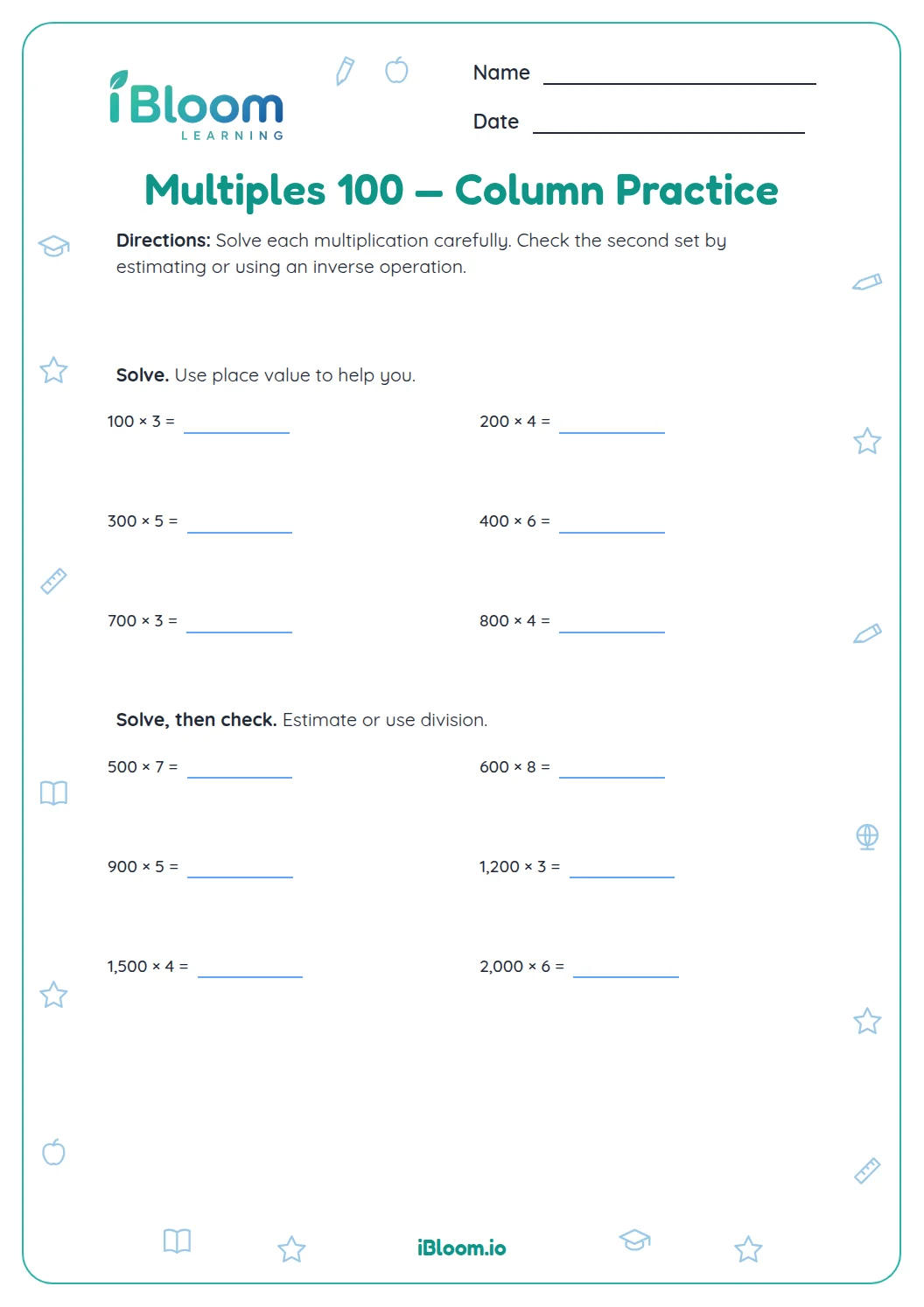
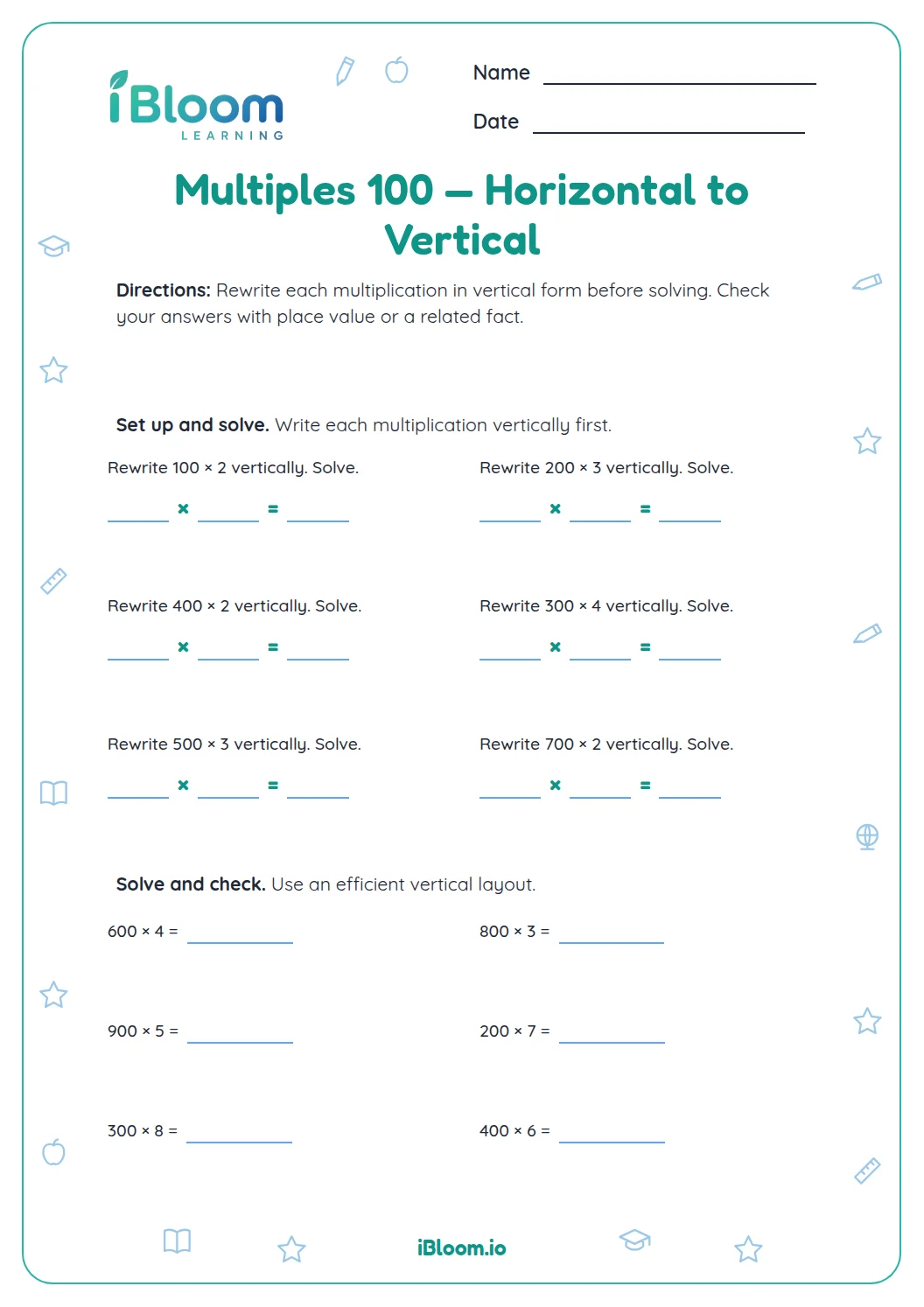
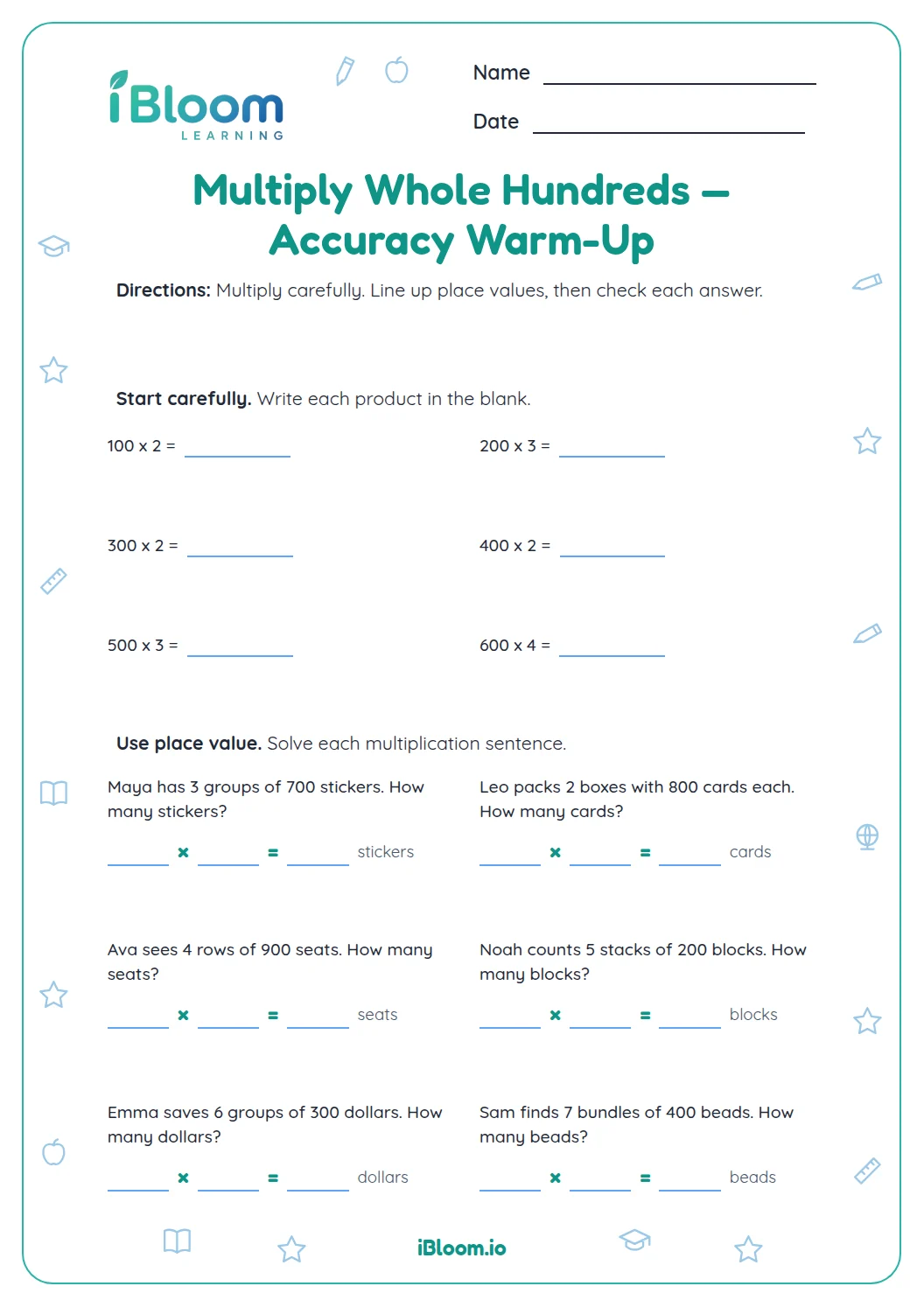
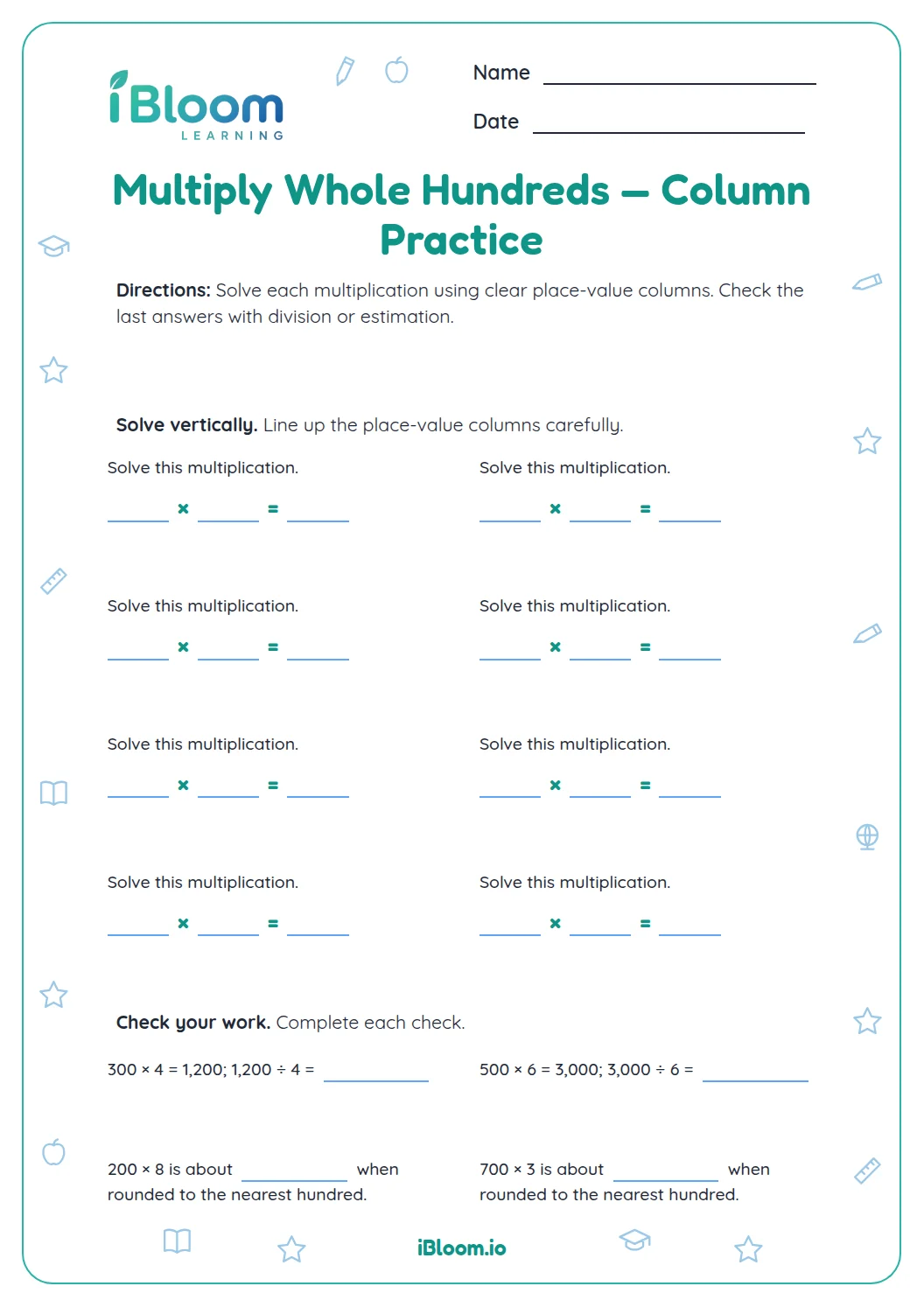
This free Grade 4 multiplication warm-up builds accuracy with one-digit factors and multiples of 100. Students solve eight short situations, calculate four products, and find four missing factors in equations. The numbers invite place-value reasoning: multiply the nonzero digits, then account for the hundreds. A separate answer key is included.
Aligned to 4.NBT.B.5
How do you multiply by a multiple of 100?
A product such as 6 × 400 can be found as 6 × 4 hundreds. Six groups of 4 hundreds make 24 hundreds, or 2,400. Question 9 uses this relationship directly.
The early questions use factors from 200 to 900. Later questions use multiples such as 1,500 and 2,300, which ask students to keep track of the thousands and hundreds together.
- 16 × 400 = 6 × 4 hundreds
- 26 × 4 = 24
- 324 hundreds = 2,400
- 4Answer: 2,400
How can a product reveal a missing multiple?
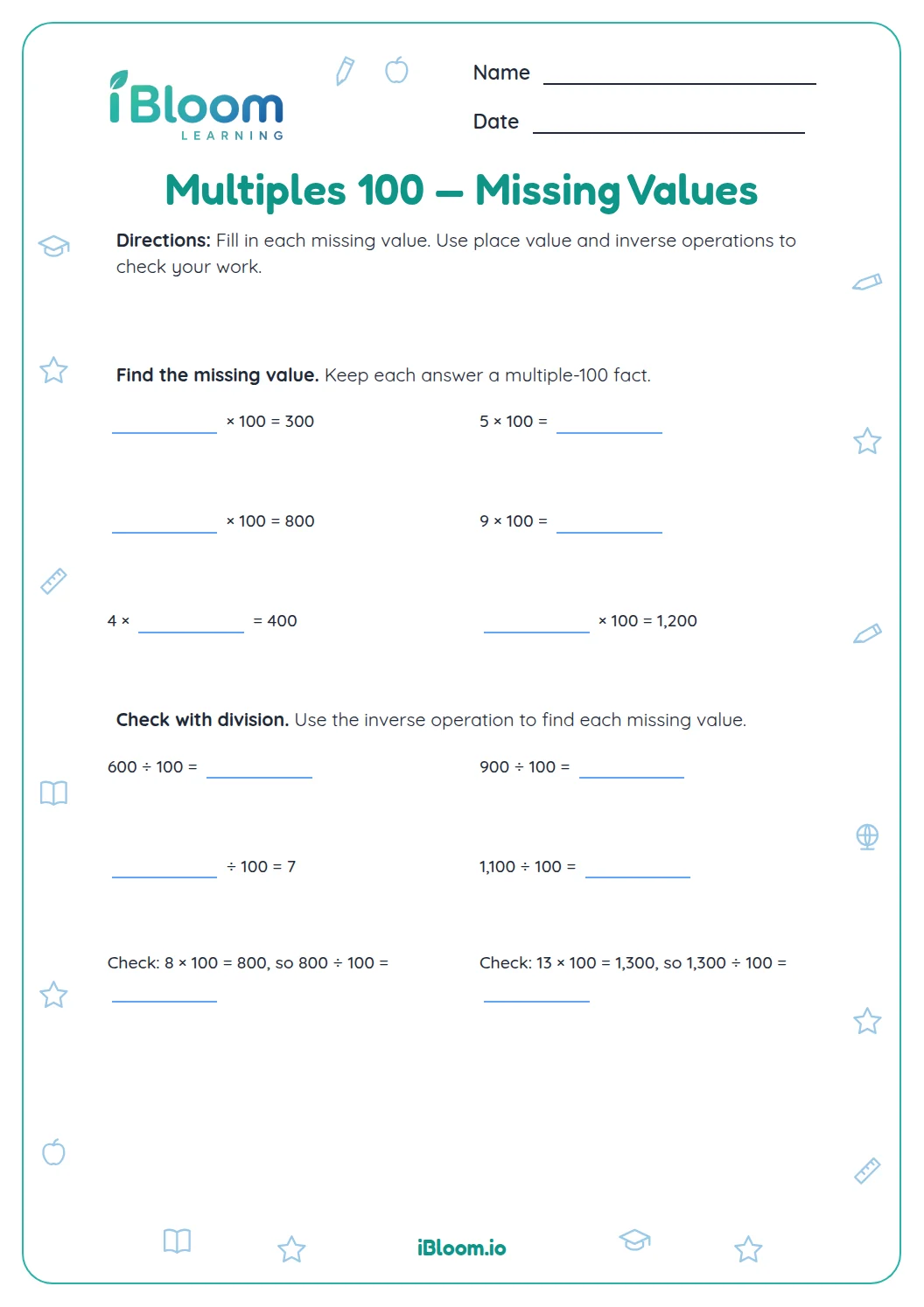
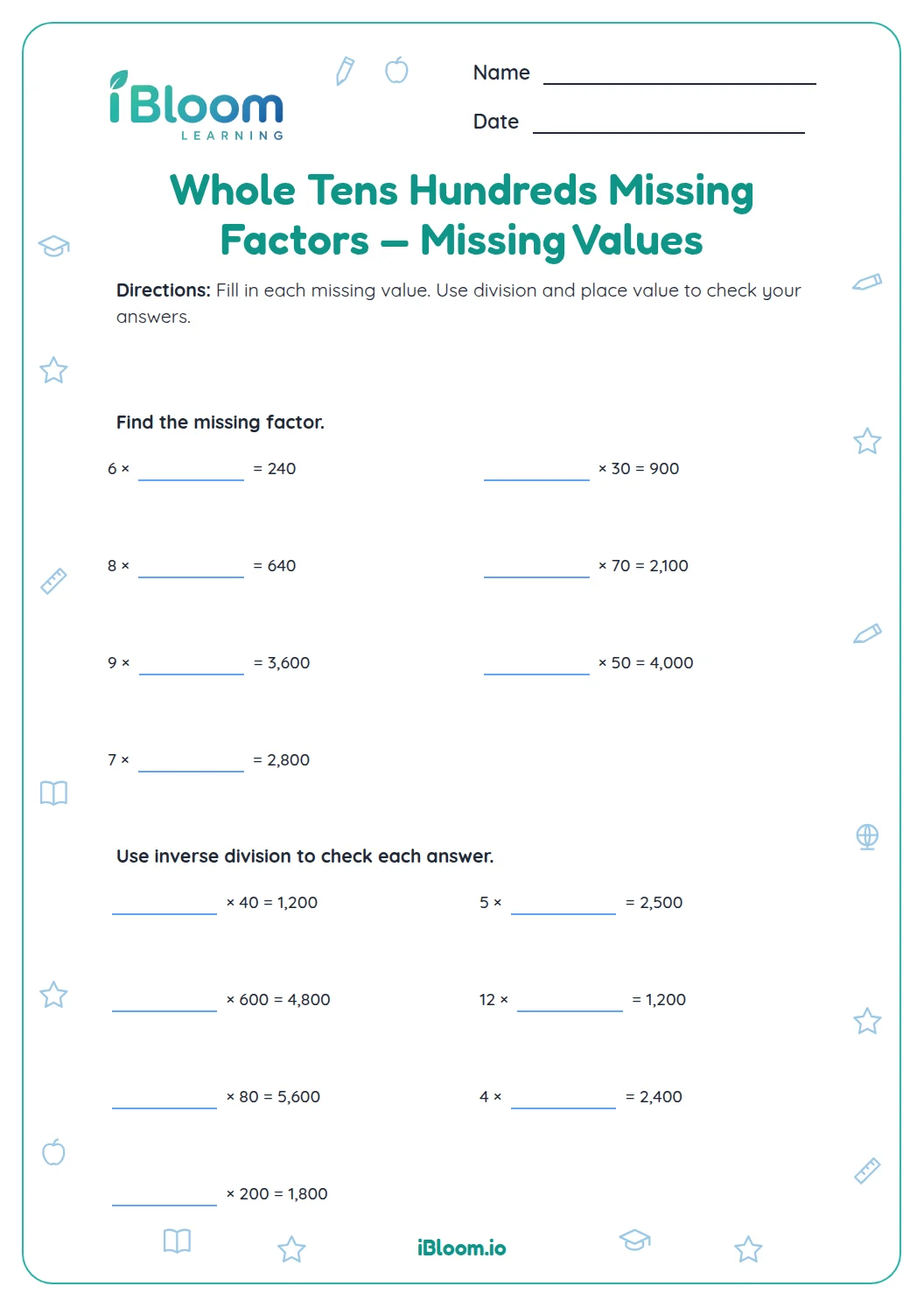
Use the known factor to work backward from the product. In question 13, 4 × ___ = 1,200. Since 1,200 ÷ 4 = 300, the missing factor is 300. Check by multiplying 4 × 300 to return to 1,200.
What is on the accuracy warm-up?
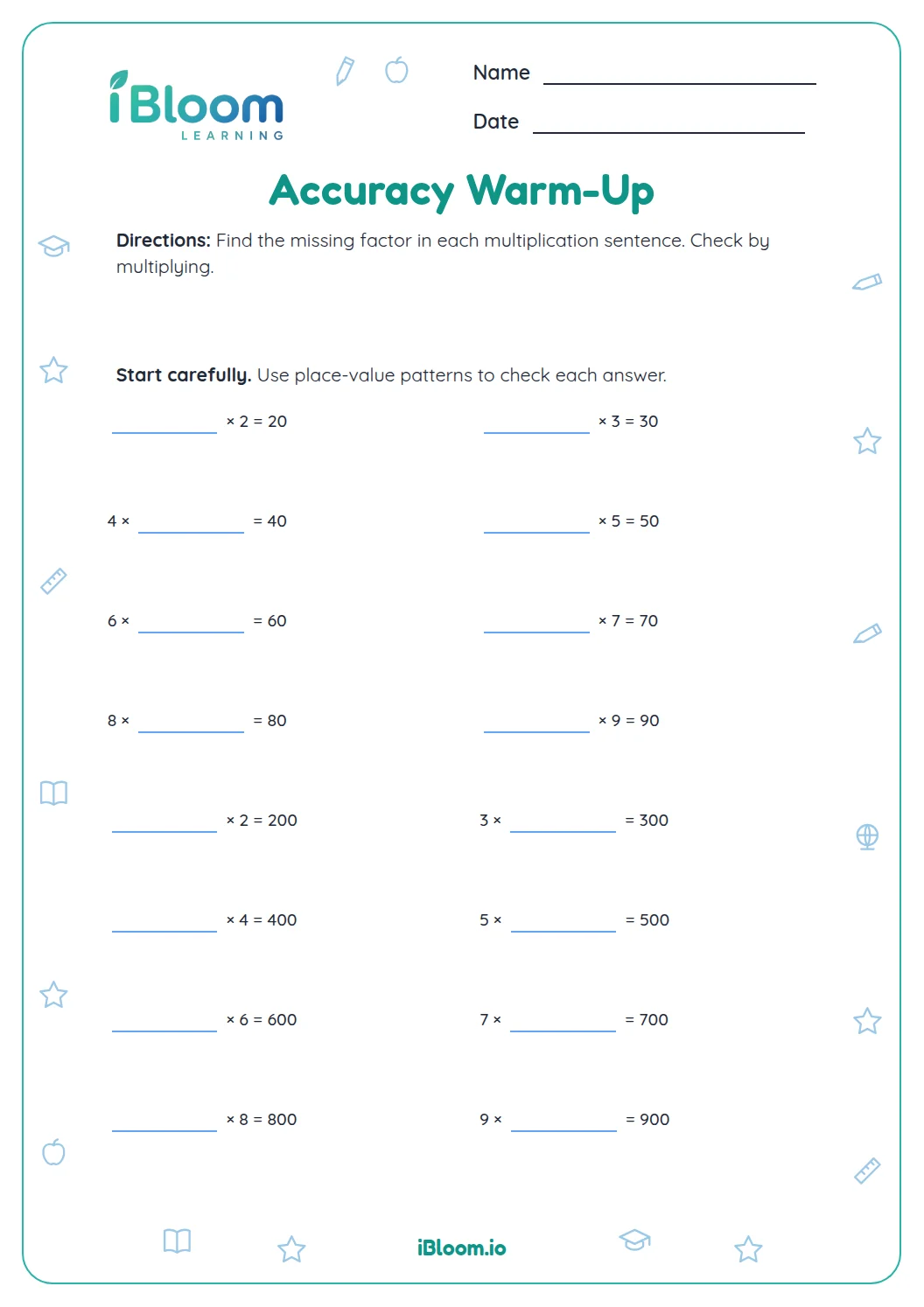
Part A applies one-digit-by-multiple-of-100 calculations in short settings. Part B has four direct products for a quick accuracy check, followed by four equations that reverse the operation. Students can use place-value notes before checking.
- Part A: eight short multiplication situations
- Part B: four products and four missing multiples of 100
- Answer key: all products and missing factors
How can a student check each product?
- 1Underline the one-digit factor and the multiple of 100.
- 2Multiply the nonzero digits first.
- 3Use the number of hundreds or thousands to place the digits correctly.
- 4Read the result aloud in place-value units, such as 24 hundreds.
- 5For a missing multiple, divide the product by the known factor.
- 6Check by multiplying the two factors again.
Common place-value slips
The mistake
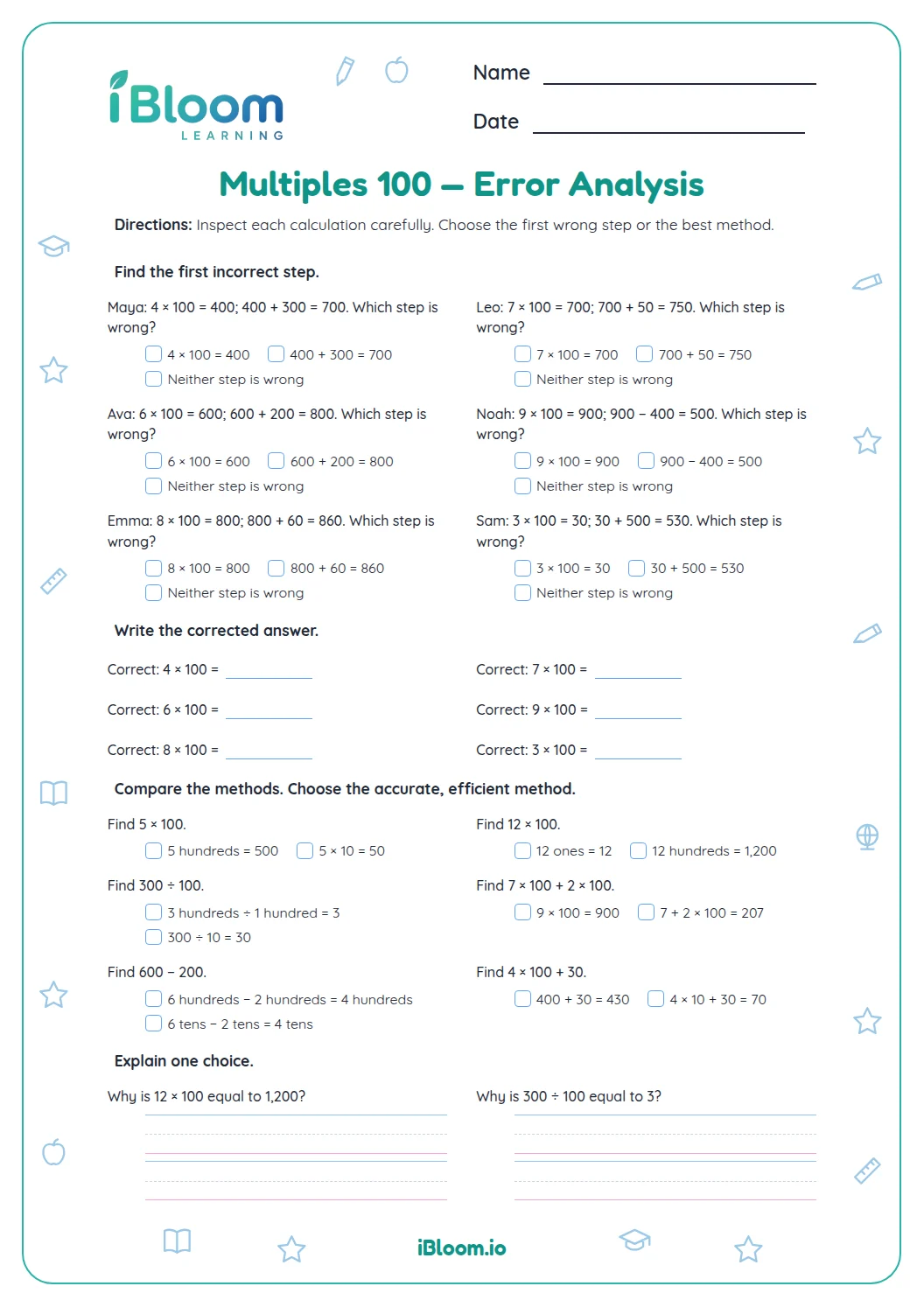
Calculating 6 × 400 as 240 instead of 2,400.
The fix
Think of 400 as 4 hundreds: 6 × 4 hundreds is 24 hundreds, or 2,400.
The mistake
Adding zeros without multiplying the nonzero digits correctly.
The fix
Compute the basic fact first, then attach the correct place value to that product.
The mistake
Treating a missing factor like a missing product.
The fix
Use the inverse operation: divide the total product by the factor that is already shown.
Common Core alignment
This worksheet practices the skill described in the standard below.
Students multiply whole numbers by one-digit factors using place-value reasoning.
On this sheet: The products multiply one-digit factors by whole numbers up to four digits, all multiples of 100.
Show the official wordingHide the official wording
Multiply a whole number of up to four digits by a one-digit whole number, and multiply two two-digit numbers, using strategies based on place value and the properties of operations. Illustrate and explain the calculation by using equations, rectangular arrays, and/or area models.
What to practice next
Make more practice
Further reading
Questions parents and teachers ask
How many problems are in the warm-up?
There are 16 questions. Eight ask students to multiply a one-digit number by a multiple of 100 in a short situation, four give direct products, and four give a product and ask for the missing multiple. The first part leaves room to write a calculation.
What does a problem like 6 × 400 mean?
It means six groups of four hundred. Multiply 6 by 4 to get 24 hundreds, then write 2,400 as the product. Saying “24 hundreds” is a useful check that the answer has the correct place value. Students can verify by decomposing 400 into four hundreds.
Why are some factors larger than 1,000?
Some missing factors are greater than 1,000 because the equation gives a large product. For example, 3 × ___ = 4,800 has the factor 1,600. Students can divide the product by 3 or reason with 3 × 16 hundreds to find it.
How can I check a missing-factor answer?
Multiply the known factor by the answer and see whether the given product returns. For 4 × ___ = 1,200, the missing factor is 300 because 4 × 300 = 1,200. Division by the known factor is another way to find it.
Is there an answer key?
Yes. The answer key is separate from the worksheet and lists each product and missing multiple. Students can use it after completing the warm-up to identify any place-value errors and retry those calculations with a written decomposition. Each answer is listed by question number.