
About this worksheet
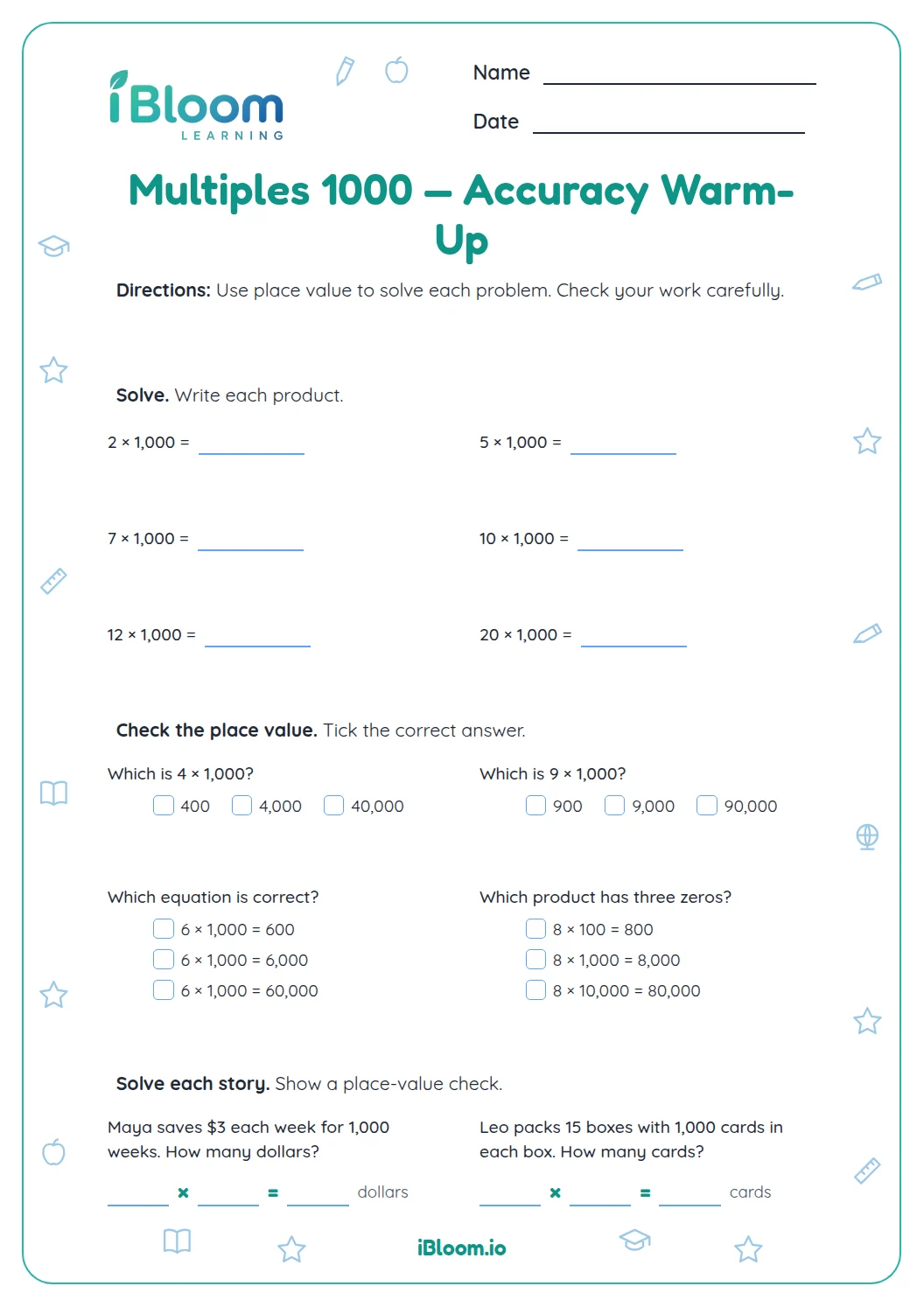
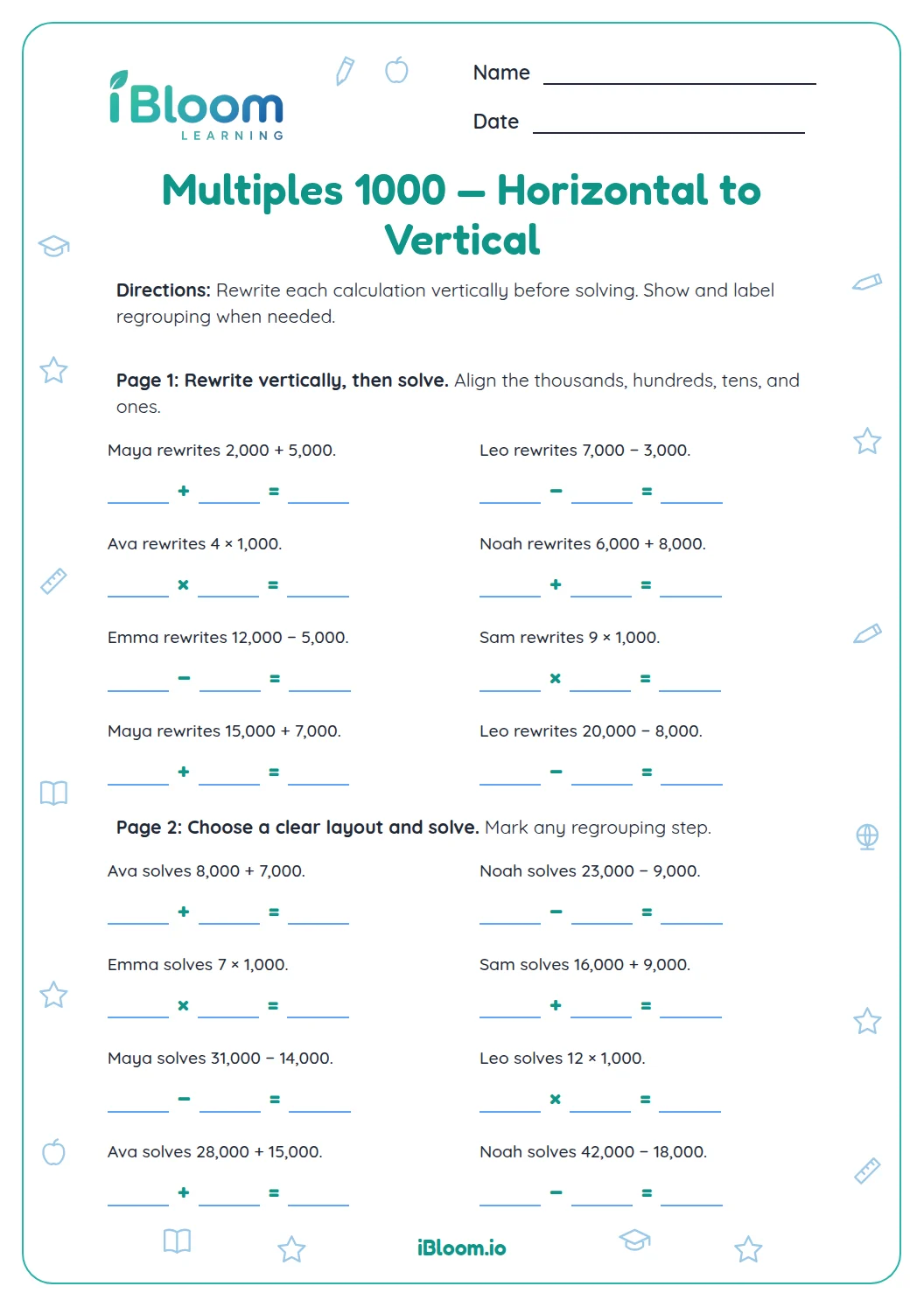
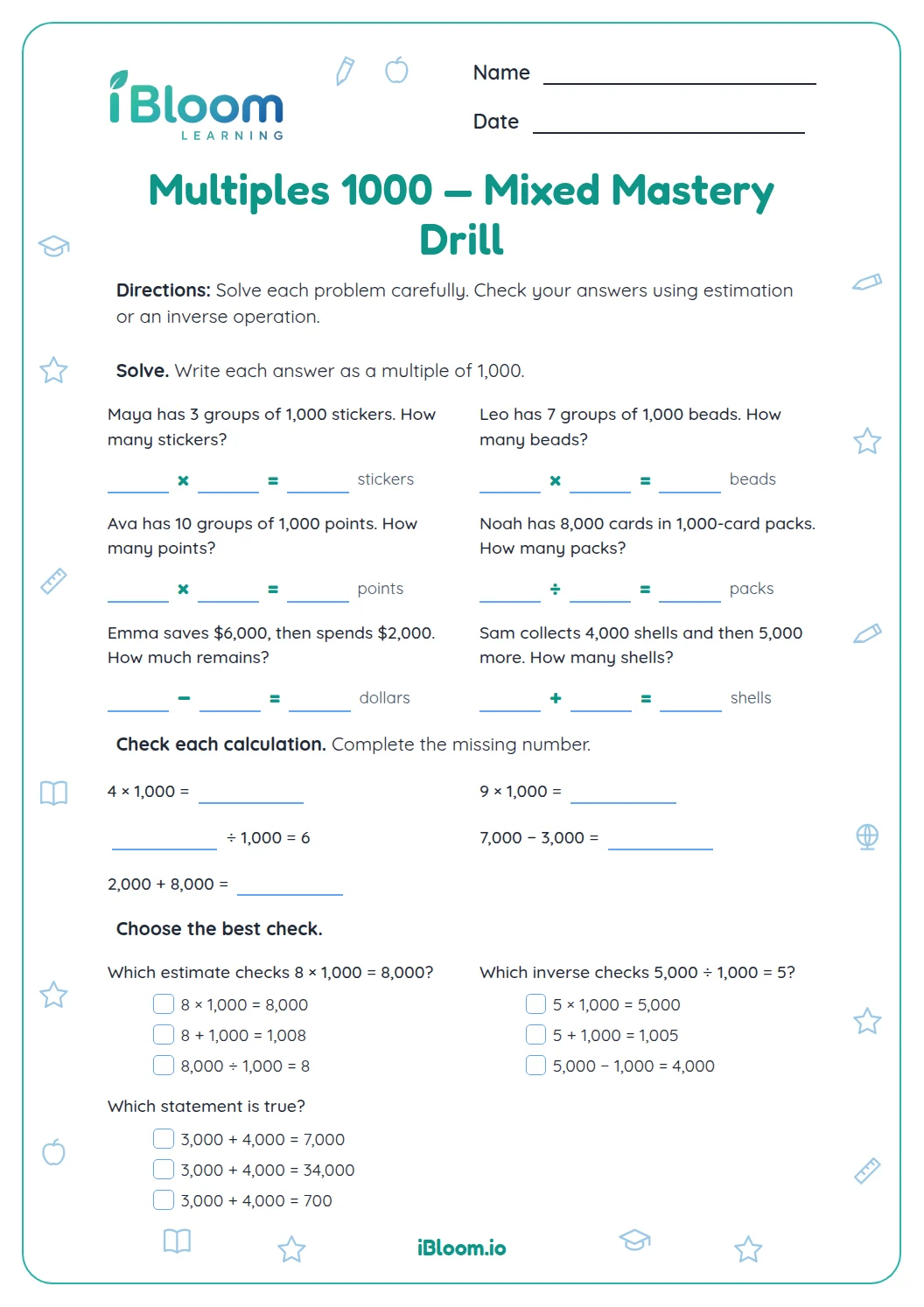
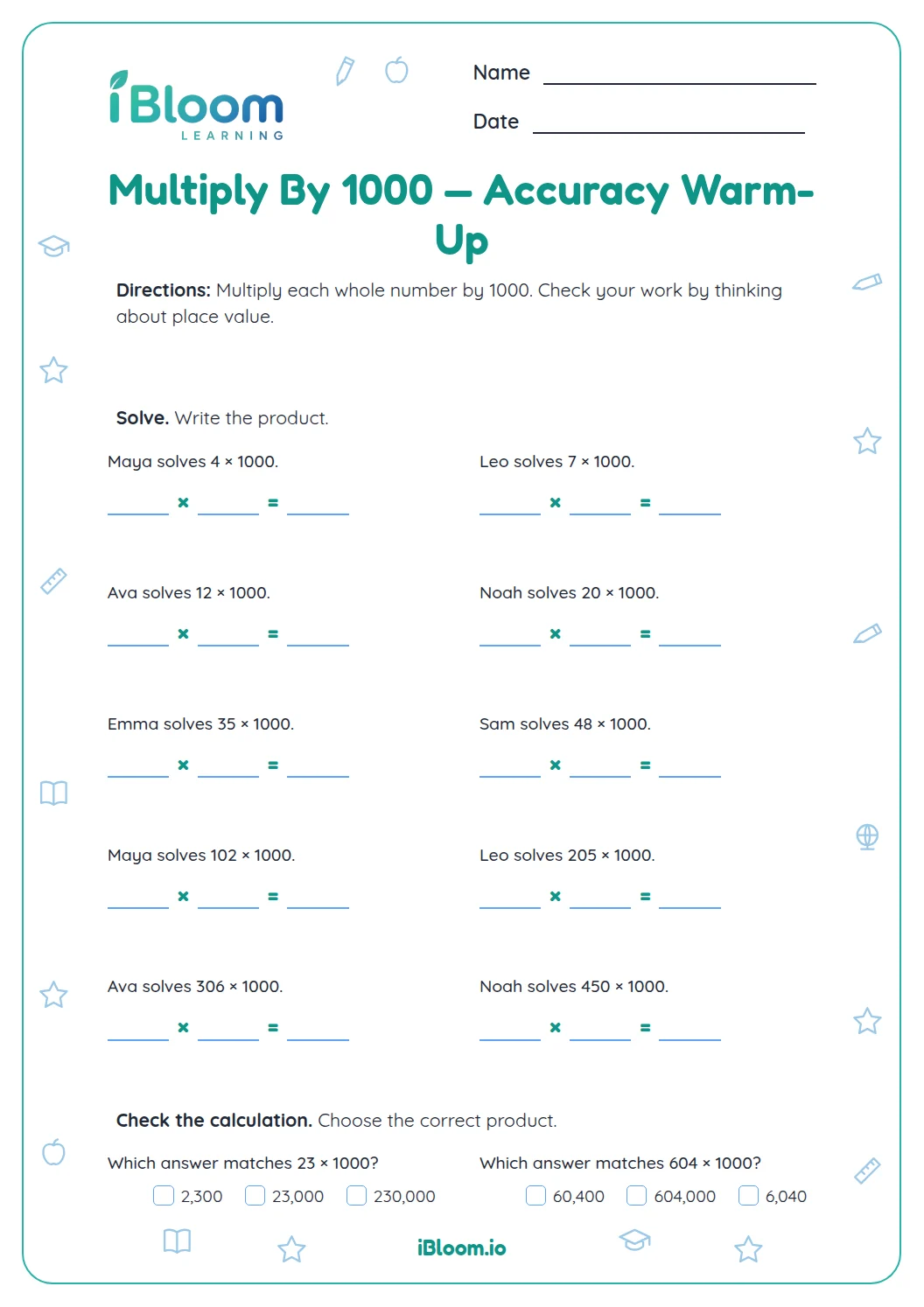
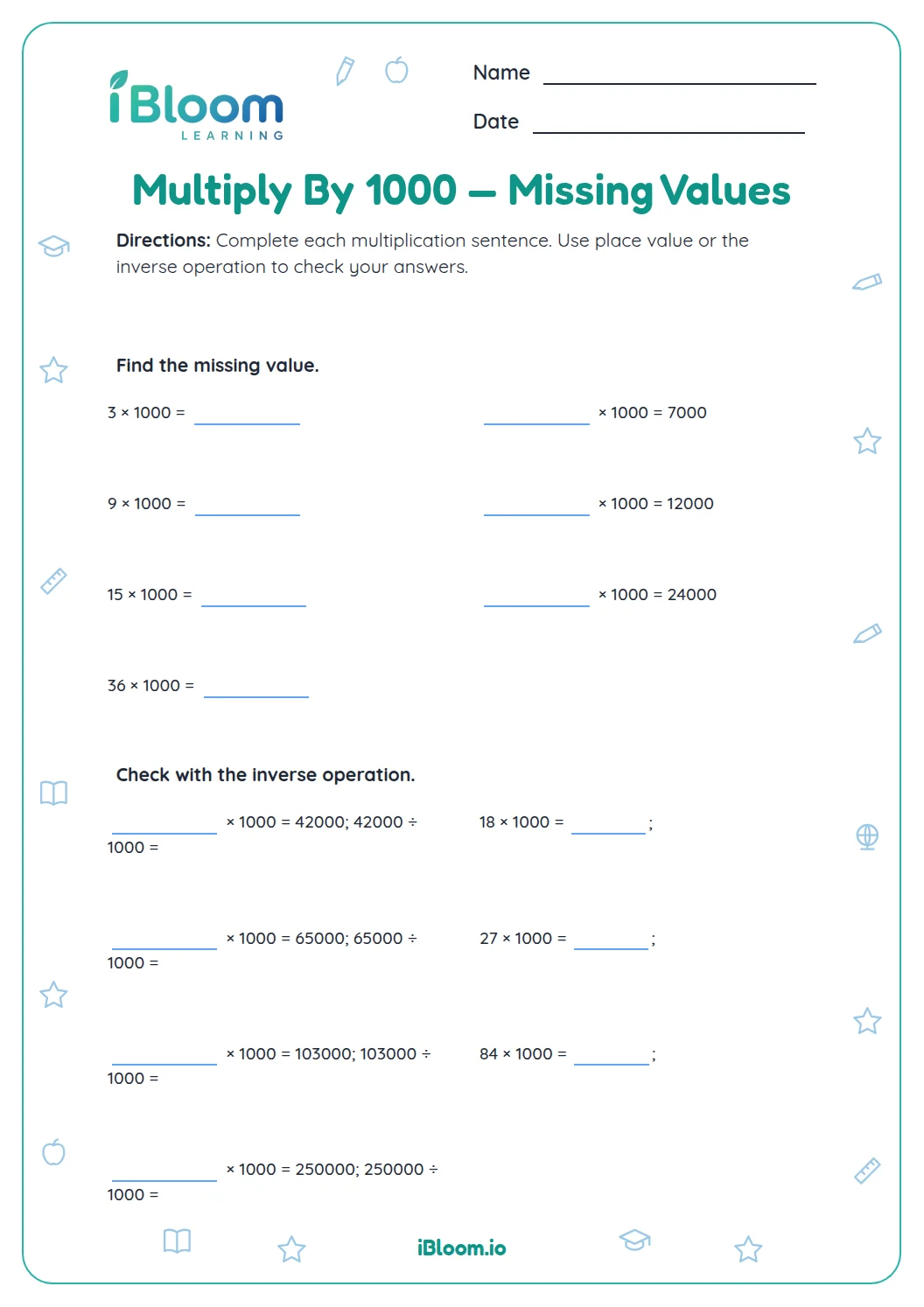
This two-page worksheet on multiples of 1,000 gives upper-elementary students 16 short calculations. They add and subtract thousands, multiply a one-digit number by 1,000, and use related operations to check results, following the old sheet’s mix of calculation and inverse-fact practice. A separate answer key is included. The multiplication items use place value to find products with 1,000.
Aligned to 4.NBT.B.5
How does multiplying by 1,000 work?
Multiples of 1,000 are numbers such as 3,000, 8,000, and 15,000. To add or subtract them, work with the thousands and keep the place values aligned. For example, 3,000 + 4,000 is 7,000.
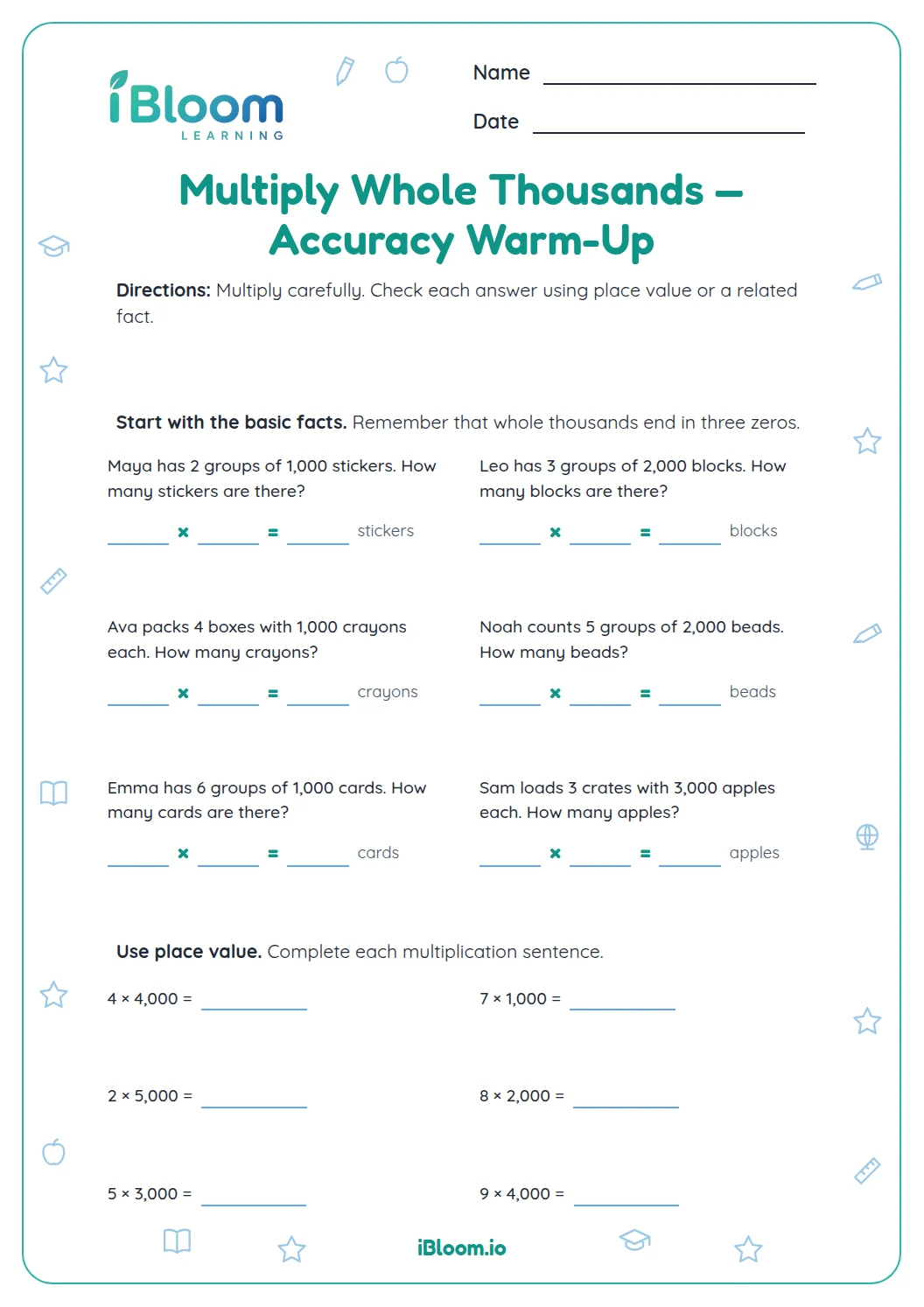
A group of 1,000 means one thousand in each group. Seven groups of 1,000 make 7,000. These patterns connect addition and subtraction to multiplication and division.
- 13,000 + 4,000 = 7,000
- 2Three thousands plus four thousands make seven thousands.
How can you find a missing factor?
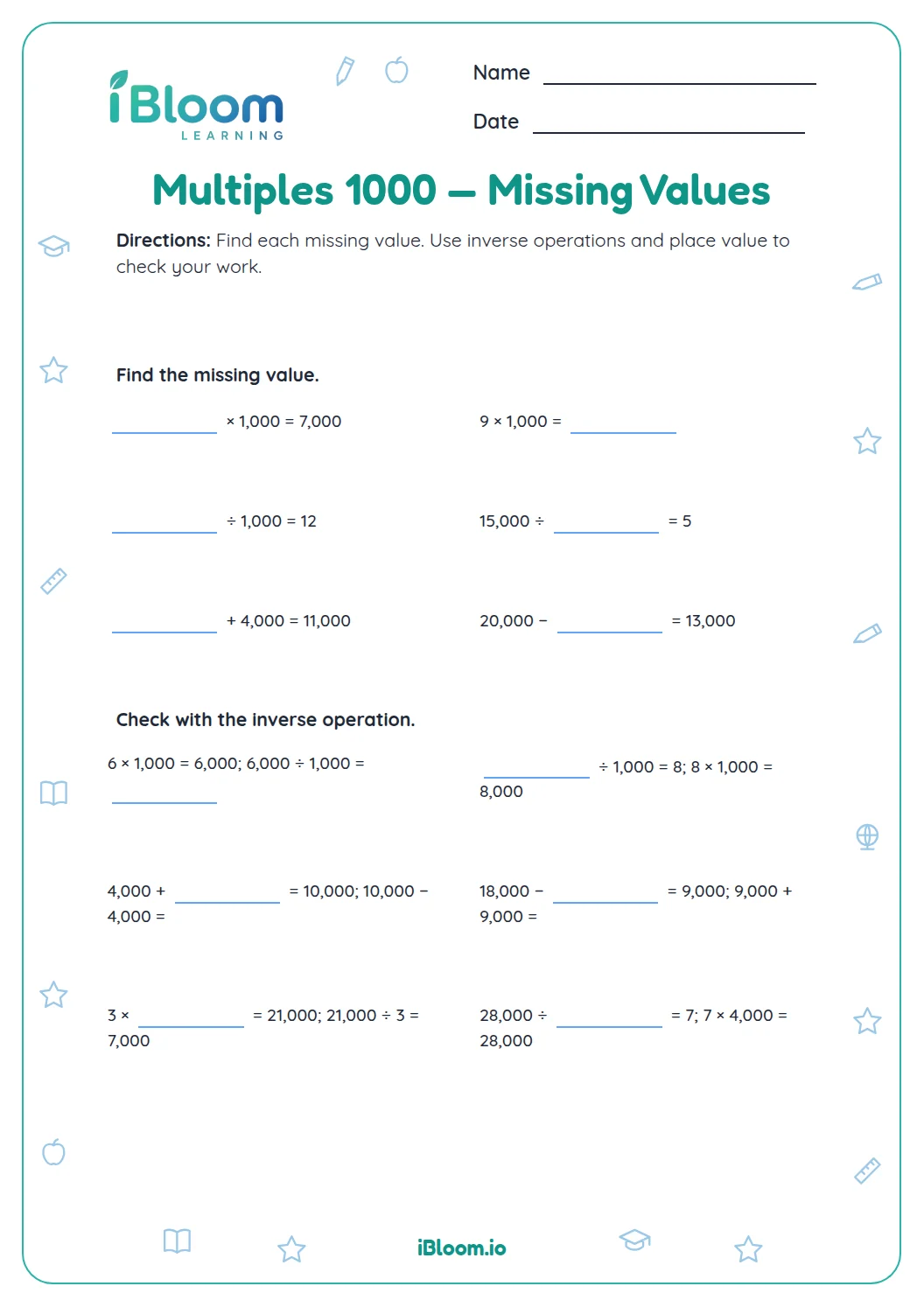
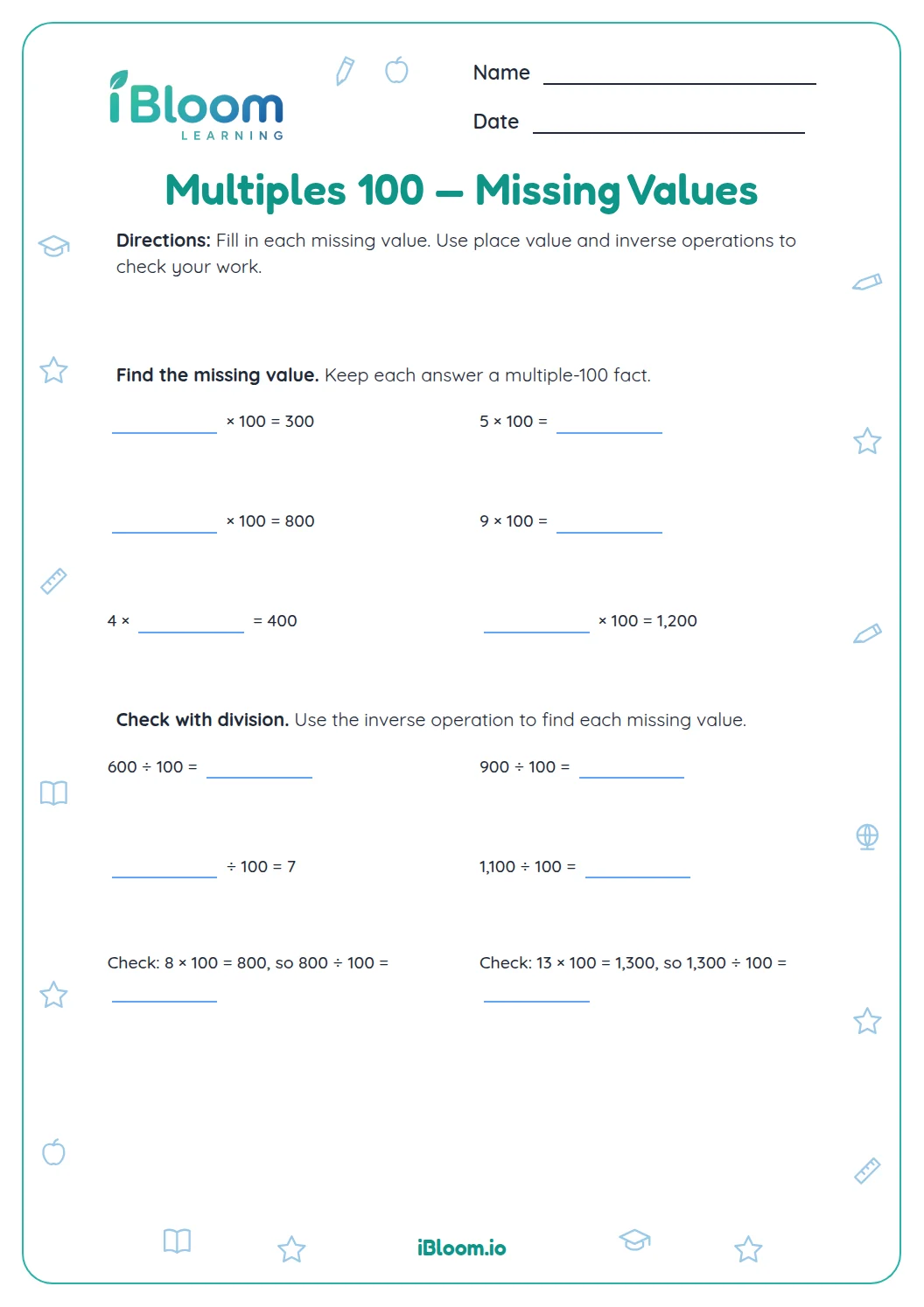
Related facts help check a calculation. If 6 × 1,000 = 6,000, then 6,000 ÷ 1,000 = 6. Addition can also check subtraction: add the difference back to the amount taken away and see whether it returns to the starting amount.
How can an inverse fact check an answer?
Addition and subtraction undo each other, as do multiplication and division. Question 13 checks 3,000 + 4,000 = 7,000 by subtracting 4,000 from 7,000 to get 3,000.
How to work through the page
- 1Line up the thousands and add or subtract their values.
- 2For equal groups, multiply the number of groups by 1,000.
- 3Use the inverse operation to check a result.
- 4Read each answer with its place value: 7,000 is seven thousand, not seven hundred.
Common mistakes
The mistake
Writing 700 for 3,000 + 4,000.
The fix
Add the numbers of thousands: 3 thousands plus 4 thousands equals 7 thousands.
The mistake
Writing 7 when asked for the value of 7 groups of 1,000.
The fix
The number of groups is 7, but their total value is 7,000.
The mistake
Dropping a zero when writing a product or sum in thousands.
The fix
Say the result in thousands first, then write the matching whole number.
Common Core alignment
The multiplication items practice this Grade 4 place-value standard.
Multiply a whole number of up to four digits by a one-digit whole number.
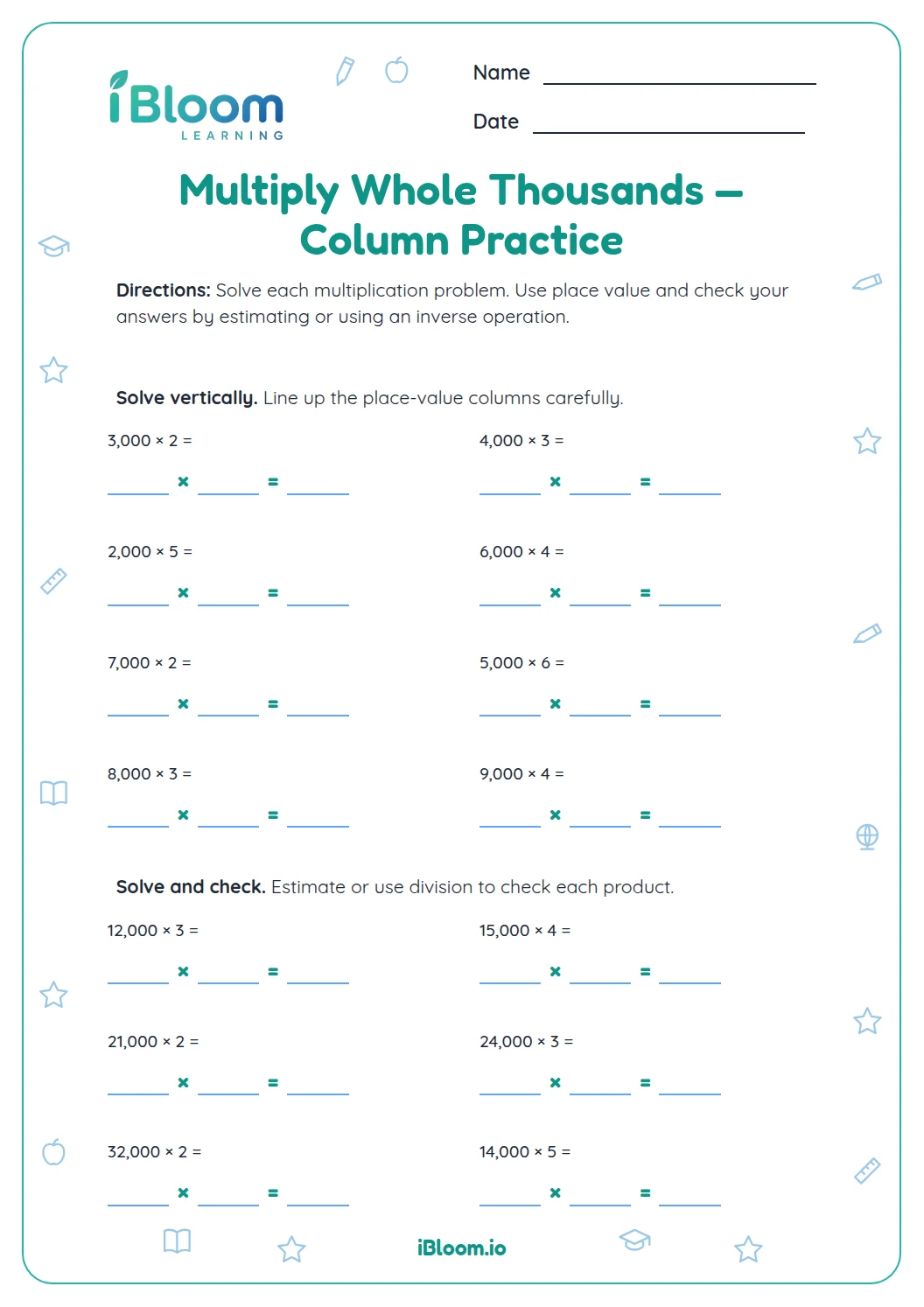
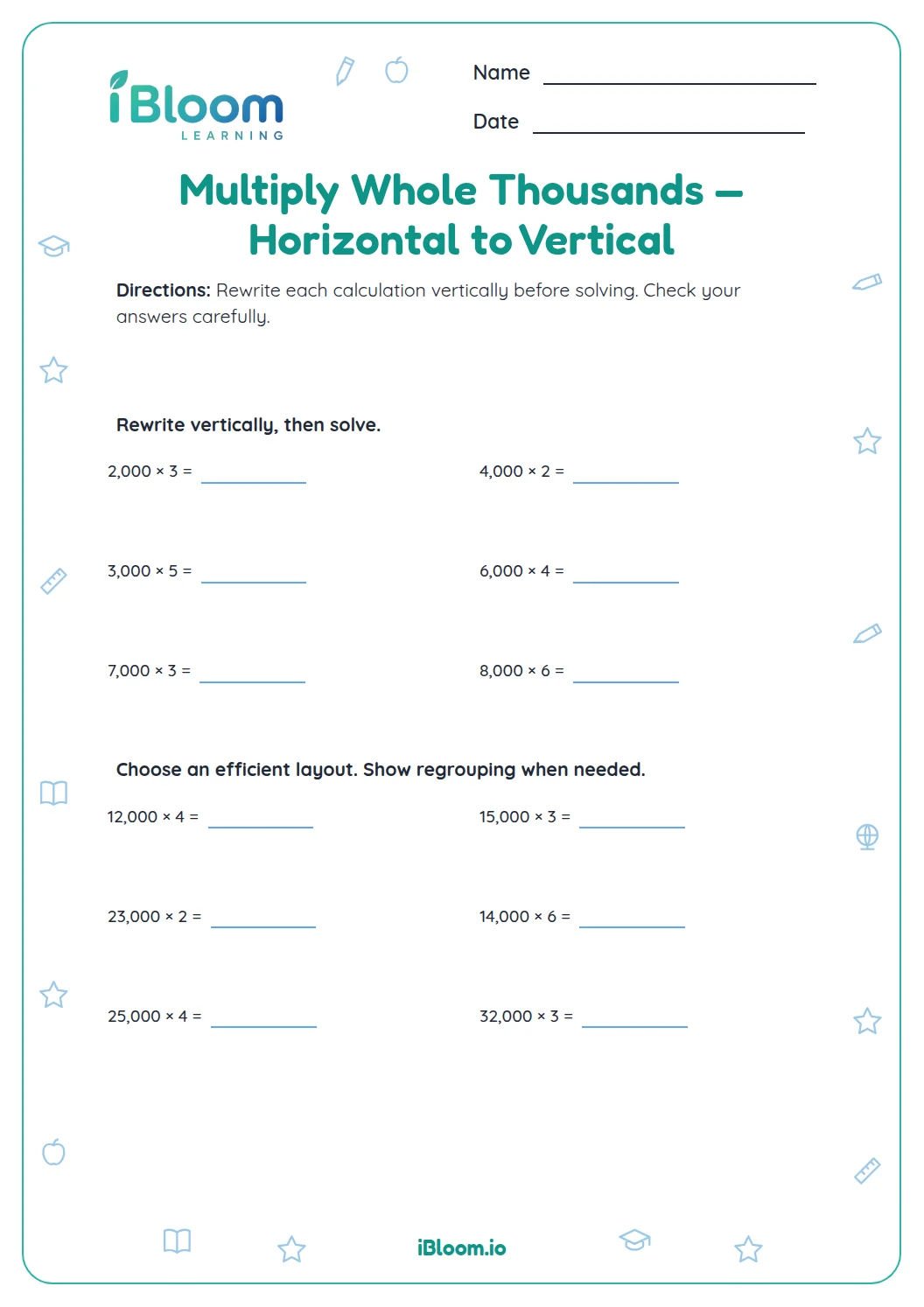
On this sheet: Part B multiplies one-digit whole numbers by 1,000, using place value.
Show the official wordingHide the official wording
Multiply a whole number of up to four digits by a one-digit whole number, and multiply two two-digit numbers, using strategies based on place value and the properties of operations. Illustrate and explain the calculation by using equations, rectangular arrays, and/or area models.
What to practice next
Make more practice
Further reading
Questions parents and teachers ask
What are multiples of 1,000?
The sheet has 16 problems in three parts: eight additions and subtractions, four products of a one-digit number and 1,000, and four related-fact checks. Students work with multiples of 1,000 throughout, then check selected results with an inverse operation repeatedly.
How can a child add thousands?
Add the number of thousands while keeping place values aligned. For example, 3,000 plus 4,000 is 7,000. Reading the answer aloud as “seven thousand” can help children notice if they wrote too few or too many zeros in the final number.
How does multiplication connect to groups of 1,000?
Multiplication counts equal groups. If there are six groups and each group holds 1,000, multiply 6 by 1,000 to find 6,000 altogether. The page includes several group-count examples to connect multiplication facts with larger place values. Each factor keeps its place-value meaning visible.
How can the answers be checked?
Use an inverse operation when possible. Addition can check subtraction by adding the difference to the amount taken away. Division can check a product such as 6 times 1,000 by dividing 6,000 by 1,000 and returning to 6. This helps check each product.
Which standards does this worksheet practice?
The addition and subtraction items connect with Grade 4 standard 4.NBT.B.4. Multiplying single-digit group counts by 1,000 connects with 4.NBT.B.5, which develops multiplication using place-value reasoning and properties of operations. The number sentences emphasize place value rather than long multiplication. Students can use the key after completing their own calculations and checks.