
About this worksheet
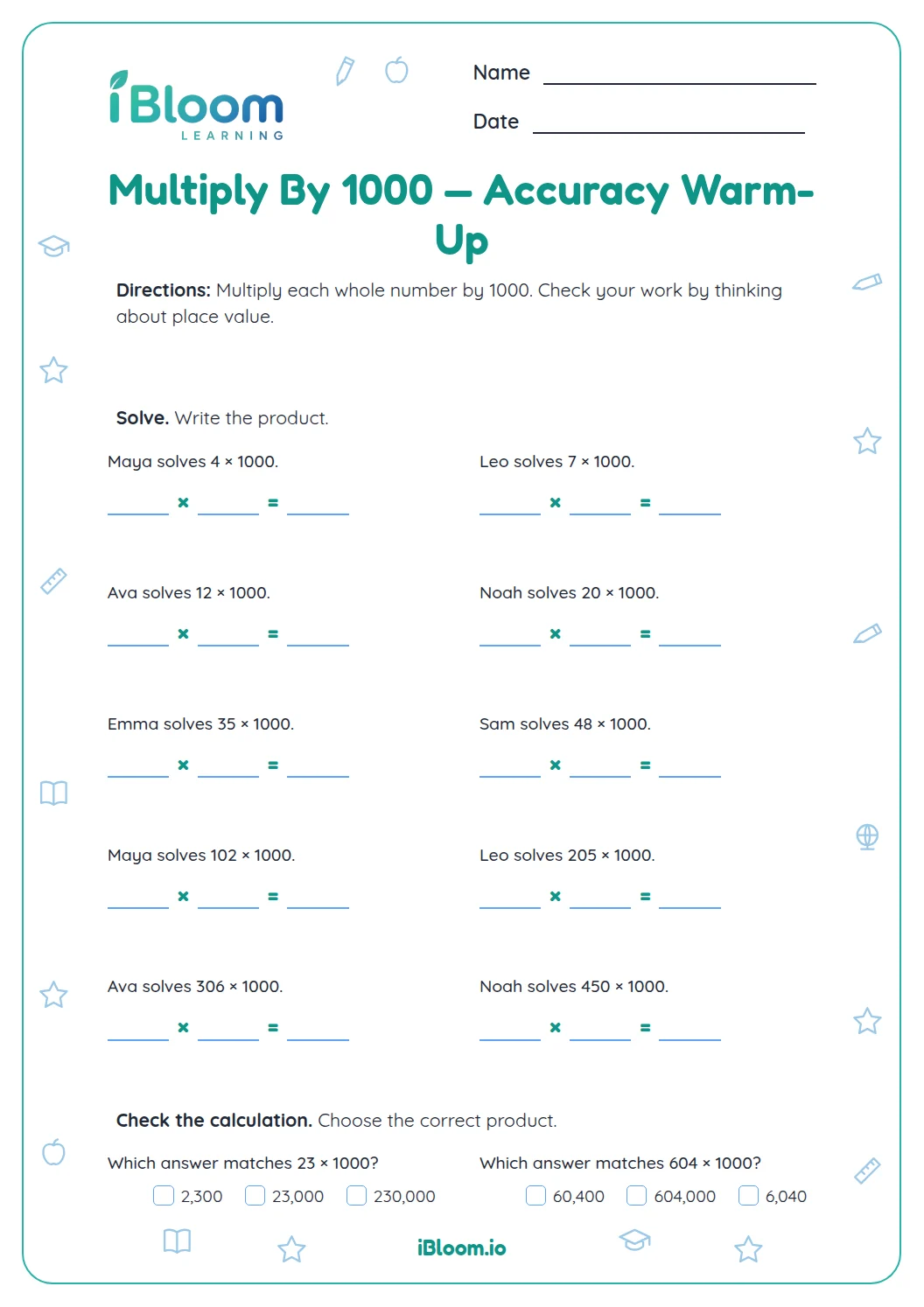
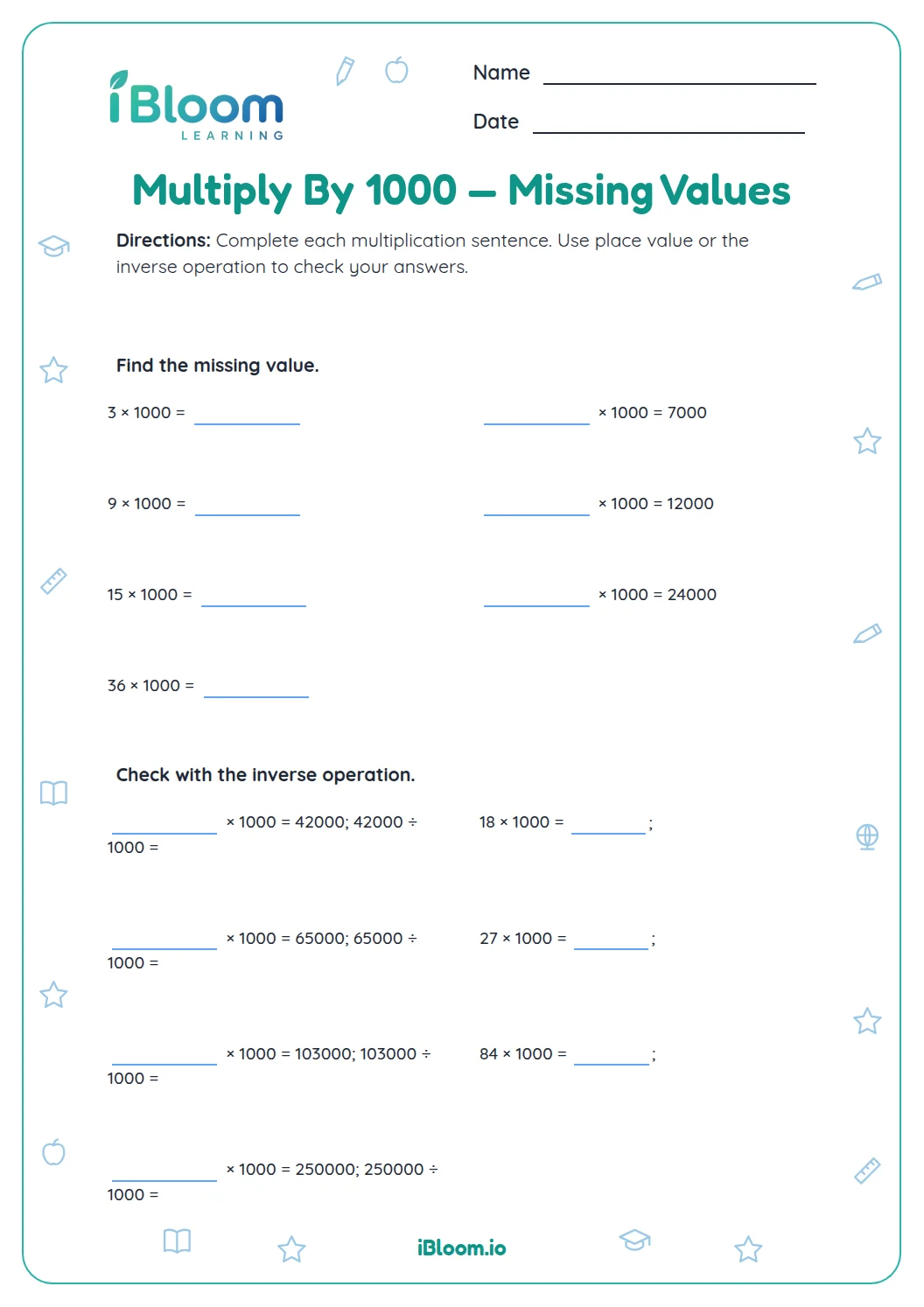
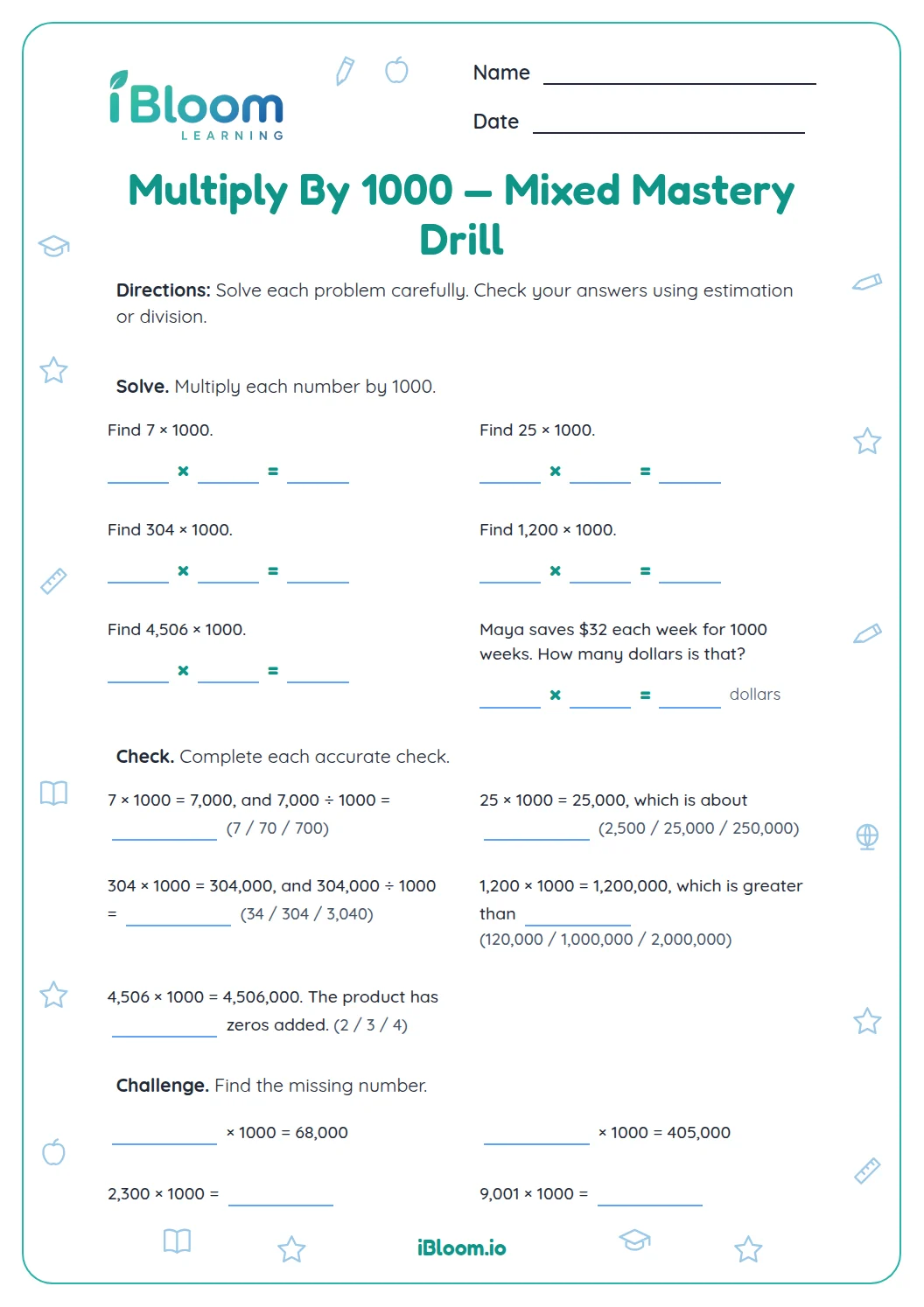
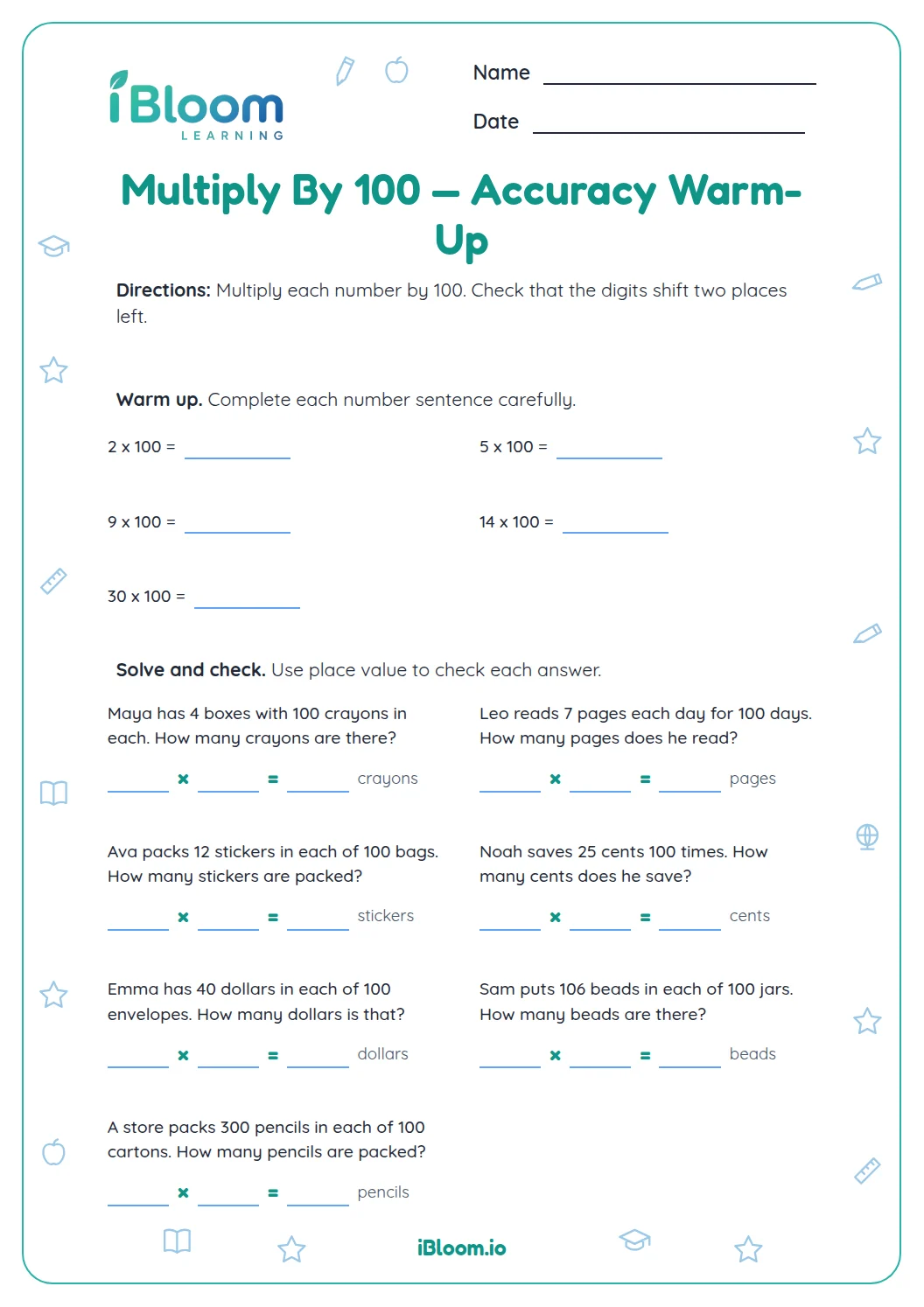
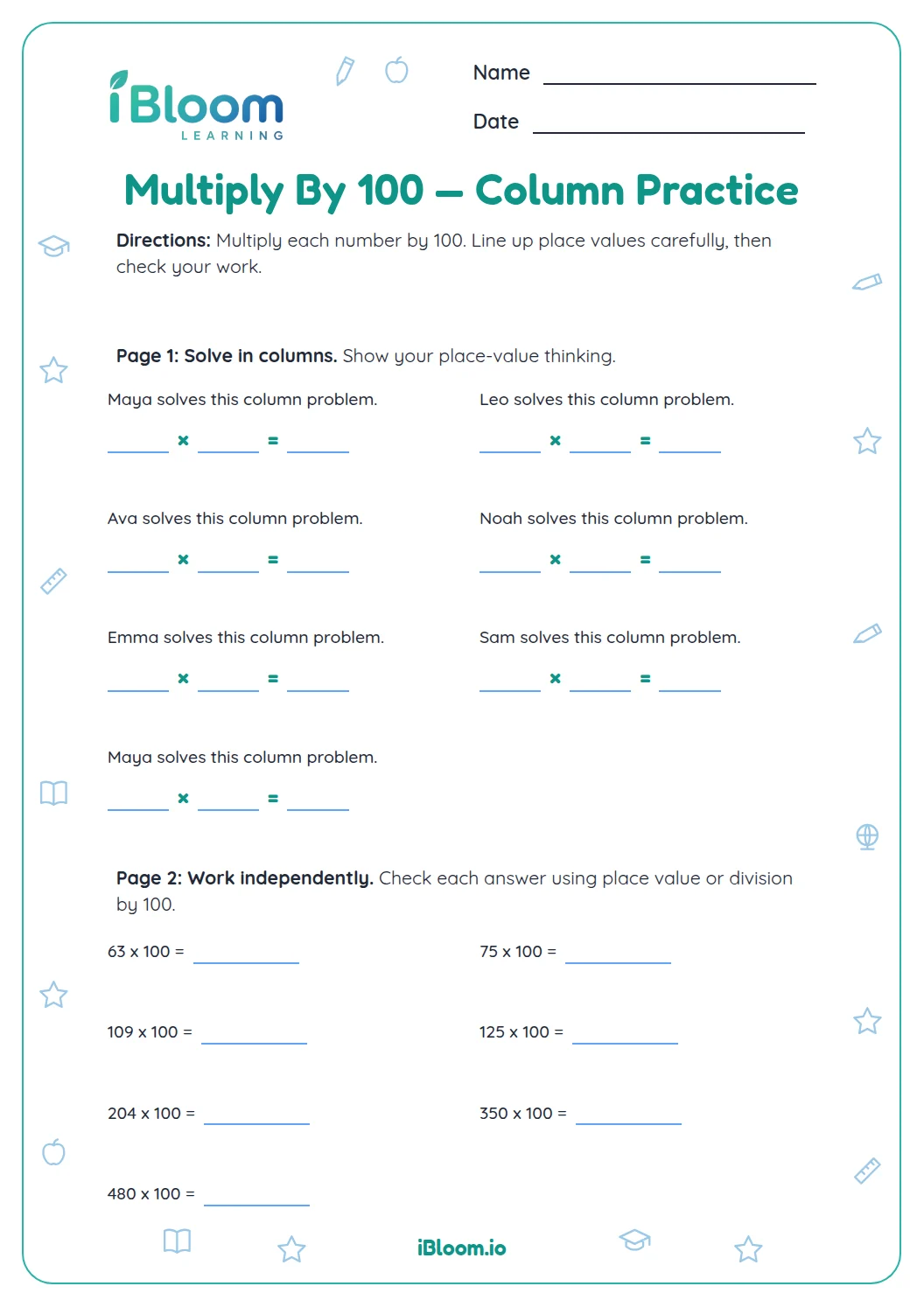
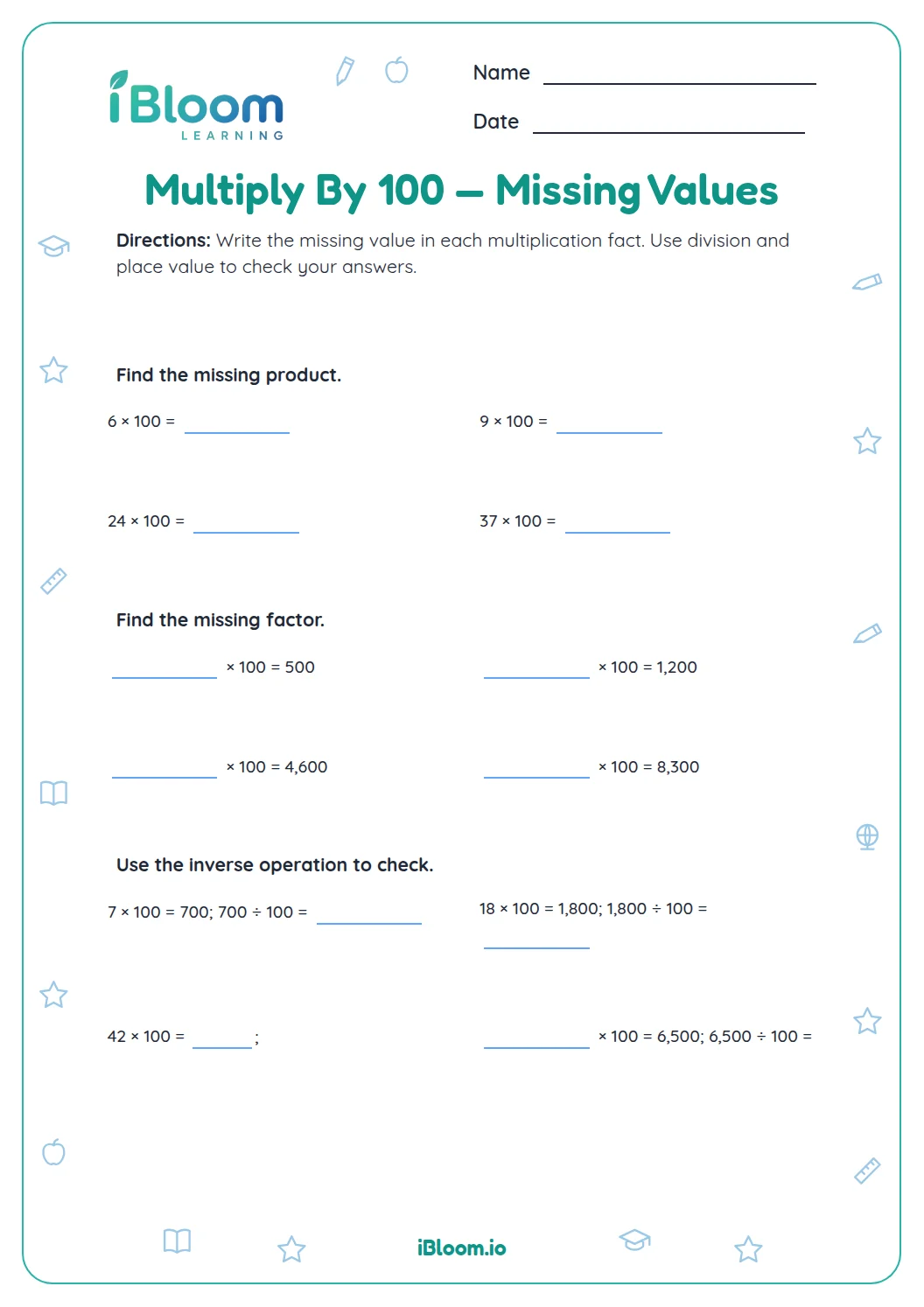
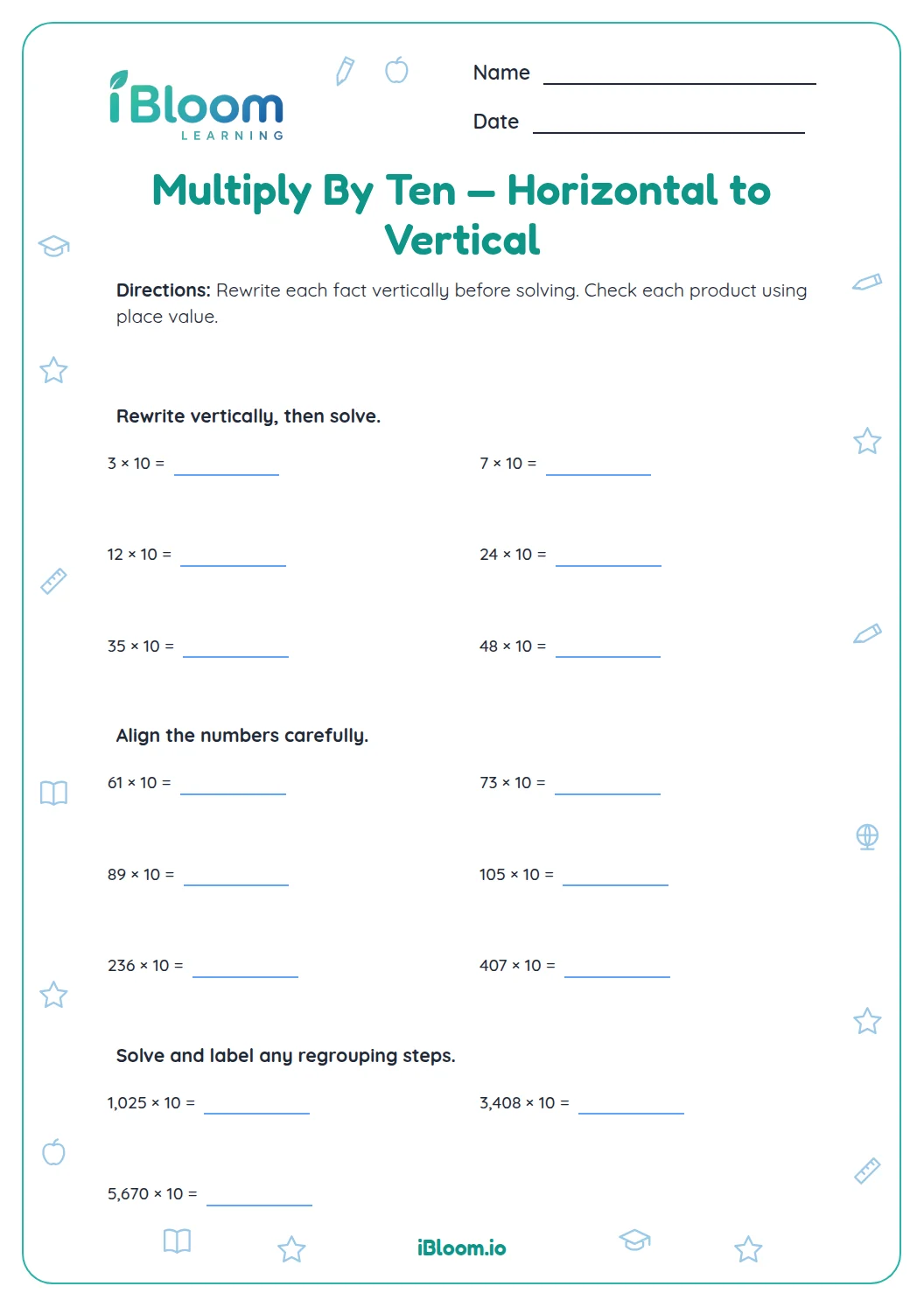
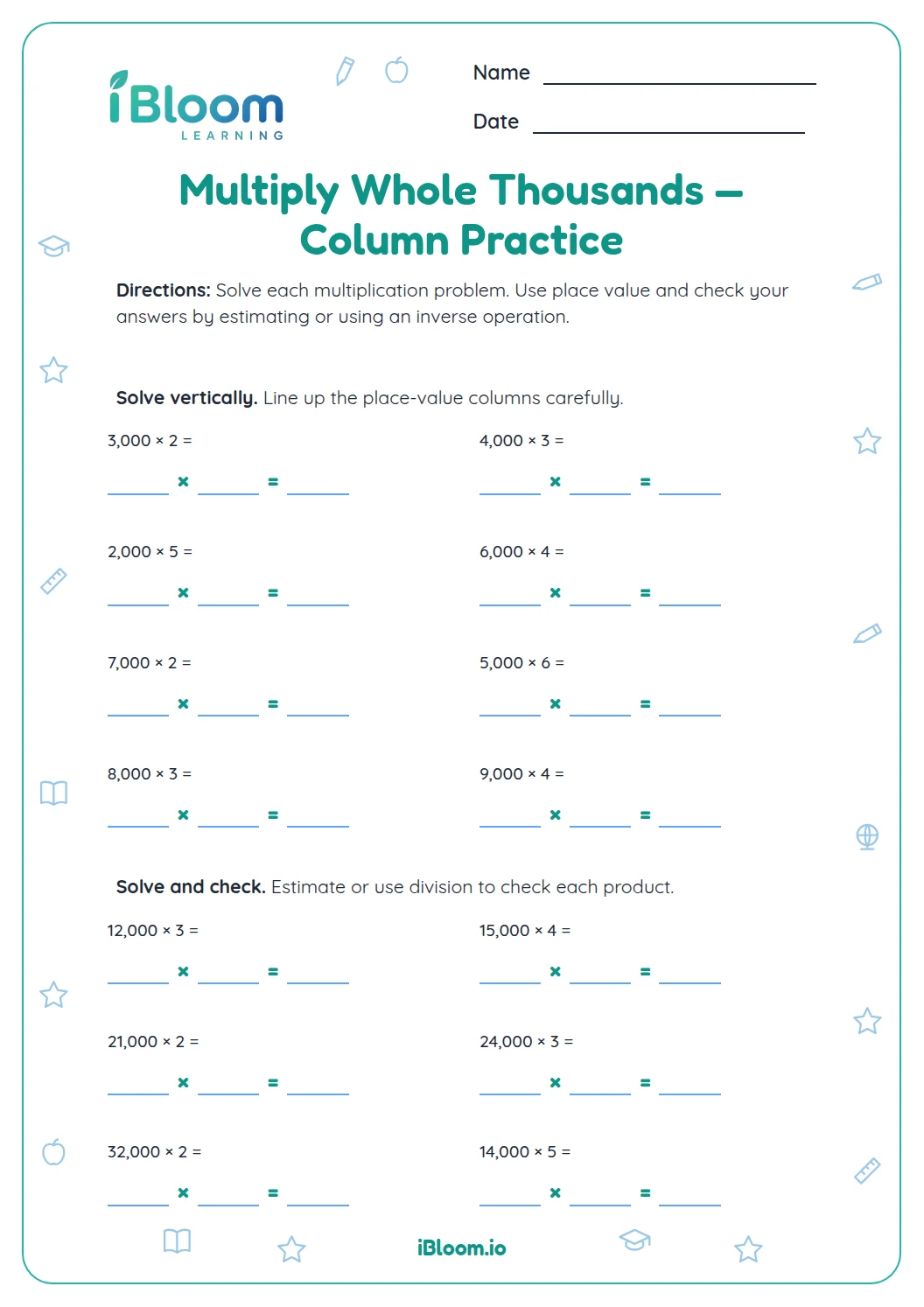
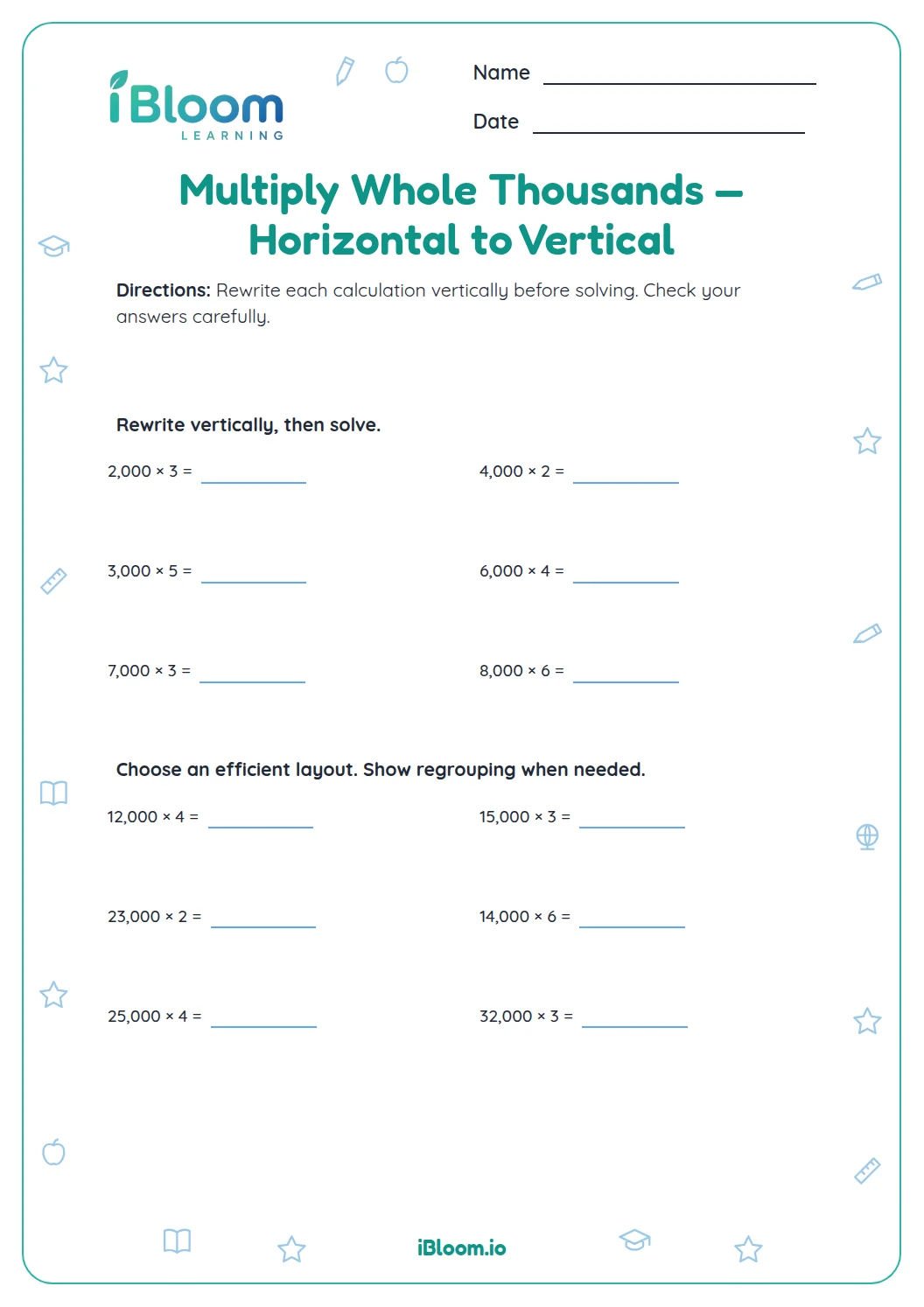
This Grade 5 worksheet practices multiplying whole numbers by 1,000. The factors progress from one digit to four digits, helping learners see how each digit shifts three places left in the product. Children record the product for each horizontal equation and can show the place-value shift in a vertical layout on their own paper. The practice supports multi-digit multiplication in CCSS 5.NBT.B.5; a separate answer key is included.
Aligned to 5.NBT.B.5
What happens to each digit when you multiply by 1,000?
Multiplying by 1,000 shifts every digit three places left in the place-value chart. For whole-number products, this is often shown by appending three zeros.
The factors grow from one digit to four digits so children can notice the same place-value change at each size.
- 1108 × 1,000
- 2Each digit shifts three places left.
- 3108,000 has three zeros after 108.
- 4108 × 1,000 = 108,000
How do the two parts build practice?
Part A begins with one-, two-, and three-digit factors. Part B continues the pattern with factors up to four digits. In each item, record the product and check that each digit has shifted three places.
The worksheet provides answer lines; learners can also use scratch paper to write a vertical place-value layout before recording a product.
How can a learner check a product?
Compare the number of digits and the place values. A factor with three digits, such as 203, becomes a six-digit product, 203,000. Multiplying the product by one thousand should reverse the shift only when dividing by one thousand.
How to multiply by 1,000
- 1Read the factor and identify each digit’s place.
- 2Shift each digit three places left in a place-value chart.
- 3Write zeros in the empty places to keep the digits aligned.
- 4Record the product with a comma every three places.
- 5Check that the product is 1,000 times the original factor.
Place-value multiplication mistakes to catch
The mistake
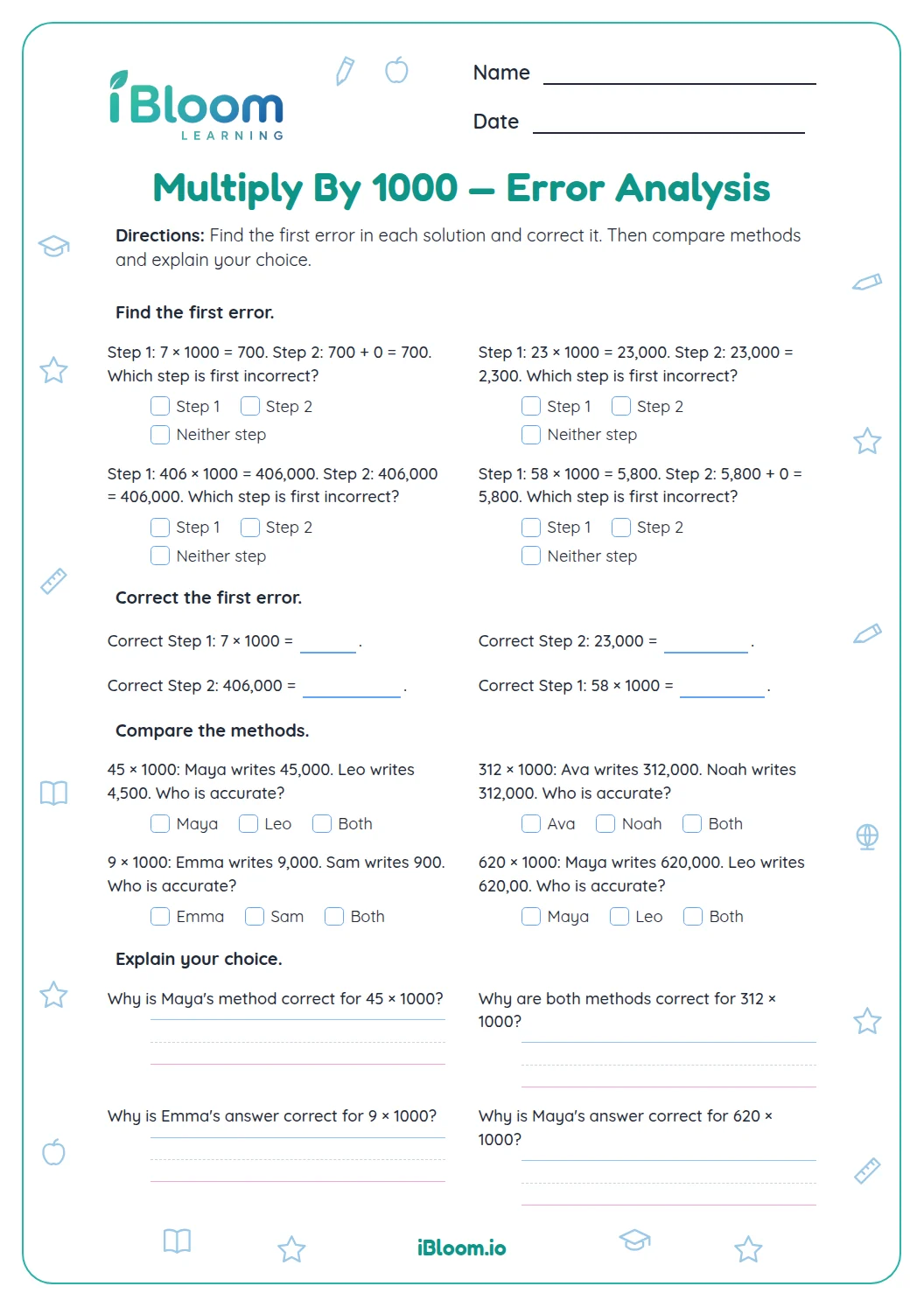
Adding three zeros to 108 but writing 10,800.
The fix
Count three places: 108,000.
The mistake
Dropping a zero from a factor such as 203.
The fix
Keep every digit in order, then shift the full number three places left.
The mistake
Leaving out the comma in a large product.
The fix
Group digits in threes from the right: 203,000.
Common Core alignment
This sheet uses place value and written multiplication for whole-number products.
Multiply multi-digit whole numbers by 1,000 using place-value shifts.
On this sheet: The worksheet asks learners to find products of whole-number factors and 1,000 using place-value reasoning.
Show the official wordingHide the official wording
Fluently multiply multi-digit whole numbers using the standard algorithm.
What to practice next
Make more practice
Further reading
Questions parents and teachers ask
What does multiplying by 1,000 do to a whole number?
It makes the number 1,000 times as large, shifting each digit three places to the left in a place-value chart. For example, 36 becomes 36,000. The worksheet moves from small factors to larger ones so learners can apply the same shift to every digit.
Why does the worksheet use factors with different numbers of digits?
The factors progress from one digit to four digits, so learners can see that every digit shifts three places left. The rule works for 4 and for 2,406. Keeping the digits in order helps when the factor contains a zero.
Why do the factors grow from one digit to four digits?
There are 16 questions across two parts. The first part starts with smaller factors, and the second includes factors up to four digits. The worksheet takes two pages, followed by a separate two-page answer key with the products.
How can a child check a product such as 203 × 1,000?
Check the digit shift and comma placement. Moving 203 three places left gives 203,000, which is 1,000 groups of 203. The comma separates the thousands from the remaining digits and makes this large product easier to read and check.
What is a quick way to check a product?
The worksheet gives answer lines for the products. A learner can use scratch paper to write the digits in a place-value chart or vertical layout, then copy the product onto the line. The answer key lists each correct product for checking.