


About this worksheet
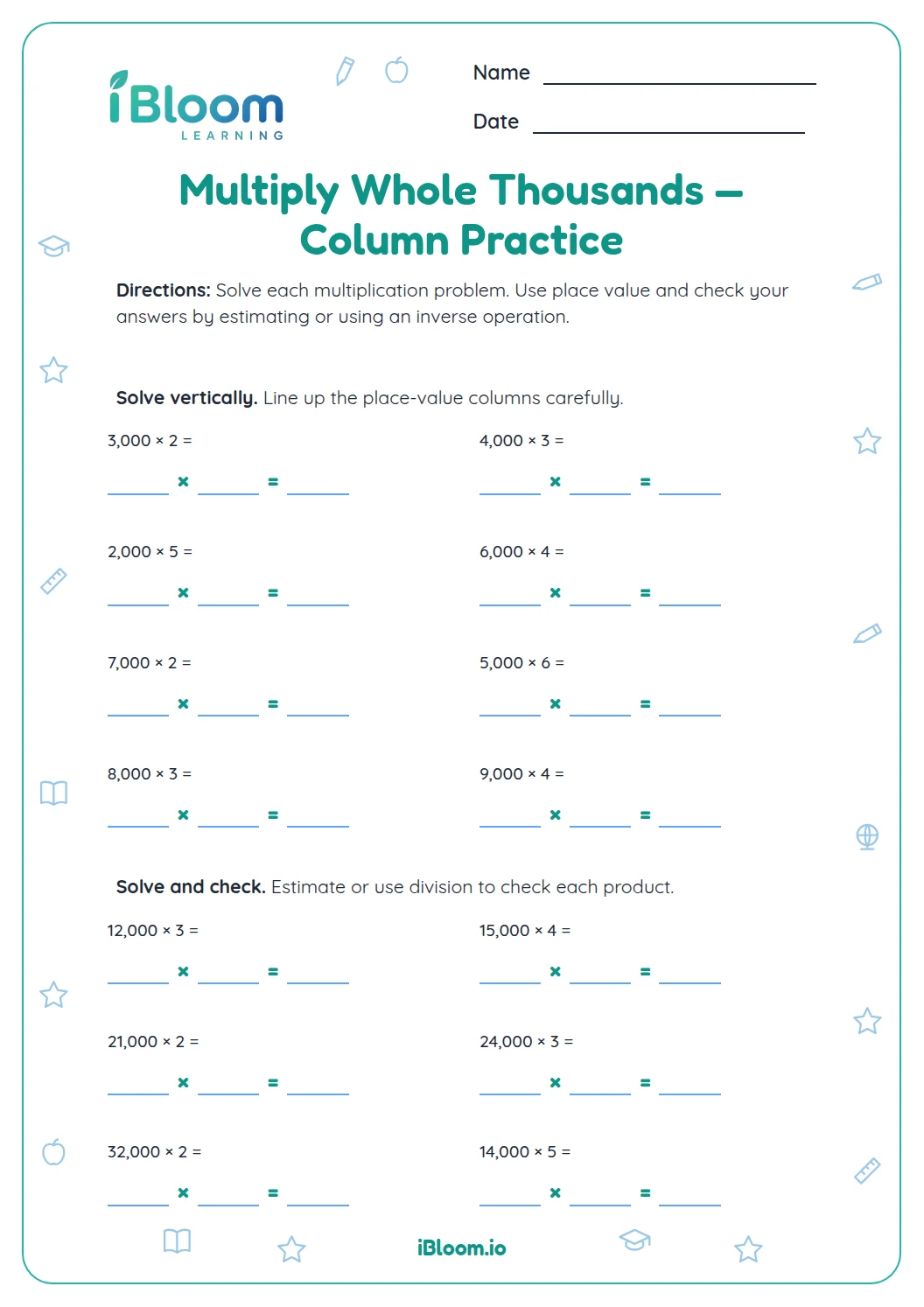
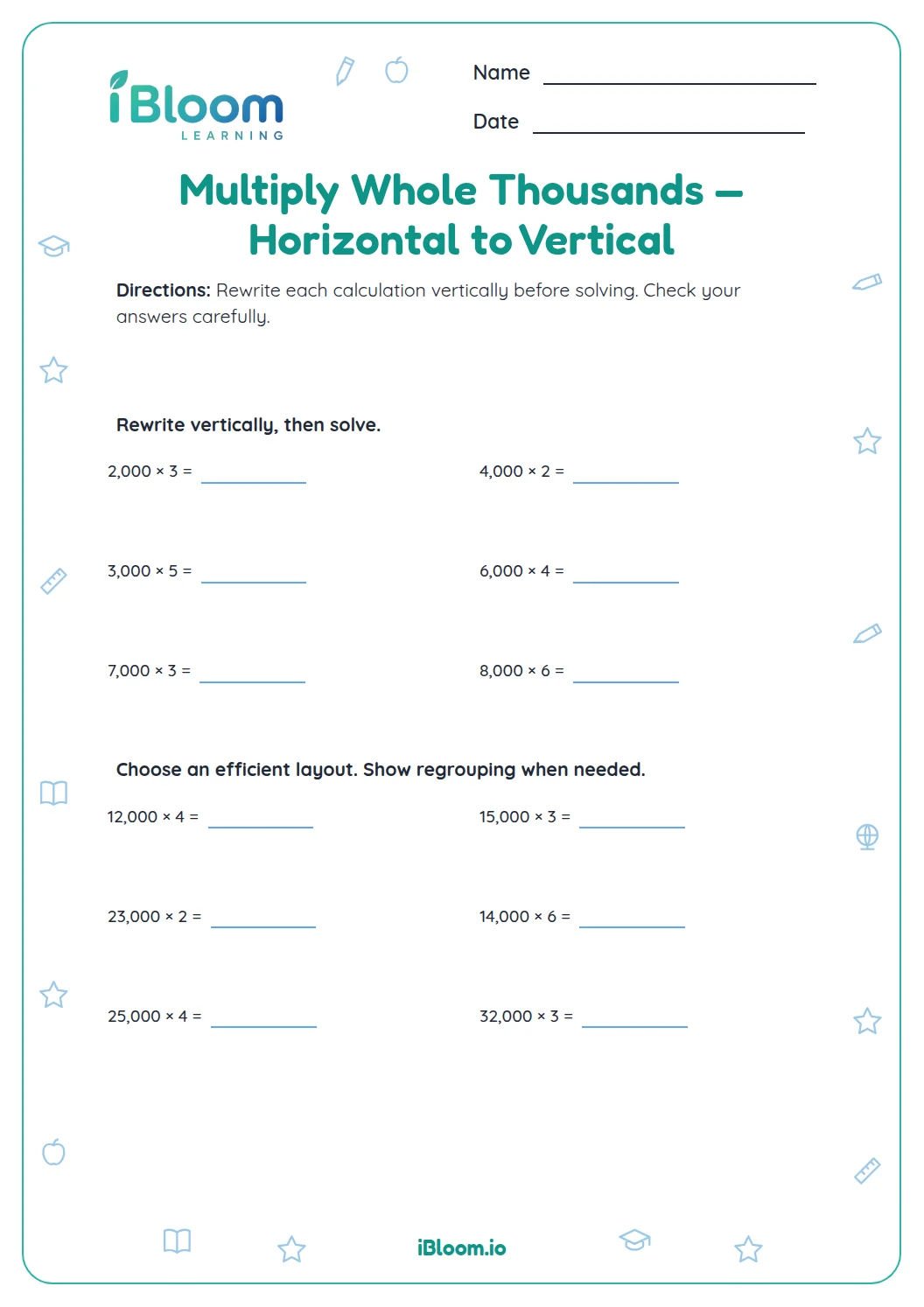
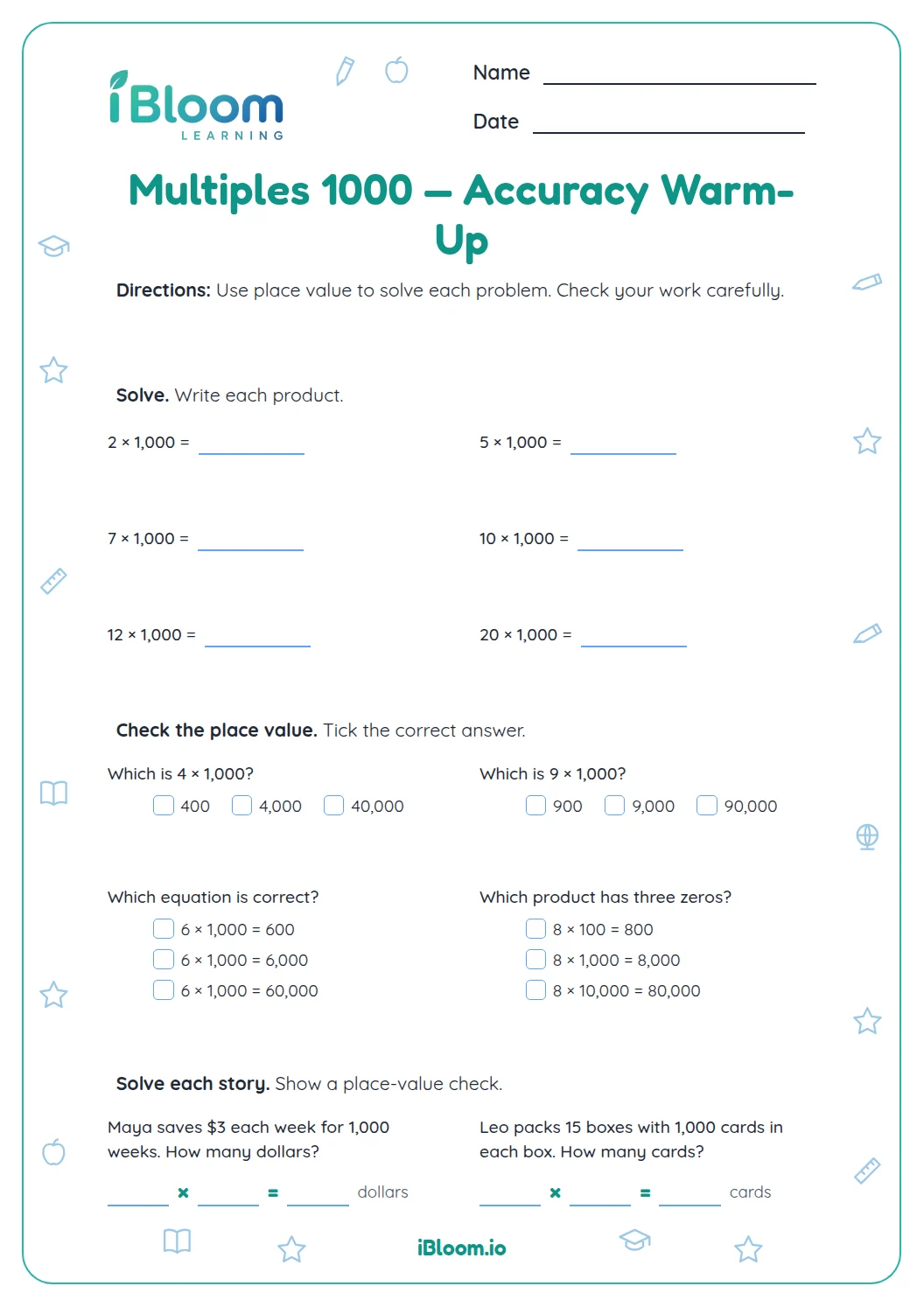
This Grade 4 multiplication worksheet practices multiplying a one-digit number by a whole thousand and finding a missing factor in an equation. Students solve eight product equations, eight missing-factor equations, and four short multiplication situations. They can multiply or divide the nonzero parts, then use place value to check. An answer key is included.
Aligned to 4.NBT.B.5
What happens when you multiply by a whole thousand?
Find the basic product, then use the place value in the factor. In question 1, 3 × 4 = 12, and 4,000 has three zeros, so the product is 12,000.
- 13 × 4,000 = 3 × 4 thousands
- 23 × 4 = 12, so the product is 12,000
How can you find the missing factor?
Think of the equation as a multiplication fact with thousands. In question 12, ___ × 3,000 = 27,000 becomes ___ × 3 = 27, so the missing factor is 9.
How can you check a missing value?
Put your answer back in the original equation. Check both the multiplication fact and the number of zeros. For question 13, 5 × 9,000 = 45,000.
How to use this worksheet
- 1Do the first product by multiplying the nonzero digits.
- 2Write the place value back into the product.
- 3For a missing factor, divide the product’s nonzero part by the known factor.
- 4Substitute your answer to check the full equation.
Common mistakes and quick fixes
The mistake
Dropping a zero from the product.
The fix
Say “twelve thousands” for 3 × 4,000, then write 12,000.
The mistake
Multiplying the known factor by the product.
The fix
Use the inverse operation to find the missing factor.
The mistake
Treating 6,000 like 6.
The fix
Use 6 × 4 = 24, then note that the factor is 6,000, so the answer is 24,000.
Common Core alignment
This page practices the following Common Core skill.
Multiply a one-digit factor by whole thousands and find a missing factor.
On this sheet: The equations practice multiplying one-digit factors by four-digit whole thousands.
Show the official wordingHide the official wording
Multiply a whole number of up to four digits by a one-digit whole number, and multiply two two-digit numbers, using strategies based on place value and the properties of operations. Illustrate and explain the calculation by using equations, rectangular arrays, and/or area models.
What to practice next
Make more practice
Further reading
Questions parents and teachers ask
How does multiplying by 4,000 work?
First multiply by 4: 3 × 4 = 12. Since the factor is 4,000, the product is 12 thousands, or 12,000. Keeping the zeroes attached to the factor is a useful way to check that the product is in the correct place value.
How do I solve ___ × 8,000 = 56,000?
Compare the nonzero parts: ___ × 8 = 56. Since 7 × 8 = 56, the missing factor is 7. Check it in the original equation: 7 × 8,000 = 56,000. The thousands stay attached to the known factor, while the one-digit multiplication fact reveals the missing number.
Why are there products and missing factors?
The worksheet has eight equations asking for a product and eight asking for a missing factor, followed by four short word problems. Switching between product and factor forms helps students connect multiplication facts to the inverse operation while whole-thousand place value stays consistent.
Should I write commas in the answers?
Commas make large numbers easier to read, so the answer key uses them in values such as 24,000 and 56,000. A student’s answer is numerically correct if the digits and place value are correct, even if the comma is omitted.
What can my child do after this page?
Try multiplying whole hundreds or whole tens, then move to larger column multiplication. The next practice links focus on multiples of 1,000, multiplying by 1,000, and missing factors with other place values. Each equation keeps the same whole-thousand pattern while varying which value is missing. The next practice pages extend this same reasoning to whole hundreds, tens, and larger column multiplication.