



About this worksheet
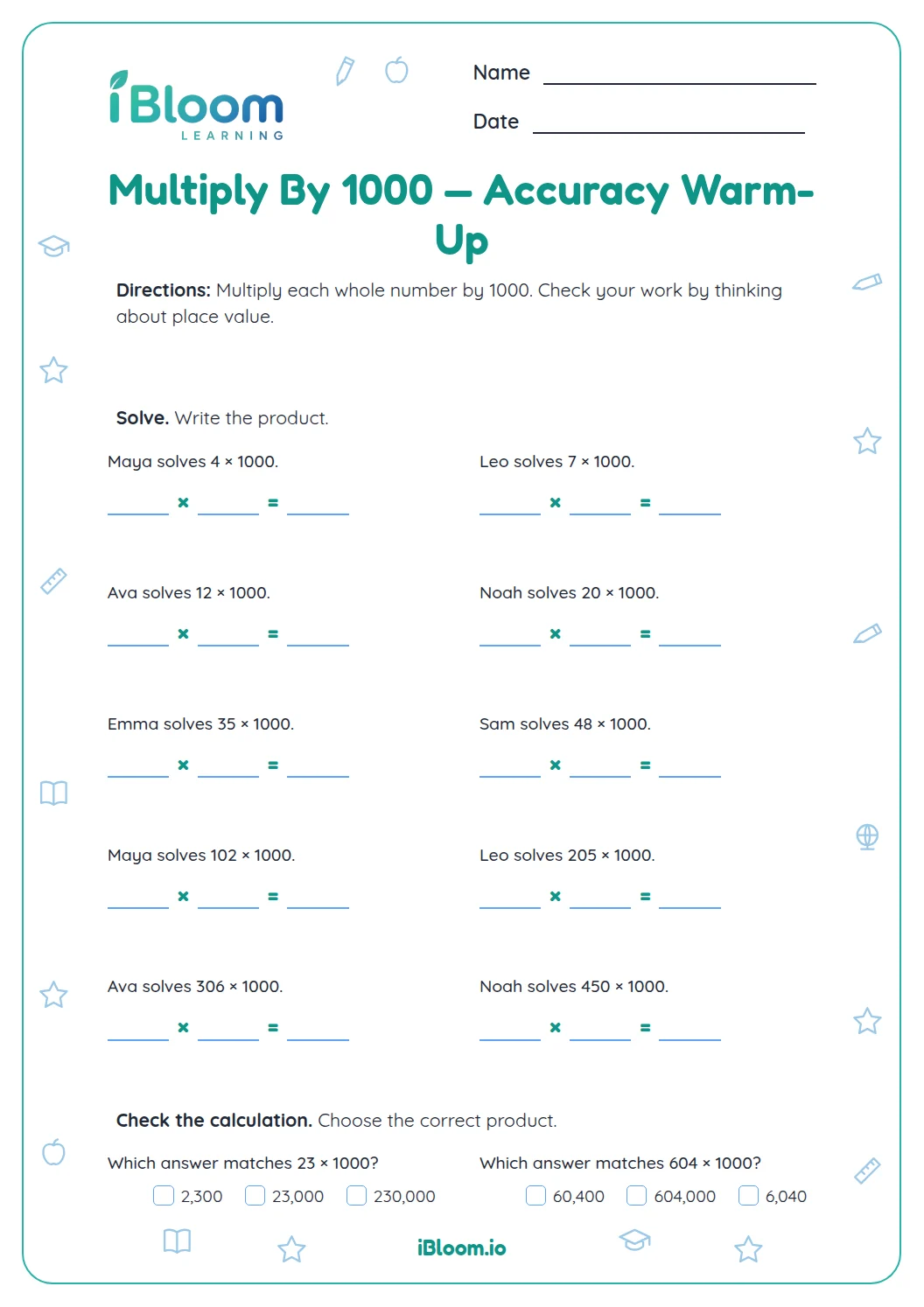
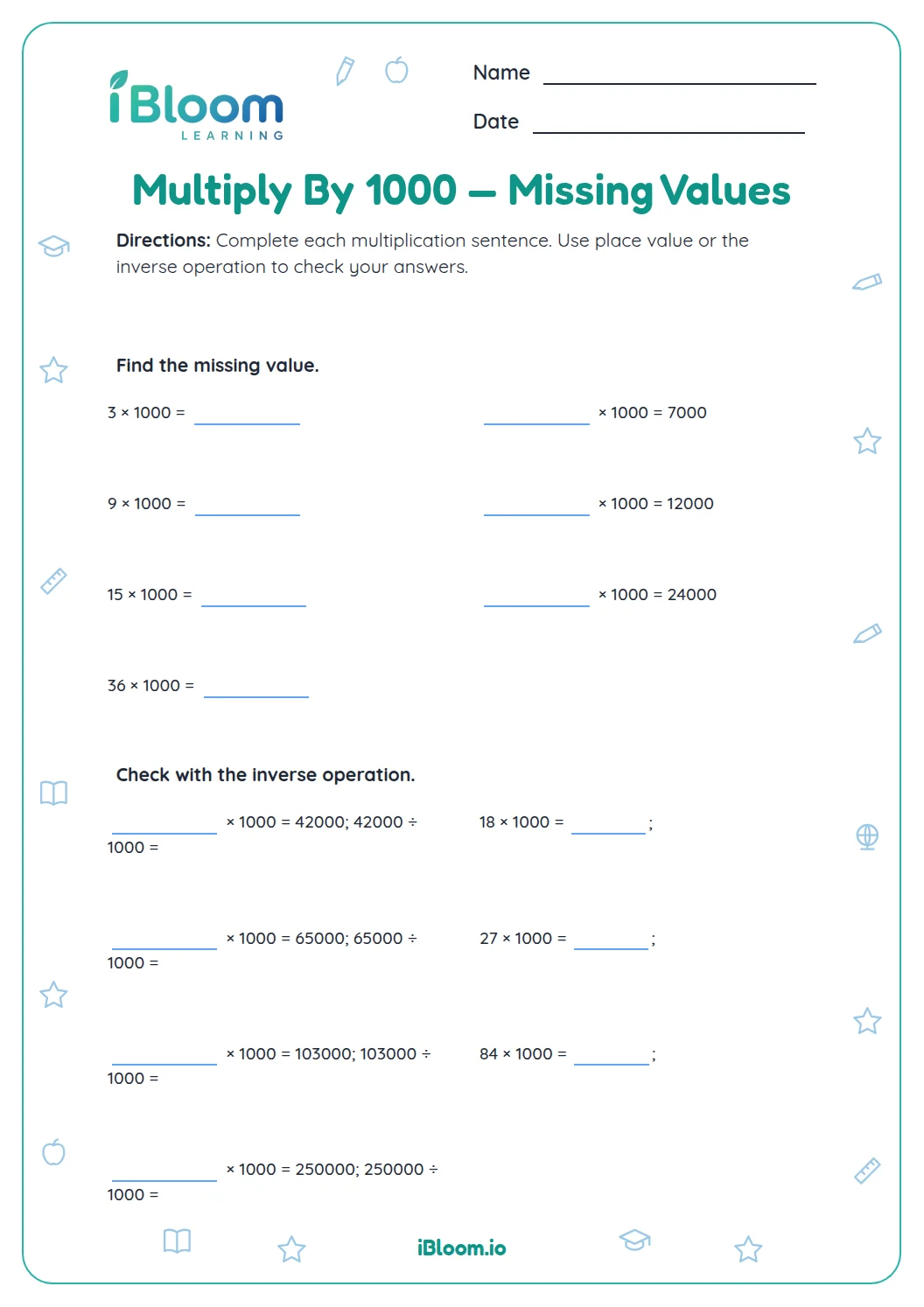
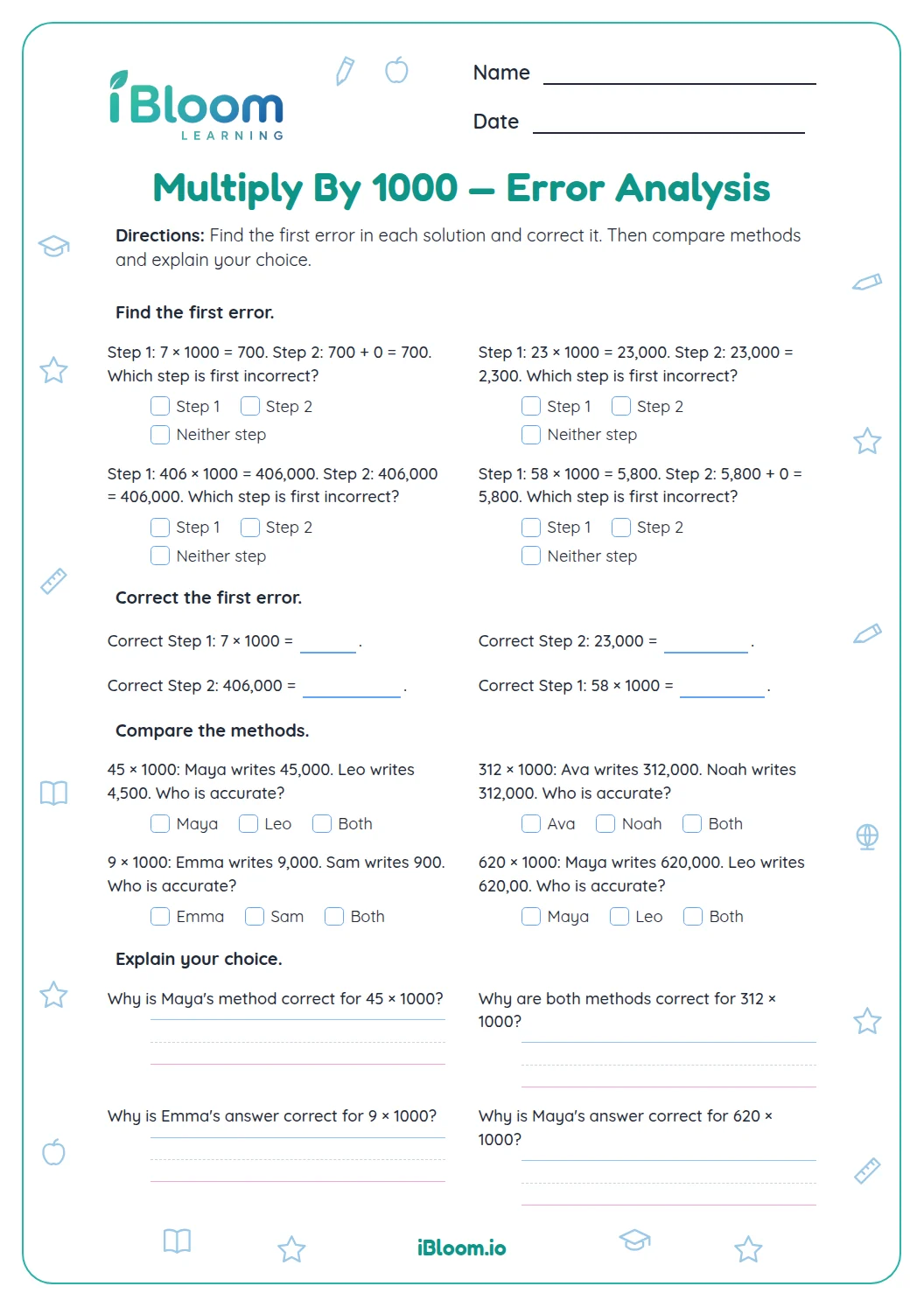
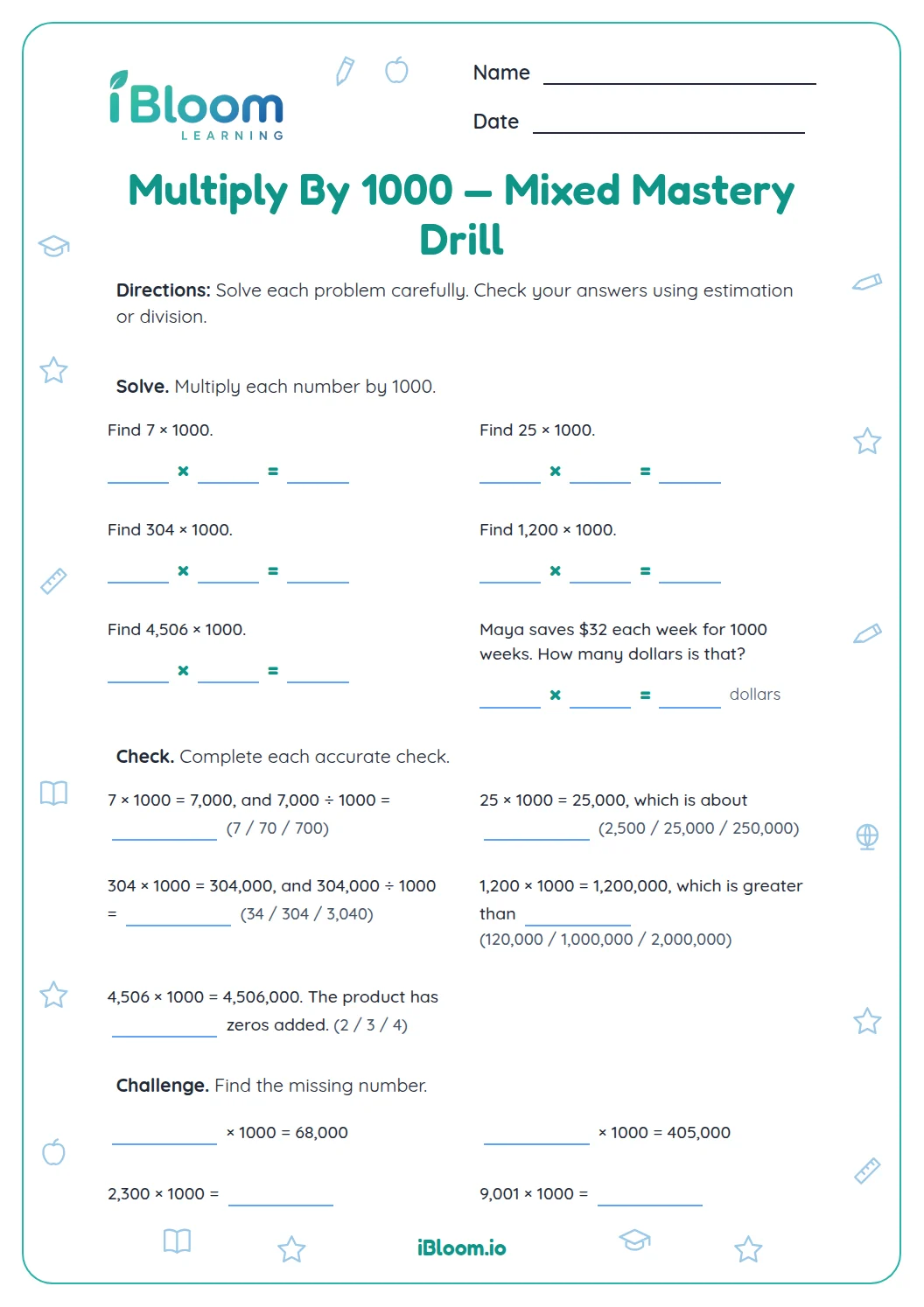
This Grade 4 worksheet has 20 equations multiplying whole numbers by 1,000. The factors range from one digit to four digits, including numbers with internal zeros such as 105, 306, 1,204, and 2,006. Learners find each product and use place value to check that each digit has shifted three places. The two-page worksheet includes a separate answer key.
What happens to place value when a number is multiplied by 1,000?
Each digit moves three places to the left in the product, so its value becomes 1,000 times as great. For example, 6 × 1,000 = 6,000. A zero inside the factor still matters: 306 × 1,000 = 306,000.
How can a learner check a product?
Estimate the number of digits, then divide the product by 1,000 to recover the original factor. For q6, 105,000 ÷ 1,000 = 105. The check catches a product with too few or too many zeros.
- 1105 × 1,000 = ___
- 2Answer: 105000
What factors appear in the drill?
The 20 factors range from 6 to 2,006. They include one-, two-, three-, and four-digit numbers, with examples that contain zeros. Every item asks for multiplication by 1,000; Part B continues the same operation as a final check section.
How to use this multiplication drill
- 1Write the factor clearly and note its place values.
- 2Multiply by 1,000 by shifting each digit three places left.
- 3Check internal zeros so every digit keeps its correct place.
- 4Complete both parts without skipping any factors.
- 5Divide a product by 1,000 or compare its place values with the factor.
Place-value mistakes and quick fixes
The mistake
Adding only three zeros to every factor, even when it already ends in zeros.
The fix
Shift every digit three places; do not use a shortcut that changes the value.
The mistake
Dropping an internal zero from the original factor.
The fix
Keep zeros in their place-value positions, as in 306,000.
The mistake
Writing too few or too many places in the product.
The fix
Divide by 1,000 to see whether the original factor returns.
What to practice next
Questions parents and teachers ask
Why does multiplying by 1,000 shift digits three places?
Each place to the left is ten times as large, and 1,000 is ten times ten times ten. Moving a digit three places left multiplies its value by 1,000. For instance, 6 becomes 6,000. Check that every digit keeps its correct place in the product.
How many questions are in the drill?
There are 20 equations across two parts, all multiplying a whole number by 1,000. Factors include numbers with internal zeros and values up to 2,006. A separate answer key lists every product. Check that every digit keeps its correct place in the product.
How can a learner check a multiplication answer?
Divide the product by 1,000. If the result is the factor from the question, the product is consistent. For example, 306,000 ÷ 1,000 = 306. Checking the places of internal zeros also helps catch errors. Check that every digit keeps its correct place in the product.
Does this worksheet teach column multiplication?
The questions are printed as horizontal equations with answer spaces. They practice multiplying by 1,000 and checking place value; learners may write their working vertically in the available space if that is their preferred method. Check that every digit keeps its correct place in the product.
What if the product has several zeros?
Keep every place-value position in the product, including zeros that hold a place between nonzero digits. For example, 2,006 × 1,000 = 2,006,000. Dividing the result by 1,000 should return 2,006. Check that every digit keeps its correct place in the product.