






About this worksheet
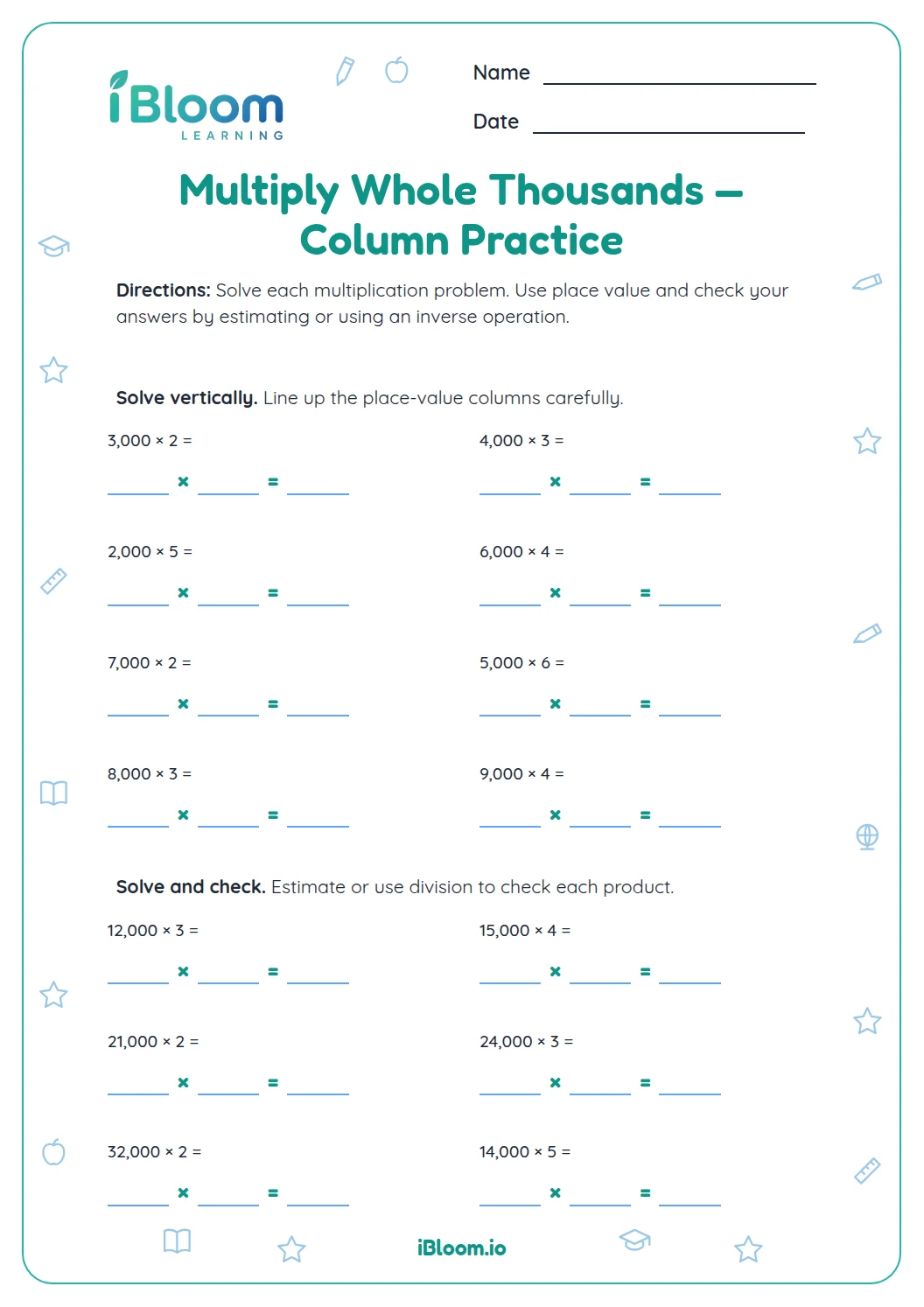
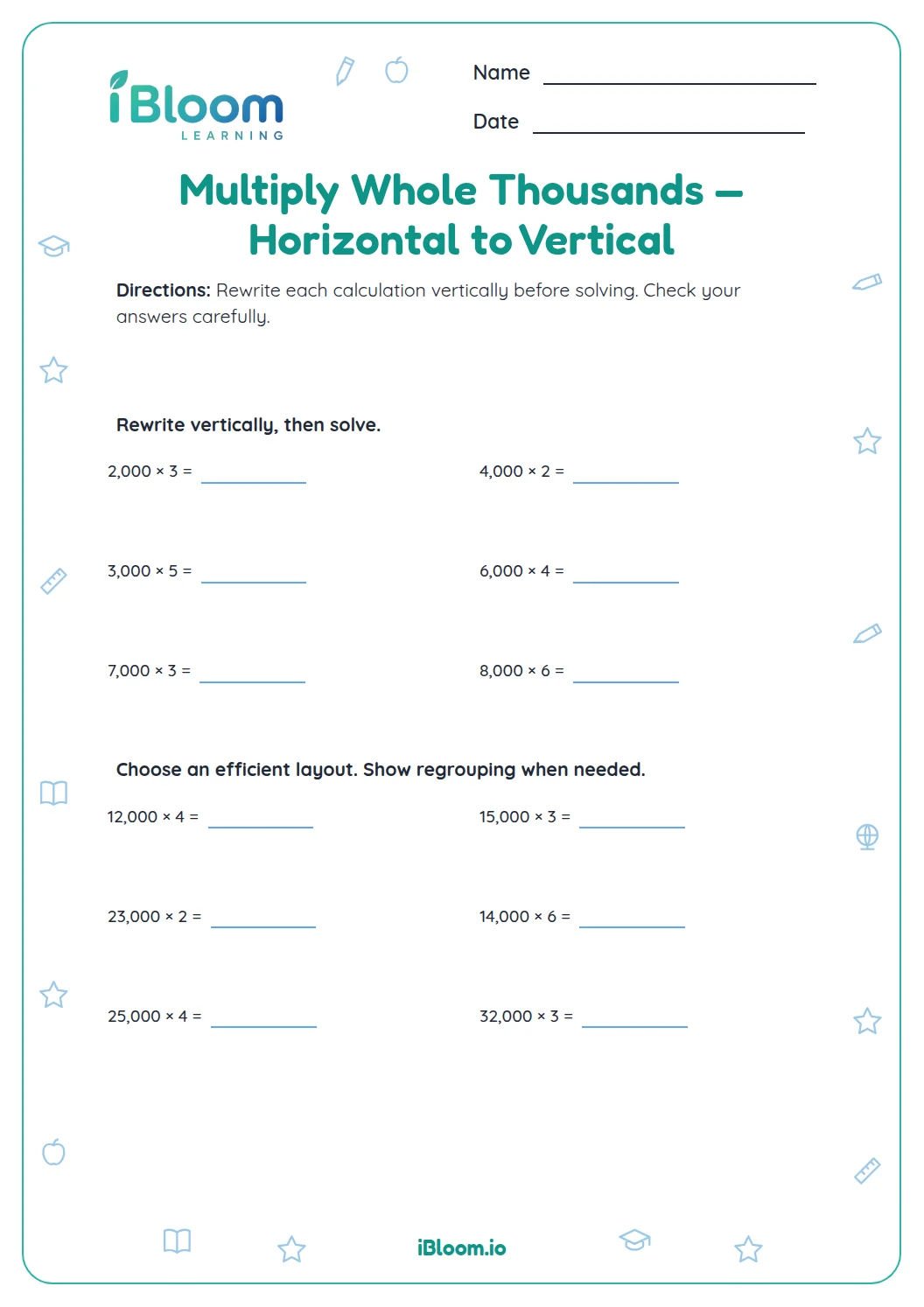
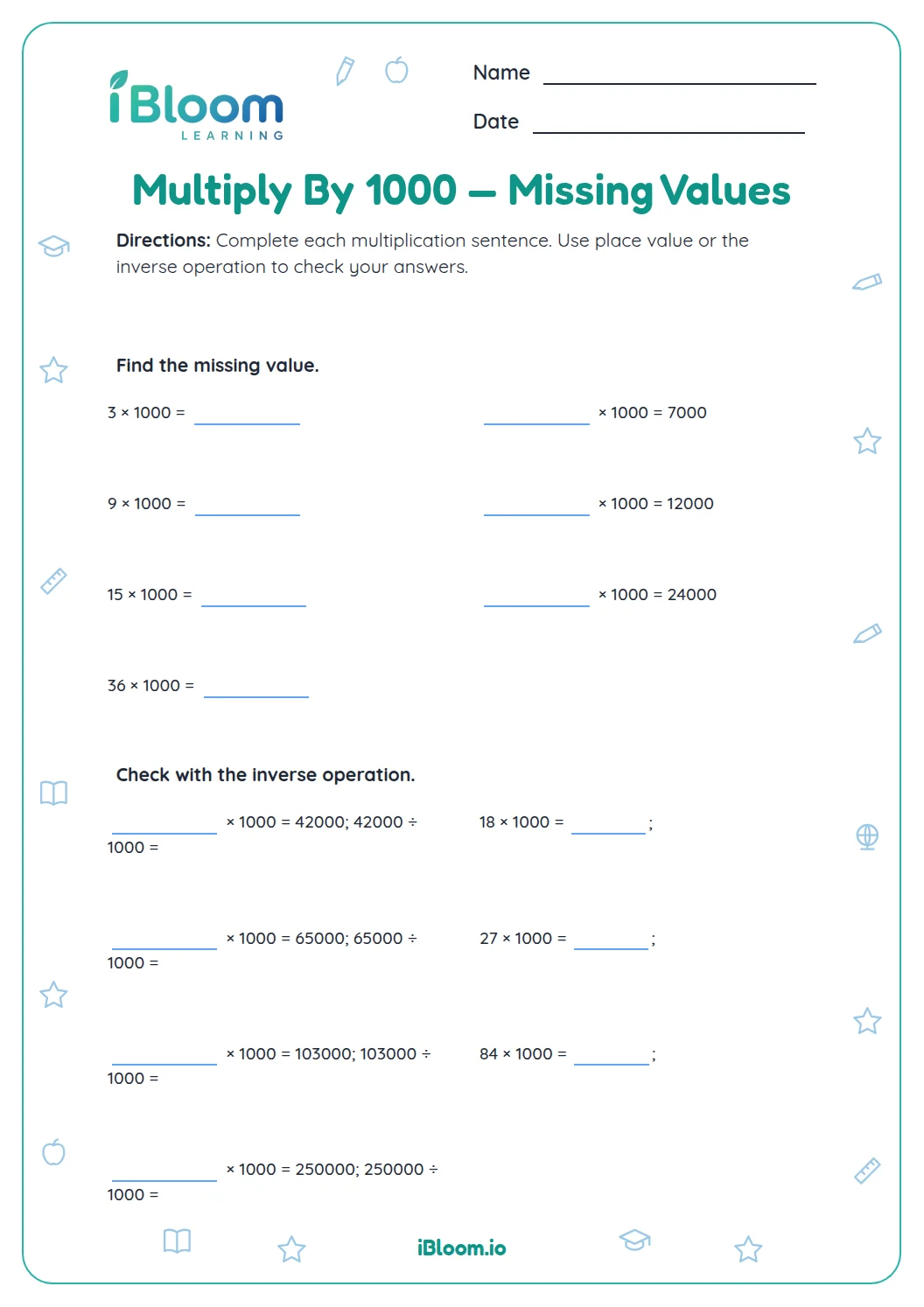
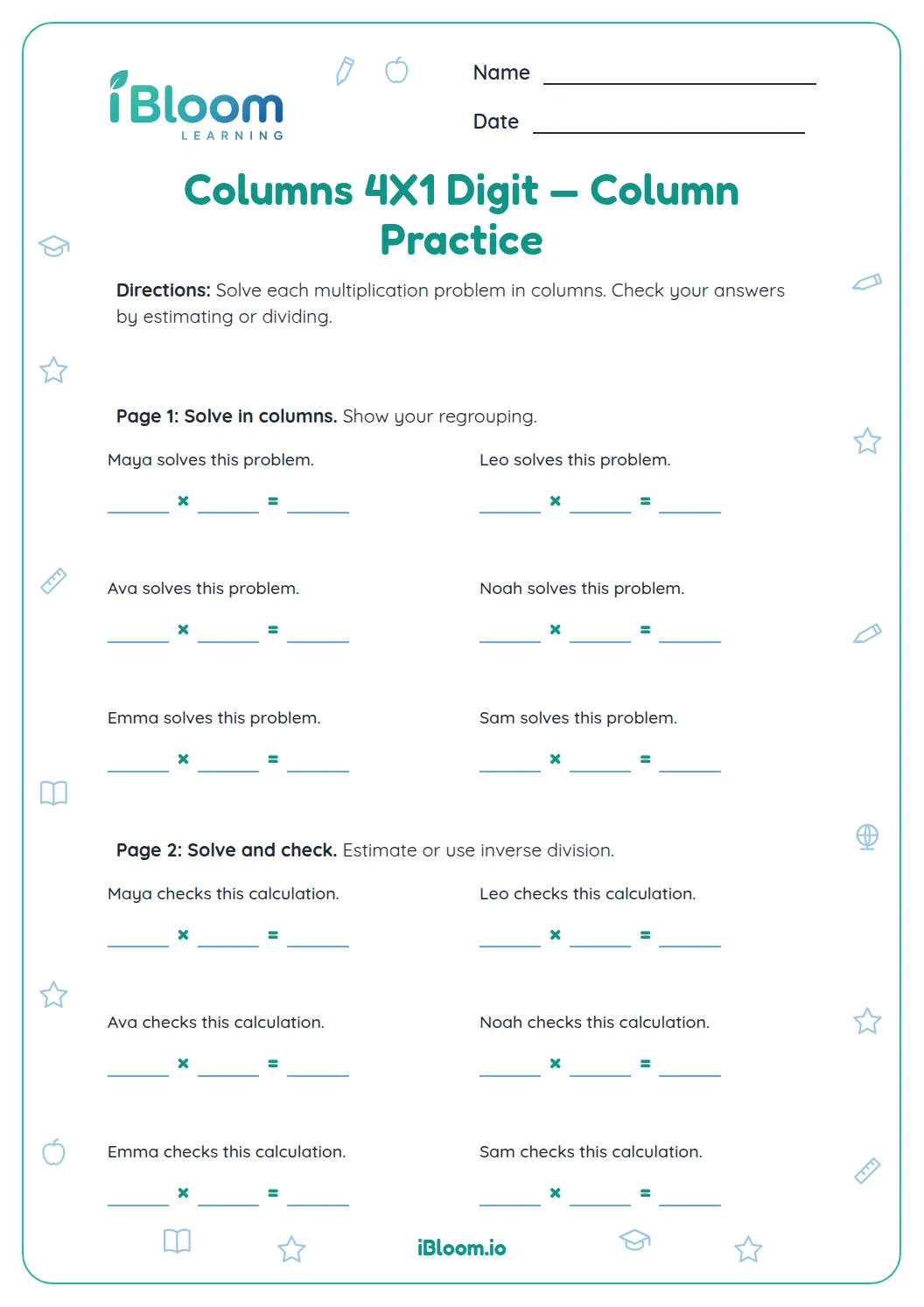
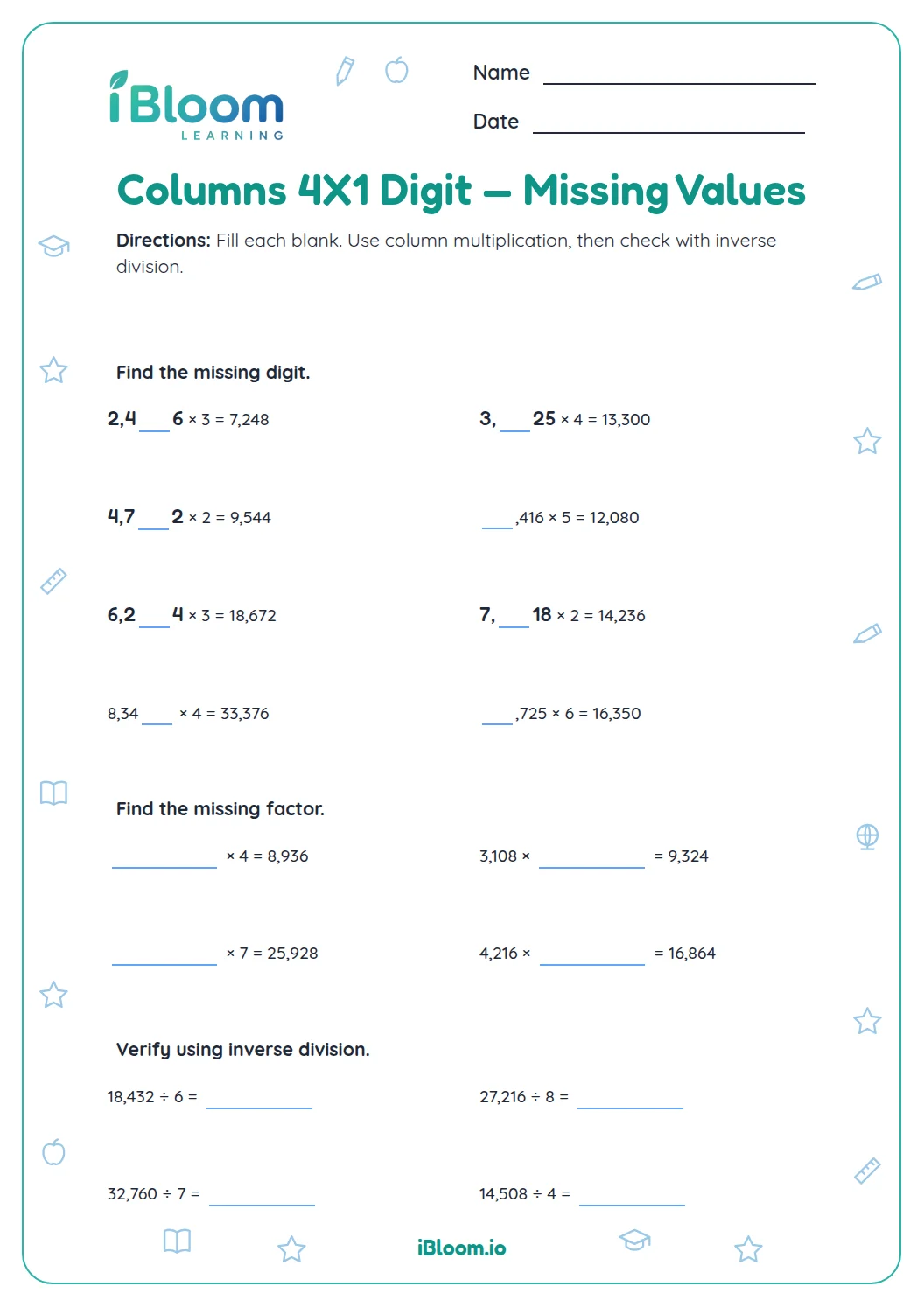
This printable multiplication drill focuses on multiplying a whole thousand by a one-digit factor. Students solve eight direct products, complete four more with attention to place-value zeros, and select four products from choices. The repeated structure gives room to check whether the number of zeros in the result makes sense. The work connects to CCSS 4.NBT.B.5, which includes multiplying a whole number of up to four digits by a one-digit number. An answer key is included.
Aligned to 4.NBT.B.5
How do you multiply a whole thousand by one digit?
Multiply the digit before the zeros by the one-digit factor, then use the place value of the thousand.
- 11,000 × 6 = 6,000
- 27,000 × 2 = 14,000
How can place value check a product?
Estimate the size first. Multiplying 7,000 by 6 should be near 42,000, so 4,200 is too small and 420,000 is too large.
What should students check in the choices?
Count the thousands represented by the product and compare with the basic fact. The last four items use factors that produce five-digit answers.
How can the answer key help?
Look for a factor-of-ten relationship: 6,000 × 4 is four times 6,000, or 24,000. If a zero is missing, rewrite the multiplication as 6 × 4 thousands.
How to use this worksheet
- 1Multiply the nonzero digits first.
- 2Estimate the product before writing it.
- 3Keep the thousand factor’s place value in mind.
- 4Write the product with commas to make groups clear.
- 5For choices, eliminate answers that are much too small or large.
- 6Check by dividing the product by the one-digit factor.
Common mistakes and quick fixes
The mistake
Dropping a zero from the product.
The fix
Think of 7,000 as seven thousands; 7 × 2 gives 14 thousands, or 14,000.
The mistake
Adding zeros without multiplying the leading digits.
The fix
Multiply first: 8 × 5 = 40, so 8,000 × 5 = 40,000.
The mistake
Choosing a product ten times too small.
The fix
Estimate: 9,000 × 5 must be greater than 9,000 and close to 45,000.
Common Core alignment
This practice connects the listed standard to the skill on the page.
Multiply four-digit whole thousands by one-digit factors using place value.
On this sheet: Every product uses a one-digit factor and a whole-thousands factor; problems emphasize place-value zeros.
Show the official wordingHide the official wording
Multiply a whole number of up to four digits by a one-digit whole number, and multiply two two-digit numbers, using strategies based on place value and the properties of operations. Illustrate and explain the calculation by using equations, rectangular arrays, and/or area models.
What to practice next
Make more practice
Further reading
Questions parents and teachers ask
What does “whole thousands” mean?
A whole-thousands number is a multiple of 1,000, such as 3,000 or 8,000. In this drill, each is multiplied by a one-digit factor, so place value helps students determine where the product belongs. Every problem keeps the thousands factor visible.
Why are there several questions with zeros?
The zeros show that the factor represents thousands. Students can multiply the leading digits first and then interpret the result in thousands. For example, 8,000 × 5 is 40 thousands, or 40,000. The answer key lists each product with commas.
How many problems are included?
There are 16 problems: 12 equations to complete and four multiple-choice product checks. The questions are split among direct products, place-value practice, and choosing a reasonable result. All factors are whole thousands multiplied by one digit in each product on the worksheet.
How can a student check a product?
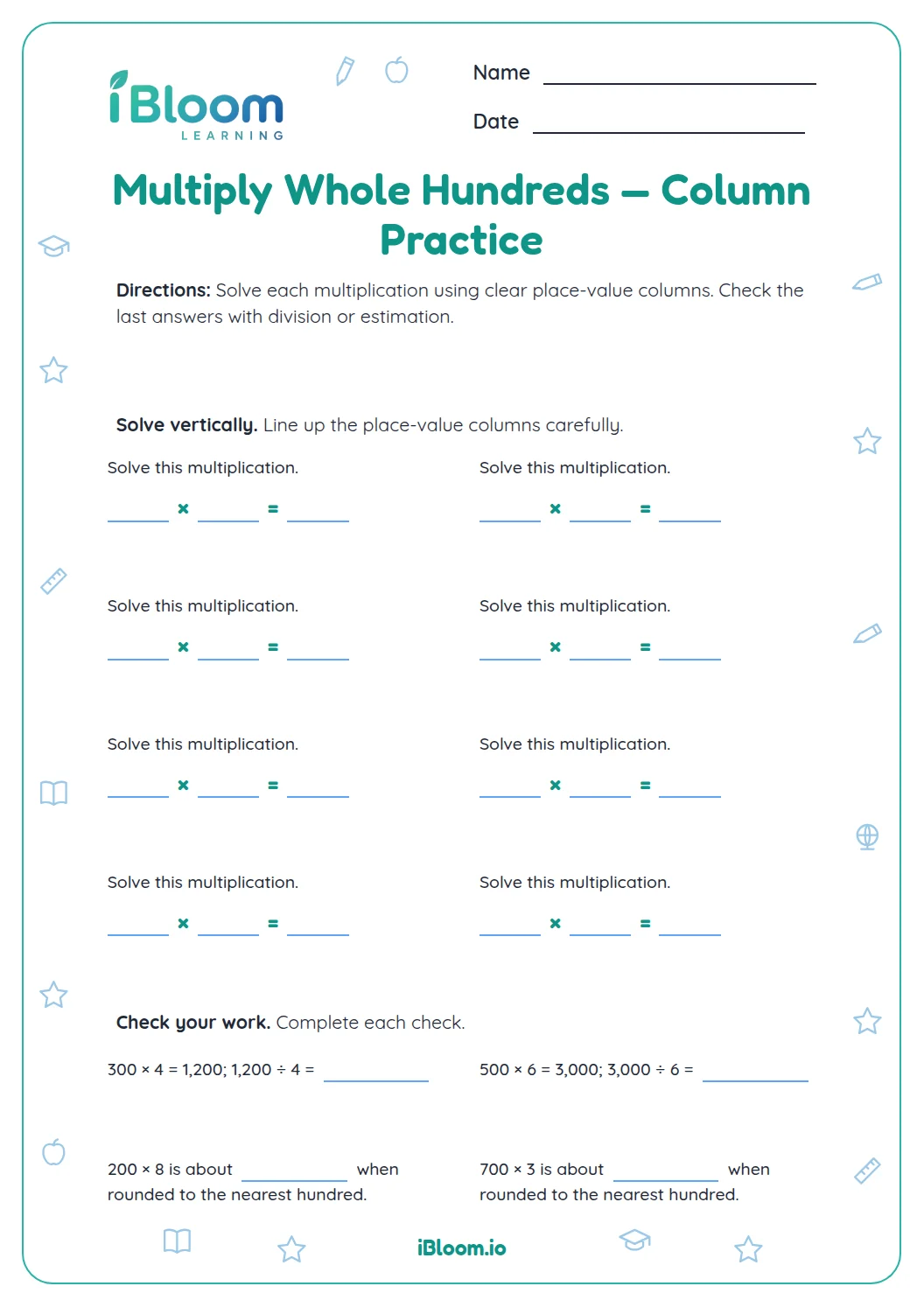
Estimate first, then divide the product by the one-digit factor. For example, a result for 8,000 × 5 should be near 40,000. Dividing 40,000 by 5 returns 8,000, confirming both the product and its place value in the answer key.
What should students do if they get the right digits but the wrong zeros?
Rewrite the factor as a count of thousands. For 6,000 × 4, think “6 thousands times 4 equals 24 thousands,” so the product is 24,000. This connects the basic fact to the place value of the full number and its zeros.