


About this worksheet
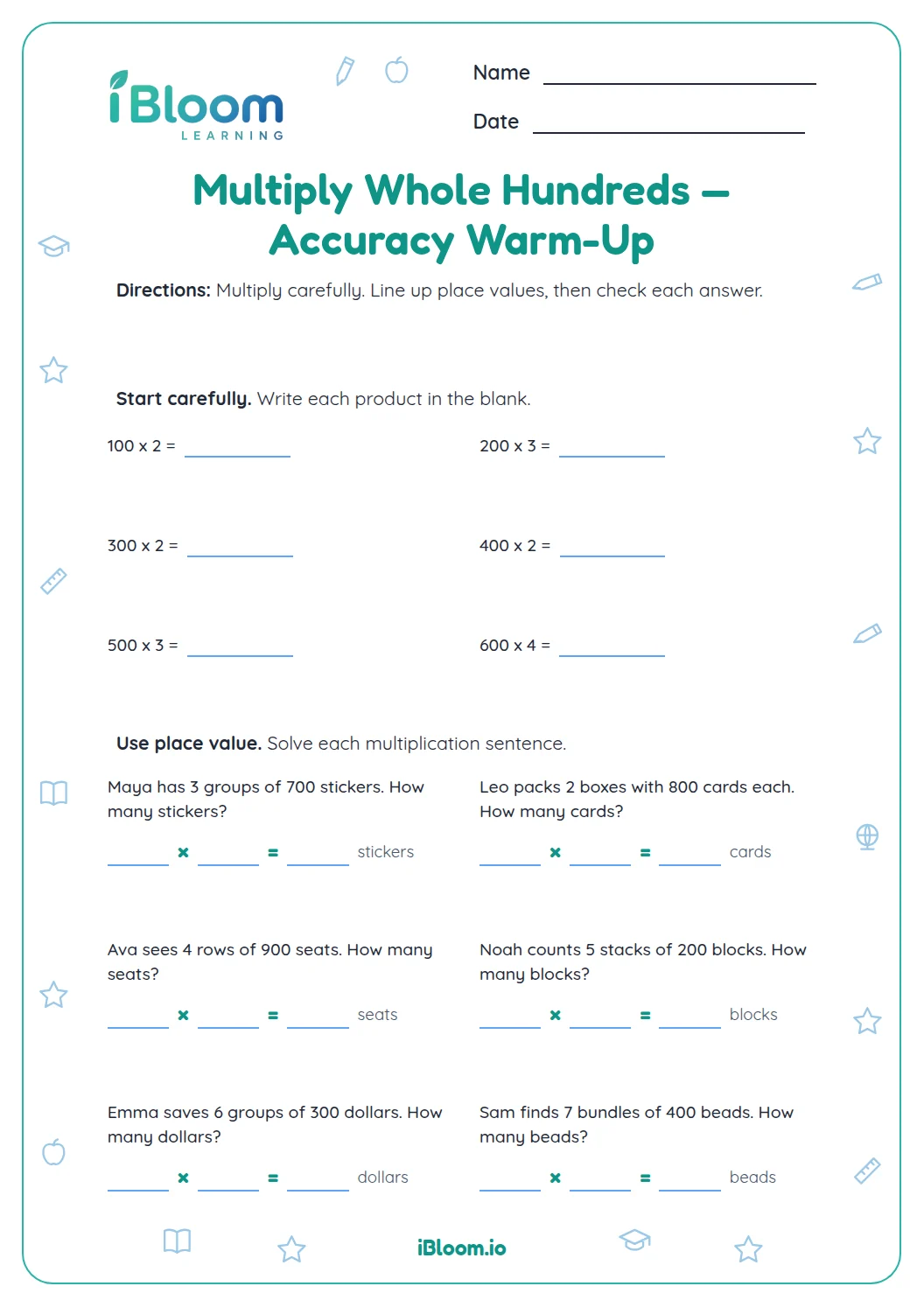
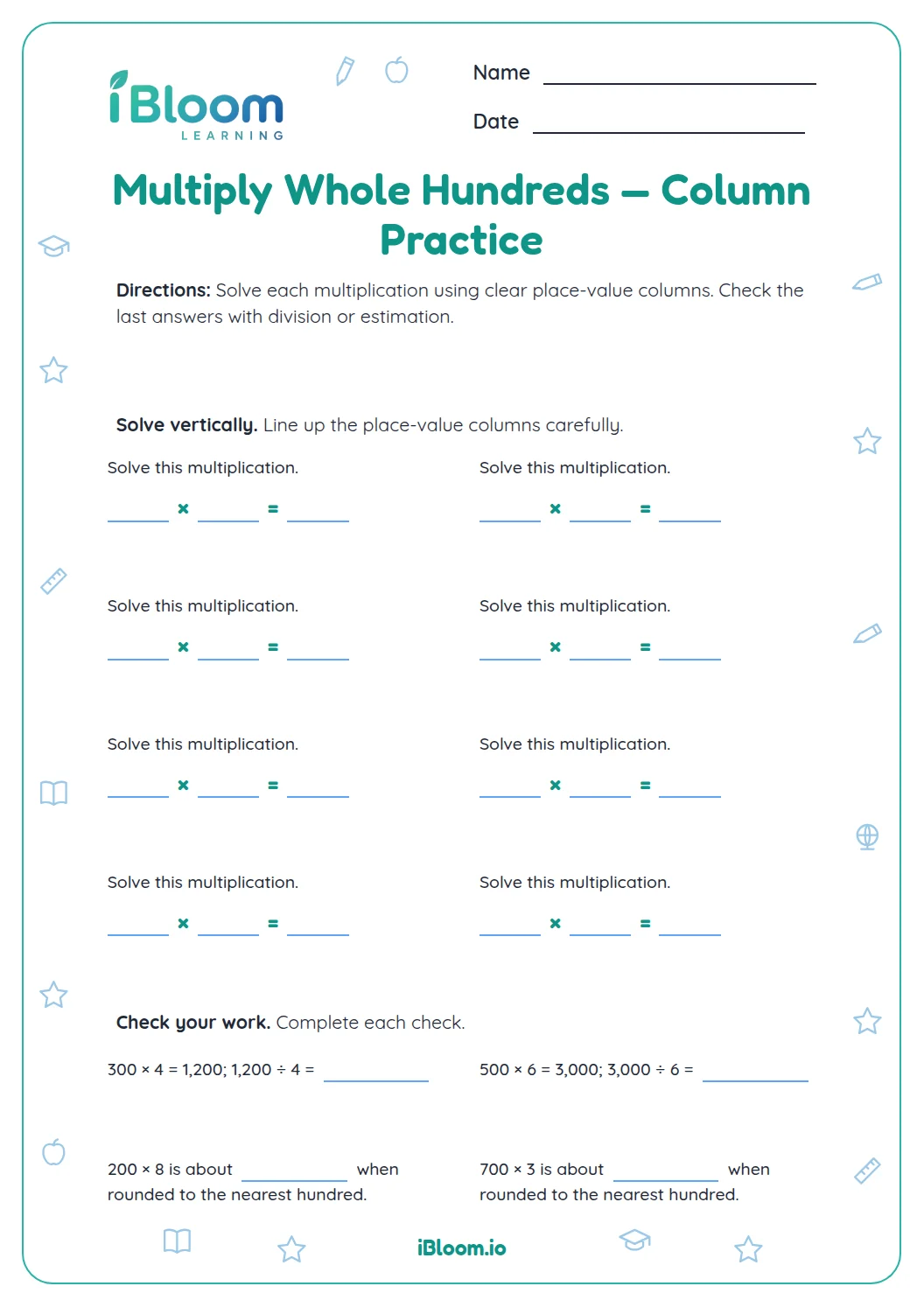
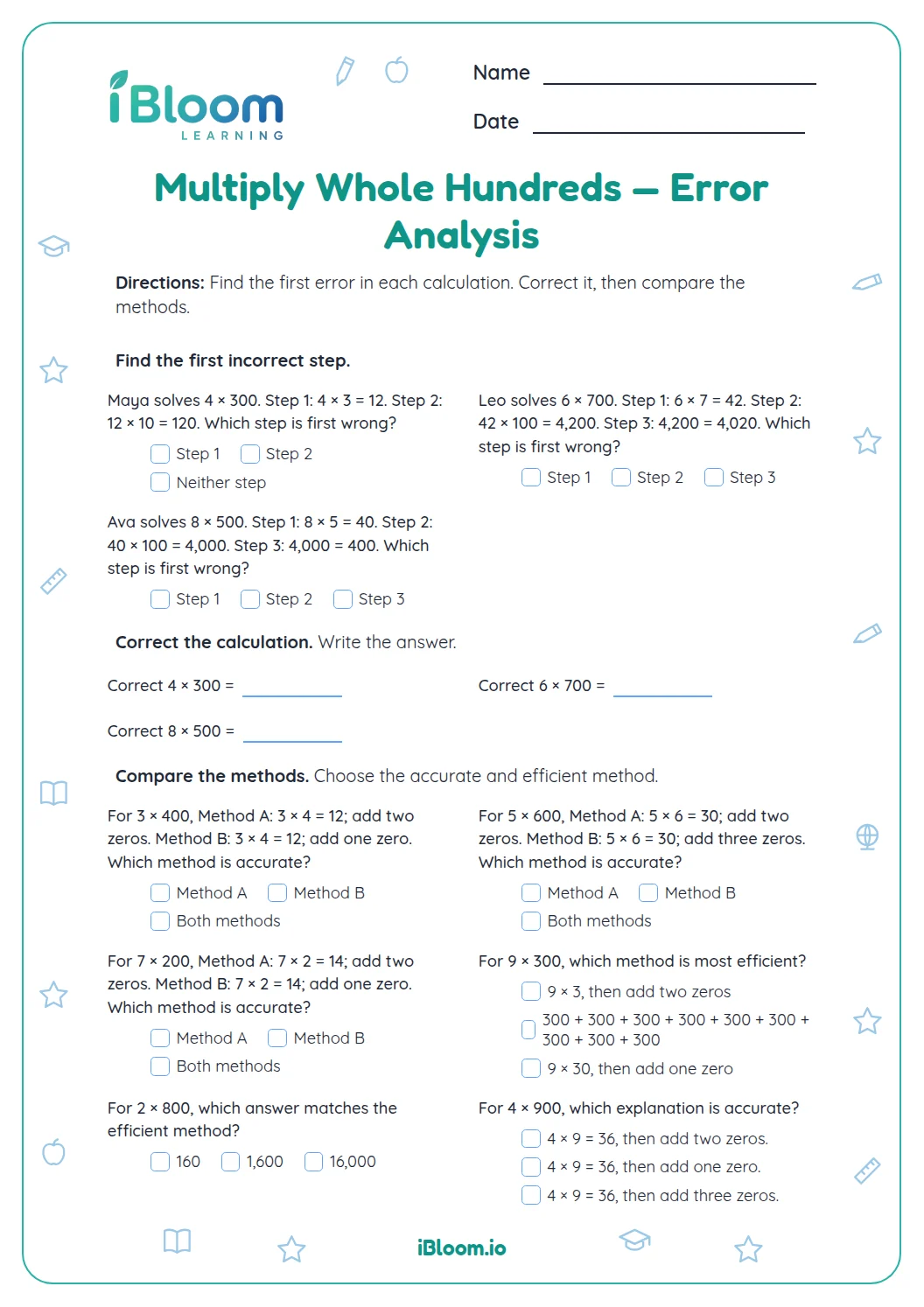
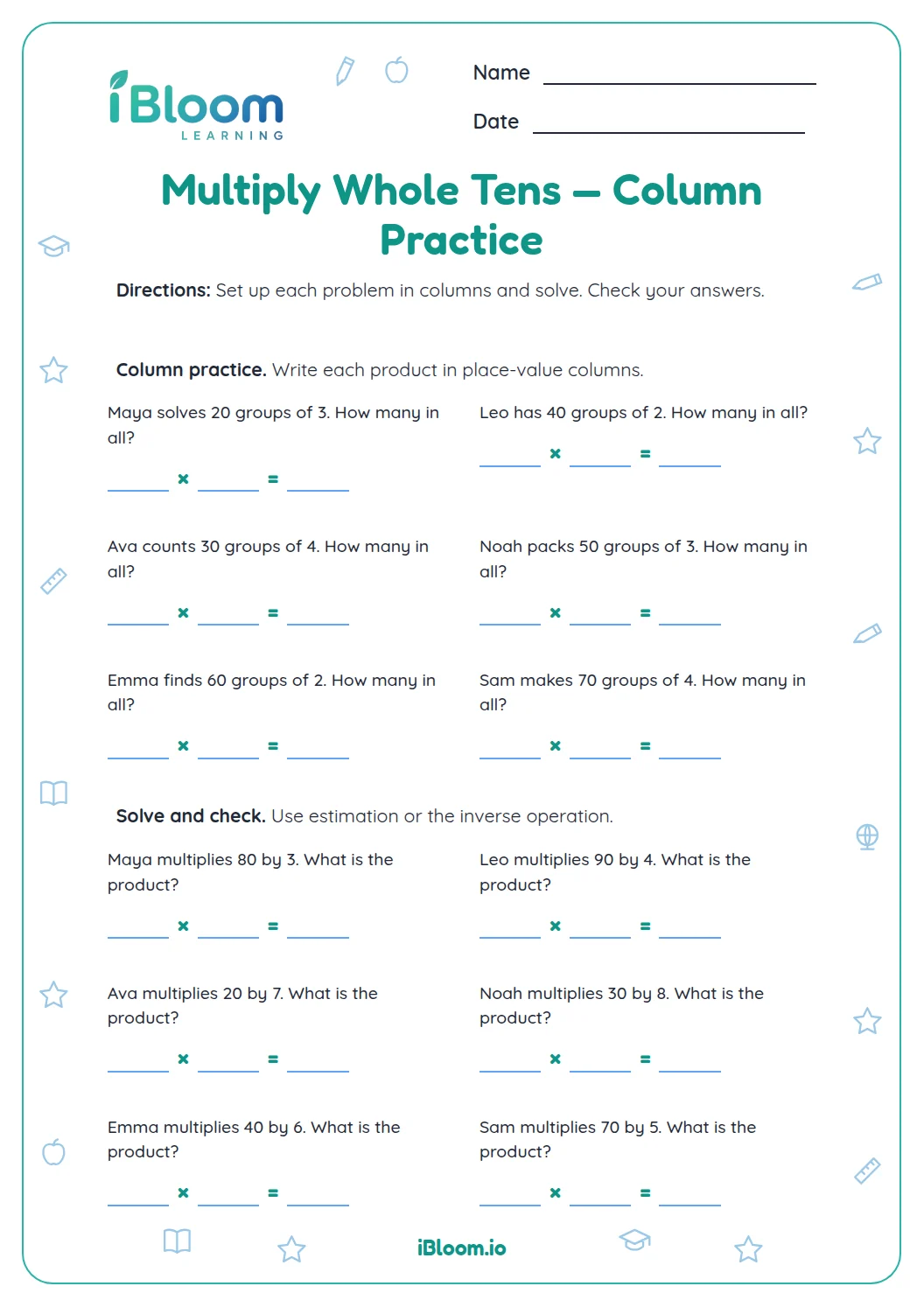
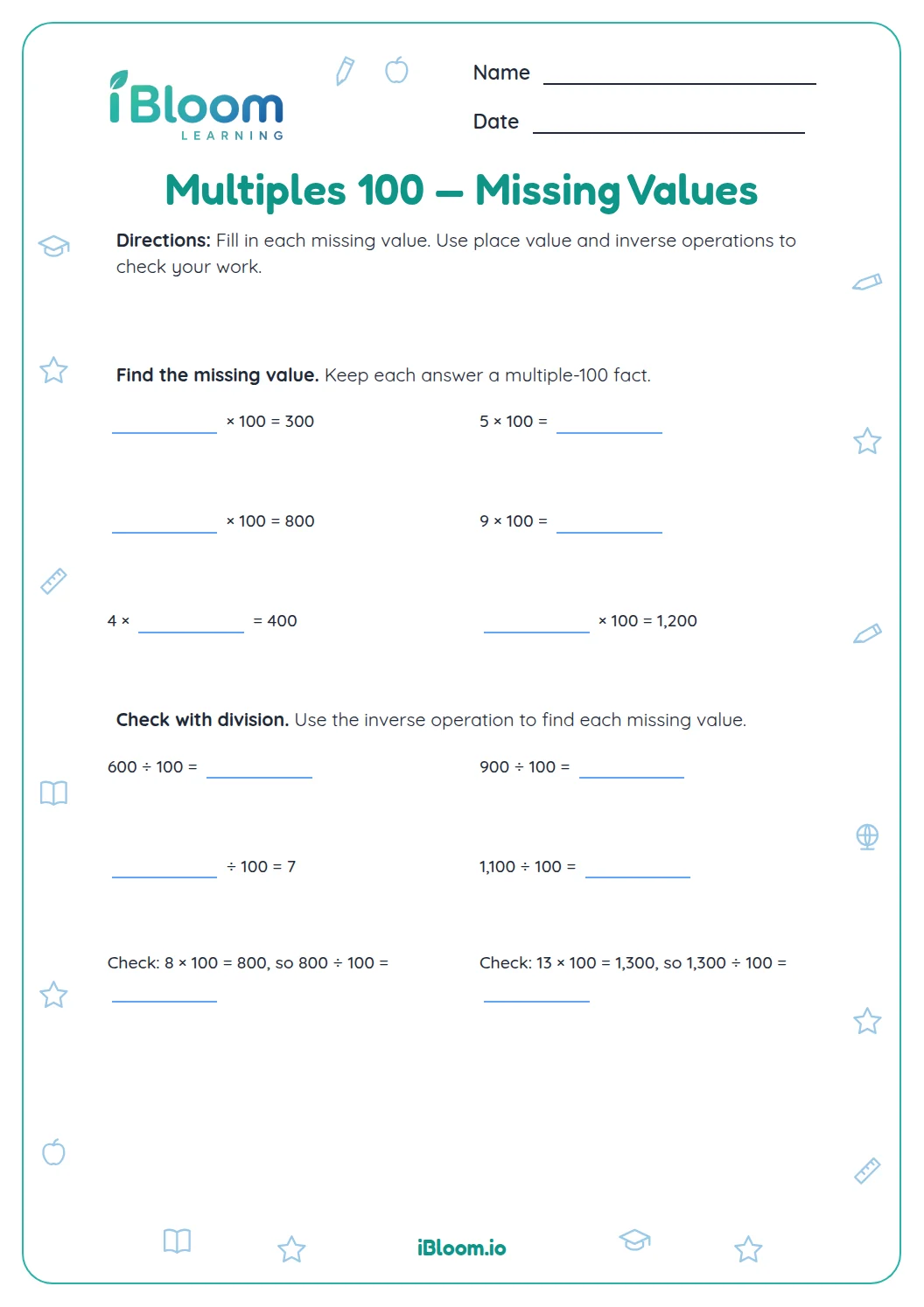
This Grade 3 multiplication worksheet practices facts with whole hundreds in three steps: find a missing factor, calculate a missing product, and check multiplication with division. The 20 questions include equations such as 3 × ___ = 600 and 1,200 ÷ 300 = ___. A separate answer key lists each result. Finding unknown factors in multiplication equations practices CCSS 3.OA.A.4.
Aligned to 3.OA.A.4
How do you find a missing factor?
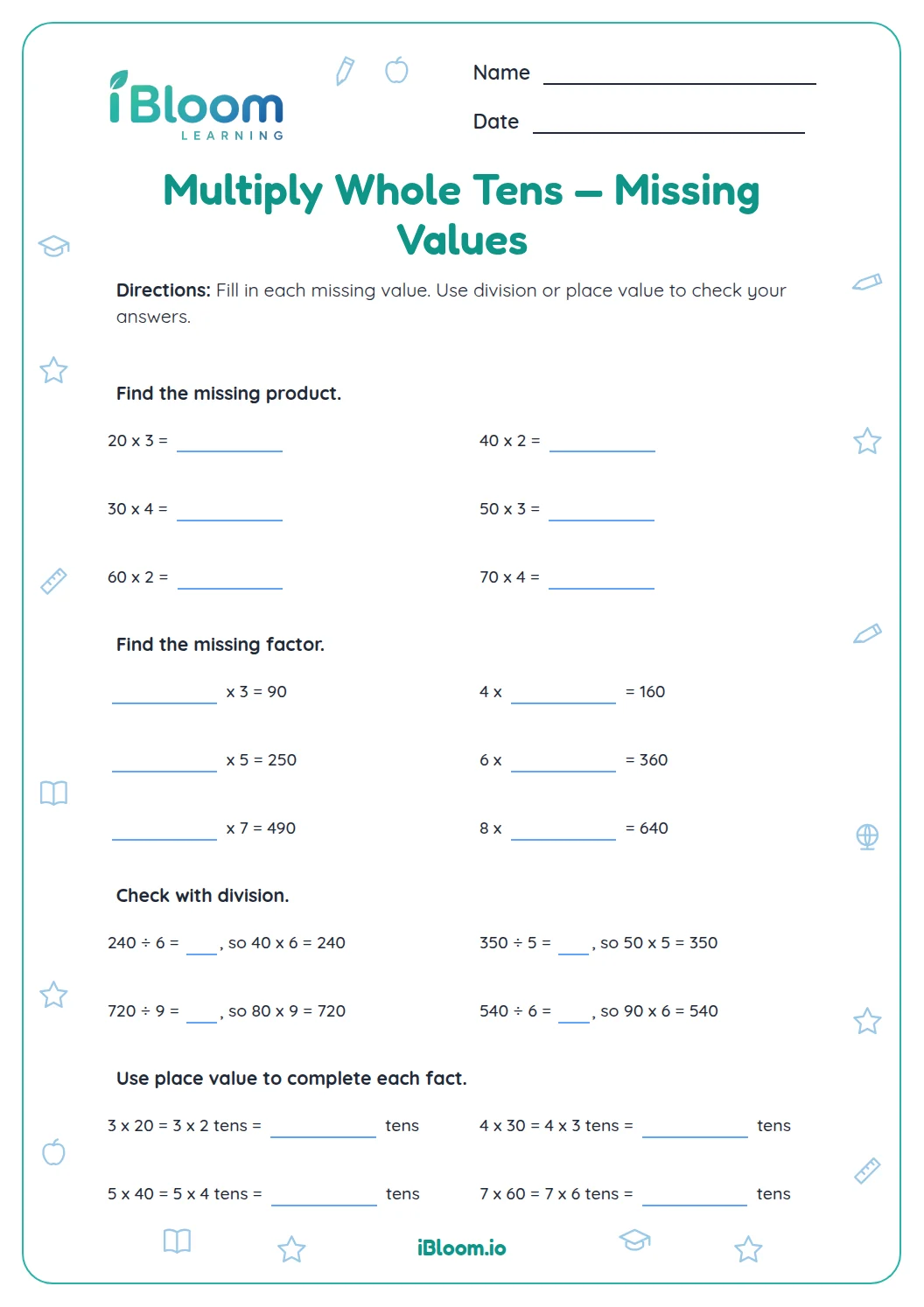
A multiplication equation can be checked with division. In 3 × ___ = 600, divide 600 by 3. Since 600 ÷ 3 = 200, the missing factor is 200. Keep the hundreds place in the quotient.
- 13 × ___ = 600
- 2600 ÷ 3 = 200, so the missing factor is 200.
How do you multiply a one-digit number by whole hundreds?
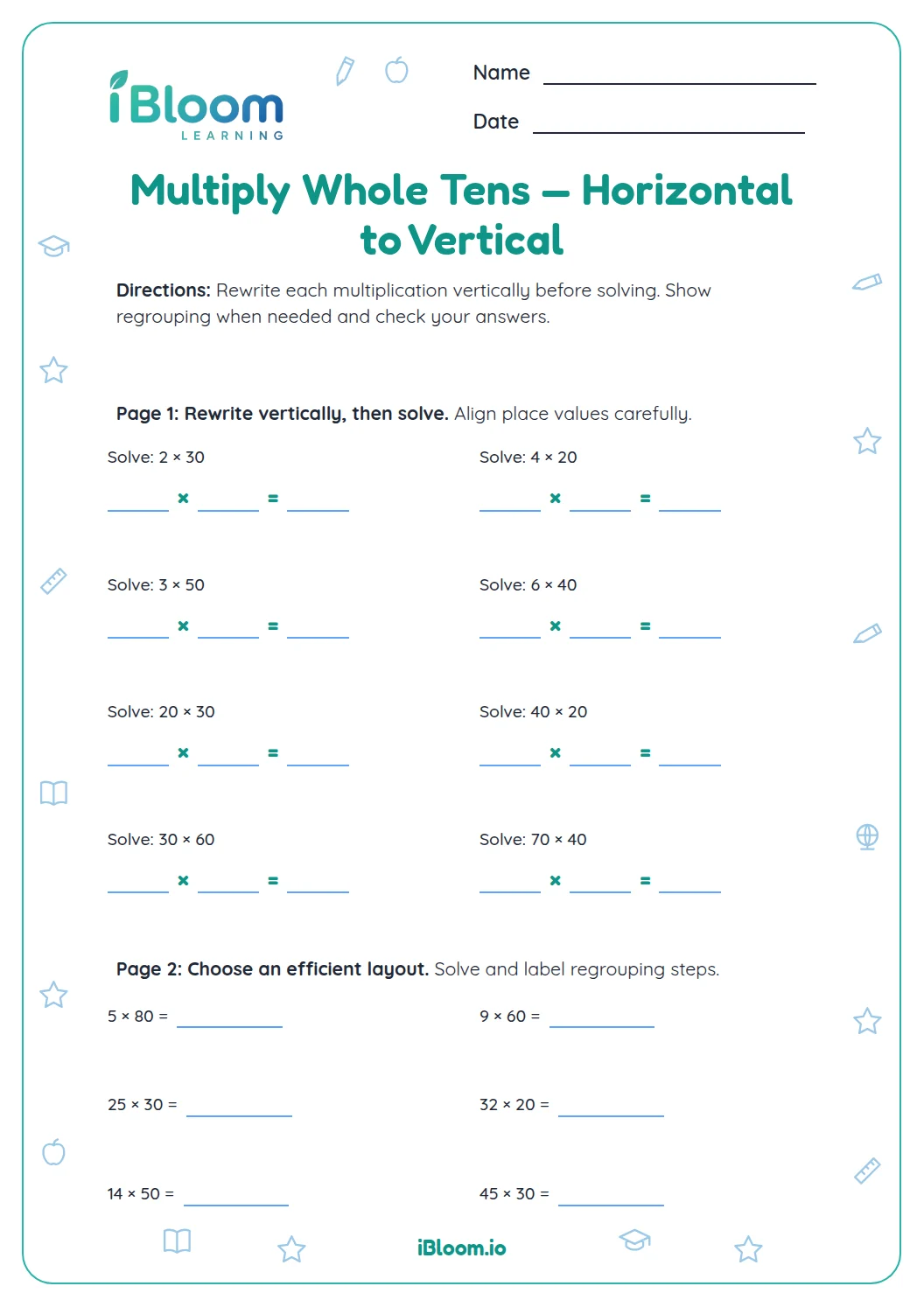
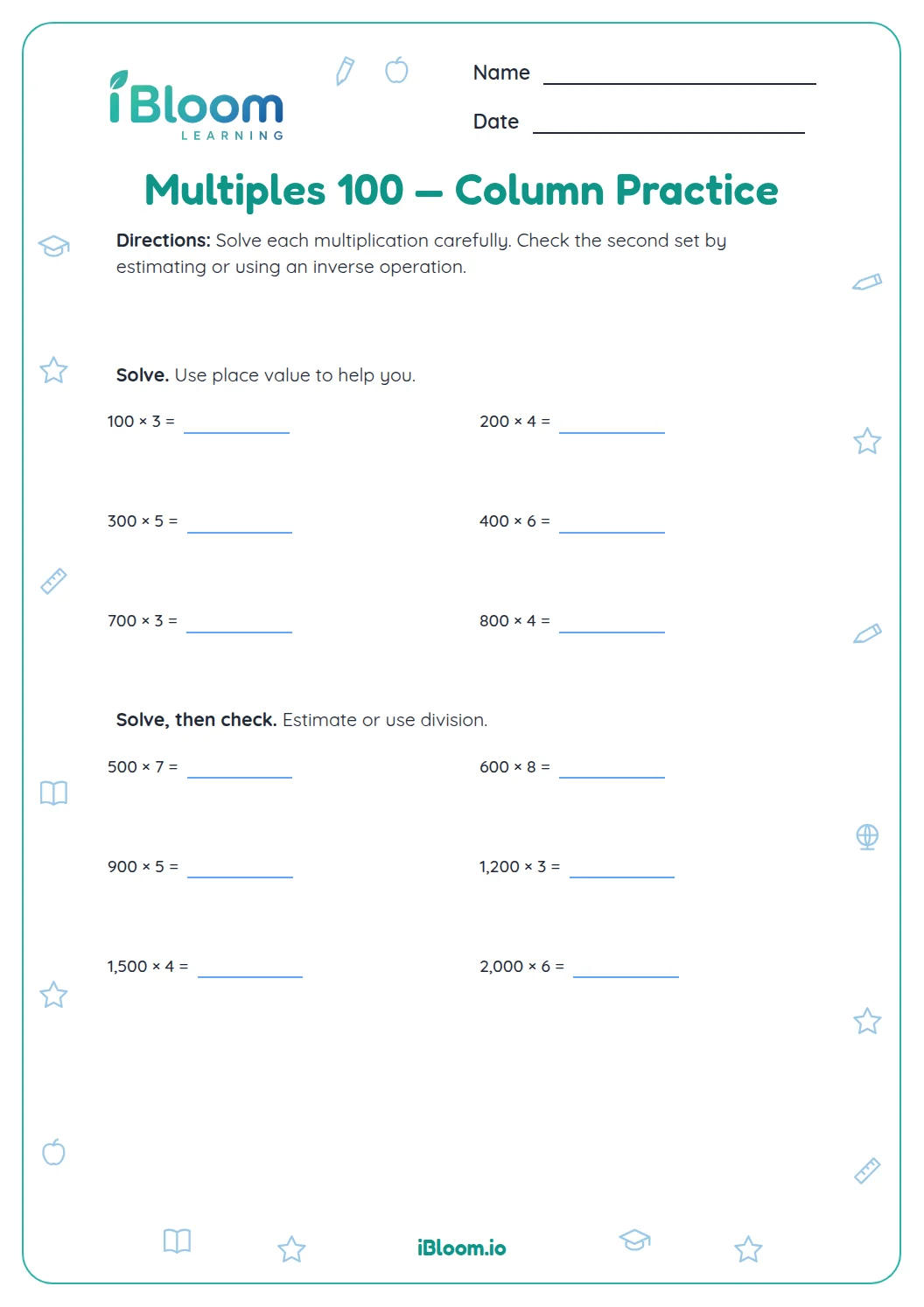
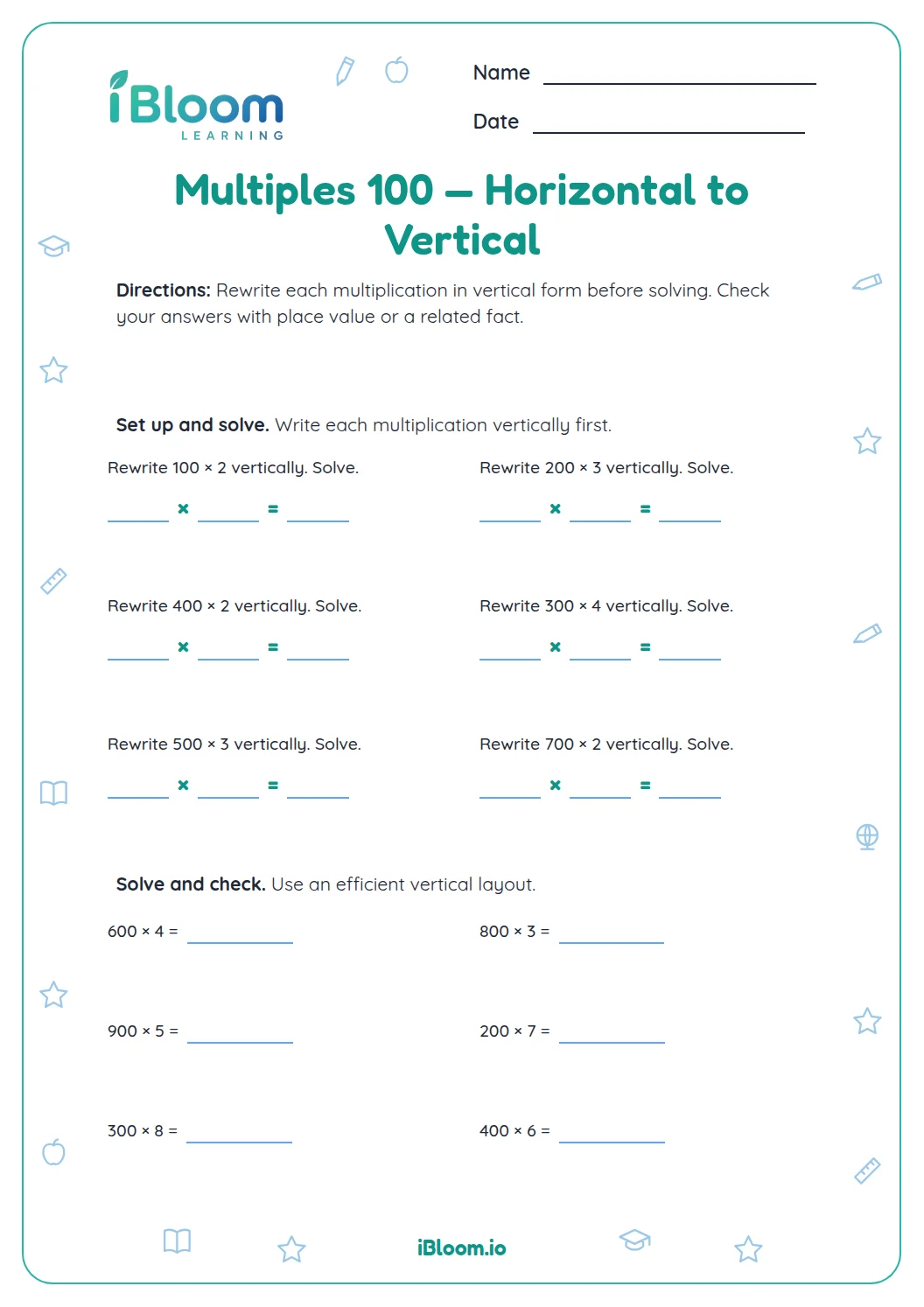
Multiply the nonzero digits, then attach the two zeros from the hundreds factor. For example, 7 × 200 is 7 × 2 hundreds, or 14 hundreds: 1,400. Use the same place-value check for every product in Part B.
How can division check a multiplication fact?
A product divided by one factor should give the other factor. For question 17, 1,200 ÷ 300 = 4 because 4 × 300 = 1,200. If the quotient does not reproduce the product when multiplied back, check the arithmetic.
How to use this worksheet
- 1Read each equation and identify which value is missing.
- 2For a missing factor, divide the product by the known factor.
- 3For a missing product, multiply the nonzero digits and preserve place value.
- 4Use the division equations in Part C to check related facts.
- 5Compare each result with the answer key and correct any place-value error.
Common mistakes and quick fixes
The mistake
Writing 20 instead of 200 for 600 ÷ 3.
The fix
Think of 600 as six hundreds; six hundreds divided by 3 is two hundreds.
The mistake
Dropping a zero when multiplying by 300 or 800.
The fix
Multiply the nonzero digits, then restore both zeros from the hundreds factor.
The mistake
Dividing the known factor by the product.
The fix
For a missing factor, divide the product by the factor you already know.
Common Core alignment
This page practices the specific reading, writing, or mathematics skills named below.
Find unknown factors in multiplication equations.
On this sheet: Every equation has one unknown factor; products involve multiples of one hundred.
Show the official wordingHide the official wording
Determine the unknown whole number in a multiplication or division equation relating three whole numbers.
What to practice next
Make more practice
Further reading
Questions parents and teachers ask
How do you solve a missing-factor equation?
Use the inverse operation. In question 1, 3 × ___ = 600, so calculate 600 ÷ 3. The missing factor is 200 because 3 × 200 = 600. The same approach works when the blank appears before the known factor.
Why are there division questions on a multiplication worksheet?
Division checks the multiplication facts and uses the same factor relationship in reverse. For example, 1,200 ÷ 300 = 4 because 4 × 300 = 1,200. The final four questions let learners verify a quotient by multiplying it back.
How many questions and pages are included?
The worksheet has 20 questions: eight find missing factors, eight find products, and four use division to check related facts. It includes a separate answer key. Students can show the division or multiplication check in the working space for the final four problems.
What does “whole hundreds” mean here?
The known multiplier is a whole hundred, such as 200, 300, or 800. Multiply the single-digit factor by the number of hundreds, then account for the two zeros. For example, 8 × 500 is 8 × 5 hundreds, or 4,000.
How can I help with a place-value error?
Ask the learner to say the factor in hundreds before calculating. For 6 × 800, they can think “6 groups of 8 hundreds,” which is 48 hundreds, or 4,800. Then use the division check to confirm the product.